
Brake casters are essential components for equipment that needs to remain stationary at times, providing the ability to lock the caster and prevent unintended movement. There are several types of brake mechanisms available, each with its own characteristics, advantages, and suitable applications. The three most common types are single brakes (wheel locks), directional locks (swivel locks), and double brakes (total locks). Understanding the differences between these brake types is essential for selecting the right brake caster for your specific application. This article provides a comprehensive analysis of these three common brake caster types, examining their mechanisms, characteristics, advantages, limitations, and typical applications.
Introduction to Brake Caster Types
Casters provide mobility for equipment, but there are many situations where equipment needs to remain stationary – for example, when working at a workstation, when loading or unloading cargo, when performing maintenance, or when equipment is parked on a slope. In these situations, a brake mechanism is essential to prevent the equipment from rolling or drifting unintentionally. Without a brake, equipment on casters could move due to floor slope, vibration, accidental contact, or other forces, creating safety hazards, operational inconveniences, and potential damage.
Brake casters are casters equipped with a brake mechanism that allows the user to lock the caster in place. There are several types of brake mechanisms, each providing a different level of immobilization and suitable for different applications. The three most common and important types are: single brakes (also known as wheel locks, tread locks, or wheel brakes), which lock only the wheel rotation; directional locks (also known as swivel locks or four-position locks), which lock only the swivel mechanism; and double brakes (also known as total locks, dual locks, or swivel and wheel locks), which lock both the wheel rotation and the swivel mechanism simultaneously. Each of these brake types has its own unique mechanism, operation, characteristics, advantages, limitations, and suitable applications. Selecting the right brake type for your equipment is essential for ensuring safety, stability, and ease of use. In this article, we will analyze each of these three brake caster types in detail, providing a comprehensive comparison to help you make an informed decision about which brake type is best suited for your specific application.
Single Brake (Wheel Lock): Locking Wheel Rotation Only
The single brake, also known as a wheel lock, tread lock, or wheel brake, is the simplest and most common type of caster brake. As its name suggests, a single brake locks only the rotation of the caster wheel, preventing the caster from rolling, but it still allows the caster to swivel (rotate 360 degrees around the vertical axis). The mechanism of a single brake typically involves a foot pedal or lever that, when pressed, pushes a brake pad or shoe against the wheel tread or wheel hub, creating friction that prevents the wheel from rotating. When the pedal or lever is released, the brake pad moves away from the wheel, allowing it to rotate freely again. Some single brake designs use a cam mechanism to apply the braking force, while others use a spring-loaded pad or a threaded adjustment.
The key advantages of single brakes include: simplicity of design, making them reliable, easy to maintain, and relatively inexpensive; ease of operation, with a simple foot pedal that can be engaged and disengaged quickly; compact size, with the brake mechanism adding minimal bulk to the caster; and wide availability, with single brakes being the most common brake type and available for virtually all caster sizes and configurations. The main limitations of single brakes include: they only lock the wheel rotation, not the swivel, so the equipment can still pivot or rotate around the locked caster, which may not provide sufficient stability for some applications; the brake pad may slip or not hold securely on very smooth or slippery wheel surfaces, particularly under heavy load or on slopes; and the brake pad wears over time and may need periodic adjustment or replacement to maintain effective braking. Single brakes are ideal for applications where preventing rolling is the primary concern and where some pivoting or movement of the equipment is acceptable or even desirable. Typical applications include: light and medium-duty carts and trolleys that need to be held in place briefly during loading/unloading; furniture and display racks that need to be prevented from rolling; workstations and benches where the operator needs the equipment to stay in place while working but may need to reposition it occasionally; and general-purpose material handling equipment where a simple, cost-effective brake is sufficient. Single brakes are not ideal for applications where the equipment needs to remain firmly in a fixed position and orientation (for these applications, a double brake is more appropriate), or where the equipment is on a significant slope (where the limited holding power of a single brake may not be sufficient).
Directional Lock (Swivel Lock): Locking Swivel Movement Only
The directional lock, also known as a swivel lock, four-position lock, or swivel and rigid lock, is a brake mechanism that locks only the swivel mechanism of the caster, allowing the wheel to roll freely but preventing the caster from swiveling (pivoting around the vertical axis). The mechanism of a directional lock typically involves a spring-loaded pin or plunger that, when engaged, inserts into a hole or notch in the swivel raceway, preventing the swivel from rotating. Most directional locks allow the swivel to be locked in one of four positions: straight ahead (0 degrees), straight back (180 degrees), left (90 degrees), or right (270 degrees), in addition to the free swivel position. This allows the user to choose whether the caster operates as a swivel caster (free pivoting) or as a rigid caster (fixed in one direction), depending on the needs of the application. The directional lock is typically operated by a foot pedal or lever that retracts the locking pin, allowing the user to rotate the caster to the desired position and then release the pedal to engage the lock.
The key advantages of directional locks include: versatility, allowing the caster to function as either a swivel caster (for easy maneuvering in confined spaces) or a rigid caster (for straight-line tracking), depending on the situation; improved straight-line tracking, as locking the swivel in the straight-ahead position prevents the caster from wandering or shimmying when moving in a straight line, making it easier to move heavy loads over long distances; reduced operator effort, as rigid casters require less force to maintain a straight path than swivel casters, which can tend to wander; and the ability to lock in multiple positions, providing flexibility for different movement patterns and equipment configurations. The main limitations of directional locks include: they do not lock the wheel rotation, so the equipment can still roll even when the directional lock is engaged – they are not a brake in the traditional sense and cannot hold equipment stationary on a slope; the locking pin and holes can wear over time, leading to play or difficulty engaging the lock; and the mechanism is more complex than a single brake, with more moving parts that can potentially fail or require maintenance. Directional locks are ideal for applications where equipment needs to be moved frequently in straight lines over longer distances, but also needs to be maneuverable in confined spaces. Typical applications include: heavy carts and trolleys that are moved long distances in warehouses and distribution centers, where straight-line tracking is important but maneuverability is needed for turning and positioning; tow-line applications where carts are towed behind a vehicle and need to track straight without wandering; material handling equipment that operates in both open areas (where straight-line movement is efficient) and confined areas (where swivel maneuverability is needed); and any application where the operator wants the flexibility to switch between swivel and rigid caster operation depending on the situation. Directional locks are not suitable for applications where the equipment needs to be held stationary (for these, a single or double brake is needed), but they are an excellent complement to brakes in applications where both straight-line tracking and maneuverability are important.
Double Brake (Total Lock): Locking Both Wheel and Swivel
The double brake, also known as a total lock, dual lock, swivel and wheel lock, or complete lock, is the most secure type of caster brake, locking both the wheel rotation and the swivel mechanism simultaneously. When a double brake is engaged, the caster is completely immobilized – it cannot roll and it cannot swivel – providing maximum stability and security for the equipment. The mechanism of a double brake typically involves a single foot pedal or lever that engages two separate locking mechanisms simultaneously: one that locks the wheel rotation (similar to a single brake, using a brake pad or shoe against the wheel) and one that locks the swivel mechanism (similar to a directional lock, using a pin or plunger that engages with a notch or hole in the swivel raceway). When the pedal is pressed, both mechanisms engage at the same time, completely immobilizing the caster. When the pedal is released, both mechanisms disengage, allowing the caster to roll and swivel freely. Some double brake designs use a single integrated mechanism that locks both functions, while others use two separate mechanisms actuated by a common pedal.
The key advantages of double brakes include: maximum stability and security, as the caster is completely immobilized (cannot roll or swivel), providing the highest level of stability for equipment; prevention of both rolling and pivoting, addressing both modes of unintended movement that can occur with single brakes (which allow pivoting) and directional locks (which allow rolling); suitability for use on slopes and uneven surfaces, as the complete immobilization prevents the equipment from drifting or rotating even on inclined floors; and improved safety for workers, as the equipment remains firmly in place when the brake is engaged, reducing the risk of accidents from unexpected movement. The main limitations of double brakes include: more complex mechanism with more moving parts, which can potentially be more prone to failure or require more maintenance than simpler brake types; higher cost, as the double brake mechanism is more complex and expensive to manufacture than a single brake or directional lock; slightly larger and bulkier design, as the mechanism needs to accommodate both locking functions; and the brake may require more force to engage and disengage, as it is actuating two mechanisms simultaneously. Double brakes are ideal for applications where maximum stability and security are required, and where the equipment needs to remain firmly in a fixed position and orientation. Typical applications include: workstations and workbenches where operators are working on or around the equipment and need it to remain completely stable; medical and healthcare equipment such as operating tables, medical carts, and patient lifts, where stability and safety are critical; industrial machinery and equipment that needs to be secured in place during operation or maintenance; equipment used on sloped or uneven floors, where a single brake may not provide sufficient holding power; heavy equipment and carts that need to be loaded or unloaded, where complete immobilization prevents shifting or movement during loading; and any application where the highest level of caster braking and stability is required. Double brakes are the preferred choice for applications where safety and stability are top priorities, and where the additional cost and complexity are justified by the need for complete immobilization.
Comparison of the Three Brake Types
To help understand the differences between the three brake types and make an informed selection, let us compare them across several key dimensions. In terms of what they lock: single brakes lock only the wheel rotation (preventing rolling but allowing swiveling); directional locks lock only the swivel mechanism (preventing pivoting but allowing rolling); and double brakes lock both the wheel rotation and the swivel mechanism (preventing both rolling and swiveling, completely immobilizing the caster). In terms of stability: single brakes provide moderate stability (preventing rolling but the equipment can still pivot); directional locks provide no stationary stability (the equipment can still roll, but improved straight-line tracking when moving); and double brakes provide maximum stability (completely immobilizing the caster). In terms of primary use: single brakes are used to hold equipment stationary briefly; directional locks are used to improve straight-line tracking and switch between swivel and rigid operation; and double brakes are used to securely immobilize equipment for extended periods or in critical applications.
In terms of mechanism complexity: single brakes are the simplest (a brake pad against the wheel); directional locks are moderately complex (a spring-loaded pin engaging holes in the raceway); and double brakes are the most complex (two separate locking mechanisms actuated by a common pedal). In terms of cost: single brakes are the least expensive; directional locks are moderately priced; and double brakes are the most expensive. In terms of maintenance: single brakes require the least maintenance (occasional brake pad adjustment or replacement); directional locks require moderate maintenance (keeping the locking pin and holes clean and lubricated); and double brakes require the most maintenance (maintaining both the wheel brake and the swivel lock mechanisms). In terms of suitability for slopes: single brakes have limited suitability (may not hold securely on steep slopes, and the equipment can still pivot); directional locks are not suitable for holding stationary on slopes (they do not lock the wheel); and double brakes are highly suitable for slopes (complete immobilization prevents both rolling and pivoting). In terms of ease of operation: all three types typically use foot pedals, but single brakes are generally the easiest to operate (simple on/off), directional locks require slightly more effort (retracting the pin and rotating to the desired position), and double brakes may require the most force (actuating two mechanisms simultaneously). By considering these differences and matching the brake type to the specific requirements of the application, purchasers can select the brake caster that provides the best combination of safety, stability, ease of use, and value for their specific needs.
Selection Guide: Choosing the Right Brake Type
Selecting the right brake type for your caster application requires careful consideration of several factors. The first and most important factor is the required level of immobilization. If the equipment only needs to be prevented from rolling briefly (e.g., during loading/unloading) and some pivoting is acceptable, a single brake may be sufficient. If the equipment needs to be completely immobilized in a fixed position and orientation (e.g., for a workstation or medical equipment), a double brake is necessary. If the primary need is improved straight-line tracking rather than stationary immobilization, a directional lock may be the best choice. In some cases, a combination of brake types may be used on the same equipment – for example, two casters with double brakes (for stability) and two casters with directional locks (for straight-line tracking) – to get the benefits of both types.
The second factor is the operating environment, particularly the floor conditions. If the equipment will be used on sloped floors, a double brake is strongly recommended, as single brakes may not provide sufficient holding power on inclines. If the equipment will be used on smooth, level floors, a single brake may be adequate. If the equipment will be moved frequently over long distances in straight lines, directional locks can significantly improve tracking and reduce operator effort. The third factor is the load weight and equipment type. Heavier loads and taller equipment require more stable braking, making double brakes more appropriate. Lighter, lower equipment may be adequately served by single brakes. Equipment that is frequently repositioned may benefit from the simplicity of single brakes, while equipment that stays in one place for extended periods may require the security of double brakes. The fourth factor is safety requirements. In applications where workers will be working on or around the equipment (e.g., workstations, medical equipment), maximum stability is essential, making double brakes the preferred choice. In applications where the equipment is simply parked and not interacted with closely, single brakes may be sufficient. The fifth factor is budget and cost considerations. Single brakes are the most economical, directional locks are moderately priced, and double brakes are the most expensive. However, it is important to consider the total cost of ownership, including safety, potential downtime, and maintenance, rather than just the initial purchase price. The sixth factor is compatibility with existing equipment. If you are replacing casters on existing equipment, you may need to match the brake type and mounting configuration of the original casters, or you may have the opportunity to upgrade to a better brake type if the original was inadequate. By carefully evaluating all of these factors and consulting with a knowledgeable caster supplier, you can select the brake type that best meets the specific needs of your application, ensuring safe, stable, and efficient operation of your equipment.
Conclusion: Matching Brake Type to Application Needs
In conclusion, the three common types of brake casters – single brakes (wheel locks), directional locks (swivel locks), and double brakes (total locks) – each offer distinct characteristics, advantages, and limitations that make them suitable for different applications. Single brakes are the simplest and most economical, locking only the wheel rotation to prevent rolling while allowing swiveling, making them ideal for general-purpose applications where brief stationary holding is needed. Directional locks are versatile, locking only the swivel mechanism to allow switching between swivel and rigid operation, improving straight-line tracking and reducing operator effort for equipment that is moved frequently over longer distances. Double brakes are the most secure and stable, locking both the wheel rotation and the swivel mechanism to completely immobilize the caster, making them essential for applications where maximum stability and safety are required, particularly on slopes or for critical equipment.
Selecting the right brake type is essential for ensuring the safety, stability, and usability of equipment on casters. The wrong brake type can lead to safety hazards (equipment that moves unexpectedly or is difficult to control), operational inefficiencies (equipment that is hard to maneuver or requires excessive effort), and user frustration (brakes that are difficult to operate or do not hold securely). By carefully evaluating the specific requirements of the application – including the needed level of immobilization, operating environment, load weight, safety requirements, budget, and compatibility – and by understanding the characteristics of each brake type, purchasers can make an informed decision that ensures their equipment has the right braking solution for the job. In many cases, a combination of brake types on the same equipment can provide the optimal solution, leveraging the strengths of each type to meet the diverse needs of the application. Whether you choose the simplicity and economy of single brakes, the versatility and tracking improvement of directional locks, or the maximum stability and security of double brakes, understanding these three common brake caster types is the first step toward ensuring safe, reliable, and efficient material handling operations. By matching the brake type to the specific needs of your application, you can ensure that your equipment remains stable, secure, and easy to use, providing years of safe and productive service.
Related Reading
Looking for more in-depth caster guides and industrial mobility resources? Explore these related articles:
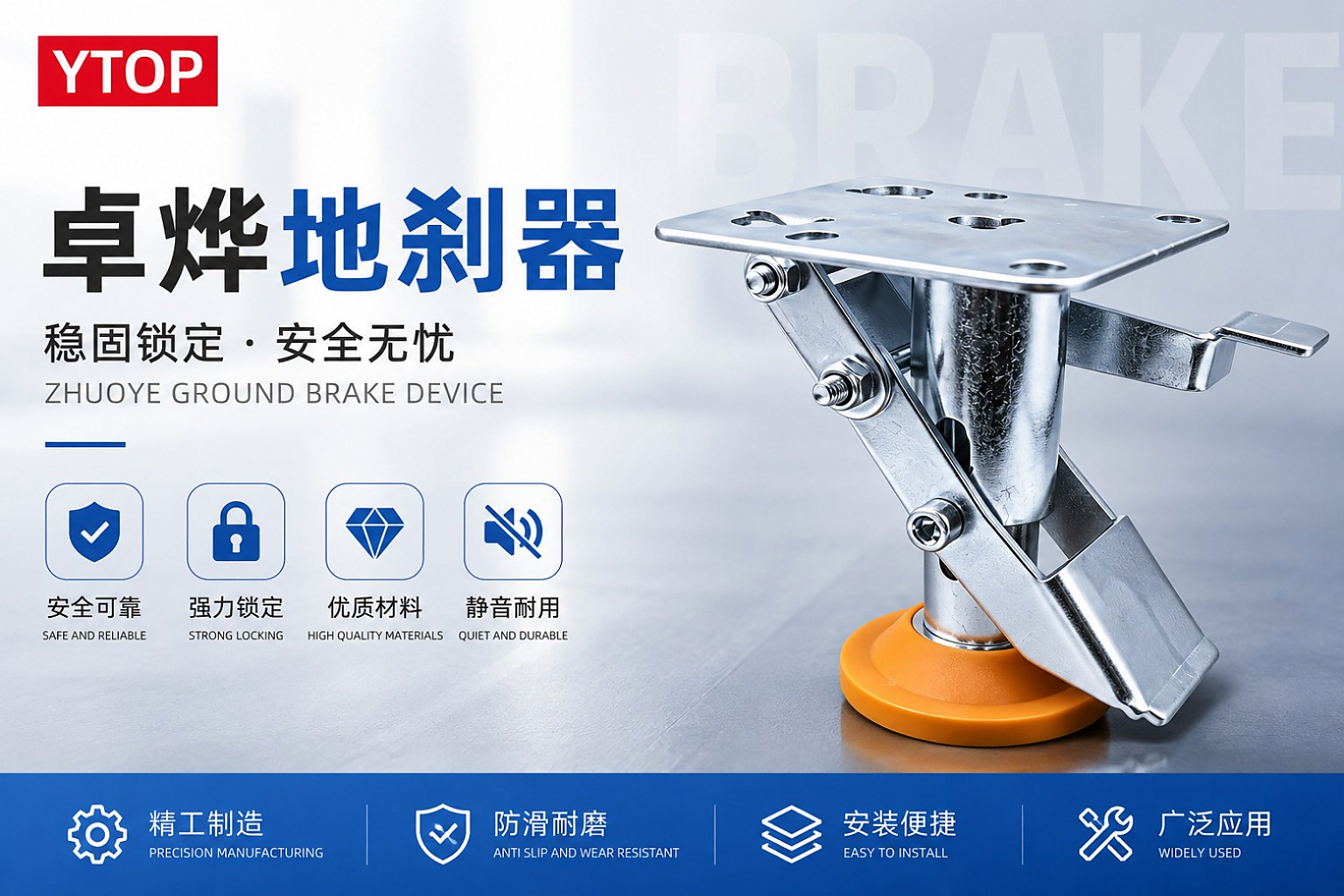


- Double vs Single Brake — Analysis of double and single brake differences.
- Double vs Side Brakes — Difference between double and side brakes.
- Brake Principle — Industrial caster brake principle analysis.
- Brake Precautions — Industrial caster brakes and precautions.
- Brake Types — Different types of caster brakes.
Explore our complete range of heavy-duty casters (150-610kg) and super heavy-duty casters (700-1600kg), or contact our engineering team for expert guidance.
Related Reading
Explore more caster brake system and selection guides:
- Single-Brake vs Dual-Brake Casters: Complete Comparison — Detailed braking principle and application scenario comparison.
- Analysis of Caster Double Brake and Single Brake — In-depth analysis of brake system differences.
- Are the Brake Wheels Universal? — Learn about brake system compatibility and interchangeability.
- Heavy-Duty Casters Selection Guide — Learn how to select casters with the right brake system.
- Extra Heavy Duty Casters: Full Analysis — In-depth look at heavy-duty caster brake systems.
Explore our complete range of heavy-duty casters (150-610kg) and medium-duty casters (100-190kg) with single brake, directional lock, and double brake options, or contact our engineering team for expert brake system selection guidance.
Post time:
Nov-16-2024
Related Reading
Looking for more in-depth caster guides and industrial mobility resources? Explore these related articles:
- Double vs Single Brake — Analysis of double and single brake differences.
- Double vs Side Brakes — Difference between double and side brakes.
- Brake Principle — Industrial caster brake principle analysis.
- Brake Precautions — Industrial caster brakes and precautions.
- Brake Types — Different types of caster brakes.
Explore our complete range of heavy-duty casters (150-610kg) and super heavy-duty casters (700-1600kg), or contact our engineering team for expert guidance.
Related Reading
Explore more caster brake system and selection guides:
- Single-Brake vs Dual-Brake Casters: Complete Comparison — Detailed braking principle and application scenario comparison.
- Analysis of Caster Double Brake and Single Brake — In-depth analysis of brake system differences.
- Are the Brake Wheels Universal? — Learn about brake system compatibility and interchangeability.
- Heavy-Duty Casters Selection Guide — Learn how to select casters with the right brake system.
- Extra Heavy Duty Casters: Full Analysis — In-depth look at heavy-duty caster brake systems.
Explore our complete range of heavy-duty casters (150-610kg) and medium-duty casters (100-190kg) with single brake, directional lock, and double brake options, or contact our engineering team for expert brake system selection guidance.