
In industries such as manufacturing, logistics, and warehousing, heavy-duty casters play a crucial role. They not only need to bear enormous weight, but must also maintain stable performance during prolonged use. Therefore, selecting the right heavy-duty casters is crucial for improving work efficiency, reducing maintenance costs, and ensuring workplace safety. This comprehensive guide will walk you through every aspect of heavy-duty caster selection—from load calculation and material choice to wheel diameter, braking systems, and mounting types—helping you easily select the right model that meets the needs of various industrial applications.
Define Usage Scenarios and Load-Bearing Requirements
The first step in selecting heavy-duty casters is to clearly define the application scenario and load-bearing requirements. Different application scenarios impose varying requirements on the material, dimensions, and load-bearing capacity of casters. For example, material handling within warehouses may require wear-resistant and impact-resistant materials; equipment movement on factory production lines places higher demands on the stability and precision of casters; automotive manufacturing facilities require casters that can withstand welding sparks and heavy equipment loads; food processing plants need casters resistant to wash-down chemicals and corrosion.
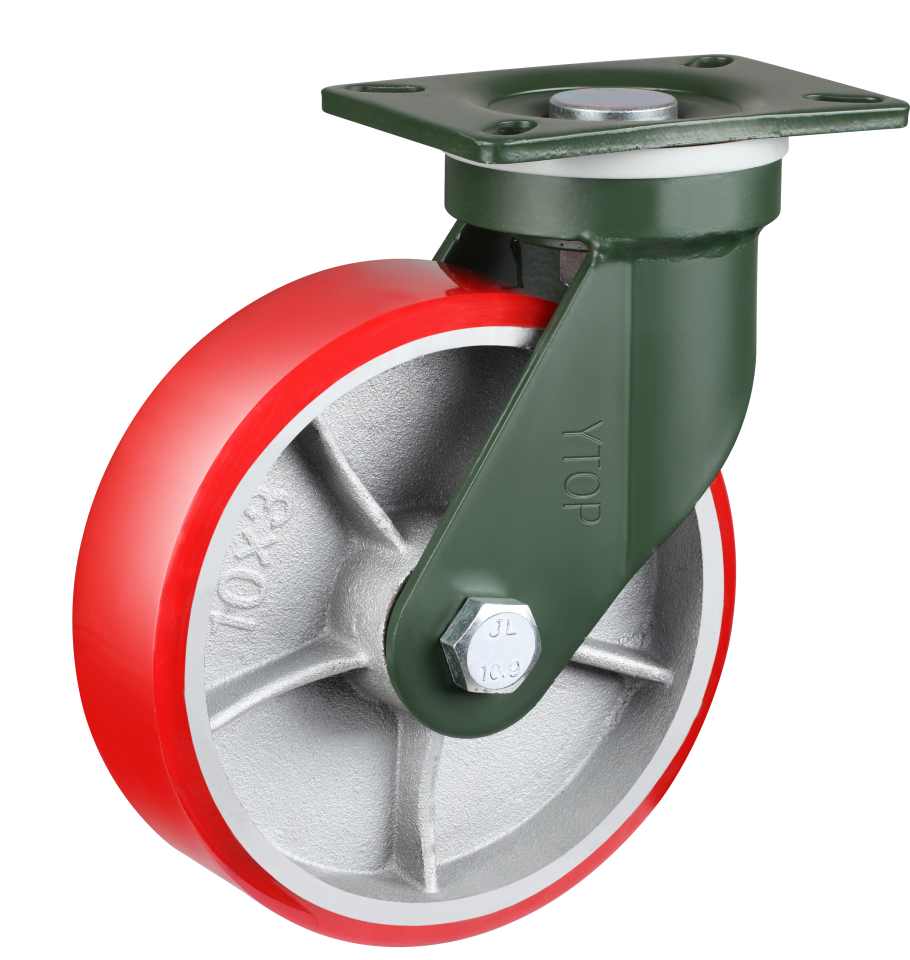
How to calculate required load capacity:
Accurate load calculation is the foundation of safe caster selection. Follow this formula:
- Calculate total weight: Add the weight of the equipment/cart itself plus the maximum load it will carry. For example: cart weight = 200kg, maximum cargo = 800kg, total = 1000kg.
- Count the number of casters: Most carts use 4 casters. However, due to uneven floors and load distribution, only 3 casters may bear weight at any given time.
- Apply safety factor: Divide total weight by 3 (not 4) to account for uneven load distribution, then multiply by a safety factor of 1.5 to 2.0. Example: 1000kg ÷ 3 × 1.5 = 500kg per caster minimum.
- Consider dynamic loads: If the cart will be pushed or pulled at speed, or if it will encounter impacts, increase the safety factor to 2.0 or higher.
Load capacity categories:
- Medium-duty: 100-200kg per caster — suitable for office furniture, display racks, light carts
- Heavy-duty: 200-600kg per caster — suitable for warehouse carts, industrial equipment, workbenches
- Extra heavy-duty: 600-1500kg per caster — suitable for automotive manufacturing, aerospace, heavy machinery
- Super heavy-duty: 1500kg+ per caster — custom solutions for extreme load applications
Determine the load capacity range of the casters based on actual requirements, ensuring that the casters you select can safely support the required weight with adequate margin for unexpected loads and dynamic forces.
Focus on Materials and Durability
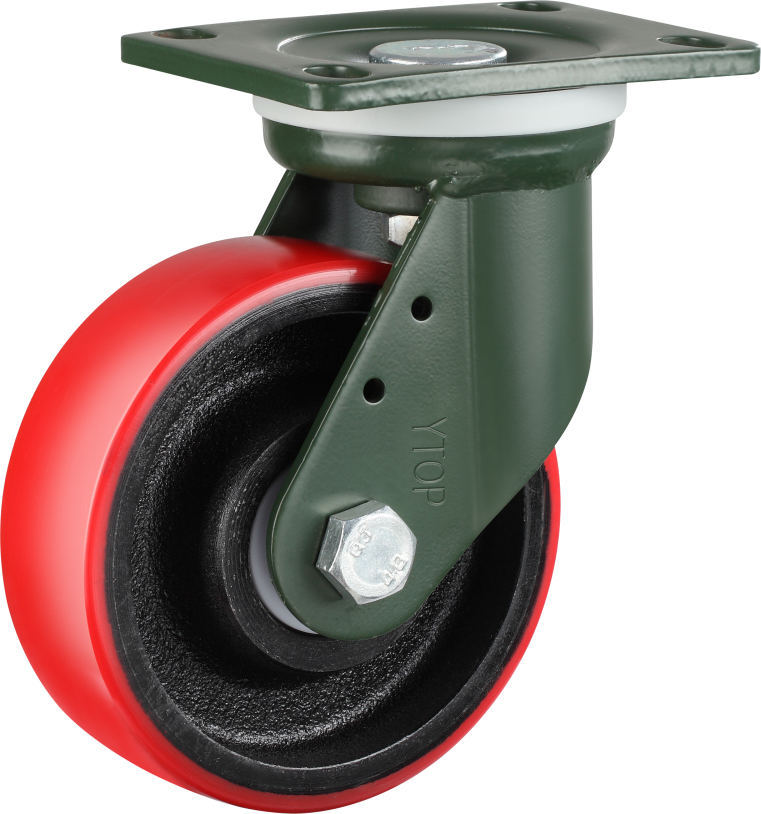
The material of heavy-duty casters directly impacts their durability, service life, and performance in specific environments. Common wheel materials include cast iron, nylon, steel, polyurethane, and rubber. Each material offers distinct advantages and is suited for different applications:
| Material | Load Capacity | Hardness | Key Advantages | Best For |
|---|---|---|---|---|
| Cast Iron | Very High (300-1500kg) | 90-95 Shore D | Extreme durability, high temp resistance, excellent wear | Heavy machinery, foundries, high-temp environments |
| Nylon (PA) | High (200-800kg) | 75-85 Shore D | Lightweight, corrosion resistant, low rolling resistance, non-marking | Warehouses, food processing, chemical plants, wet environments |
| Steel | Very High (400-2000kg) | Very Hard | Maximum strength, impact resistance, extreme durability | Automotive manufacturing, heavy equipment, military applications |
| Polyurethane (PU) | High (200-1000kg) | 80-95 Shore A | Quiet operation, floor protection, good shock absorption, non-marking | Manufacturing floors, retail, hospitals, noise-sensitive environments |
| Rubber | Medium-High (150-600kg) | 60-80 Shore A | Excellent shock absorption, traction, quiet, floor protection | Outdoor use, rough surfaces, wet environments, shock-sensitive cargo |
| Phenolic Resin | High (300-1000kg) | Very Hard | High temp resistance, chemical resistance, lightweight | Bakery ovens, industrial ovens, high-temp manufacturing |
Caster rig (fork) materials:
- Mild steel: Most common, cost-effective, suitable for general heavy-duty use. Typically 4-8mm thick plate steel with welded construction.
- Stainless steel (304/316): Corrosion-resistant, ideal for food processing, pharmaceutical, marine, and wash-down environments. More expensive but essential in corrosive settings.
- Zinc-plated steel: Basic corrosion protection for indoor use with occasional moisture exposure. The most common finish for standard heavy-duty casters.
- Chrome-plated steel: Enhanced corrosion resistance and aesthetic appeal, suitable for medical, food service, and retail applications.
When selecting materials, consider not just the wheel material but also the rig material, bearing type, and finish. The combination of these components determines the overall durability and suitability for your specific environment.
Consider Wheel Diameter and Steering Performance
The size of the wheel diameter not only affects the load capacity of the caster, but also impacts its steering performance, mobility speed, and ability to overcome obstacles. Generally speaking, casters with larger wheel diameters offer superior stability and load-bearing capacity, but steering flexibility may be slightly reduced; casters with smaller wheel diameters offer greater maneuverability and are suitable for operation in confined spaces.
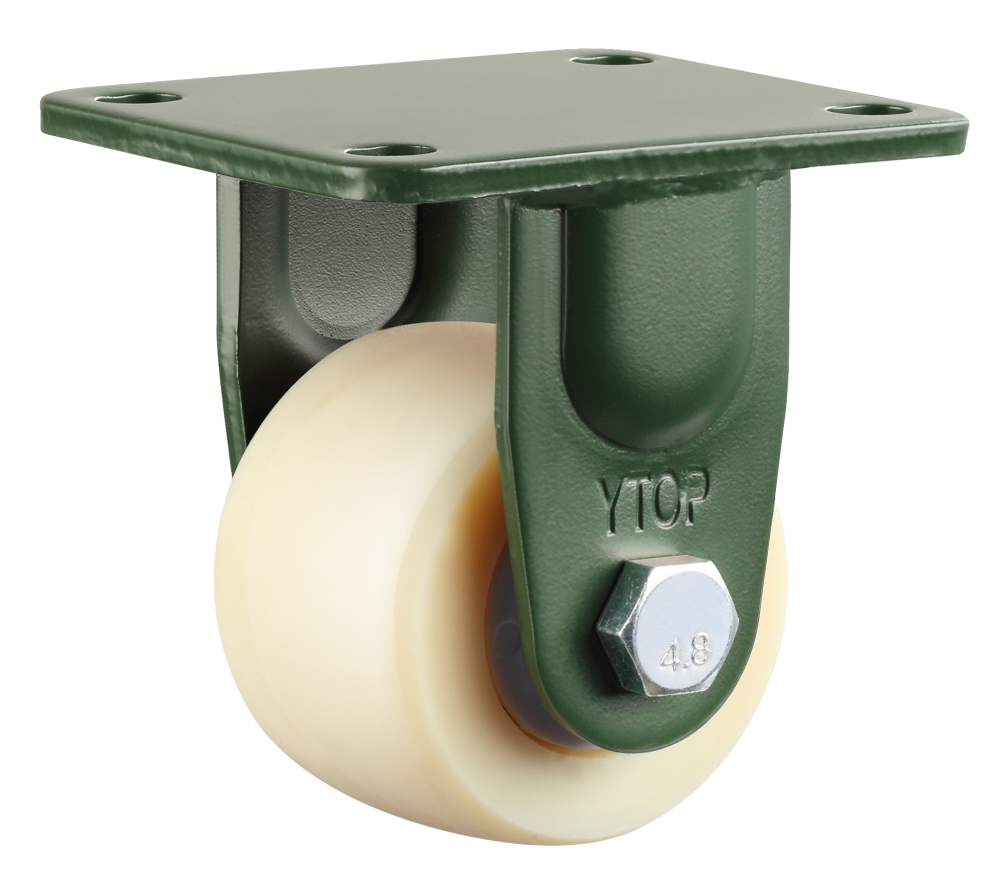
Wheel diameter selection guide:
| Wheel Diameter | Typical Load Capacity | Best For | Obstacle Clearance |
|---|---|---|---|
| 100mm (4″) | 100-300kg | Light carts, workbenches, confined spaces | Up to 10mm obstacles |
| 125mm (5″) | 150-400kg | General warehouse carts, medium equipment | Up to 15mm obstacles |
| 150mm (6″) | 200-600kg | Heavy-duty carts, industrial equipment, most common size | Up to 20mm obstacles |
| 200mm (8″) | 300-1000kg | Extra heavy loads, rough floors, long-distance transport | Up to 30mm obstacles |
| 250mm (10″) | 500-1500kg | Extreme heavy loads, outdoor use, severe floor conditions | Up to 40mm obstacles |
| 300mm (12″)+ | 800-2000kg+ | Super heavy-duty, aerospace, military, custom applications | Up to 50mm+ obstacles |
Swivel vs. rigid casters:
- Swivel casters: Rotate 360 degrees, allowing the cart to change direction and maneuver in tight spaces. Ideal for the front of a cart where steering is needed. Heavy-duty swivel casters feature a kingpin or kingpinless design with a raceway for smooth rotation.
- Rigid (fixed) casters: Only move forward and backward in a straight line, providing stability and tracking. Ideal for the rear of a cart where straight-line movement is desired. More durable and lower cost than swivel casters.
- Typical configuration: 2 swivel casters at the front (steering end) + 2 rigid casters at the rear = optimal combination of maneuverability and stability. For maximum maneuverability, use 4 swivel casters. For maximum stability and straight-line tracking, use 4 rigid casters.
Kingpin vs. kingpinless swivel casters:
- Kingpin design: Uses a central bolt (kingpin) to hold the swivel assembly together. More economical but the kingpin can loosen over time under heavy loads, requiring periodic maintenance.
- Kingpinless design: Uses an interlocking raceway system with no central bolt. More durable, higher load capacity, better shock absorption, and virtually maintenance-free. Preferred for heavy-duty and extra heavy-duty applications.
Select swivel casters or fixed casters based on your needs, and consider the wheel diameter carefully to meet the needs of movement in different directions and environments.
Braking Systems and Locking Mechanisms
For heavy-duty casters, braking and locking mechanisms are critical safety features that prevent unintended movement and ensure stability during loading, unloading, and stationary use. Several brake types are available for heavy-duty applications:
Common brake types:
- Total lock brake: Locks both the wheel rotation and the swivel rotation simultaneously, preventing any movement. The most secure option for heavy loads and inclines. Ideal for loading docks, ramps, and equipment that must remain completely stationary.
- Directional lock: Locks the swivel rotation only, converting a swivel caster to a rigid caster for straight-line tracking. Useful for long-distance transport where straight-line movement is desired, then unlocked for maneuvering at the destination.
- Wheel brake (face contact): Applies pressure to the wheel tread to stop rotation. The swivel still rotates, allowing directional changes while the wheel is locked. Suitable for level surfaces where only wheel locking is needed.
- Cam brake: Uses a cam mechanism to apply pressure to the wheel. Typically operated by foot pedal. Common on medium-duty casters but less common for heavy-duty due to lower holding force.
- Wrap-around brake: Encircles the wheel for maximum braking force. Ideal for heavy-duty and extra heavy-duty applications where maximum holding power is required.
Brake selection considerations:
- Load weight: Heavier loads require stronger braking force. Total lock or wrap-around brakes are recommended for loads over 300kg per caster.
- Floor slope: If the equipment will be used on inclines or ramps, total lock brakes are essential to prevent rolling.
- Operating environment: In wet or oily environments, choose brakes with enhanced holding force, as reduced friction can compromise braking performance.
- Foot vs. hand operation: Most heavy-duty brakes are foot-operated for convenience, but hand-operated brakes are available for applications where foot access is limited.
- Number of brakes: At minimum, install brakes on the two swivel casters at the steering end. For maximum stability, install brakes on all four casters.
Bearing Types and Axle Configurations
The bearing type significantly affects a caster’s rolling resistance, load capacity, durability, and maintenance requirements. Choosing the right bearing is essential for heavy-duty applications where smooth rolling and long service life are critical.
Common bearing types:
| Bearing Type | Load Capacity | Rolling Resistance | Maintenance | Best For |
|---|---|---|---|---|
| Plain bore (sleeve) | Medium | Higher | Regular lubrication | Light-medium duty, low frequency use |
| Roller bearing | Very High | Low | Sealed/lubricated for life | Heavy-duty, high load, frequent use |
| Ball bearing (precision) | High | Very Low | Sealed, maintenance-free | Medium-heavy duty, smooth rolling, high speed |
| Tapered roller bearing | Extremely High | Low | Periodic lubrication | Extra heavy-duty, shock loads, extreme conditions |
| Delrin (plastic) bearing | Medium | Medium | Maintenance-free, corrosion-proof | Wet environments, food processing, chemical plants |
Axle configurations:
- Standard axle: A bolt passing through the wheel and secured with a nut. Common for medium-duty applications. Easy to disassemble for wheel replacement.
- Shoulder axle: Features a shoulder that spaces the wheel from the fork legs, reducing friction and preventing wheel rub. Preferred for heavy-duty applications.
- Welded axle: Axle is welded to the fork legs for maximum strength. Cannot be disassembled for wheel replacement—wheel must be pressed off. Used for extra heavy-duty and super heavy-duty applications.
- Threaded axle: Axle has threads on both ends for securing with nuts. Allows for easy disassembly and wheel replacement. Common on swivel casters with accessible axles.
For heavy-duty applications, roller bearings or tapered roller bearings with shoulder axles are generally recommended for their superior load capacity, durability, and low rolling resistance.
Mounting Types and Installation Considerations
Heavy-duty casters are available in several mounting configurations, and selecting the right one ensures a secure, stable installation that can handle the intended load. The mounting type also affects the overall height of the equipment and ease of installation.
Common mounting types:
- Top plate mount: The most common mounting type for heavy-duty casters. A flat steel plate (typically 4″x4.5″ or 5″x5″ for heavy-duty) with 4 bolt holes that bolts to the bottom of the equipment. Provides the most secure attachment and highest load capacity. Ensure the equipment frame is strong enough to support the plate and load—reinforce with backing plates if necessary.
- Threaded stem mount: A threaded stem (typically 1/2″-13 or 3/4″-10 for heavy-duty) that screws into a threaded insert or nut on the equipment. Easier to install but lower load capacity than plate mount. Ensure the threaded insert is securely mounted and rated for the load.
- Grip ring stem mount: A smooth stem with a spring-loaded retaining ring that expands inside a mounting hole. Common on medium-duty casters but less common for heavy-duty due to lower load capacity. Ensure the mounting hole is the correct size and the equipment frame is thick enough.
- Stem with top lock: A stem with a locking collar that clamps onto the equipment leg. Common on tubular furniture and carts. Ensure the leg diameter matches the collar size and the collar is securely tightened.
- U-channel mount: A U-shaped channel that fits over the equipment frame and bolts through both sides. Provides excellent stability and is common on carts and trailers with tubular frames.
- Custom mounts: For specialized applications, custom mounting plates, brackets, or adapters can be fabricated to fit unique equipment configurations.
Installation best practices:
- Reinforce mounting surfaces: Ensure the equipment frame or mounting surface is strong enough to support the casters and load. Add backing plates or reinforcement gussets if the frame is thin or weak.
- Use proper hardware: Use grade 5 or grade 8 bolts and lock nuts for heavy-duty installations. Ensure bolt length is appropriate—threads should extend through the nut but not interfere with wheel movement.
- Maintain consistent height: All casters on a piece of equipment should be the same height to prevent wobbling and uneven load distribution. If mixing caster types, verify that the overall heights match.
- Allow swivel clearance: Ensure there is adequate clearance around swivel casters for full 360-degree rotation without interference from equipment frames, walls, or other obstacles.
- Torque specifications: Tighten mounting bolts to the manufacturer’s recommended torque. Overtightening can strip threads or warp plates; undertightening can cause loosening and instability.
Brand, Service, and Quality Certification
When selecting heavy-duty casters, brands and services are equally important. Well-known brands typically adhere to high production standards and implement strict quality control, ensuring the performance and quality of the casters. At the same time, excellent after-sales service is a crucial consideration during the purchasing process. Choose brands with a comprehensive after-sales service system to receive timely technical support and maintenance services during use, reducing maintenance costs and improving work efficiency.
Key quality certifications to look for:
- ISO 9001: Quality management system certification ensures consistent manufacturing processes and quality control.
- CE marking: Indicates compliance with European Union health, safety, and environmental protection standards. Essential for equipment exported to the EU.
- RoHS compliance: Restriction of Hazardous Substances directive limits the use of certain hazardous materials in electrical and electronic equipment.
- REACH compliance: Registration, Evaluation, Authorization, and Restriction of Chemicals regulation for EU market access.
- FDA compliance: For food contact applications, ensure materials are FDA-compliant (21 CFR Part 177 for polymers).
- NSF/ANSI 51: Certification for food equipment materials, relevant for food processing and foodservice casters.
After-sales service considerations:
- Warranty period: Look for brands offering at least 1-2 year warranties on heavy-duty casters. Some premium brands offer 3-5 year warranties.
- Technical support: Ensure the supplier provides engineering support for caster selection, custom solutions, and troubleshooting.
- Replacement parts availability: Verify that replacement wheels, bearings, and other components are readily available to minimize downtime.
- Lead times: For critical applications, ensure the supplier can meet your delivery schedule and maintain adequate stock of common sizes.
- Customization capability: If standard casters don’t meet your needs, choose a manufacturer with in-house engineering and custom fabrication capabilities.
Budgeting and Cost-Effectiveness
When selecting heavy-duty casters, a trade-off must be made based on actual needs and budget. Prices for casters vary significantly depending on brand, material, specifications, and features. Therefore, it is necessary to ensure that the requirements for use are met while reasonably controlling costs. At the same time, avoid sacrificing quality in pursuit of low prices, as inferior casters can lead to premature failure, safety hazards, and higher long-term costs due to frequent replacement and downtime.
Cost breakdown for heavy-duty casters (approximate):
| Caster Type | Price Range (per caster) | Key Cost Drivers |
|---|---|---|
| Medium-duty (100-200kg) | $10-$30 | Wheel material, bearing type, brake option |
| Heavy-duty (200-600kg) | $25-$80 | Rig thickness, wheel material, bearing type, brake type |
| Extra heavy-duty (600-1500kg) | $60-$200 | Kingpinless design, tapered bearings, forged rig, heavy-duty brake |
| Super heavy-duty (1500kg+) | $150-$500+ | Custom fabrication, special materials, precision bearings, testing |
| Stainless steel (corrosion-resistant) | 2-3x standard price | Stainless steel rig and hardware, special bearings |
| High-temperature (oven-rated) | 1.5-2.5x standard price | High-temp wheel material, high-temp grease, special construction |
Total cost of ownership (TCO) considerations:
- Initial purchase cost: The upfront price of the casters.
- Installation cost: Labor and hardware for installation.
- Maintenance cost: Lubrication, inspection, and adjustment over the service life.
- Replacement cost: Cost of replacement wheels, bearings, or complete casters when worn out.
- Downtime cost: Lost productivity when equipment is out of service due to caster failure.
- Safety cost: Potential costs associated with accidents or injuries caused by caster failure.
While premium casters may have a higher initial cost, they often provide lower TCO due to longer service life, reduced maintenance, fewer replacements, and minimized downtime. Always evaluate casters based on TCO rather than just initial purchase price.
Common Selection Mistakes to Avoid
Even with careful planning, common mistakes can lead to poor caster performance or premature failure. Avoid these pitfalls:
- Underestimating load capacity: The most common mistake. Always calculate load based on 3 casters bearing weight (not 4) and apply a safety factor of 1.5-2.0. Under-rated casters fail catastrophically and create safety hazards.
- Ignoring floor conditions: Hard wheels (nylon, cast iron) on rough or debris-covered floors can chip, crack, or develop flat spots. Soft wheels (rubber, PU) on smooth concrete with heavy loads can have excessive rolling resistance. Match wheel material to floor conditions.
- Neglecting environmental factors: Casters used in wet, chemical, high-temperature, or outdoor environments require special materials and finishes. Standard casters will corrode, degrade, or fail in harsh environments.
- Wrong wheel diameter: Wheels too small for the load or floor conditions will have high rolling resistance and wear quickly. Wheels too large may not fit under equipment or create instability. Follow the wheel diameter selection guide.
- Inadequate braking: Using wheel brakes only (not total lock) on heavy loads or inclines can lead to unintended movement. Always specify total lock brakes for heavy-duty applications where stationary stability is critical.
- Poor mounting surface: Installing heavy-duty casters on thin or weak equipment frames without reinforcement leads to frame bending, bolt pull-out, and catastrophic failure. Always reinforce mounting surfaces.
- Mixing caster heights: Using casters of different heights on the same equipment causes wobbling, uneven load distribution, and premature wear. Always verify that all casters have the same overall height.
- Ignoring maintenance requirements: Even the best casters require periodic inspection, lubrication, and cleaning. Neglecting maintenance leads to premature bearing failure, reduced swivel performance, and safety hazards.
- Choosing based on price only: Selecting the cheapest casters without considering quality, load rating, or suitability for the application leads to frequent replacement, downtime, and potential safety issues. Always evaluate total cost of ownership.
FAQs About Heavy-Duty Caster Selection
Q: What is the difference between heavy-duty and extra heavy-duty casters?
A: Heavy-duty casters typically support 200-600kg per caster and feature 4-6mm thick steel rigs with standard ball or roller bearings. Extra heavy-duty casters support 600-1500kg per caster and feature 6-10mm thick forged or welded steel rigs, kingpinless swivel designs, and tapered roller bearings. The choice depends on your specific load requirements and operating conditions.
Q: Can I use medium-duty casters for heavy loads if I use more of them?
A: No. While adding more casters distributes the load, medium-duty casters have rigs, wheels, and bearings that are not designed for heavy loads. They will fail prematurely due to structural fatigue, bearing overload, and wheel deformation. Always use casters rated for the appropriate load per caster, even if you use more than 4 casters.
Q: How do I determine the correct wheel diameter for my application?
A: Consider three factors: (1) Load capacity—heavier loads require larger wheels; (2) Floor conditions—rough floors or obstacles require larger wheels for better clearance; (3) Space constraints—confined spaces may require smaller wheels for maneuverability. As a general rule, 150mm (6″) wheels are the most versatile for heavy-duty applications, 200mm (8″) for extra heavy loads or rough floors, and 100-125mm (4-5″) for confined spaces with moderate loads.
Q: What bearing type is best for heavy-duty casters?
A: For most heavy-duty applications (200-600kg per caster), precision ball bearings or roller bearings are recommended. Ball bearings offer very low rolling resistance and are maintenance-free when sealed. Roller bearings offer higher load capacity and better shock resistance. For extra heavy-duty applications (600kg+), tapered roller bearings are preferred for their extreme load capacity and ability to handle both radial and thrust loads.
Q: Do I need brakes on all four casters?
A: Not necessarily. For most applications, brakes on the two swivel casters (at the steering end) are sufficient. However, for heavy loads (over 500kg total), equipment used on inclines, or equipment that must remain completely stationary during operation (such as workbenches or machinery), total lock brakes on all four casters are recommended for maximum stability and safety.
Q: How often should heavy-duty casters be maintained?
A: For normal industrial use, inspect casters monthly for wear, damage, and loose hardware. Lubricate bearings and swivel raceways every 3-6 months, or more frequently in wet, dusty, or high-temperature environments. Replace wheels when tread wear exceeds 30%, when flat spots or cracks develop, or when bearings become rough or noisy. Proper maintenance can extend caster life by 50% or more.
Q: Can I replace just the wheel on a heavy-duty caster, or do I need to replace the entire caster?
A: In most cases, you can replace just the wheel if the caster rig (fork, swivel assembly, mounting plate) is still in good condition. Ensure the replacement wheel has the same diameter, width, bearing size, and load capacity as the original. For welded-axle casters, the wheel must be pressed off and on, which may require special tools. If the rig is damaged, bent, or has worn swivel raceways, replace the entire caster.
Q: What is the expected lifespan of heavy-duty casters?
A: With proper maintenance and appropriate use, quality heavy-duty casters typically last 3-7 years in industrial applications. Lifespan varies significantly based on load (lighter loads = longer life), frequency of use (occasional use = longer life), floor conditions (smooth clean floors = longer life), and maintenance (regular lubrication and inspection = longer life). Casters in harsh environments (wet, chemical, high-temp) may have shorter lifespans of 1-3 years.
Conclusion
In summary, when selecting heavy-duty casters, it is essential to comprehensively consider multiple factors including the intended application, load-bearing requirements, material composition, wheel diameter, steering configuration, braking systems, bearing types, mounting options, brand reputation, after-sales service, and budget constraints. By carefully evaluating each of these factors and avoiding common selection mistakes, you can ensure that the casters you choose provide reliable, safe, and cost-effective performance for your specific application.
Remember that the cheapest caster is rarely the most cost-effective choice when you consider total cost of ownership—including maintenance, replacement, downtime, and safety. Investing in quality heavy-duty casters from a reputable manufacturer with proper engineering support and after-sales service pays dividends in the form of longer service life, reduced maintenance, improved safety, and lower overall operating costs.
At YTOP Casters, we offer a comprehensive range of heavy-duty caster solutions tailored to your specific needs. Our heavy-duty casters (150-610kg) feature robust steel rigs, precision bearings, and a choice of wheel materials including nylon, polyurethane, rubber, and cast iron. For extreme load applications, our super heavy-duty casters (700-1600kg) offer kingpinless designs, tapered roller bearings, and forged steel construction for maximum durability. With 15 years of manufacturing experience, ISO 9001 and CE certification, and a dedicated engineering team, we can help you select the perfect heavy-duty caster solution for your application. Contact us today for expert guidance and a customized quote.
Related Reading
Looking for more in-depth caster guides and industrial mobility resources? Explore these related articles:
- Extra Heavy Duty Analysis — In-depth look at extra heavy duty casters.
- EHD Application Areas — Where extra heavy duty casters are used.
- Choose High Load Casters — How to select high load casters.
- 18B Nylon Manganese Steel — High-quality heavy duty casters.
- Advantages of HD Casters — Benefits of heavy duty casters.
Explore our complete range of heavy-duty casters (150-610kg) and super heavy-duty casters (700-1600kg), or contact our engineering team for expert guidance.
Related Reading
Explore more heavy-duty caster selection, load capacity, and buying guides:
- Analysis of Heavy-Duty Industrial Caster Selection Questions — Learn about heavy-duty industrial caster selection including load stability and key considerations.
- Difference Between Heavy Duty and Medium Duty Industrial Casters — Learn about heavy-duty vs medium-duty industrial caster differences including load capacity and selection guidance.
- Extra Heavy Duty Casters: Full Analysis of Features, Load Capacity and Applications — Learn about extra heavy-duty caster features including load capacity and application scenario selection.
- Casters Buying Guide — Complete caster buying guide including heavy-duty caster selection for load stability.
- Common Casters Selection Guide — Learn about common caster selection including heavy-duty load stability and hassle-free buying.
Explore our complete range of load-stable heavy-duty casters (150-610kg) and super heavy-duty casters (700-1600kg) for hassle-free selection, or contact our engineering team for expert heavy-duty caster selection guidance.
Post time: Sep-12-2025