
When selecting caster brakes for industrial carts, medical equipment, or material handling systems, understanding the caster double brake vs single brake distinction is critical for ensuring workplace safety and equipment stability. Double brakes (total lock) secure both wheel rotation and swivel movement, while single brakes (wheel brake) only lock the wheel. This comprehensive analysis compares both brake types across safety, cost, ergonomics, and application suitability to help you make an informed braking decision.
Caster Double Brake (Total Lock Brake)
How It Works
A caster double brake, also known as a total lock brake or dual lock brake, engages two independent locking mechanisms simultaneously. The first mechanism prevents the wheel from rotating (rolling lock), while the second locks the swivel bearing, preventing the caster from pivoting. When fully engaged, the caster becomes completely immobilized in both directions, effectively converting a swivel caster into a fixed caster.
Key Advantages
Double brakes provide the highest level of caster security available. They prevent both rolling and swiveling movement, making them essential for applications requiring exact positioning. This is particularly important on sloped surfaces, when equipment experiences vibration during operation, or in healthcare settings where patient safety is paramount. The dual-action pedal requires a decisive foot press, reducing accidental disengagement.

Caster Single Brake (Wheel Brake)
How It Works
A caster single brake, or wheel brake, operates by pressing a brake pad against the wheel tread or sidewall. This prevents the wheel from rotating but leaves the swivel bearing free. The caster can still pivot around its vertical axis while being unable to roll. Single brakes are simpler in design, with fewer moving parts, and are typically more compact and economical.
Key Advantages
Single brakes are lightweight, cost-effective, and quick to engage and disengage. They are ideal for light-duty applications where simple rolling prevention is sufficient, such as office furniture, retail displays, and light equipment carts. The compact brake mechanism adds minimal height to the caster, making single brakes suitable for low-profile applications where space is limited.
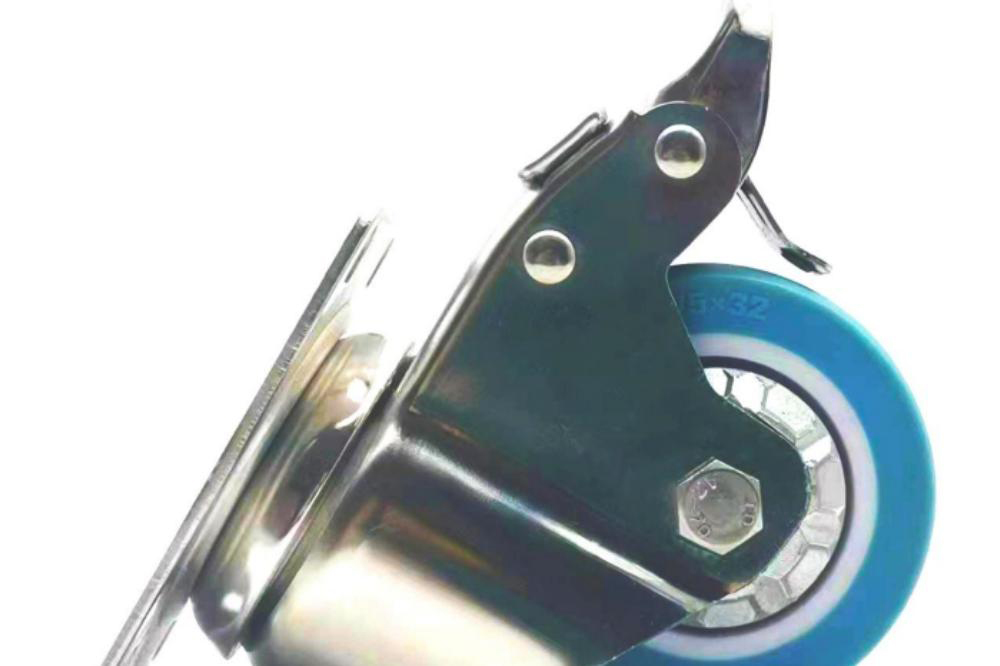
Caster Double Brake vs Single Brake: Detailed Analysis
Level of Immobilization
The primary difference in the caster double brake vs single brake comparison is the level of immobilization. Double brakes lock both wheel and swivel, creating a fully fixed position. Single brakes only prevent rolling, allowing the caster to pivot. In applications where equipment must remain perfectly still, double brakes are indispensable.
Safety Performance
Double brakes significantly outperform single brakes in safety-critical scenarios. On inclined surfaces, single-braked casters may still slide or rotate. Double brakes keep equipment securely in place regardless of lateral forces. In industrial environments with forklift traffic, vibration, or uneven floors, double brakes provide essential safety margins.
Cost Comparison
Single brakes typically cost 15-25% less than double brakes. They have simpler mechanics and fewer wear components. However, double brakes distribute braking force across two mechanisms, potentially offering longer service life. For budget-sensitive light-duty applications, single brakes offer adequate performance at lower cost.
Ergonomics and Operation
Double brake pedals are larger and easier to locate by foot. They require a more deliberate press, which can be an advantage in preventing accidental release. Single brake pedals are smaller and faster to engage, making them better suited for applications requiring frequent repositioning.
Application Recommendations
Choose Double Brakes For
Industrial carts, medical equipment, outdoor use, sloped surfaces, heavy loads, and any application where equipment must remain stationary during operation.
Choose Single Brakes For
Office furniture, retail displays, light equipment, flat-surface applications, and budget-conscious projects where simple rolling prevention is sufficient.

Brake Mechanism Engineering Details
Double Brake Internal Mechanics
A quality double brake uses a single foot pedal that simultaneously actuates two independent locking arms: one presses against the wheel tread to stop rotation, while the other engages a notched ring on the swivel race to prevent pivoting. This synchronized action ensures both mechanisms engage simultaneously, providing immediate and secure immobilization. The pedal return spring automatically releases both mechanisms when pressure is removed.
Single Brake Internal Mechanics
Single brakes typically use a simple lever or pedal that pushes a brake pad against the side of the wheel. The brake pad may be made of felt, nylon, or composite material. When the pedal is pressed, a cam mechanism increases the clamping force on the wheel. No mechanism affects the swivel bearing, so the caster can still rotate freely.
Load on Brake Components
Double brakes experience higher mechanical stress because they must resist both rolling forces and swivel torque. This requires stronger pedal construction, thicker brake arms, and more durable pivot points. Single brakes only resist rolling forces, allowing simpler and lighter construction.
Performance Testing and Standards
Brake Holding Power Tests
Industry standards (such as BIFMA X5.1 and ANSI IC-120) require caster brakes to hold a specified load on a 5-degree incline without movement. Double brakes typically exceed these requirements by a wide margin, holding loads on 10-degree or steeper inclines. Single brakes may meet minimum requirements on flat surfaces but fail on inclines.
Cycle Life Testing
Brake mechanisms undergo cycle testing to simulate years of use. Quality double brakes are tested to 20,000+ engagement cycles before performance degradation. Budget single brakes may fail after 5,000-10,000 cycles. For high-frequency applications, the cycle life rating is an important specification.
Application Case Studies
Industrial Manufacturing Equipment
A stamping press supplier upgraded their equipment cart casters from single to double brakes. During machine operation, vibration caused single-braked carts to slowly creep toward the press, creating a safety hazard. Double brakes eliminated all movement, meeting machine guarding safety requirements.
Educational Furniture
For classroom furniture and mobile whiteboard stands, single brakes proved sufficient. The lighter loads and flat floors meant swivel-only movement was negligible. The lower cost and faster operation of single brakes made them the preferred choice for budget-conscious school districts.
Cost Analysis and Long-Term Value
Purchase Price Comparison
Single brake casters are typically 15-25% cheaper than double brake equivalents. For a set of four casters, this savings ranges from $30 to $150 depending on size. For budget-sensitive projects with light loads on flat floors, single brakes offer adequate performance.
Total Cost of Ownership
Double brakes reduce workplace accidents, prevent equipment damage, and often have longer service life due to distributed braking forces. For safety-critical applications, the cost of a single workplace accident far exceeds the brake upgrade cost. Calculate the risk exposure when deciding between brake types.
Maintenance and Troubleshooting
Brake Pad Replacement
Worn brake pads reduce holding power. Replace pads when the contact surface is worn to half its original thickness. Keep spare brake pads on hand for high-use applications. Most brake designs allow pad replacement without removing the entire caster.
Pedal Adjustment
Over time, brake pedals may develop slack from wear. Some designs include adjustment screws to take up this slack. Consult the manufacturer documentation for adjustment procedures. Do not over-adjust, as this can cause constant drag and premature wheel wear.
Conclusion
The caster double brake vs single brake decision comes down to one question: does your application require complete immobilization, or is simple rolling prevention sufficient? For industrial, medical, or safety-critical applications, double brakes provide essential security. For light-duty, flat-floor use, single brakes offer economy and convenience. When in doubt, choose double brakes for maximum safety and compliance.
Environmental Factors Affecting Brake Performance
Brake performance varies significantly depending on environmental conditions. On oily or wet floors, brake grip is reduced for both brake types. Low temperatures can stiffen brake pads and increase required pedal force. Dust and debris can jam brake mechanisms, requiring more frequent cleaning. In outdoor or corrosive environments, stainless steel brake components are recommended to prevent rust and ensure reliable operation over time. Always consider the operating environment when selecting and maintaining caster brakes.
Regular inspection and preventive maintenance are the best ways to ensure brake reliability over the service life of your casters.
Investing in quality brake mechanisms now prevents costly accidents and downtime later.
Choose wisely and maintain regularly.
This is essential.
Frequently Asked Questions
Can I retrofit single brakes to double brakes?
In most cases, no. The brake mechanism is integrated into the caster fork design. Retrofitting requires replacing the entire caster assembly.
How many braked casters does a cart need?
For optimal stability, equip at least two diagonally opposite casters with brakes. This prevents the cart from sliding or rotating when brakes are applied.
What is the service life of caster brakes?
With normal medium-duty use, caster brakes typically last 2-4 years. Heavy use or abrasive conditions may shorten brake life to 1-2 years.
Related Reading
- 📚 Caster Double Brakes vs Side Brakes — Compare total lock brakes with tread brake mechanisms.
- 📚 Brake Wheel vs Universal Wheel — Understand braked vs unbraked caster options.
- 📚 How to Choose Casters: Selection Guide — Expert caster selection including brake types.
- 📚 Caster Selection Strategy — Material and brake selection strategy.
- 📚 Common Caster Materials Guide — Material properties for caster wheels.
Explore our heavy-duty casters (150-610kg) with double brake options and medium-duty casters (100-190kg) with single brake configurations, or contact our sales team for brake selection guidance.
Post time: May-11-2026