
What Is an AGV? A Quick Introduction
To understand what an AGV caster is, you first need to understand the machine it supports. AGV stands for Automated Guided Vehicle — a wheeled mobile robot that moves materials, components and finished goods around factories, warehouses and hospitals without a human driver on board. AGVs follow pre-defined paths marked by magnetic tape, QR codes, laser guidance strips or natural-feature navigation, and they are coordinated by central dispatch software.
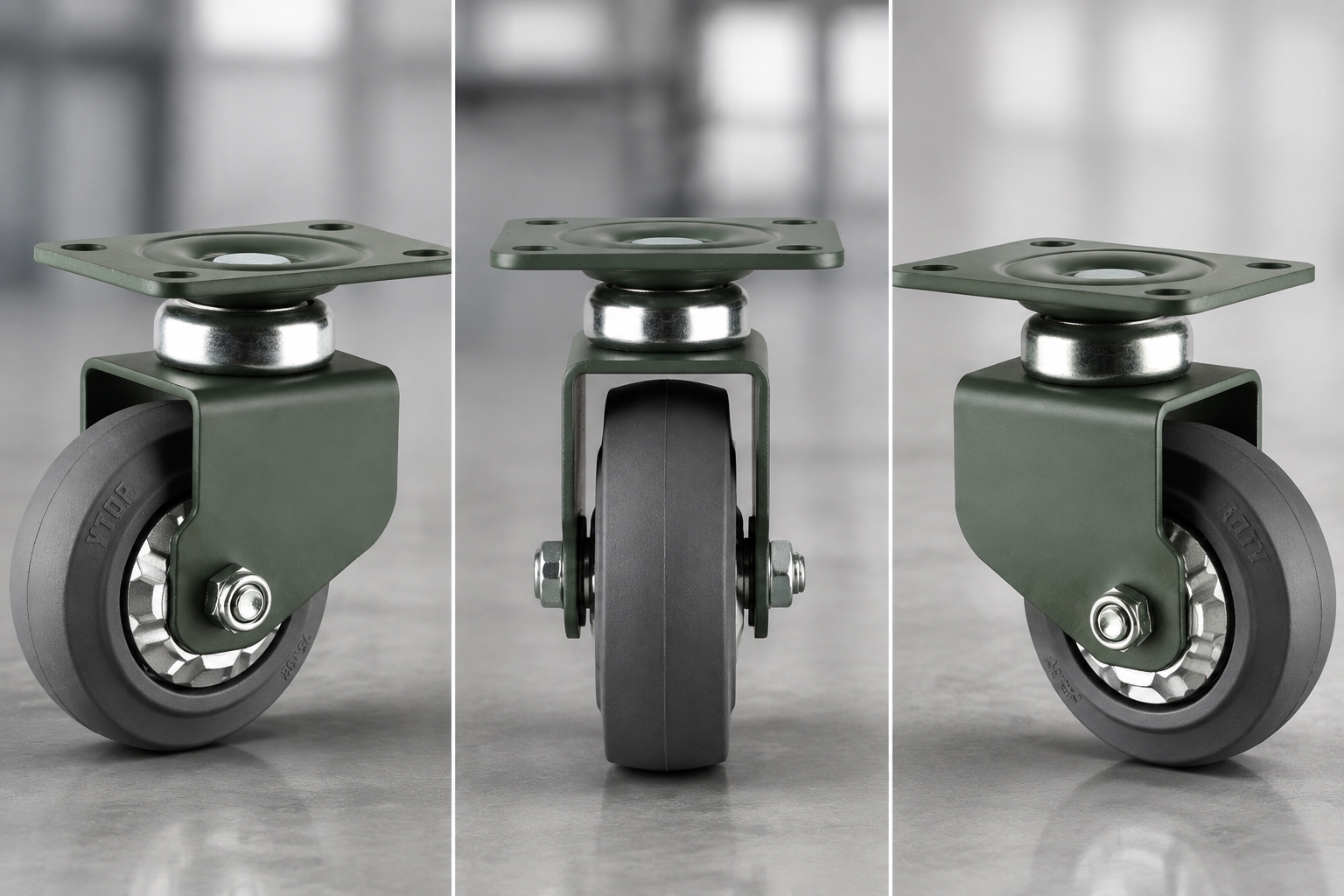
AGV technology is the product of several disciplines converging: artificial intelligence, automatic control, image processing, communication, mechanical design and electronics. Over the past decade it has become one of the hottest areas in logistics and factory automation, and the wheels an AGV rides on are no longer ordinary furniture casters — they are engineered components that directly determine whether the vehicle stops at the right place, holds the right load and lasts long enough to justify the investment.
Where AGVs Are Used
AGVs are no longer limited to a single industry. You will find them towing parts carts on automobile assembly lines, carrying bins between racking aisles in e-commerce warehouses, delivering meals and medications inside hospitals, shuttling pallets in FMCG distribution centers, and even moving raw materials inside cleanroom electronics plants. In every one of these settings, the casters must do far more than simply roll — they must roll precisely, quietly and reliably, often for 24 hours a day.
What Is an AGV Caster? Definition and Structure
An AGV caster is a specialized wheel assembly mounted on the underside of an automated guided vehicle to support its weight, transmit driving torque and guide it along its planned route. Unlike a general-purpose caster bought off the shelf, an AGV caster is engineered as a subsystem that interfaces with the vehicle’s motor, gearbox, steering controller and navigation sensors.
Core Components of an AGV Caster
A typical AGV caster is built from several precision-machined parts working together:
- Tire / wheel tread — usually made from high-quality polyurethane (PU) bonded to a metal hub, chosen for traction, floor protection and low noise.
- Rim or hub — machined aluminum or cast steel, often with bolt-hole patterns that match a motor flange or bearing housing.
- Axle and bearings — sealed deep-groove ball bearings or tapered roller bearings selected for very low rotational resistance and long service life under continuous loading.
- Swivel bearing assembly (for follower and omni wheels) — a precision thrust bearing that lets the wheel self-align with the direction of travel with minimal side friction.
- Drive interface — on driven wheels, the hub is coupled to a gearbox and motor through a coupling, timing belt or direct shaft connection, sometimes with an integrated gear ring machined into the wheel itself.
The structure varies by application: AGV casters may be gear-driven, motor-driven, belt-driven or even pneumatically sprung, depending on the required speed, load and floor condition.
The Core Functions of AGV Casters
As one of the most safety-critical components of any AGV platform, the caster set must perform five jobs simultaneously.
Load Bearing and Vehicle Stability
AGV casters must carry the full weight of the chassis, battery, payload and any towing attachment — often from a few hundred kilograms on a small unit to several tons on a heavy-load AGV. Even load distribution across the caster set keeps the vehicle stable when starting, stopping, turning on a gradient or passing over an expansion joint. An ordinary caster chosen by guesswork will deflect, flatten or jam under these cyclic loads.
Driving Power and Precise Steering
Driven AGV wheels must transmit high torque to the floor without slipping, while follower wheels must track accurately so the vehicle does not crab sideways. The steering caster assembly responds to commands from the on-board controller, adjusting heading within fractions of a degree so the AGV docks at a conveyor, a work cell or a charge station on the first try.
Beyond these two, AGV casters are also expected to:
- Support guidance accuracy — encoders mounted on the driven wheel feed odometry data back to the navigation system; wheel slip or eccentricity directly degrades positioning accuracy.
- Run efficiently and quietly — low rolling resistance means longer battery life per shift; low noise is essential in hospitals, offices and night-time distribution centers.
- Last through millions of meters — a commercial AGV is expected to operate for five to ten years, so the tire compound, bearings and swivel race must resist abrasion, fatigue and contamination.
AGV Casters vs. Ordinary Casters: A Detailed Comparison
It is tempting to assume that any sturdy caster will work on an AGV, but the requirements differ in almost every respect. The table below summarizes the most important differences.
| Feature | Ordinary / General-Purpose Casters | AGV Casters |
|---|---|---|
| Precision requirement | Free-rolling within ordinary tolerances; a few millimeters of wobble is acceptable | High concentricity and low eccentricity required, because encoders measure distance through the wheel |
| Running speed | 0.5–2 km/h typical, pushed by hand | 1–2 m/s (3.6–7.2 km/h) or faster, continuously, hour after hour |
| Durability | Hundreds to a few thousand kilometers of use | Millions of meters under full load; rated by mileage or duty hours |
| Navigation integration | Purely passive; no link to a control system | Works hand-in-hand with motor, gearbox, encoders and obstacle sensors |
| Drive method | Non-driven; moved by external push or pull | Either actively driven (drive wheels) or precisely aligned followers |
| Tire compound | Hard rubber, nylon or PP chosen mainly for cost | Polyurethane (PU), Vulkollan or rubber-over-steel chosen for grip, floor protection and wear rate |
| Bearing quality | Open or lightly shielded bearings; periodic greasing assumed | Sealed, pre-lubricated, high-precision bearings for maintenance-free duty |
| Environmental sealing | No special sealing | Resists dust, oil mist, cleaning chemicals and, in some cases, wash-down cycles |
Why Precision Matters More Than People Think
The single biggest difference is that an ordinary caster is blind — it does not know how far it has traveled — while an AGV caster is part of a measurement loop. If the tire wears unevenly, its effective diameter shrinks, the encoder counts the wrong number of wheel revolutions, and the AGV believes it is somewhere it is not. Multiplied across thousands of trips per day, even a 0.5% diameter error adds up to docking failures, dropped cartons and alarms. This is why AGV wheels are specified to tight tolerances and why they must be replaced as matched sets.
Speed, Material and Floor Compatibility
Ordinary casters rarely see sustained speed, so cheap nylon or hard rubber works fine. An AGV running continuously at 1.5 m/s heats up the tire; a low-quality compound will chunk, glaze or leave black streaks on epoxy flooring. PU-on-steel wheels are the default because they combine traction, quiet running and floor protection, and their wear rate is predictable enough to schedule replacement before a failure.
Main Types of AGV Casters
Not every wheel on an AGV does the same job. Designers usually combine four caster roles into one vehicle layout.
Drive Wheels, Follower Wheels and Omni Wheels
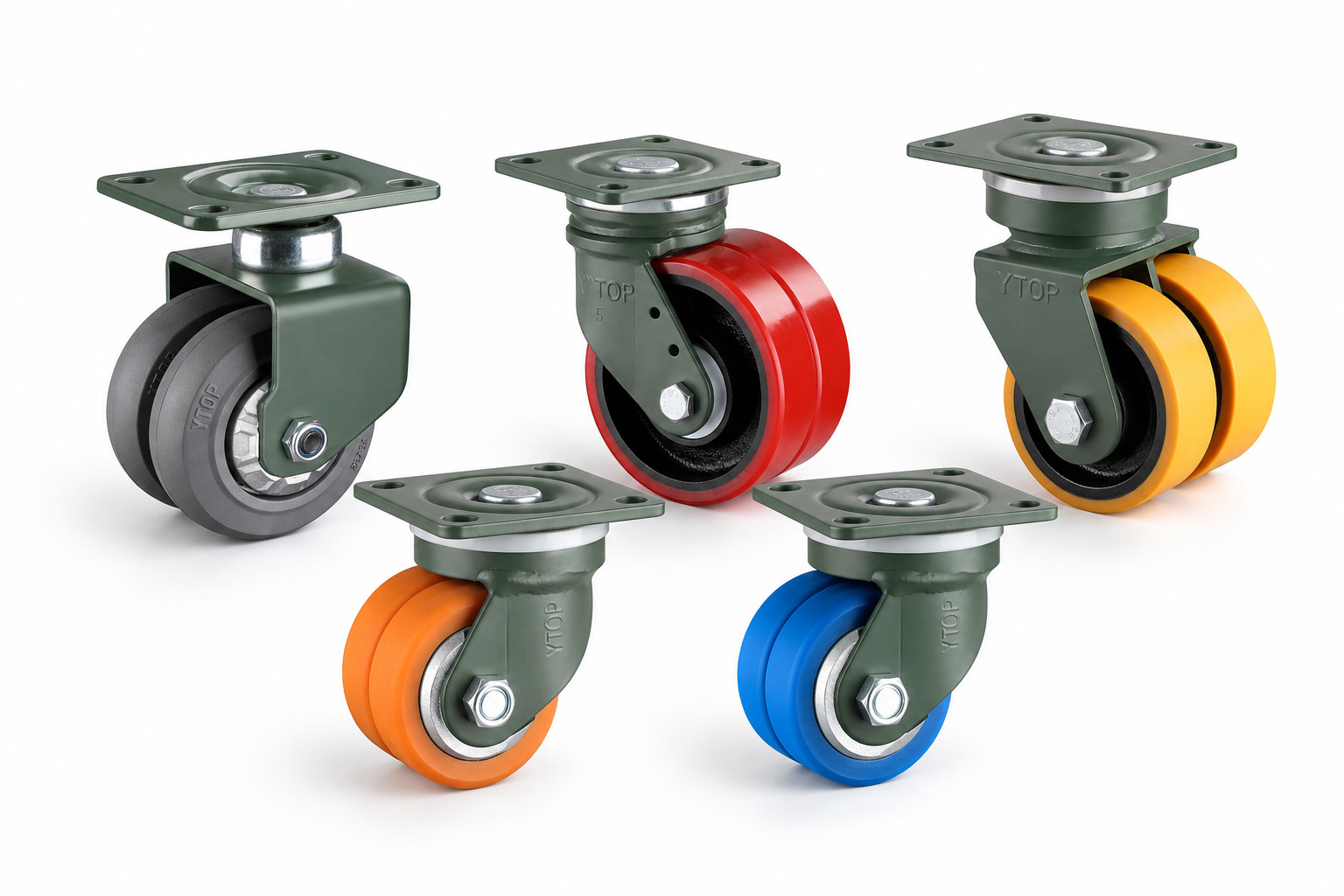
- Drive (active) wheels — connected to a motor and gearbox, these wheels propel the AGV. They carry the highest torque and are usually the largest diameter in the set. Differential-drive AGVs use two parallel drive wheels; tricycle layouts use one central drive/steer wheel.
- Follower (caster) wheels — passive swivel casters that stabilize the chassis and absorb load. They must swivel freely so they do not scrub sideways during turns, and they are usually smaller than the drive wheels.
- Omni / mecanum wheels — fitted with angled rollers around the circumference, these allow the AGV to translate sideways without turning the chassis. They are common in tight manufacturing cells and mixed fleets.
- Horizontal / transverse rollers — used on specialized omni-directional platforms to allow movement in any direction from a stationary start, often combined with traditional drive wheels.
Key Factors for Selecting AGV Casters
Choosing the wrong caster for an AGV is expensive — it undermines the automation investment the whole project depends on. Engineers usually evaluate the following parameters:
- Load per wheel — divide the worst-case loaded weight across the caster set, including a safety margin for acceleration and cornering forces.
- Speed and duty cycle — a wheel designed for intermittent use will fail quickly if asked to run 24/7.
- Floor condition — cracks, expansion joints, oil and debris all change traction and impact loading; some applications need a slightly larger wheel diameter to bridge gaps.
- Tire material and Shore hardness — harder compounds roll more efficiently but transmit noise; softer compounds grip better but wear faster. Match to the floor and the acoustic environment.
- Mounting interface — flange diameter, bolt pattern, hub bore and coupling must match the motor gearbox or existing chassis without custom adapters.
- Bearing sealing and IP rating — important in food, pharmaceutical and wet-cleanroom environments.
- Replaceability — on-site wheel change should be possible with standard tools; otherwise maintenance downtime erodes the ROI of the fleet.
Industry Application Examples
How these principles play out depends on the sector.
- Automotive manufacturing — heavy-load AGVs carry chassis sub-assemblies along the assembly line. They need super-heavy-duty PU drive wheels (often 700–1600 kg per wheel) and extremely high repeatability, because the AGV must dock with tooling to within a millimeter.
- Electronics warehousing — smaller, lighter AGVs move totes between shelving in cleanroom conditions. Medium-duty, electrically conductive PU wheels prevent static discharge that could damage components.
- E-commerce parcel sorting — high-throughput fleets run almost non-stop. Durability, low rolling resistance and quiet running matter more than peak load; wheel mileage becomes a scheduled maintenance metric.
- Hospital logistics — AGVs deliver meals, linen and medicines around the clock. Ultra-quiet non-marking tires are essential, and the casters must bridge elevator thresholds and ramp transitions without jolting fragile cargo.
Future Trends in AGV Caster Design
As fleets grow larger and navigation shifts from magnetic tape to natural-feel SLAM, the caster is being rethought as a sensor component, not just a wheel. Integrated load sensors can detect a dropped payload; internal encoders and even tire-compound monitoring can feed the fleet management system predictive-maintenance data. Energy efficiency also pushes wheel design: lower rolling resistance directly translates into fewer opportunity charges per shift, which is one of the biggest operating costs in a 24/7 depot. Meanwhile, Vulkollan-style high-performance polyurethanes and wider, flatter tread profiles are extending wheel life on polished concrete floors. The result is that AGV casters will keep converging with the vehicle’s mechatronic system — blurring the line between a mechanical component and an intelligent subsystem.
Frequently Asked Questions
Can I use ordinary heavy-duty casters on my AGV instead of AGV-specific wheels?
It is technically possible to roll, but not advisable. Ordinary casters lack the concentricity, sealed bearings and controlled tire wear that the AGV’s encoders and odometry rely on. You will quickly see drifting navigation, docking failures and much shorter wheel life. Specify an AGV-grade drive or follower wheel matched to your motor and load rating.
What load rating should an AGV caster have?
Calculate the maximum weight of the loaded vehicle (chassis + battery + payload + towing), then divide by the number of wheels and add a 20–30% safety margin for acceleration, cornering and uneven floors. Heavy-load automotive AGVs typically need heavy-duty (150–610 kg) or super-heavy-duty (700–1600 kg) wheels per corner, while light warehouse robots can use medium-duty or even light-duty casters as followers.
Why are AGV wheels usually made of polyurethane (PU)?
PU bonds well to a steel or aluminum hub, grips smooth concrete without leaving marks, runs quietly, resists oil and abrasion, and can be cast to very tight diameter tolerances. Hard rubber and nylon alternatives either mark the floor, wear too fast or lack the damping needed for sensitive payloads.
How often should AGV wheels be replaced?
It depends on mileage and load, but most AGV fleet managers treat wheels as a wear item inspected at scheduled service intervals and replaced as matched sets once the tread reaches the manufacturer’s minimum depth or the diameter drops beyond the encoder’s calibration tolerance. Mixing new and worn wheels reintroduces the odometry error problem.
What is the difference between an AGV and an AMU, and does it change the caster choice?
AMR (Autonomous Mobile Robot) is a newer term for a vehicle that navigates using natural features rather than fixed tape or wires. From the caster perspective, the requirements are almost identical — high precision, low noise, predictable wear and clean integration with drive motors. Whether you specify for an AGV or an AMR, use the same selection criteria.
Related Reading
To learn more about how casters are built, how to specify the right load rating and how locking and braking systems work, browse the following guides from our news center. If you are designing or retrofitting an AGV fleet, our engineers can help you size wheels correctly the first time.
- In-Depth Understanding of the Structure of Casters
- What Are the Common Caster Specifications?
- What Is a Universal Wheel and Where Is It Mainly Used?
- How Does the Locking Mechanism of a Caster Work?
- What Is a Floor Brake? Features and Application Scenarios
- Browse Heavy-Duty Casters (150–610 kg per wheel)
- Browse Super Heavy-Duty Casters (700–1600 kg per wheel)
- Contact Us for AGV Caster Selection Support
Post time: Oct-25-2023