
A universal wheel—more commonly known in industry as a swivel caster—is one of the most ubiquitous yet underappreciated components in modern logistics, manufacturing, healthcare, and everyday life. Unlike a fixed caster that only rolls forward and backward, a universal wheel can rotate a full 360 degrees around its vertical axis. This simple mechanical freedom allows trolleys, hospital beds, shopping carts, suitcases, and industrial equipment to turn on a dime, navigate narrow aisles, and be positioned with fingertip control.
In this guide, YTOP (卓烨锰钢脚轮) explains exactly what a universal wheel is, how it is constructed, where it is mainly used, and how to choose and maintain the right one for your application.
What Is a Universal Wheel?
Core Definition and Terminology
A universal wheel is a caster assembly equipped with a swivel mechanism that lets the wheel pivot freely around a vertical kingpin or ball-race axis while simultaneously rolling horizontally. The term “universal” refers to its ability to move in any direction—forward, backward, sideways, or diagonally—without the operator having to lift or re-angle the entire load.
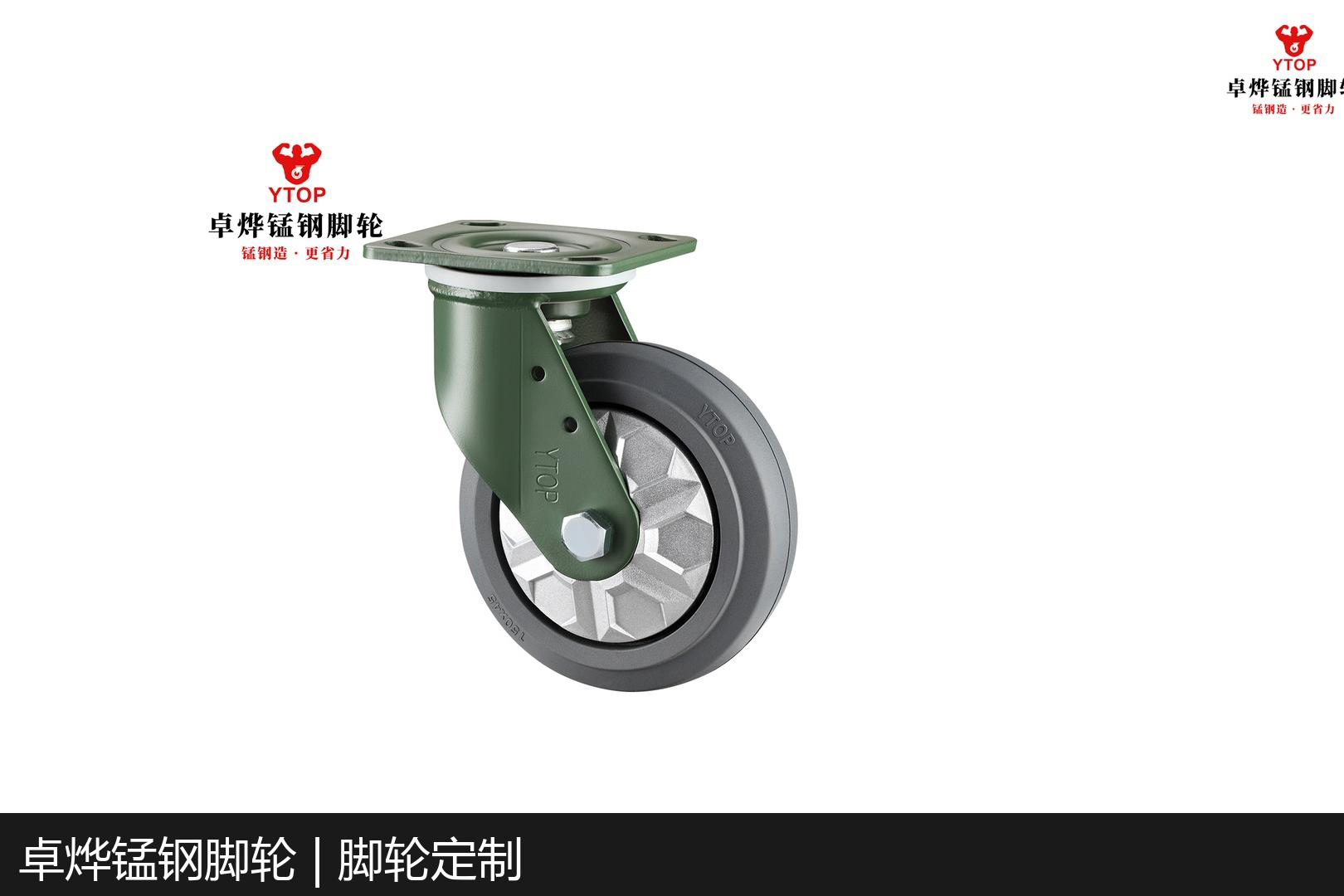
In technical literature, you will also see it called a swivel caster, 360-degree caster, or omnidirectional caster. In Chinese manufacturing circles, it is widely referred to as 万向轮 (wànxiànglún), literally the “all-direction wheel.”
How It Differs from a Rigid (Fixed) Caster
A rigid caster (定向轮) has a fork welded or bolted to the load, and the wheel can only roll along the straight line defined by the fork. A universal wheel adds a rotating raceway between the mounting plate and the fork. When the cart moves, the swivel joint naturally aligns the wheel with the direction of travel, giving the operator precise steering control. Most practical carts combine both: two rigid casters at the rear for tracking stability and two swivel casters at the front (or four swivel casters) for maneuverability.
Anatomy of a Universal Wheel
A well-built universal wheel is a precision assembly of several key components. Understanding each part helps when selecting, troubleshooting, or replacing casters.
Swivel Bracket and Mounting Interface
The upper bracket connects to the load via a top plate, a threaded stem, a grip-neck stem, a square stem, or a bolt-hole design. Heavy-duty brackets are typically pressed, welded, or forged from stamped steel; premium industrial versions use manganese steel (锰钢) for exceptional strength and impact resistance—the signature material behind YTOP’s heavy-duty caster line.
Ball Raceway (Swivel Bearing)
Beneath the top plate is the heart of the swivel action: a set of hardened steel balls running between upper and lower raceways (single-ball or double-ball construction). The double-ball design distributes load more evenly, resists side-thrust, and provides smoother rotation under heavy loads. Cheaper single-ball designs often develop play or stiffness after repeated use.
Wheel Tread and Wheel Bearing
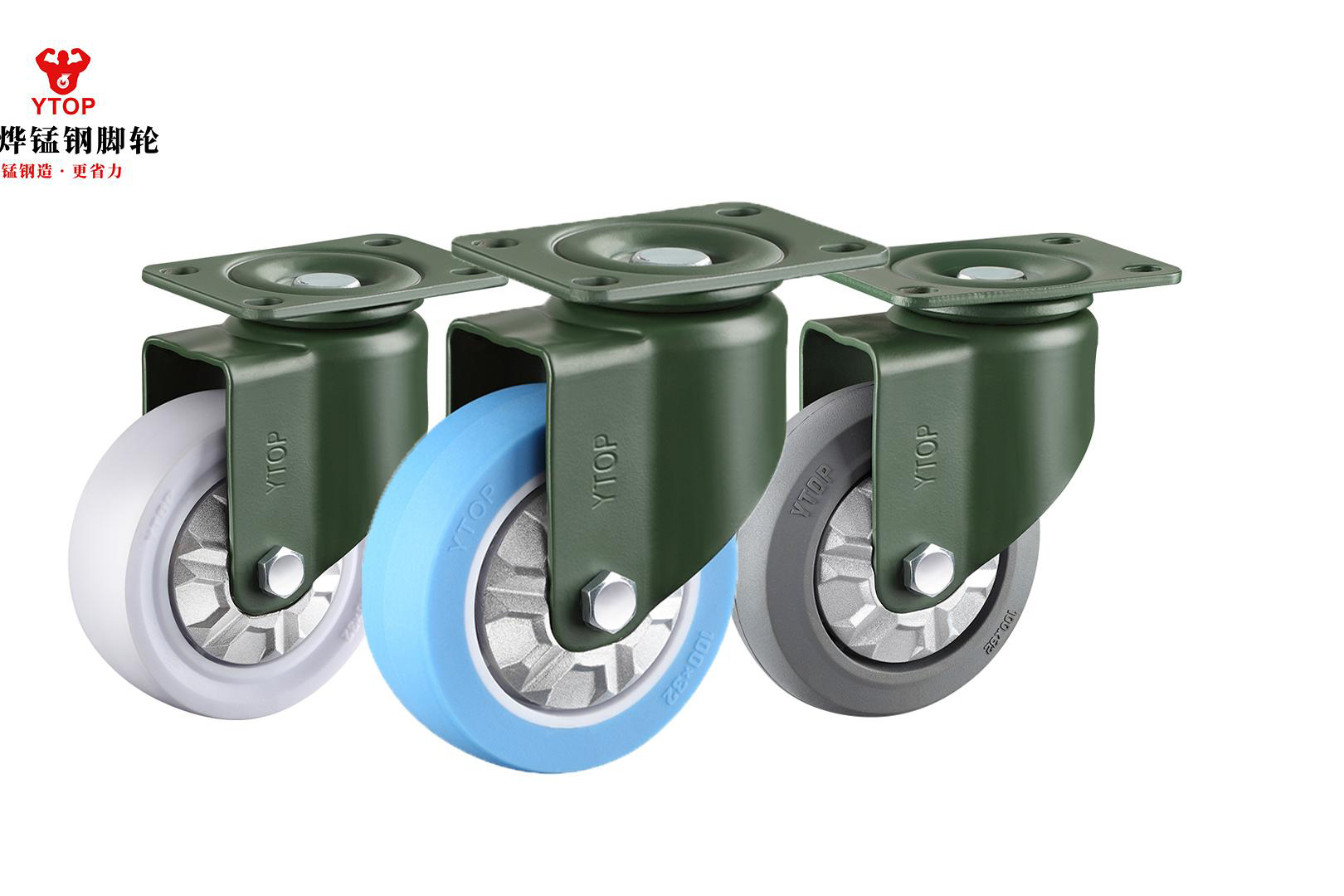
The wheel itself consists of a hub (plastic, cast iron, aluminum, or pressed steel) and a tread made of nylon (PA), polyurethane (PU), rubber (TPR/EPDM), cast iron, or phenolic resin. The tread determines floor protection, noise level, rolling resistance, and chemical resistance. Inside the wheel, an axle (bolted, riveted, or press-fit) passes through a ball bearing, roller bearing, or plain bore. Sealed double-shielded ball bearings are preferred for smooth, maintenance-light rolling.
How Does a Universal Wheel Work?
The Physics of 360-Degree Rotation
When you push a cart fitted with universal wheels, the wheel experiences a small sideways force at the contact patch. Because the swivel joint sits offset ahead of the axle (this offset is called the caster lead or trail), the sideways force creates a torque that automatically pivots the fork until the wheel aligns with the direction of motion. This self-aligning behavior is what makes the cart feel intuitive to steer—you do not have to actively “turn” the casters; they follow you.
The lead distance (typically 20–50 mm depending on wheel size) is a critical design trade-off. Too little lead and the wheel “chatters” or shimmies at speed; too much lead and steering becomes heavy and the cart feels sluggish.
Brake Options on Universal Wheels
Most universal wheels can be fitted with one of several braking systems:
- Total lock brake (dual brake): locks both wheel rotation and swivel, fixing the cart in place.
- Wheel brake (single brake): locks only the rolling motion, leaving the swivel free.
- Side brake / toe brake: a foot-operated lever on the bracket.
- Floor lock: a pedal that extends a metal pad to the ground, lifting the wheel slightly off the floor—popular for stationary workstations.
Universal Wheels vs. Rigid Casters: Key Differences
Choosing between swivel and rigid casters is one of the most common early decisions in material-handling design. The two are not substitutes; they complement each other.
- Direction control: a universal wheel rotates 360° and moves in any direction; a rigid caster only rolls along a single straight line.
- Maneuverability: universal wheels excel in tight aisles, elevators, and crowded rooms; rigid casters require wide turning radii.
- Stability under load: rigid casters track straight at speed; swivel casters feel slightly less stable on long runs.
- Best position on a cart: rigid casters are usually mounted at the rear for tracking; swivel casters at the front provide steering.
- Typical use cases: universal wheels on trolleys, equipment, and furniture; rigid casters on trailers, long racks, and dollies.
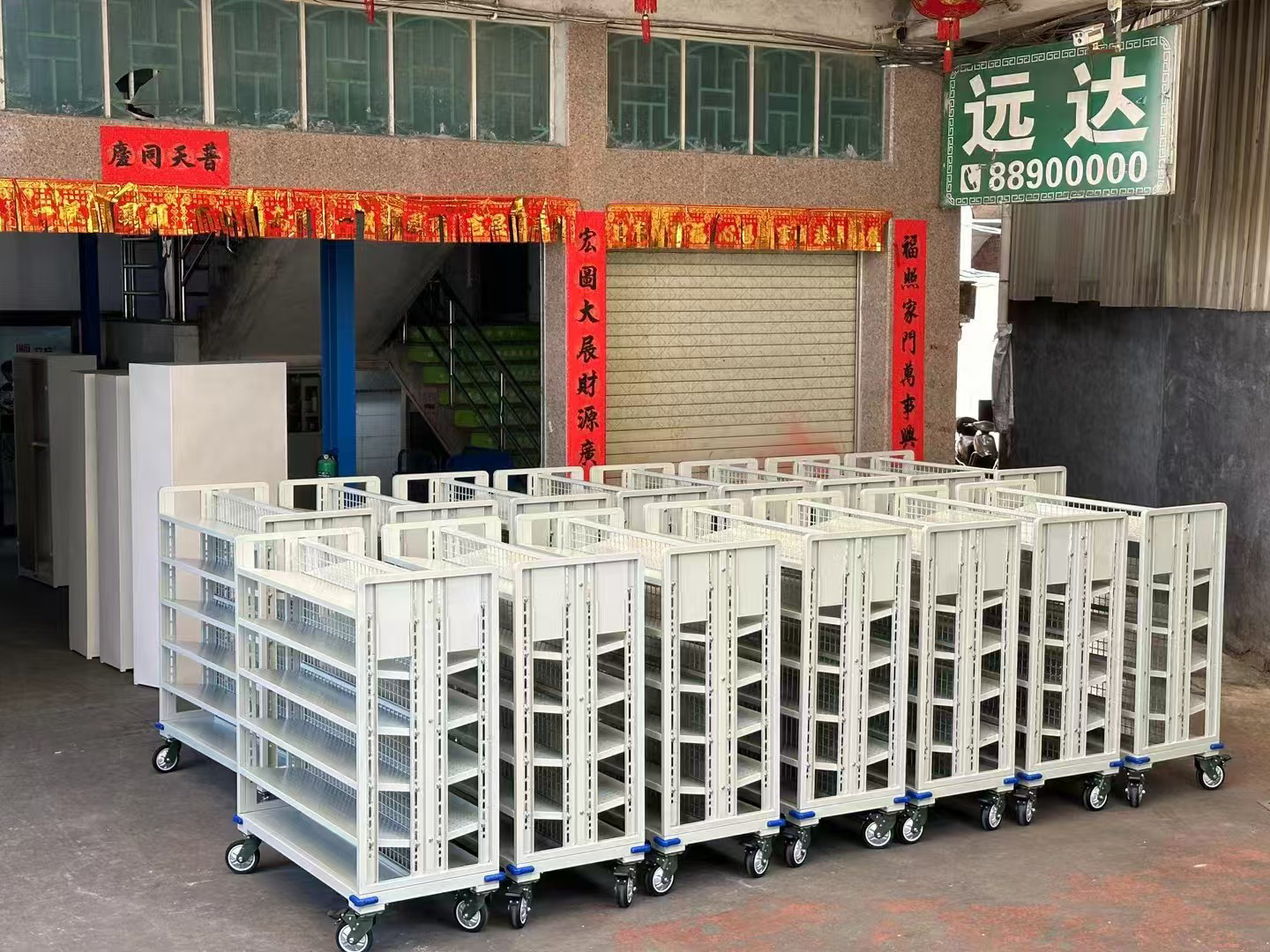
In practice, the most versatile configuration is two swivel casters (often with brakes) at one end and two rigid casters at the other—this gives directional stability at speed plus tight cornering. For very heavy or compact equipment, four swivel casters (often with a central tow bar) provide true omnidirectional movement.
Main Applications of Universal Wheels
Logistics Carts and Material Handling
Warehouse trolleys, picking carts, platform trucks, and distribution cages rely on universal wheels to negotiate narrow aisles, elevator lobbies, and loading docks. For loads above 500 kg, buyers typically specify heavy-duty casters (150–610 kg per wheel) or super heavy-duty casters (700–1600 kg per wheel) with forged manganese steel brackets and polyurethane treads for quiet, floor-friendly rolling.
Medical Equipment and Hospital Beds
Hospital beds, IV poles, instrument carts, and dialysis machines need ultra-smooth, quiet, non-marking casters that roll on tile and vinyl without vibration. Medium-duty polyurethane or TPR swivel casters with total-lock brakes are the standard; easy-to-clean, sealed housings are essential in clinical environments.
AGV Robots and Automated Guided Vehicles
Modern factory floors depend on AGVs and AMRs (autonomous mobile robots). These vehicles need AGV-specific casters with low rolling resistance, precise swivel geometry, conductive or antistatic tread options, and sealed bearings that can run 24/7 without relubrication. Many AGV swivel casters use precision tapered bearings and polyurethane-on-aluminum wheels to protect both the floor and the robot’s navigation sensors.
Supermarket Shopping Carts and Retail Displays
Shopping carts and luggage carts are the most visible everyday universal wheels. They typically use small (80–125 mm) light-duty PP or TPR swivel casters with simple brake-free construction, optimized for low cost, clean rolling on polished tile, and resistance to coffee spills and cleaning chemicals.
Luggage, Furniture, and Home Appliances
Rolling suitcases use double-wheel (dual-wheel) swivel casters that allow the bag to be pushed alongside you rather than tilted. Office chairs, TV stands, mobile cabinets, kitchen islands, and machine tool enclosures also use universal wheels—often light-duty casters (35–80 kg per wheel) with threaded stems for easy mounting and soft treads that protect hardwood floors.
How to Choose the Right Universal Wheel
Calculate the Load per Wheel
As a rule of thumb, divide the total load (cart weight + payload) by the number of casters, then add a 20–30% safety margin. For four casters on a cart, load per wheel = (cart weight + payload) ÷ 4. Match this figure to the caster’s rated capacity rather than rounding down.
Pick the Right Tread Material and Mounting Type
- Nylon (PA): hard, low rolling resistance, chemically resistant; ideal for dry warehouses but can mark polished floors.
- Polyurethane (PU): non-marking, quiet, high load capacity; the go-to choice for industrial floors.
- Rubber / TPR: softest, floor-friendly, quiet; lower capacity than PU.
- Cast iron / forged steel: for the heaviest loads on rough concrete.
For mounting, a top plate is most common for heavy industrial carts; threaded stems fit furniture and medical equipment; grip-neck stems are quick-release; bolt-hole stems suit retrofit applications. Add total-lock brakes whenever the cart will stop on inclines, carry fragile loads, or operate in crowded zones.
Maintenance Tips for Universal Wheels
A universal wheel that is properly maintained will deliver years of trouble-free service. YTOP recommends:
- Inspect monthly: check wheels for flat spots, hair or fiber wrap around the axle, and bracket play.
- Clean regularly: remove thread wrap and debris; wash with mild detergent, never with a high-pressure jet aimed directly at the bearing seals.
- Lubricate on schedule: use a quality multi-purpose or extreme-pressure grease. For heavy industrial casters, YTOP uses molybdenum disulfide (MoS₂) grease in sealed bearings to withstand high loads and shock.
- Tighten fasteners: check bolts and nuts at the plate and axle every quarter on heavy-use carts.
- Replace early: never run a caster with a cracked bracket, cracked wheel, or seized swivel—failure under load is a serious safety hazard.
Frequently Asked Questions
What is the difference between a universal wheel and a swivel caster?
There is no functional difference. “Universal wheel” is the common consumer and trade term; “swivel caster” is the formal engineering term. Both describe a caster that rotates 360° around a vertical axis.
How much weight can a universal wheel carry?
Capacity depends entirely on construction. Light-duty universal wheels handle 35–80 kg per wheel; medium-duty models handle 100–190 kg; heavy-duty casters handle 150–610 kg; and super heavy-duty casters reach 700–1600 kg per wheel. Always size with a 20–30% safety margin.
Why does my cart pull to one side when I push it?
This usually means one swivel caster is seized, has lost its lead offset, or has a flat spot on the wheel. Check that all casters rotate freely and that the swivel raceway is not contaminated with dirt.
Can universal wheels be used outdoors?
Yes, but choose UV-resistant rubber or polyurethane treads, stainless or zinc-plated brackets, and sealed bearings. Avoid bare nylon wheels outdoors, as they become brittle in cold weather.
How often should universal wheels be lubricated?
For light-duty indoor use, once a year is usually enough. For heavy-duty industrial, AGV, or washdown applications, follow the equipment maker’s schedule—typically every 6 months, or after every 500 hours of operation.
Related Reading
- What Is an AGV Caster? What Is the Difference Between It and Ordinary Casters?
- In-Depth Understanding of the Structure of Casters
- Classification of Casters by Different Criteria
- How Does the Locking Mechanism of a Caster Work?
- What Is a Floor Brake? Features and Application Scenarios
- Shop Heavy Duty Casters (150–610 kg)
- Shop Super Heavy Duty Casters (700–1600 kg)
- Contact YTOP for a Custom Caster Solution
Post time: Nov-06-2023