
Caster locking mechanisms are essential safety components that hold mobile equipment stationary when needed. From hospital beds and medical carts to industrial workstations and retail displays, reliable caster locks prevent unintended movement, protect workers, and ensure equipment stability during operation. Understanding how caster locking mechanisms work helps equipment designers select the right brake type for each application and helps end users operate and maintain casters safely. This comprehensive guide explains the major caster brake types, their working principles, advantages, limitations, and selection criteria.
How Caster Locking Mechanisms Work: Basic Principles
At their core, all caster locking mechanisms work by creating friction between a moving component and a stationary surface. When engaged, the brake applies pressure to either the wheel tread, the swivel raceway, or both, converting kinetic energy into heat through friction. The holding power depends on the contact surface area, the force applied, and the coefficient of friction between the brake pad and the wheel or swivel surface.
Modern caster brakes use mechanical leverage systems that amplify foot pedal force into substantial clamping force on the wheel or swivel. A typical total-lock brake can apply hundreds of newtons of clamping force with minimal foot pressure, thanks to lever mechanics and hardened steel brake pads.
Friction-Based Braking Systems
The most common caster brake designs use friction pads pressed against the wheel tread or sidewall. When the foot pedal is depressed, a linkage mechanism pushes a brake pad firmly against the rotating wheel surface. The coefficient of friction between the brake pad material (usually phenolic resin or hard nylon) and the wheel tread determines holding power. Different wheel materials require different brake pad formulations for optimal performance and wear resistance.

Types of Caster Locking Mechanisms
Caster brakes come in several distinct types, each designed for specific locking functions and application requirements. Choosing the right type ensures both mobility and safety.
Wheel Brakes (Thread Locks)
Wheel brakes—the most common type—lock the wheel rotation but allow the caster to still swivel. When engaged, a brake pad presses against the wheel tread, preventing rolling. However, the equipment can still rotate around the swivel axis, which may allow gradual movement on sloped floors. Wheel brakes are ideal for flat floors where preventing rolling is the primary concern, and minor swivel movement is acceptable.
Swivel Locks (Kingpin Locks)
Swivel locks freeze the swivel rotation, forcing the caster to roll in a fixed direction, but allow the wheel to continue rotating freely. This is useful when equipment needs to travel in a straight line without wandering, but still must roll smoothly. Swivel locks are common on long carts and trailers where directional stability during movement is important.
Total Lock Brakes (Dual Locks)
Total lock brakes are the most secure option, locking both the wheel rotation and the swivel simultaneously. When engaged, the caster is completely immobilized—neither rolling nor swiveling. This provides maximum stability and is the standard choice for medical equipment, workstations, and any application where the equipment must remain perfectly stationary during use. Total locks engage with a single foot pedal action, making them easy to operate despite their dual function.
Face Contact Brakes
Face contact brakes apply friction to the side face of the wheel rather than the tread. This design provides excellent holding power without wearing the tread surface, extending both brake and wheel life. Face contact brakes are often found on heavy-duty casters where consistent, long-lasting braking performance is required.
Key Advantages of Quality Caster Locking Mechanisms
Reliable caster locks offer significant benefits across all mobile equipment applications.
Enhanced Worker Safety
The primary advantage of caster brakes is safety. Uncontrolled equipment movement can cause workplace accidents, damage inventory, or injure bystanders. Properly functioning brakes ensure equipment stays where it is placed—critical on sloped floors, near operating machinery, and in patient care settings. Total lock brakes are particularly important for medical and laboratory equipment where even slight movement can compromise procedures.
Improved Equipment Stability During Use
Many types of mobile equipment double as work surfaces: rolling tool chests become workbenches, mobile medical carts become treatment stations, and rolling carts become packing stations. Without brakes, applying force to the equipment causes it to roll away. Locked casters provide a stable, stationary platform for these tasks, improving both productivity and safety.
Reduced Equipment and Product Damage
When equipment rolls unexpectedly, it can collide with walls, machinery, or other equipment. Loaded carts can tip over, spilling contents and causing damage. Proper caster brakes prevent these incidents, protecting both equipment and inventory. The cost of quality brakes is negligible compared to the potential cost of a single accident.
Potential Drawbacks and Maintenance Considerations
While caster brakes are essential, they do add complexity and require proper maintenance to function reliably.
Brake Wear and Degradation
Brake pads wear over time, especially in high-frequency use. Worn brakes lose holding power and may not hold equipment securely on slopes. Regular inspection of brake pad thickness and engagement feel is important. On average, brake pads last 1-3 years in normal industrial use, and replacement is straightforward with most modern caster designs.
Environmental Factors
Dust, debris, moisture, and chemicals can affect brake performance. Dirt buildup on brake pads reduces friction and holding power. In outdoor or washdown environments, sealed brake mechanisms or stainless steel casters are recommended. In food processing or pharmaceutical environments, brakes must withstand frequent cleaning and sanitization.

Selecting the Right Brake Type
Choose the brake type based on your application requirements:
- Flat floor, occasional use: Wheel brake (simple, cost-effective)
- Medical/lab equipment, patient care: Total lock brake (maximum stability)
- Long carts, straight-line travel: Swivel lock (directional control)
- Heavy-duty industrial, long service life: Face contact brake (durable, tread-friendly)
- Outdoor/sloped surfaces: Total lock with high-friction pads
Frequently Asked Questions
What is the difference between a wheel brake and a total lock?
A wheel brake locks only the wheel rotation, preventing rolling but still allowing the caster to swivel and move sideways. A total lock (also called dual lock) locks both the wheel rotation and the swivel, completely immobilizing the caster in all directions. Total locks are essential for medical equipment, workstations, and sloped floors where complete stability is required.
How much weight can a caster brake hold?
Caster brake holding power is typically rated at 15-25% of the caster’s static load capacity. For example, a caster rated for 500 kg static load might hold 75-125 kg on a slope. Always verify with the manufacturer’s specifications. On level floors, brakes hold far more than the rated holding capacity—this rating is designed for safety on inclined surfaces.
Why does my caster brake feel loose or not hold well?
Common causes include: worn brake pads, dirt or debris on the braking surface, misadjusted brake linkage, or using the wrong brake type for your application. Inspect the brake pad thickness—replace if worn below the manufacturer’s minimum. Clean the braking surface. On adjustable brake designs, follow the manufacturer’s adjustment procedure. If the caster is on a slope, ensure you’re using total lock brakes.
Can I add brakes to casters that don’t have them?
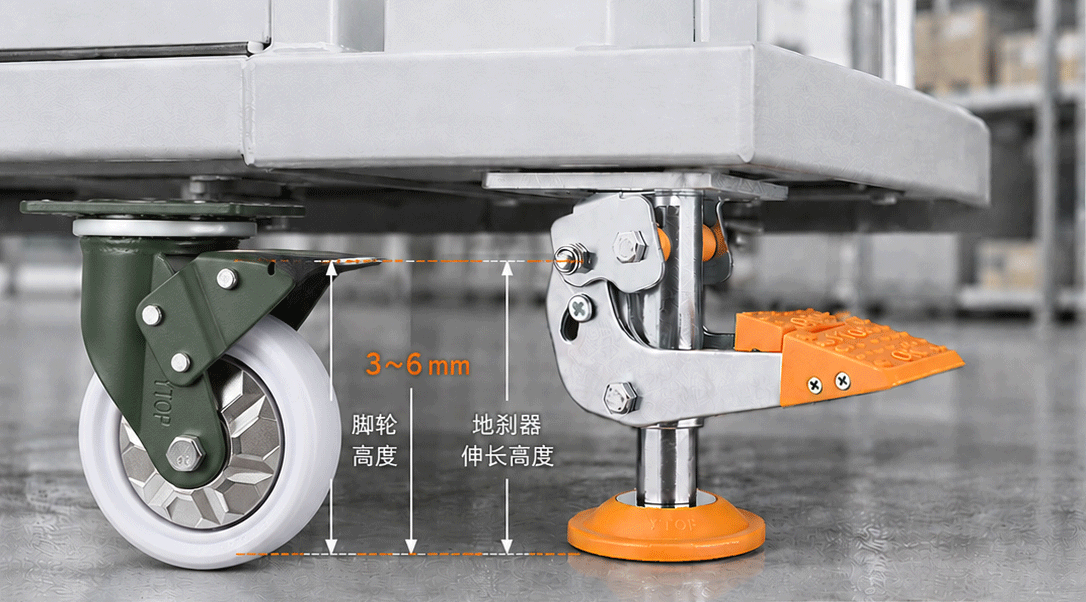
Most caster models offer brake and non-brake versions using the same mounting pattern. If your current casters have a compatible mounting size, you can replace them with the braked version. However, not every caster model has a brake option. When replacing, ensure the new caster has identical installation height and load rating as the original.
How do I maintain caster brakes?
Keep brake surfaces clean and free of grease, oil, and debris. Inspect brake pad wear quarterly in heavy-use applications. Test brake holding force monthly—try pushing the locked equipment to verify it holds. Lubricate pedal linkages lightly with dry lubricant. Replace worn brake pads promptly. With proper maintenance, caster brakes remain reliable for the life of the caster assembly.
Related Reading
Learn more about caster technology and selection:
- Caster Diameter Impact — How wheel size affects caster performance.
- Caster Width Performance — Wheel width and load capacity relationship.
- Caster Structure Guide — Understanding caster structural parameters.
- Installation Height Guide — Proper caster mounting height details.
- Casters for Mobile Equipment — Selection guide for all mobile equipment types.
Explore our medium-duty casters and heavy-duty casters with total-lock brake options, or contact our team for brake selection assistance.
Post time: May-27-2025