
Do you know what to look for when installing casters? Do you install the height of the caster? In the selection of casters, to determine the specifications of the casters, the correct installation of casters is also very important, not only to ensure the flexibility of the casters operation, improve operational efficiency; can also extend the service life of the casters, the following for you to introduce the correct installation of casters of the matters to be aware of:
Understanding Caster Installation Height
What Is Caster Installation Height?
Caster installation height, is the caster in use, after the installation of casters in the height of the ground. The total height of the flat universal wheel or directional wheel is the installation height of the casters, the measurement method is the straight line distance from the flat plate to the bottom of the wheel.
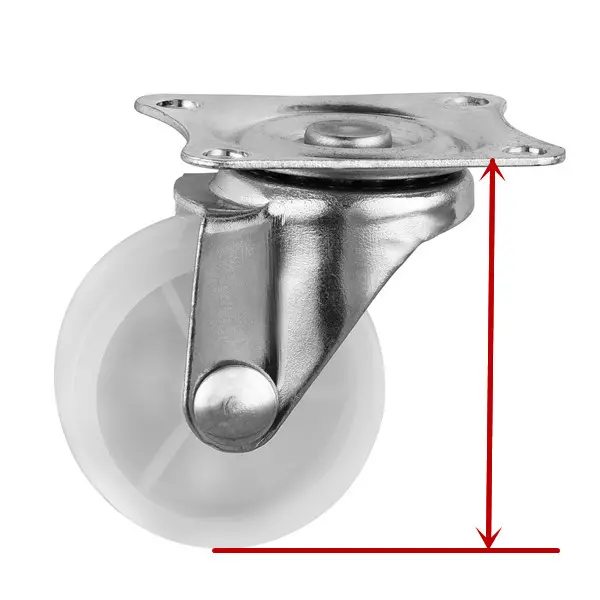
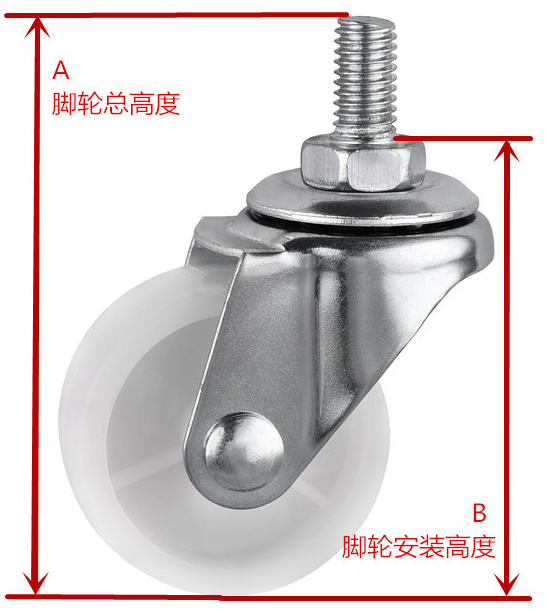
Total Height vs. Mounting Height for Screw Casters
The total height and mounting height of a screw caster or a screw caster with brake represent 2 dimensions, as shown below: A represents the total height of the caster, and B represents the mounting height of the caster.
Important Installation Precautions
Mounting Surface Preparation
Installation Notes: 1, caster installation, to keep in the horizontal state for installation, 2, universal caster, to keep the swivel axis in the vertical state for installation 3, after confirming that the connection parts are fixed, select the appropriate size screws, nuts, spacers, etc., inserted into the mounting holes, tighten the casters until there is no gap, so as to avoid loosening. In particular, when screwing in the installation, please tighten the hexagonal part with appropriate torque. Avoid excessive screwing in and cause the rotating shaft to expand, causing breakage. 4, brake casters in the installation, please avoid the brake in the state of operation to screw the installation, because that will cause damage to the brake deformation, and performance deterioration. 5, directional wheel and universal wheel to choose the same specifications of the product, so that the degree of match is higher, the degree of coordination of the operation is better. After the installation of casters, try to ensure the stability and flexibility of each caster, everything is fine, you can rest assured that the operation.
How Caster Installation Height Affects Equipment Performance
The installation height of casters directly influences how mobile equipment performs in real-world use. Equipment that sits too high becomes top-heavy, raising the center of gravity and increasing tipping risk. Equipment that sits too low may not clear floor obstacles, door thresholds, or uneven surfaces. Understanding this relationship is essential for equipment designers and facility planners.
Center of Gravity and Stability
Each additional inch of caster installation height raises the equipment’s center of gravity by the same amount. For loads approaching the caster’s rated capacity, even a small height increase can significantly reduce lateral stability. This is especially critical for tall, narrow equipment like shelving units, display racks, and tall cabinets. When designing mobile equipment, always verify the center of gravity remains within the base footprint even at maximum load and full extension.
Clearance and Floor Obstacle Clearance
Installation height must be sufficient to clear common floor obstacles including expansion joints, door thresholds, carpet transitions, and minor debris. A general rule is that wheel diameter should be at least 1.5 times the height of the largest expected obstacle. For industrial environments with rough floors, consider larger diameter wheels that provide greater obstacle clearance without requiring excessively tall caster mounts.
Mounting Type and Its Impact on Installation Height
Different caster mounting types produce different installation heights even with the same wheel diameter. Selecting the right mounting type balances equipment height, load distribution, and installation convenience.
Plate-Mount Casters
Plate-mount casters distribute load across a wider mounting surface, making them ideal for heavy-duty applications. However, they typically add the most to overall installation height due to the mounting plate, stamped housing, and fork assembly. For applications where height is critical, compare competing caster models with the same wheel diameter—installation height can vary by 10-20 mm between manufacturers.
Stem-Mount Casters
Stem-mount casters (grip neck, expanding, threaded stems) reduce installation height compared to plate mounts, making them popular for office furniture, medical equipment, and retail displays. However, they have lower load capacities and are susceptible to loosening under heavy use. Always verify stem grip length and engagement depth before use in dynamic applications.
Low-Profile Casters
When installation height is the primary constraint, low-profile casters are specifically designed to minimize overall height while maintaining reasonable load capacity. These use smaller diameter wheels with wide tread faces and reinforced brackets. Typical low-profile caster heights range from 50-90 mm with load capacities of 150-500 kg per caster—ideal for equipment where floor clearance is limited.
Installation Height Calculation and Verification
Proper installation height selection involves more than just picking a wheel diameter. Engineers must account for the entire caster assembly including mounting plate, fork, wheel bore, and any brackets or adapters.
Standard Height Formulas
For plate-mount casters: Installation height = wheel radius + fork height + mounting plate thickness + any adapter thickness. Always refer to the manufacturer’s dimension drawing—estimated values can be off by several millimeters, which matters for equipment that must fit under counters or through tight spaces.
Load Deflection Considerations
Under load, both the wheel and the mounting structure deflect slightly, reducing actual installation height. For polyurethane wheels under heavy load, this compression can be 2-5% of wheel diameter. Account for this deflection when designing equipment that requires exact floor clearance or level surfaces across multiple caster stations.
Frequently Asked Questions
What is the standard caster installation height for industrial carts?
Industrial cart caster installation heights typically range from 100 mm to 250 mm depending on load capacity and wheel diameter. Standard 4-inch (100 mm) casters have installation heights of approximately 125-135 mm. 6-inch (150 mm) casters install at 190-200 mm. Always check manufacturer specifications—height varies by bracket design and mounting type.
Can I mix different height casters on the same piece of equipment?
No. Mixing caster heights causes the equipment to sit unevenly, resulting in uneven load distribution that can overload shorter casters and cause premature failure. If different swivel/rigid configurations are needed, ensure all casters have identical installation heights. When replacing worn casters, always use the exact same height specification.
How does caster installation height affect pushing force?
Generally, larger diameter wheels (which mean taller installation height) require less pushing force because they roll more easily over minor surface irregularities. The relationship between wheel diameter and rolling resistance is inverse—larger wheels roll easier. However, taller equipment also has a higher center of gravity, which can make it feel less stable when pushed at speed.
What should I check before installing new casters?
Verify mounting hole pattern matches the equipment, confirm all casters have identical installation height, check that load ratings exceed the distributed load (with safety margin), inspect the mounting surface for flatness and structural integrity, and ensure appropriate brake configuration. Tighten mounting hardware to manufacturer torque specifications, and re-torque after the first week of use.
Are there height-adjustable caster options?
Yes, adjustable leveling casters combine caster mobility with adjustable height for leveling on uneven surfaces. These are commonly used for machinery stands, workbenches, and industrial equipment where both mobility and precise leveling are needed. Adjustment ranges typically span 10-50 mm, allowing equipment to be leveled on uneven factory floors.
Related Reading
Looking for more in-depth caster guides and industrial mobility resources? Explore these related articles:
- Foma Installation — Installation of Foma casters in aluminum profiles.
- Install Process — Caster structure and industrial installation process.
- Main Components — What are the main components of a caster?
- Installation Height — Caster installation height details and precautions.
- Casters Buying Guide — Find the right wheel for your needs.
Explore our complete range of heavy-duty casters (150-610kg) and super heavy-duty casters (700-1600kg), or contact our engineering team for expert guidance.

Related Reading
Explore more caster installation and selection guides:
- Heavy-Duty Casters Selection Guide — Learn how to select casters with the correct installation height.
- Extra Heavy Duty Casters: Full Analysis — In-depth look at heavy-duty caster installation dimensions.
- Caster Load Capacity Calculation — Learn how load capacity affects installation height requirements.
- Industrial Caster Load Grading Guide — Understand load classifications and installation height standards.
- Caster Maintenance Tips — Learn how proper installation extends caster lifespan.
Explore our complete range of heavy-duty casters (150-610kg) and medium-duty casters (100-190kg) with detailed installation specifications, or contact our engineering team for expert installation height guidance.
Post time: Nov-20-2024