
For many manufacturing enterprises, because the warehouse often have to pick up the product, this situation requires a lot of manpower to operate, so how to reduce the labor costs in this area has become the first issue that enterprises need to consider. So there is the birth of the AGV car, AGV car can effectively solve the problem of manual handling, reduce labor costs, and improve operational efficiency. However, what many people may not realize is that AGV trolleys cannot function properly without the right types of casters. In fact, AGV trolleys rely on two primary types of casters to move efficiently, safely, and reliably: drive wheels and follower (swivel) casters. This article explores these two essential caster types, their roles, characteristics, and why AGV trolleys cannot do without them.
Introduction to AGV Trolley Casters
AGV (Automated Guided Vehicle) trolleys are sophisticated automated material handling systems that transport goods, materials, and products within warehouses, manufacturing facilities, and distribution centers without the need for human operators. While the navigation system, control software, and drive motors are often considered the most important components of an AGV trolley, the casters (wheels) are equally critical, as they are the interface between the vehicle and the floor and directly determine how well the vehicle moves, carries loads, and navigates its environment. Without the right types of casters, an AGV trolley cannot function properly, regardless of how advanced its navigation and control systems may be.
AGV trolleys typically use two primary types of casters to achieve the combination of powered movement and flexible maneuverability that is essential for their operation: drive wheels and follower (swivel) casters. Drive wheels are the powered wheels that propel the AGV trolley forward, backward, and (in some configurations) steer it, while follower casters are the non-powered, swiveling wheels that support the vehicle’s weight and allow it to change direction smoothly. The combination of these two caster types creates a stable, maneuverable platform that can carry heavy loads, navigate complex facility layouts, and position itself accurately. This article examines these two essential caster types in detail, explaining their roles, characteristics, advantages, and why AGV trolleys cannot do without either of them.
The First Essential Caster Type: Drive Wheels
Drive wheels are the first essential caster type for AGV trolleys, serving as the powered wheels that propel the vehicle and enable it to move under its own power. Unlike follower casters, which are passive and simply roll as the vehicle moves, drive wheels are actively powered by electric motors (typically DC servo motors or stepper motors) and are responsible for accelerating, decelerating, and (in differential drive configurations) steering the AGV trolley. Drive wheels are typically positioned near the center of the vehicle (in differential drive configurations) or at one or both ends (in other configurations), and they are designed to provide good traction, high load capacity, and reliable performance over long service lives.
The key characteristics of AGV drive wheels include high traction, which is essential for reliable acceleration and deceleration, particularly when carrying heavy loads or operating on potentially slippery floor surfaces; low rolling resistance, which reduces energy consumption and extends battery life; high load capacity, to support the weight of the vehicle and its cargo; excellent durability and wear resistance, to withstand the stresses of continuous use and frequent starts and stops; and precise speed and torque control, which is essential for accurate navigation and positioning. Drive wheels are typically made with a polyurethane (PU) tread bonded to a steel, cast iron, or aluminum core, as polyurethane offers an excellent balance of traction, wear resistance, low rolling resistance, and durability that makes it ideal for AGV drive wheel applications. The drive wheels are controlled by the AGV’s control system, which precisely regulates their speed and torque to achieve the desired movement, navigation, and positioning. Without drive wheels, an AGV trolley would have no means of self-propulsion and would simply be a passive cart that requires external force to move, defeating the purpose of automation. Drive wheels are therefore the first and most fundamental essential caster type for AGV trolleys.
The Second Essential Caster Type: Follower (Swivel) Casters
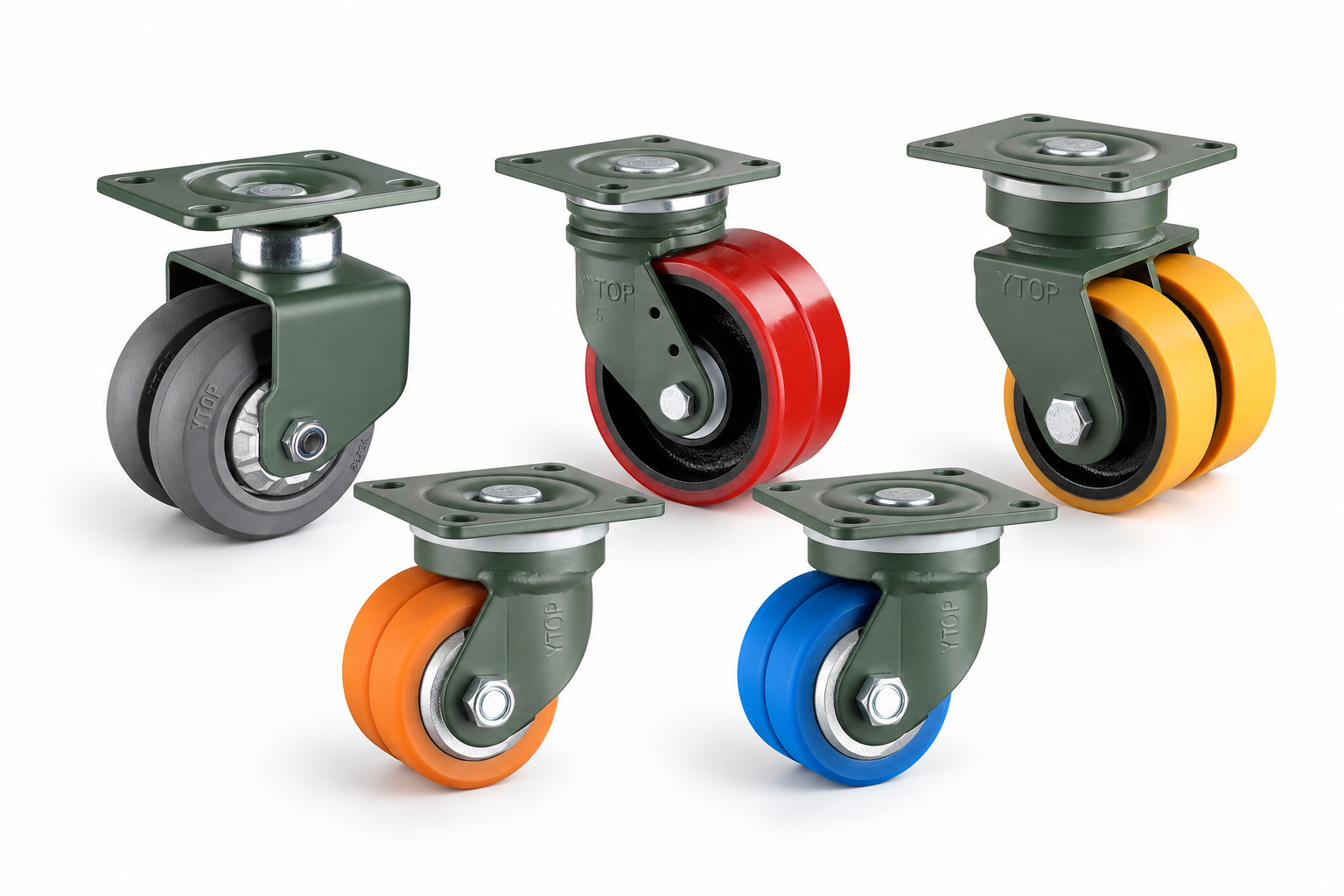
Follower casters, also known as trailing wheels or swivel casters, are the second essential caster type for AGV trolleys, providing stable support and enabling smooth, flexible movement alongside the powered drive wheels. Unlike drive wheels, which are actively powered, follower casters are passive components that simply rotate as the vehicle moves, providing support and allowing the vehicle to change direction smoothly. Follower casters are typically configured as swivel casters, meaning they can rotate 360 degrees around a vertical axis, which allows the wheel to align itself with the direction of travel automatically. This swivel capability is essential for enabling the AGV trolley to change direction smoothly, turn in tight spaces, and navigate complex facility layouts without the wheels dragging or skidding.
The key characteristics of AGV follower casters include high load capacity, to support a significant portion of the vehicle’s total weight (in many configurations, the follower casters carry more weight than the drive wheels); smooth, consistent swiveling action, with minimal play or binding, to ensure accurate tracking and smooth turns; low rolling resistance, to minimize energy consumption and extend battery life; excellent durability and wear resistance, for long service life with minimal maintenance; quiet operation, to create a comfortable working environment; and non-marking properties, to protect floor surfaces. Follower casters are typically made with a polyurethane (PU) or nylon tread on a steel, cast iron, or aluminum core, with a precision swivel bearing assembly that allows smooth 360-degree rotation. The swivel geometry, including the swivel offset (the distance between the vertical swivel axis and the wheel’s contact point with the floor), is carefully optimized to ensure smooth, consistent swiveling action and stable tracking. Without follower casters, an AGV trolley would be supported only by its drive wheels, which would create an unstable platform that is prone to tipping, has limited load capacity, and cannot change direction smoothly (in differential drive configurations, the vehicle would pivot on its drive wheels, but would lack the stable support and smooth movement provided by follower casters). Follower casters are therefore the second essential caster type for AGV trolleys, providing the stability, support, and maneuverability that drive wheels alone cannot offer.
How Drive Wheels and Follower Casters Work Together
The true magic of AGV trolley mobility lies in how drive wheels and follower casters work together to create a stable, maneuverable, and efficient platform. In the most common AGV configuration, known as differential drive, two drive wheels are positioned near the center of the vehicle, on opposite sides, and two or more follower casters are positioned at the corners or ends of the vehicle. The drive wheels are powered independently, meaning each wheel can be controlled separately in terms of speed and direction. By varying the speed and direction of the two drive wheels, the AGV control system can achieve different types of movement: when both drive wheels move at the same speed in the same direction, the vehicle moves straight forward or backward; when one wheel moves faster than the other, the vehicle turns in an arc; when the wheels move in opposite directions at the same speed, the vehicle rotates in place (zero-radius turning). The follower casters, with their 360-degree swivel capability, automatically align themselves with the direction of travel, allowing the vehicle to change direction smoothly without dragging or skidding.
This combination of independently controlled drive wheels and freely swiveling follower casters creates a platform that is both stable and highly maneuverable. The follower casters provide multiple points of support that distribute the vehicle’s weight evenly, prevent tipping, and maintain stability during turns and stops. The drive wheels provide the powered movement and precise control that enable automation. Together, they allow the AGV trolley to carry heavy loads, navigate complex facility layouts, turn in tight spaces, and position itself accurately. The interaction between the drive wheels and follower casters is carefully managed by the AGV’s control system, which uses feedback from encoders, sensors, and navigation systems to precisely regulate wheel speeds and ensure smooth, accurate movement. This coordinated operation is what makes AGV trolleys such effective and versatile material handling tools, and it would not be possible without both types of casters working in harmony.
Material Selection for AGV Casters
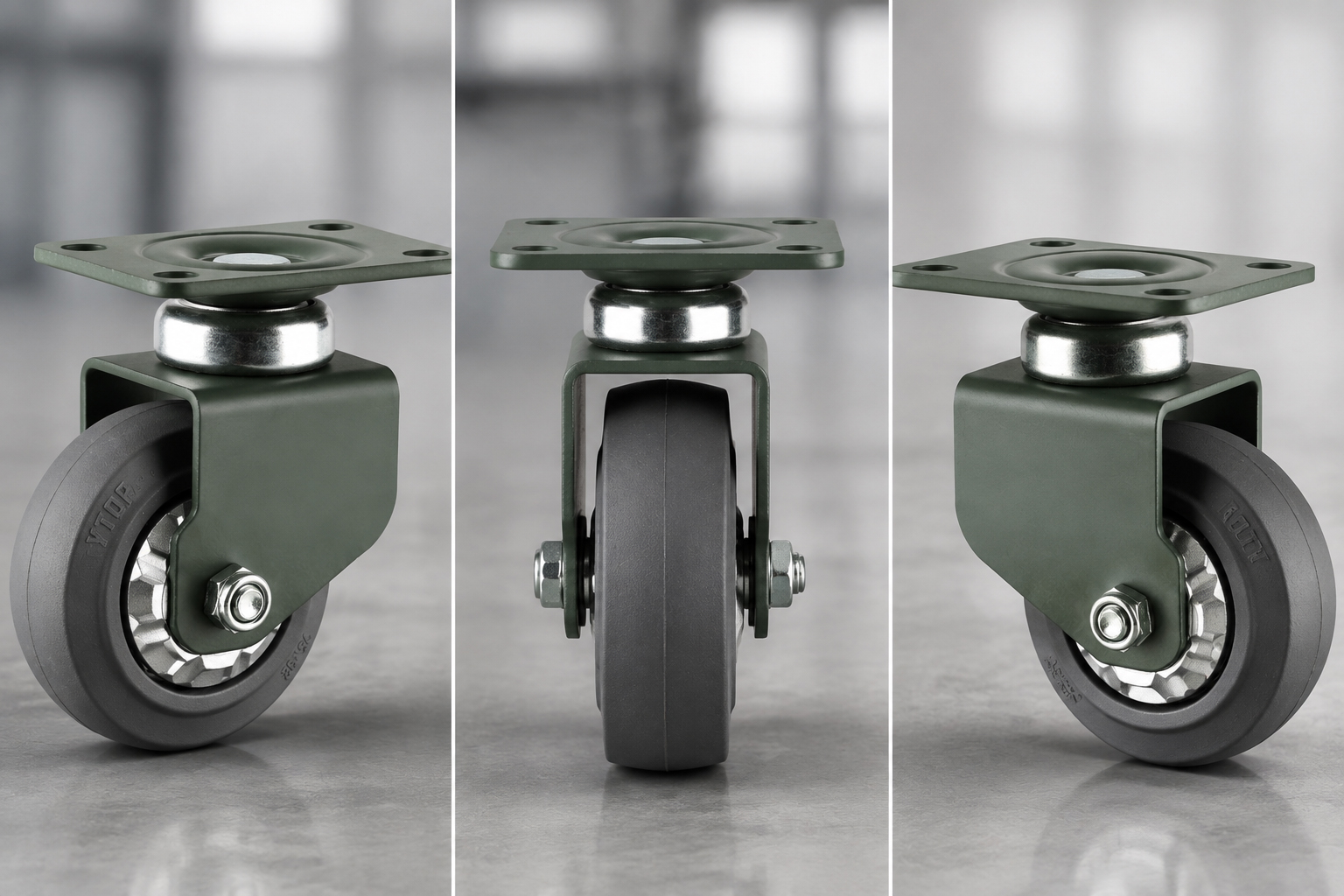
Material selection is a critical decision for both drive wheels and follower casters, as the wheel material directly affects traction, rolling resistance, wear resistance, noise level, floor protection, load capacity, and overall performance. For the vast majority of AGV applications, polyurethane (PU) is the preferred tread material for both drive wheels and follower casters, offering an excellent balance of performance characteristics that makes it ideal for AGV use. Polyurethane can be formulated across a range of hardness levels (durometer), allowing wheel manufacturers to tailor the properties to specific application requirements: softer PU grades offer better traction, noise reduction, and floor protection, while harder grades offer higher load capacity and lower rolling resistance. For AGV drive wheels, a medium-hard polyurethane (typically 90-95 Shore A) is often used to balance traction with wear resistance and rolling resistance, while for follower casters, a slightly softer grade (typically 85-90 Shore A) may be used for enhanced noise reduction and floor protection.
Nylon is another common material for AGV follower casters, particularly for heavy-duty applications where load capacity and durability are top priorities. Nylon offers high load capacity, excellent wear resistance, low rolling resistance, and good chemical resistance, but it is generally noisier and less floor-protective than polyurethane, and it provides less shock absorption. Nylon follower casters are suitable for heavy-duty AGV applications where noise and floor protection are not significant concerns and where maximum load capacity and durability are required. Rubber is occasionally used for AGV casters in specific applications where noise reduction, shock absorption, or traction are the primary concerns, but rubber has lower load capacity, higher rolling resistance, poorer wear resistance, and is susceptible to damage from oils and chemicals, making it less suitable for most AGV applications. Steel or cast iron wheels are used only in extremely heavy-duty AGV applications where maximum load capacity is required and where noise and floor damage are acceptable. For the wheel core (the structural component beneath the tread), common materials include steel (for maximum strength and load capacity), cast iron (for good strength and cost-effectiveness), and aluminum (for lightweight applications). The core material should be selected based on load requirements, environmental conditions, weight considerations, and cost. By carefully selecting the appropriate tread and core materials for both drive wheels and follower casters, AGV designers can ensure optimal performance, durability, and reliability for their specific application requirements.
Common AGV Caster Configurations
While the differential drive configuration with two drive wheels and two follower casters is the most common AGV caster arrangement, there are several other configurations used in specific AGV applications, each with its own advantages and suitable use cases. The differential drive configuration, as described earlier, uses two independently controlled drive wheels positioned near the center of the vehicle, with two or more follower casters at the corners or ends. This configuration offers excellent maneuverability (including zero-radius turning), good load capacity, and relatively simple control, making it the most popular choice for general-purpose AGV trolleys. The primary limitation of differential drive is that the vehicle cannot move directly sideways (it must rotate to change direction), which can be a limitation in very confined spaces.
Another common configuration is the tricycle drive, which uses one powered, steerable drive wheel at the front of the vehicle and two follower casters at the rear. This configuration is simpler and less expensive than differential drive, but it has a larger turning radius and lower maneuverability, and it is generally suitable for simpler, more predictable AGV applications such as towing or fixed-path transport. A third configuration is the four-wheel drive, which uses four powered wheels (either all steerable or in a differential arrangement), offering maximum traction, load capacity, and maneuverability, but at the cost of increased complexity, weight, and expense. Four-wheel drive is typically used in heavy-duty or outdoor AGV applications where maximum traction and capability are required. A fourth configuration is the omnidirectional drive, which uses special wheels such as Mecanum wheels or omni wheels to enable movement in any direction, including directly sideways, without rotation. This configuration offers the ultimate in maneuverability and precise positioning, making it ideal for AGVs operating in very confined spaces or that need to align precisely with equipment or workstations, but it is more complex and expensive than other configurations and may have lower load capacity. Regardless of the specific configuration, all AGV trolleys rely on the combination of powered drive wheels and passive follower casters (or omnidirectional wheels that combine both functions) to achieve the movement, stability, and maneuverability required for automated material handling. The selection of the appropriate caster configuration depends on the specific application requirements, including load capacity, maneuverability needs, operating environment, budget, and complexity constraints.
Maintenance and Care of AGV Casters
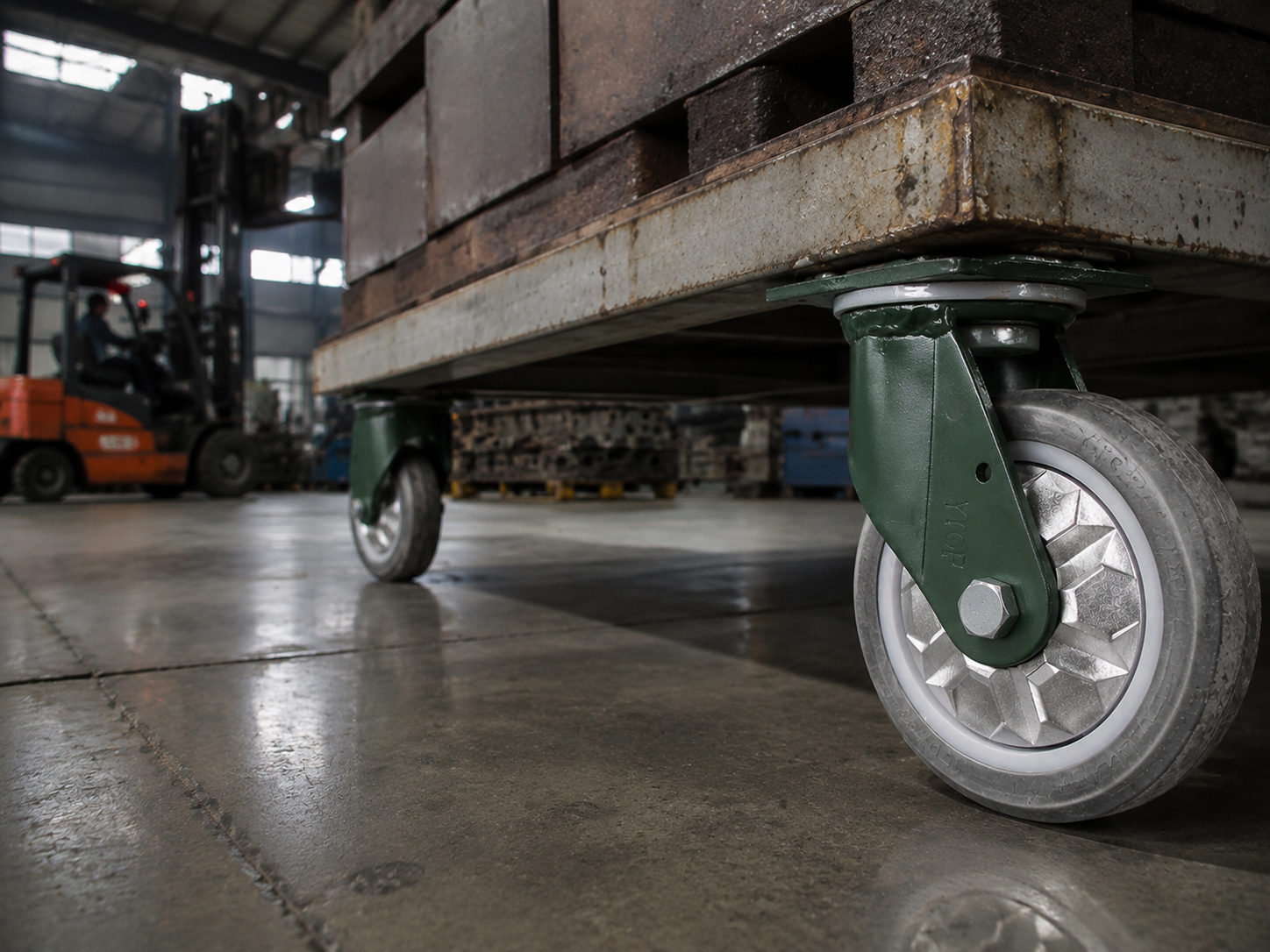
Proper maintenance and care are essential for maximizing the service life and performance of AGV casters, both drive wheels and follower casters, particularly in high-utilization applications where the vehicles operate for long hours and carry heavy loads. Regular inspection should include checking the tread condition of both drive wheels and follower casters for signs of wear, cracking, chunking, or flat spotting; verifying that the tread thickness is within acceptable limits; inspecting the wheel cores for damage or deformation; checking the swivel mechanism of follower casters for smooth, free rotation without excessive play or binding; inspecting bearings (both wheel bearings and swivel bearings) for smooth rotation and adequate lubrication; verifying that mounting hardware is tight and secure; and checking for any signs of misalignment or abnormal wear patterns. The frequency of inspection depends on the application severity, but monthly inspection is recommended for most AGV applications, with more frequent inspection for severe environments or high-usage equipment.
Lubrication of wheel bearings and swivel bearings should be performed according to the manufacturer’s recommendations, typically every 3-6 months for normal applications or more frequently for severe environments. Clean casters regularly to remove dirt, debris, and contaminants that could accelerate wear, affect swiveling action, or damage floors. Pay particular attention to the tread surface of drive wheels, as embedded debris can affect traction and accelerate wear, and to the swivel mechanism of follower casters, as debris accumulation can cause binding or excessive wear. Replace worn or damaged casters promptly to prevent further damage to the wheel, the vehicle, or the floor, and to maintain safe, reliable AGV operation. When replacing drive wheels, it is generally recommended to replace both drive wheels at the same time to ensure consistent traction and performance, as mixing new and worn drive wheels can lead to uneven loading, tracking issues, and potential control problems. Similarly, when replacing follower casters, it is generally recommended to replace all follower casters at the same time to ensure consistent performance and load distribution. Several factors affect the service life of AGV casters including load weight (heavier loads accelerate wear), operating frequency (more hours of operation lead to faster wear), floor conditions (rough or contaminated floors increase wear), acceleration and braking patterns (frequent hard starts and stops increase drive wheel wear), turning frequency (frequent turns increase follower caster swivel mechanism wear), and caster material and quality (higher-quality casters typically last longer). With proper selection, installation, and maintenance, AGV casters can provide thousands of hours of reliable service, contributing to the efficient, uninterrupted operation of automated material handling systems.
Conclusion
AGV trolleys are sophisticated automated material handling systems that have transformed warehouses, manufacturing facilities, and distribution centers by reducing labor costs, improving efficiency, and enabling more flexible material handling. However, what many people may not fully appreciate is that AGV trolleys cannot function properly without the right types of casters. In fact, AGV trolleys rely on two essential caster types to achieve the combination of powered movement, stable support, and flexible maneuverability that is fundamental to their operation: drive wheels and follower (swivel) casters.
Drive wheels are the powered wheels that propel the AGV trolley, providing the self-propulsion that is the essence of automation. Without drive wheels, an AGV trolley would simply be a passive cart, requiring external force to move and defeating the purpose of automation. Follower casters are the non-powered, swiveling wheels that provide stable support and enable smooth, flexible movement, allowing the vehicle to change direction smoothly and navigate complex layouts. Without follower casters, an AGV trolley would be unstable, prone to tipping, limited in load capacity, and unable to change direction smoothly. Together, these two caster types work in harmony to create a stable, maneuverable, and efficient platform that can carry heavy loads, navigate complex facility layouts, and position itself accurately. The selection of appropriate materials, configurations, and maintenance practices further ensures that these casters provide optimal performance, durability, and reliability over long service lives. As AGV technology continues to advance and become more widespread across industries, the importance of high-quality, well-matched drive wheels and follower casters will only continue to grow, as these components are fundamental to the successful operation of AGV trolleys. For AGV designers, manufacturers, and operators, understanding the roles and characteristics of these two essential caster types, and selecting the right casters for each application, is a critical decision that can significantly impact the performance, reliability, and cost-effectiveness of their AGV trolley systems. In short, AGV trolleys truly cannot do without these two types of casters, and investing in high-quality, well-matched drive wheels and follower casters is essential for achieving the full benefits of automated material handling.
Related Reading
Explore more AGV caster and trolley system guides:
- How to Select AGV Casters: Key Parameters — Complete guide to selecting drive and follower wheels for AGV trolleys.
- What Role Do AGV Casters Play in Material Handling? — Understand AGV caster applications in automated trolley systems.
- AGV Casters: Mobile Pioneers in Intelligence — Learn about AGV caster evolution in intelligent trolley systems.
- AGV Drive Wheels: Intelligence and Strength — Learn about AGV drive wheel technology for trolley systems.
- AGV Follower Wheel: Intelligent Logistics Solution — Learn about AGV follower wheel technology for trolley systems.
Explore our complete range of heavy-duty casters (150-610kg) and medium-duty casters (100-190kg) with AGV trolley caster options, or contact our engineering team for expert AGV trolley caster selection guidance.
Post time: Oct-25-2023