
Nylon vs Polyurethane Casters: Which Material Is Better?
Walk onto any factory floor, warehouse, hospital ward or automated production line and you will find the same question hidden inside almost every rolling cart, trolley and equipment stand: what should the wheels be made of? Among the dozens of caster wheel materials available today, two names dominate industrial selection discussions: nylon (polyamide) and polyurethane (PU). Both are strong, both are widely available, and both can be molded into almost any wheel size. Yet they perform in almost opposite ways.
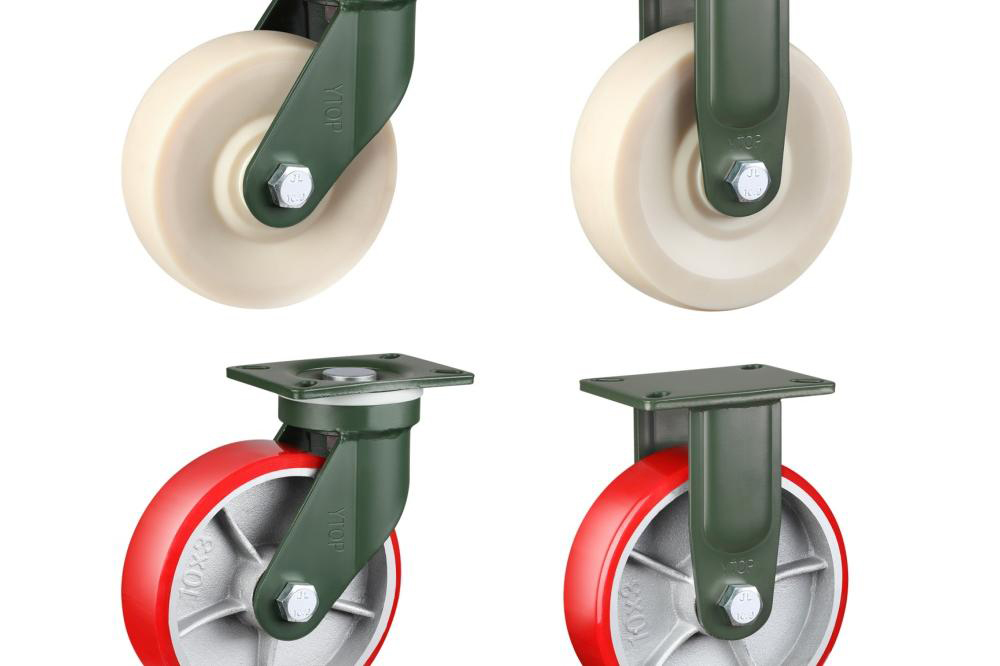
The honest answer is that there is no single “best” material. Nylon and polyurethane are engineered for different jobs. Nylon casters are harder, stiffer and built to carry heavy loads over long distances in dry, aggressive environments. Polyurethane casters are softer, more elastic and chosen where noise, vibration and floor protection matter more than raw stiffness. This guide breaks down how each material is built, how it behaves in service, and exactly how to choose between them for your own carts and equipment.
What the Wheel Material Actually Determines
The wheel material controls four outcomes that the steel bracket, swivel bearing and fork cannot fix: rolling resistance under load, noise and vibration, wear rate on the wheel itself, and protection of the floor surface. A cheap bracket will wobble, but a wrong wheel material will either grind your floor, squeal down the hallway, or crack after a few months. Because these four outcomes pull in different directions, no material wins everywhere—and that is precisely why nylon and PU coexist rather than one replacing the other.
Nylon Casters: Material Properties and Performance
Nylon is the common name for the family of polyamide (PA) engineering plastics. The two grades you will meet most often on industrial casters are PA6 (extruded or injection-molded nylon) and MC nylon (monomer-cast nylon, also called cast nylon 6). MC nylon is poured as a liquid monomer that polymerizes directly into the finished wheel blank, producing a denser, more uniform and stronger part than injection molding. It is the premium choice for heavy-duty caster wheels.
PA6 vs MC Cast Nylon
PA6 wheels are affordable and dimensionally stable, which makes them the default for medium-duty carts and general equipment. MC cast nylon wheels offer higher tensile strength, better impact resistance, lower water absorption and a far longer wear life under heavy loads. For truly heavy or ultra-heavy applications—the kind that press hundreds of kilograms onto a single wheel—cast nylon is usually the grade specified, because its internal grain structure does not develop the micro-cracks that eventually split cheaper injection-molded wheels.
Key Strengths and Weaknesses
- High hardness and rigidity. Nylon wheels run hard, so they support high point loads without deflecting or flattening.
- Excellent wear resistance and low rolling drag. The hard, smooth surface rolls easily on flat concrete and polished floors.
- High load capacity at low weight. A nylon wheel is surprisingly light for the load it carries, and it will not deform under sustained static load the way an elastomer can.
- Naturally corrosion-resistant. Nylon shrugs off oils, greases, many chemicals and wet industrial conditions that would rust a metal wheel or degrade rubber.
- Non-marking but noisy. High-quality nylon leaves few marks, but because it is rigid it transmits bumps and clatters loudly over expansion joints, cracks and debris.
The trade-off is stiffness: a hard wheel does not absorb shock, so it transfers every seam, pebble and expansion joint directly into the cart and its contents. That is fine for steel pallets and tooling, but unpleasant for people working beside the cart and risky for fragile or precision loads.
Polyurethane (PU) Casters: Material Properties and Performance
Polyurethane is not a hard plastic—it is a flexible elastomer. PU caster wheels are typically a load-bearing core (nylon, aluminum or cast iron) bonded or treaded with a layer of polyurethane elastomer. This is what people mean when they say a “PU wheel” or an “elastic caster”: the important rolling surface is the elastomer, and the core only transfers the load.
Why PU Behaves Like an Elastomer
Polyurethane can be formulated anywhere from a soft, gel-like feel to a firm, near-plastic hardness. For casters, manufacturers tune it to a hardness around Shore A 85–95. In that range it is firm enough to carry heavy loads yet elastic enough to deflect under contact. That deflection is the whole point: it spreads the contact patch over a larger area, dampens vibration, grips the floor for traction, and rolls quietly. The same elasticity that makes PU quiet also makes it an outstanding floor protector—PU treads will not mark, scuff or mar epoxy, polished concrete, tile or cleanroom flooring.
Key Strengths and Weaknesses
- Quiet, cushioned rolling. PU absorbs small shocks and rolls far more quietly than hard nylon on rough joints.
- Superior floor protection. A high-grade PU tread is non-marking and gentler on expensive flooring.
- High load capacity with grip. Premium PU treads rival nylon for load while adding traction that nylon simply cannot provide.
- Excellent tear and abrasion resistance. Good polyurethane wears slowly and resists chunking under edge loading.
- Weaker points. PU rolls on a slightly higher drag than hard nylon, it can be degraded by prolonged UV exposure or certain solvents, and cheap PU can flatten-set if parked loaded for months.
Chemical Structure: Why the Two Behave So Differently
The performance gap is not accidental—it is built into the molecules. Nylon is a polyamide, formed when diamine and diacid monomers link together through strong, regular amide bonds. Those bonds create a tightly packed, semi-crystalline structure. Crystallinity is what gives nylon its hardness, stiffness and resistance to deformation. The price is brittleness and little ability to stretch and recover.
Polyurethane is built from a reaction between isocyanates and hydroxyl (polyol) compounds, producing a segmented polymer with alternating hard and soft blocks. The hard blocks provide strength; the soft blocks give elasticity. Because PU is engineered as a “block copolymer,” chemists can dial its hardness, rebound and tear strength up or down almost like a slider. This is why PU can be made soft and quiet or firm and load-bearing—the formulation is the variable, not the species.
One Chemistry, Two Design Goals
In short: nylon is designed to be a hard, dimensionally stable structural plastic. Polyurethane is designed to be a tunable, elastic cushion. When you understand that difference, every practical—and sometimes surprising—behavior follows. Nylon clatters because it is stiff; PU grips because it stretches. Nylon stays rigid under load; PU conforms to the floor. These are not flaws; they are the design intent.
Side-by-Side Comparison Table
The table below summarizes how the two materials compare on the properties that actually matter when you specify a caster. Use it as a filter, not a verdict.
| Property | Nylon (PA / MC Nylon) | Polyurethane (PU Elastomer) |
|---|---|---|
| Material type | Hard engineering plastic (polyamide) | Flexible elastomer on a rigid core |
| Hardness | High (R118+ Rockwell) | Medium (Shore A 85–95) |
| Elasticity / cushioning | Very low | High |
| Load capacity | Very high, low deflection | High (premium PU comparable) |
| Abrasion wear | Excellent on smooth floors | Excellent on mixed/rough floors |
| Noise level | Loud over joints and debris | Quiet |
| Shock absorption | Poor | Good |
| Floor protection / marking | Clean but can mark soft floors | Non-marking, gentle on floors |
| Rolling resistance | Low | Slightly higher |
| Temperature range | Broad, heat-resistant | Limited at very high heat |
| Chemical resistance | Very good to oils/weak acids | Good; sensitive to strong solvents/UV |
| Weight | Light | Slightly heavier (core + tread) |
| Relative cost | Lower | Moderate to higher |
| Best floor | Smooth, dry, industrial concrete | Mixed floors, epoxy, tile, cleanrooms |
Reading the Table for Your Application
If your first three rows are all “high load, smooth floor, price-sensitive,” nylon usually wins. If the loudest complaints on your line are about squealing carts, scuffed epoxy or delicate equipment being jostled, PU is almost always the better engineering choice. The table is a decision map: start with the property you cannot compromise on, and let that row point you toward the material.
Application Scenarios: Where Each Material Wins
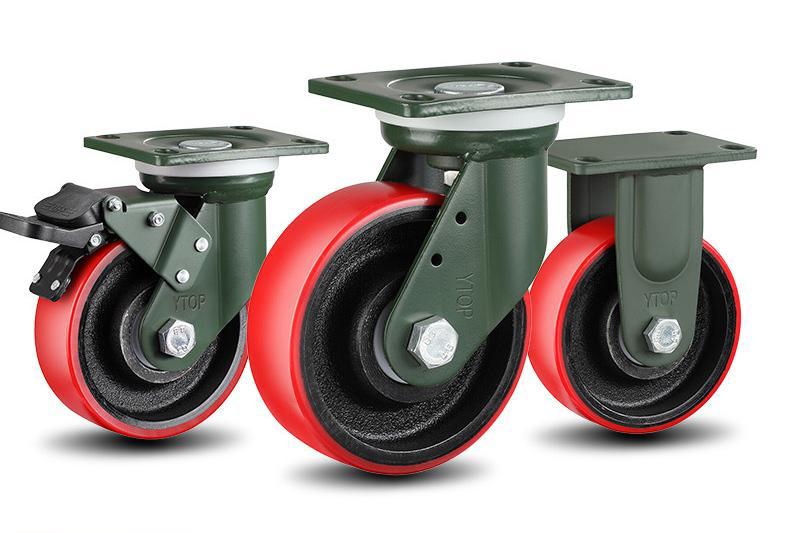
Nylon excels in industrial, warehousing and heavy-load, mostly dry environments. Think steel material trolleys, heavy machine bases, storage racks, pallet carts and foundry or machining areas where oils, swarf and occasional chemicals are present. Nylon stays true under repeated heavy loading, resists those chemicals, and its low rolling drag means a loaded cart is not a struggle to push. It is also the economical choice when floor aesthetics and silence are not priorities.
Polyurethane excels where people and surfaces are sensitive. Medical carts, laboratory equipment, office and hospitality trolleys, supermarket rolling racks, display stands and any cart that moves over tiled or epoxy flooring benefit enormously from PU’s silence and non-marking tread. It is also preferred outdoors or on imperfect paving because it cushions the ride and grips uneven surfaces that would bounce a hard nylon wheel.
Why AGV and Automated Platforms Often Prefer PU
Automated Guided Vehicles (AGVs) and AMRs are a special case—and a great illustration of the trade-off. AGVs move repeatedly at controlled speed, carry valuable and sensitive payloads, and must run predictably on defined routes. They need traction to accelerate and brake without slipping, quiet operation that does not disturb the working environment, and smooth contact that protects the guidance surface and reduces maintenance on motors and drive trains. PU’s grip, cushioning and low noise deliver all three. That is why PU—sometimes a specialty PU formulated for low noise and high rebound—is the default wheel material for AGV drive and load wheels, even though a nylon wheel could theoretically carry the weight. For more on this, see our breakdown of nylon wheels for AGV casters.
Caster Selection Decision Guide and Maintenance
Choosing between nylon and PU becomes straightforward once you rank your priorities. Ask four questions: How heavy is the load? If it approaches the upper end of a wheel’s rating, favor the stiffer, lower-deflection choice. How clean and smooth is the floor? Rough, cracked or jointed floors reward PU cushioning; perfect concrete rewards nylon’s low drag. Do noise and floor condition matter? If yes—hospitals, offices, cleanrooms, epoxy floors—choose PU. What chemicals and temperatures will the wheel meet? Aggressive chemicals or heat push the decision toward nylon; UV, solvents and long parked loads caution against cheap PU. When load is extreme, pair the right wheel with a properly rated heavy-duty bracket rather than under-sizing the wheel.
Maintenance Tips for Both Materials
- Inspect and clean regularly. Remove swarf, hair and debris from around both nylon and PU wheels; wound debris shortens bearing and tread life on either material.
- Keep nylon dry-sensitive concerns in mind. Nylon absorbs a little moisture; it performs best in stable conditions, and you should not exceed its rated temperature.
- Avoid long static parking load on PU. Parked, loaded PU wheels can develop flat spots. Move the cart periodically or choose a higher-grade tread for long-term stationary loads.
- Lubricate the swivel and bearings. Wheel material is only half the story—clean, lubricated bearings are what keep a caster rolling freely regardless of tread material.
- Respect the load rating. Overspeed and overload are the two fastest ways to destroy either a nylon wheel or a PU tread.
Need help matching the right wheel material to your carts? Our engineering team routinely specifies nylon, cast nylon and polyurethane wheels across light, medium, heavy and super-heavy ranges. Tell us your load, floor and environment, and we will recommend the material that carries the load quietly and lasts. Contact YTOP Caster today for a tailored caster selection.
Frequently Asked Questions
Is nylon or polyurethane better for heavy loads?
Both can carry heavy loads when correctly rated, but nylon’s rigidity means it deflects less under sustained point loading, which can be an advantage on ultra-heavy, stationary loads. Premium polyurethane treads carry comparable dynamic loads while cushioning the ride. For the heaviest, mostly dry industrial loads, nylon is often chosen; for heavy loads over sensitive floors, a high-grade PU wheel on a heavy-duty core is preferred.
Which is quieter, nylon or polyurethane casters?
Polyurethane is significantly quieter. Because PU is an elastic elastomer, it absorbs small shocks and rolls smoothly over expansion joints and cracks, whereas rigid nylon clatters and transmits noise directly. This is the single biggest reason medical, office and cleanroom applications standardize on PU.
Do polyurethane wheels damage or mark floors?
Quality polyurethane wheels are non-marking and actually protect floors, which is why they are specified on epoxy, polished concrete, tile and marble. Hard nylon can scuff softer or finished surfaces under heavy edge loads, so PU is the safer choice when floor appearance is a priority.
Can I use nylon casters outdoors or in wet conditions?
Nylon resists moisture, oils and many chemicals well, so it performs reliably in wet and chemically active industrial environments. However, it rolls noisily and transmits bumps on uneven outdoor paving. For outdoor carts on rough ground, a PU tread or even a rubber wheel is usually the better ride, while nylon remains fine on paved, dry, hard surfaces.
How do I decide quickly between the two?
If your priorities are maximum load, low cost, chemical resistance and a dry smooth floor, choose nylon. If noise, floor protection, traction and cushioning dominate—especially for AGV, medical or office carts—choose polyurethane. When in doubt, specify the floor and environment first; that decision usually settles the material.
Related Reading
News & Guides
- Polyurethane vs Nylon Swivel Casters: Wear Resistance and Load Resilience Comparison
- Advantages and Disadvantages of Nylon Wheels for AGV Casters
- What Role Do AGV Casters Play in Automated Material Handling Systems?
- How to Calculate Industrial Caster Load Capacity: Dynamic vs Static Load
- Core Parameters to Confirm in Industrial Caster Selection
Product Pages
Get in Touch
Post time: Aug-12-2024