
Nylon wheels in AGV casters are a choice with “clear applicable boundaries” — high load capacity, durable, cheap, but the two shortcomings of cushioning and noise are also hard. Before selecting, first lay out both ends, then judge whether your working conditions are within its applicable zone.
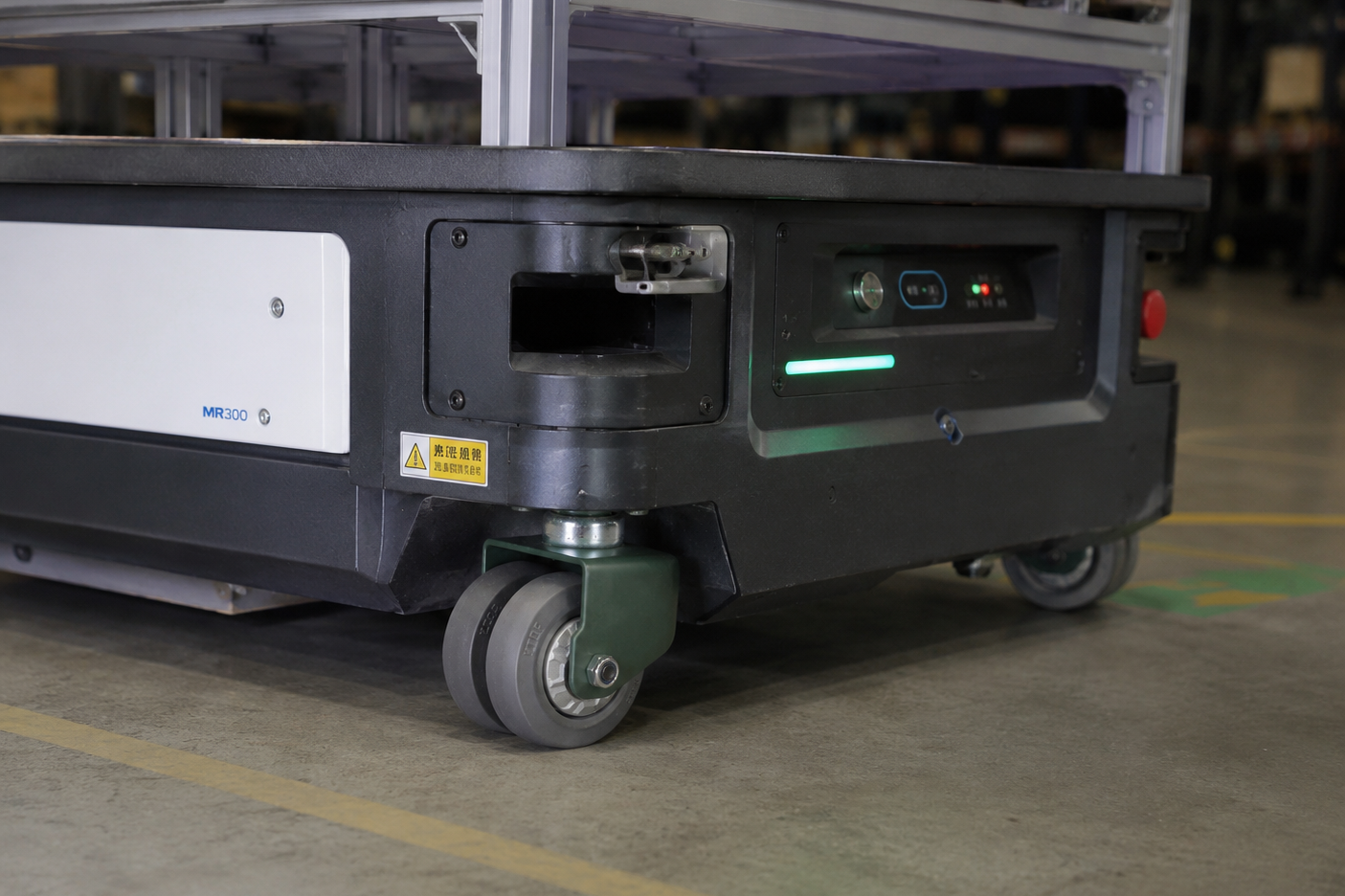
Several advantages can be counted.
Load capacity is really high. Nylon’s compressive strength is there, and under the same size, nylon wheel’s rated load can reach 1.5 to 2 times that of PU wheels. When heavy-load AGVs have used PU to the limit and still fall a bit short, nylon is the option to go up one more grade. High hardness means extremely small deformation under heavy load, and rolling resistance doesn’t increase due to compression deformation. On flat hard floors, operating resistance is one of the lowest among several materials, with resistance coefficient about 0.02-0.03, lower than PU’s 0.025-0.035 and rubber’s 0.035-0.05.
Good oil and chemical resistance. Engine oil, lubricating oil, most acids-alkalis and solvents can be withstood, and material performance decays slowly in oily and chemical environments. High temperature resistance is also high, long-term use temperature range is wider than ordinary PU, and in high-temperature workshops nylon wheels are still within range while PU may have reached the edge. Low cost — material is cheap, injection molding efficiency is high, and same-specification price is usually significantly a notch lower than PU wheels.
But for the AGV scenario, nylon’s disadvantages often offset its advantages.
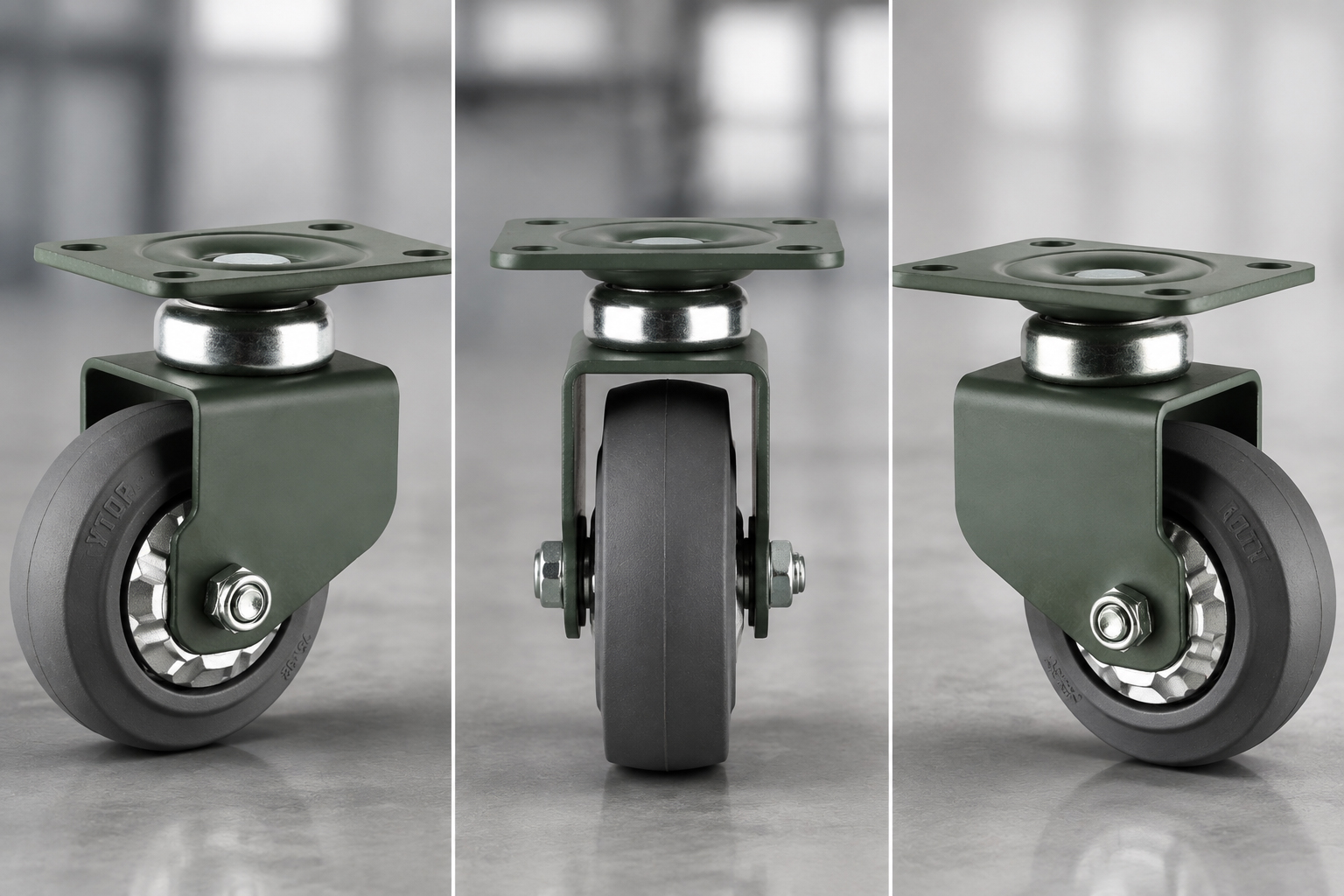
No cushioning is the biggest problem. Nylon basically has no elasticity, and floor impact is directly poured into the vehicle body and cargo — navigation sensors, control boxes and other precision parts fear this most, and fragile cargo crossing joints is basically hard impact all the way. Noise is also loud — rolling sound of hard tread on hard floors, impact sound crossing joints are both obvious, and there is almost no usage space near office areas or manned workstations. Also damages floors: nylon has high hardness, and running for a long time on epoxy flooring and anti-static PVC floors will scrape wheel tracks, especially obvious on floors with surface treatment, and the cost of repairing floors is much more expensive than wheels. Low friction coefficient (about 0.2-0.3, PU at 0.4-0.6), when used as drive wheels easily slips, and AGVs with large driving force requirements need to verify this item first. Becomes brittle at low temperatures — impact toughness drops sharply at minus ten-something degrees, and using nylon wheels in cold storage has cracking risk. Additionally nylon absorbs water, and materials like PA6 change in size and strength after moisture absorption, with dimensional stability in humid environments not as good as PU.
Organize the applicable zone: high load, flat hard concrete floors, with oil or high temperature, insensitive to noise, heavy-load projects with tight budgets — nylon wheels are suitable. Conversely, epoxy flooring, anti-static floors, occasions needing quiet, cold storage, drive wheels, uneven floor working conditions — don’t touch nylon.
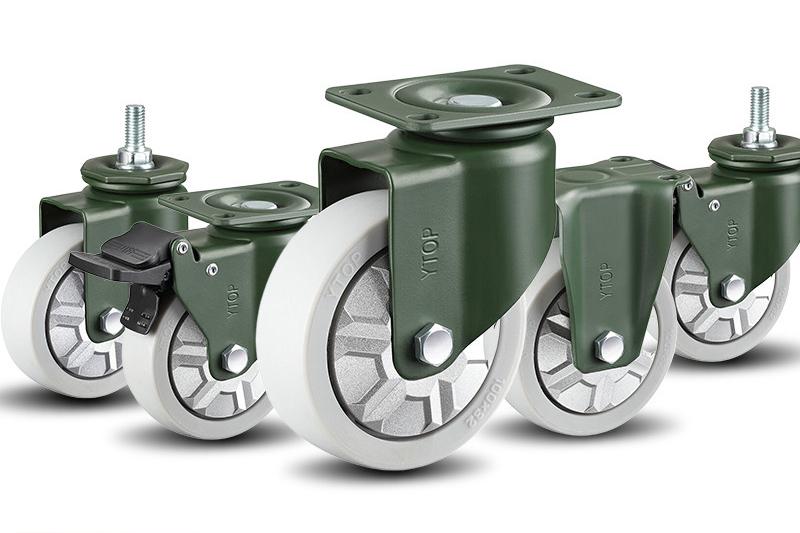
Compared with PU: load nylon higher, cushioning PU better, noise nylon louder, floor protection PU better, friction nylon lower, oil resistance nylon superior, temperature resistance nylon higher, cost nylon lower — no all-rounder, all trade-offs. In AGVs, PU remains the default for most scenarios, and nylon belongs to the backup option pulled out when PU is insufficient under certain conditions, such as load really too large, oil unavoidable, or budget locked. Without these clear reasons, prioritize PU, don’t gamble on noise and floors to save a little wheel money.
In the information given to the manufacturer, “what the floor is,” “whether there is oil,” “whether it will enter cold storage” — these few items determine whether nylon can actually be used. Zhuoye manganese steel casters’ handling of tread material also matches solutions according to working conditions — after customers confirm floor and load, then judge whether nylon wheels are applicable, and won’t use “nylon is cheap” as a recommendation reason.
Related Reading
Explore more AGV caster and tread material guides:
- How to Select AGV Casters: Key Parameters — Complete guide to AGV caster selection including tread material.
- What Role Do AGV Casters Play in Material Handling? — Understand AGV caster applications in automated systems.
- Polyurethane vs Nylon Casters: Material Comparison — Detailed comparison of PU and nylon caster materials.
- Polyurethane Materials: Applications in Caster Production — Learn about PU material properties and AGV applications.
- Industrial Caster Selection: 10 Core Parameters — Complete guide to caster selection parameters.
Explore our complete range of heavy-duty casters (150-610kg) with nylon and polyurethane wheel options, or contact our engineering team for expert guidance on AGV caster material selection.
Post time: Sep-14-2026