
Universal wheels, also called swivel casters, are the heart of nearly every movable cart, trolley, rack and machine chassis in modern industry. While the swivel bearing and bracket get most of the attention, the material of the wheel itself is what actually decides how the caster rolls, how long it lasts, and whether it protects your floor. Choosing the wrong wheel material turns a smooth, quiet cart into a floor-scratching, noise-making, prematurely failing headache. In this guide we explain exactly what materials universal wheels are made of, how each one performs across load, floor and environment, and how to match the right material to your application.
What Are Universal Wheels and Why Material Matters
A universal wheel is a swivel caster designed to rotate a full 360 degrees horizontally, allowing equipment to move freely in any direction. Unlike fixed (rigid) casters that only travel in a straight line, universal wheels are usually paired with rigid wheels on the corners of a trolley. The wheel tread is the only part that actually contacts the floor, so its material directly determines rolling resistance, load rating, noise level, floor protection, chemical resistance and overall service life. A bracket can be perfectly designed, but if the tread material is mismatched to the job, the caster will underperform. This is why experienced engineers always start the material selection process from the wheel tread, not from the bracket.
The Most Common Universal Wheel Materials
Nylon (Polyamide / PA) Wheels
Nylon wheels are among the most widely used wheel materials in light and medium-duty industrial casters. Molded from cast nylon (PA6) or glass-fiber reinforced nylon (PA66), they offer an excellent strength-to-weight ratio, very low rolling resistance and outstanding wear resistance. Nylon is also naturally resistant to oils, greases, fuels and many chemicals, which makes it popular in machine shops, warehouses, textile mills and clean rooms. The main trade-off is noise: hard nylon rolls loudly on hard floors and can scuff or mark smooth surfaces under heavy loads, especially in cold conditions where nylon becomes slightly brittle.
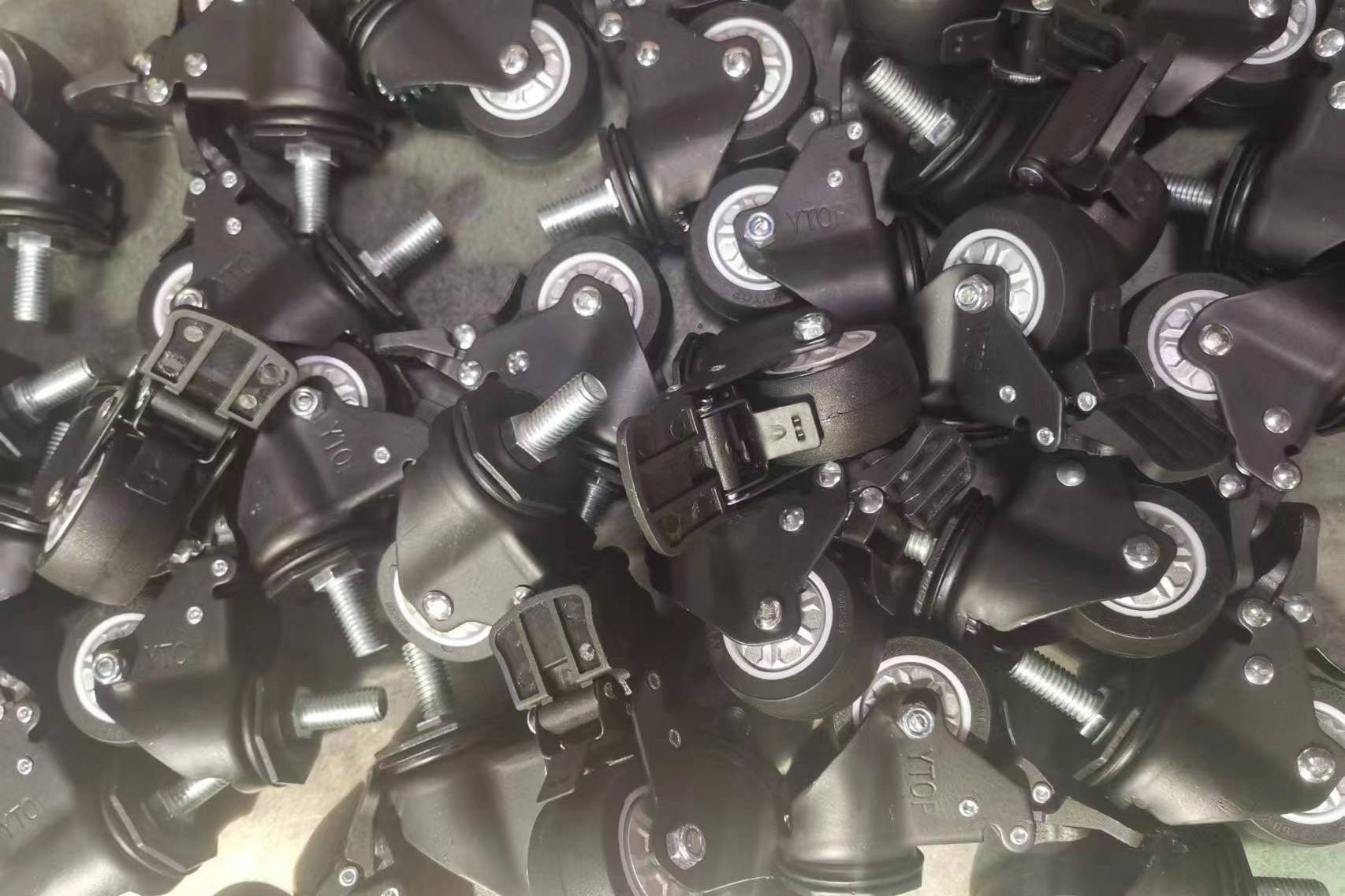
Polyurethane (PU) Wheels
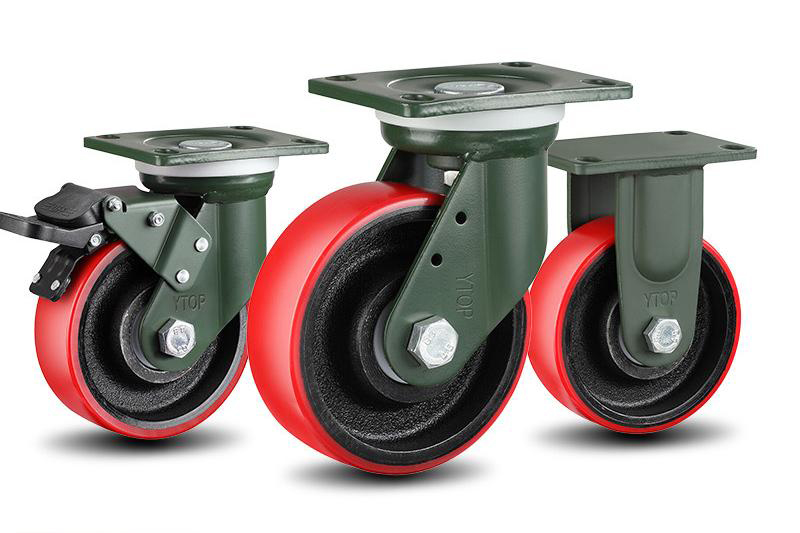
Polyurethane wheels sit between hard plastic and soft rubber in performance. They bond a tough polyurethane tread to a plastic, cast iron or aluminum core. PU combines the high load capacity of nylon with excellent floor protection and very low noise. It is highly resistant to abrasion, cuts and oils, rolls smoothly on concrete, epoxy and tile, and will not leave black marks on floors. These characteristics make PU the default choice for medium and heavy-duty universal wheels used in logistics centers, supermarkets, hospitals and automated equipment. For extra-heavy loads, PU is commonly molded directly onto a cast iron or aluminum hub so the wheel carries the load without deflecting.
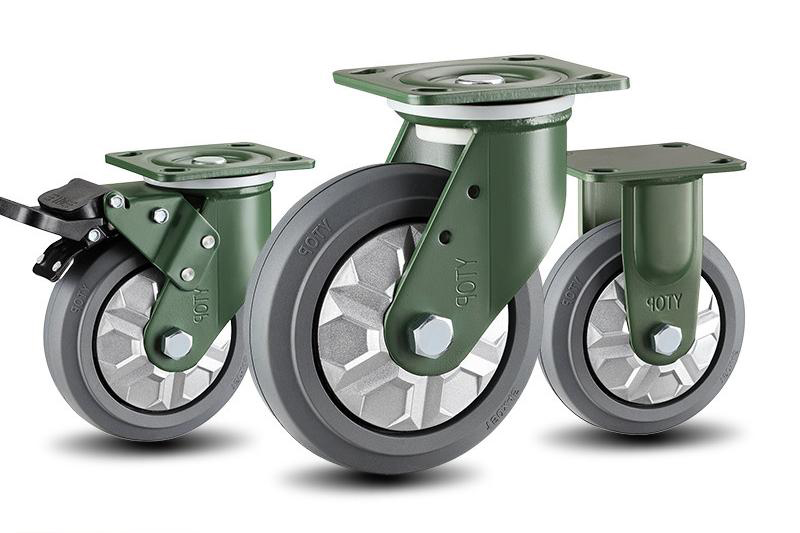
Rubber Wheels
Natural or synthetic rubber wheels are the softest option. They excel at cushioning, shock absorption and noise reduction, and are gentle on every kind of floor. Because the tread deflects under load, however, rubber has higher rolling resistance and a lower load rating than nylon or PU. Rubber wheels are best for light-duty carts, office equipment, drums and uneven outdoor floors where cushioning and traction matter more than raw load capacity.
Cast Iron and Forged Steel Wheels
For the heaviest loads, cast iron and forged steel wheels are unbeatable. They carry enormous weight, resist high temperatures well and will not deform under static or dynamic loads. The downside is that they scratch floors, roll loudly, and rust unless coated. They are normally reserved for steel platforms, industrial dollies, foundry carts and furnace equipment where floor finish is irrelevant and extreme load or heat is the priority.
TPR and TPE Wheels
Thermoplastic rubber (TPR/TPE) wheels are a newer blend that mimics rubber softness while being injection-moldable at low cost. They provide good floor protection and quiet rolling at light duty, and are extremely common on shopping carts, service trolleys, hotel linen carts and medical equipment where aesthetics and low noise matter.
Comparing Core Properties of Each Material
Load Capacity
Load capacity rises as the wheel gets harder: cast iron and forged steel carry the most, followed by reinforced nylon, then polyurethane, then rubber and TPR. Always size a universal wheel so that each wheel carries no more than its rated dynamic load, and add a safety margin of at least 20 to 30 percent for impact, uneven floors and occasionally heavier loads.
Floor Protection and Noise
Soft wheels protect floors but roll with more effort. Rubber and TPR are the quietest and kindest to epoxy and tile floors. PU is the best all-round compromise: quiet enough for offices and hospitals, tough enough for warehouses. Nylon and cast iron are quiet only on rough concrete and become noisy and marking on smooth finished floors, so they should be avoided where floor appearance matters.
Chemical and Environmental Resistance
Nylon and polyurethane resist oils and most industrial chemicals very well. Rubber can swell or degrade under certain oils, solvents and ozone. Cast iron rusts in wet or corrosive environments, so stainless brackets, zinc plating or epoxy coatings are recommended for washdown rooms, coastal areas and outdoor use.
Impact Resistance and Temperature Limits
Handling Shock and Load Surges
Wheels roll over thresholds, expansion joints and dock plates every day. PU and rubber absorb these impacts because the tread deflects, protecting both the load and the bearings. Nylon is stiff and transmits shock directly, while cast iron can crack if dropped from a height. Choose an elastic tread when your path has frequent bumps or your load is fragile.
Operating Temperature Range
Most polymer wheels lose strength above about 60 to 80 degrees Celsius and become brittle below freezing. Cast iron and steel wheels handle extreme heat and cold. If your universal wheels run through ovens, freezers or autoclaves, specify the material and its rated temperature range explicitly before ordering.
How to Choose the Right Universal Wheel Material
Match the Material to the Floor
On smooth epoxy, tile or marble, choose PU or rubber to avoid marks and noise. On rough concrete in a warehouse, nylon or PU handles abrasion best. Outdoors on gravel or asphalt, go for resilient rubber or PU bonded to an iron core. If you need floor protection and high load together, PU on an aluminum or iron hub is the proven solution.
Match the Material to Load and Speed
Heavy, slow-moving loads favor hard nylon, PU on iron core, or cast iron. Light, fast-moving loads favor TPR or PU for comfort and noise. For AGV and automated carts, polyurethane is the industry standard because it balances traction, wear, quiet operation and floor protection. Always confirm the combined weight of the cart plus load, then divide evenly across all wheels.
Why YTOP Universal Wheels Perform Better
At YTOP, universal wheels are manufactured in-house under ISO9001 quality management, with injection-molded treads, precision double-ball raceway swivel bearings and manganese steel brackets built to outlast generic imports. Every wheel material we offer is tested for load, wear, salt spray and noise before it leaves the Quanzhou factory, so you can select a wheel with confidence instead of trial and error. Whether you need nylon, PU, rubber or cast iron treads, we can match the tread, core, bearing and bracket to your exact floor, load and speed.
Frequently Asked Questions
What is the best material for universal wheels?
Polyurethane (PU) is the best all-round choice because it balances high load capacity, floor protection and low noise. Choose nylon for maximum wear resistance on rough concrete, and rubber for the quietest, softest roll on finished floors.
Are polyurethane wheels better than nylon wheels?
PU rolls more quietly and protects floors better than nylon, while nylon costs slightly less and resists abrasion on rough surfaces. PU is usually the better overall compromise for universal wheels; nylon wins only when maximum chemical and abrasion resistance is needed.
Which wheel material is the quietest?
Soft rubber and TPR wheels are the quietest, followed closely by polyurethane. Hard nylon and cast iron wheels roll much louder on smooth floors.
Can I use nylon wheels on epoxy or tile floors?
Nylon can scuff or mark smooth epoxy and tile floors under load. For finished floors, choose a polyurethane or rubber tread instead to prevent permanent marks.
How do I calculate the load per wheel?
Add the weight of the empty cart and the maximum load, then divide by the number of wheels. Add a 20 to 30 percent safety margin, and remember that uneven floors can momentarily overload one wheel, so never run close to the rated limit.
Related Reading
Explore more about caster wheel materials, selection and applications:
- Polyurethane vs Nylon Swivel Casters: Wear Resistance, Load and Resilience Comparison
- How to Choose the Appropriate Caster Material According to the Floor Material
- Advantages and Disadvantages of Nylon Wheels for AGV Casters
- What Is the Difference Between Aluminum Core and Iron Core Casters?
- What Are the Advantages of Universal Wheels Over Directional Wheels?
- Browse Medium-Duty Universal Casters (100-190kg)
- Browse Heavy-Duty Universal Casters (150-610kg)
- Contact YTOP for a Custom Universal Wheel Quote
Post time: Nov-27-2023