
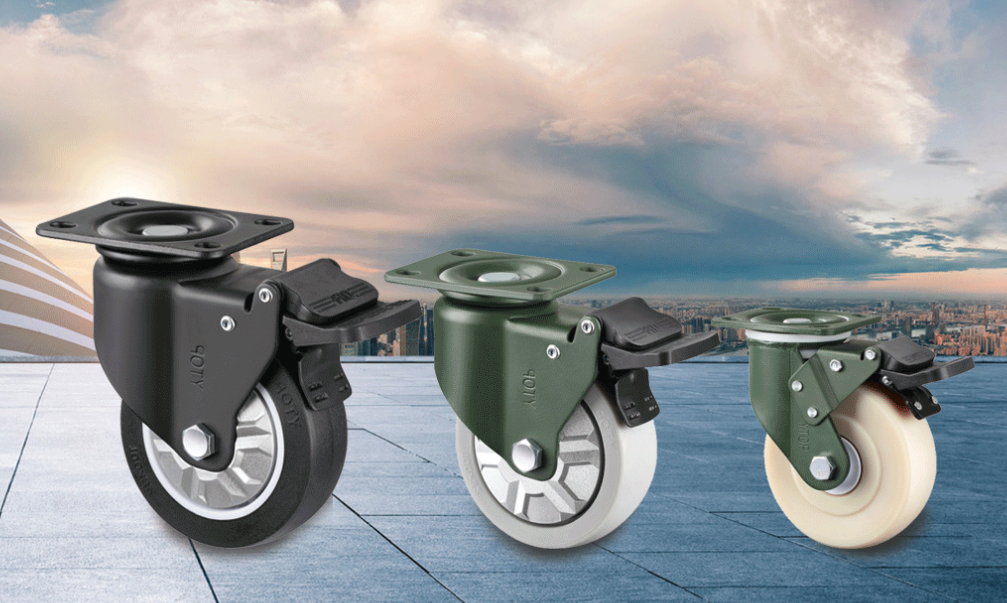
Casters are important accessories for various types of mobile equipment, and their performance and selection are directly related to the use effect and life of the equipment. In the caster market, aluminum core casters and iron core casters are two common choices. Although they are both important components of casters, there are significant differences in materials, performance, application scenarios, etc. This article will analyze in detail the differences between aluminum core casters and iron core casters to help users better understand and choose caster products that suit them.
Material differences
Aluminum core casters use aluminum alloy as the core material. Aluminum alloy has the characteristics of light weight, corrosion resistance and high strength. Iron core casters are made of iron material. Although iron material has high strength, it is relatively heavy and susceptible to environmental corrosion. Therefore, in terms of material, aluminum core casters are lighter and more corrosion-resistant, while iron core casters are heavier and more susceptible to environmental effects.
Performance differences
Due to different materials, there are also differences in performance between aluminum core casters and iron core casters. Due to its lightweight characteristics, the aluminum core caster makes the entire caster more flexible and easier to move, and is suitable for occasions that require frequent movement and steering. Iron-core casters, on the other hand, may provide better stability due to their heavier mass, but may be slightly clumsy when it comes to moving and turning. In addition, aluminum core casters are more corrosion-resistant and can adapt to a wider range of use environments, while iron core casters may require more frequent maintenance and replacement in humid or corrosive environments.
Differences in application scenarios
According to the performance characteristics of aluminum core casters and iron core casters, their application scenarios are also different. Because of their lightness and flexibility, aluminum core casters are more suitable for use in light equipment that requires frequent movement and turning, such as medical equipment, supermarket shelves, etc. Due to its good stability and strong load-bearing capacity, iron core casters are more suitable for equipment that needs to carry heavy objects or needs to operate stably for a long time, such as industrial production lines, heavy machinery, etc.
Price and maintenance costs
In terms of price, aluminum core casters are usually slightly more expensive than iron core casters, which is related to the processing difficulty and performance advantages of their materials. However, from the perspective of long-term maintenance costs, aluminum core casters can often reduce maintenance frequency and replacement costs due to their corrosion-resistant and wear-resistant properties. Iron-core casters may require more frequent maintenance and replacement under certain circumstances, so long-term maintenance costs may be relatively high.
To sum up, there are obvious differences between aluminum core casters and iron core casters in terms of material, performance, application scenarios, price and maintenance costs. When choosing casters, users should comprehensively consider their actual needs and usage environment to choose the caster product that best suits them. Whether you are pursuing lightweight and flexible aluminum core casters, or you are looking for stable and load-bearing iron core casters, it is possible to achieve the best performance in specific application scenarios.
Related Reading
Explore more caster material comparisons, types, and selection guides:
- How Many Types of Caster Materials Are There? — Learn about various caster material types including core materials.
- Characteristics of Different Caster Materials and How to Select — Learn about different caster material characteristics including core types.
- What Is the Difference Between Nylon PA6 and Nylon MC for Casters? — Learn about nylon material differences including caster applications.
- What Is the Difference Between Rubber Casters and Nylon Casters? — Learn about rubber vs nylon caster differences including materials.
- What Is the Difference Between TPR Casters and Rubber Casters? — Learn about TPR vs rubber caster differences including material comparisons.
Explore our complete range of durable medium-duty casters (100-190kg) and heavy-duty casters (150-610kg) with various core materials, or contact our technical team for expert caster material guidance.
Post time: May-25-2026