
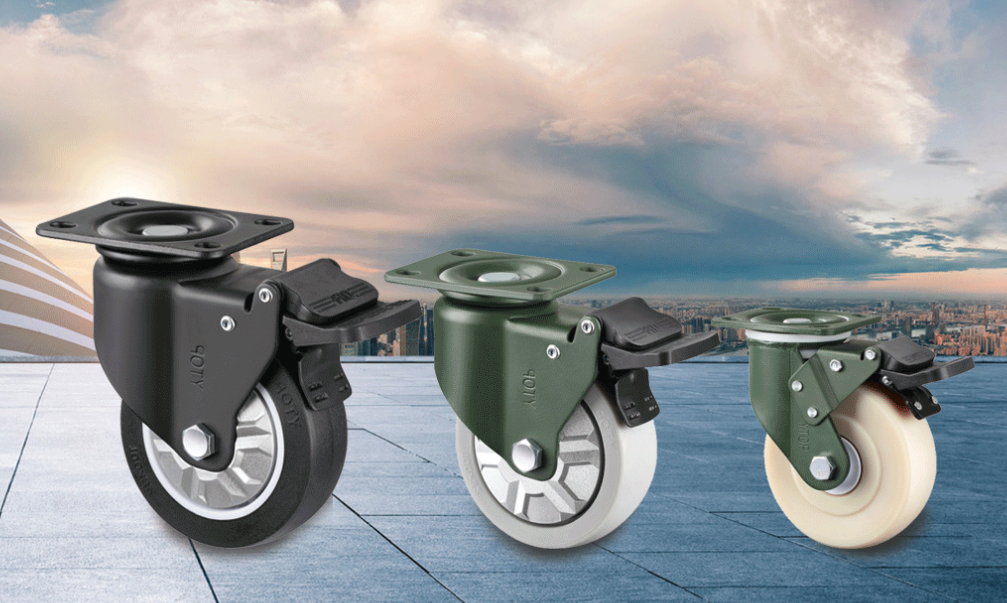
Choosing the right caster material is critical to ensuring the performance of your mobile equipment and the protection of your floor. The following are suggestions for selecting caster materials based on different floor materials:
1. Hard floors (such as concrete, ceramic tiles):
It is recommended to use polyurethane casters, or PU casters because they have good wear resistance and rolling properties and can provide smooth operation on hard floors.
2. Wooden or composite floor:
You can choose rubber casters because their elasticity can absorb shock and reduce damage to the ground.
Rough or uneven ground:
3. Nylon casters or polyurethane casters are suitable choices as their wear and tear resistance help provide stable movement in these conditions.
4. Environment where chemicals are exposed:
Nylon casters should be avoided as they are less resistant to corrosion by strong acids and alkalis. In this case, polyurethane casters should be chosen as they generally have better chemical stability.
5. Environments that require silent operation:
TPR casters or thermoplastic rubber casters may be better choices because they have lower rolling noise.
6. Applications with heavy loads or high durability requirements:
Steel casters or reinforced engineering plastic casters are suitable for heavy loads or use in harsh environments, and they provide high strength and durability.
In summary, when choosing caster material, you should consider the characteristics of the floor material, the load of the mobile equipment, and whether it will be exposed to chemicals or require silent operation. By combining these factors, the most appropriate caster material can be selected to optimize the performance and longevity of your mobile device.
Post time: Apr-14-2026