
“How much load can 8-inch heavy-load casters bear” appears frequently in inquiries, but it has no fixed answer. Load capacity is not determined by wheel diameter alone — wheel diameter, tread material, hub structure, and bracket structure work together, and same 8-inch, different configurations, load capacity can differ by one to two times.
Selecting 8-inch heavy-load casters, must understand the logic of load capacity, to select a truly matching model.
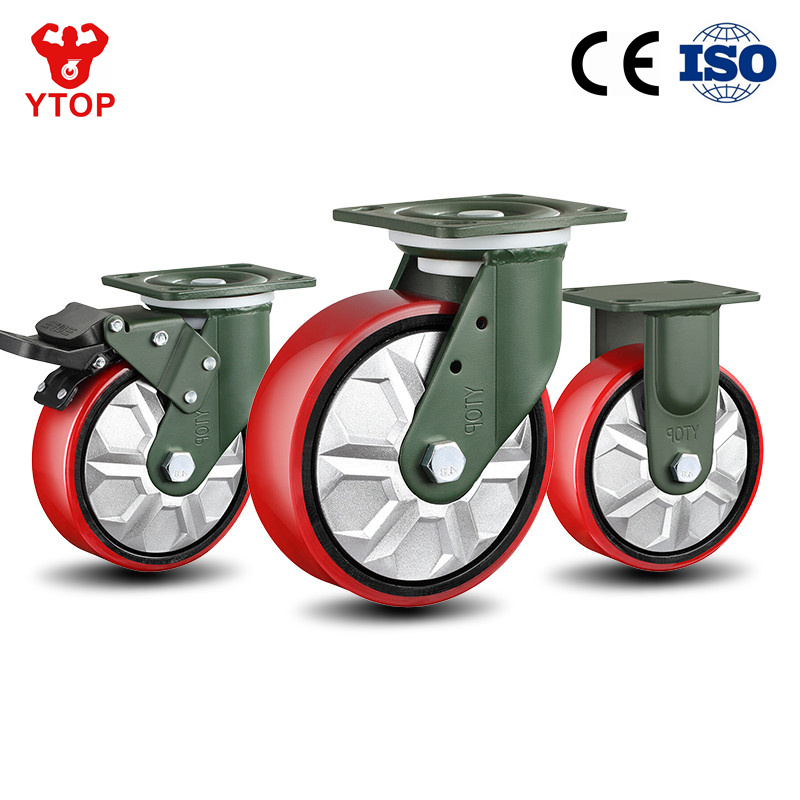
Large Wheel Diameter Does Not Equal More Load Capacity
First say a common understanding deviation: load capacity cannot only look at “8-inch.”
8-inch is foot caliber, about 200mm, refers to wheel diameter. Large wheel diameter, good passability, force distribution relatively dispersed — this is its role. But wheel actual load capacity is determined by a combination of several factors:
- Wheel diameter determines the basis of load distribution and passability.
- Tread material determines wheel body compressive strength, hard material high load, elastic material relatively low load.
- Hub structure is the core of load bearing, material and structural strength directly determine maximum load.
- Bracket structure determines support upper limit, plate thickness and structural strength all inside.
So same marked 8-inch, elastic tread and hard tread load capacity may differ a lot, and cannot take wheel diameter as sole basis.
Load Capacity Level of 8-Inch Heavy-Load
According to industrial general caliber, 8-inch heavy-load specification per-wheel dynamic load commonly in the hundreds of kilograms range, and specifically which number it falls on depends on material and structural configuration. Static load is generally marked according to caliber higher than dynamic load, so when comparing load capacity need to note whether it’s dynamic or static caliber.
The difficult point of 8-inch lies in per-wheel load upper limit, and heavy-load equipment accounting uses dynamic load.
Reverse Engineer Specifications from Load Demand
Starting from demand reverse engineering is more reliable than starting from wheel diameter. First calculate per-wheel dynamic load, then determine specification grade.
For example: a piece of equipment total weight 1500kg, four wheels bearing, considering uneven force multiply a coefficient, calculated at 1.4, 1500 divided by 4 then multiplied by 1.4, gets per-wheel about 525kg demand. Then need to select specifications with per-wheel dynamic load above 600kg, and 8-inch heavy-load grade generally can cover.
If per-wheel demand exceeds 800kg, need to consider larger wheel diameter or heavier structure. The correct order of load capacity selection is calculating from total weight and distribution, rather than first deciding “I want 8-inch” then stuffing in.
Structural Details Under Heavy Load
8-inch heavy-load bearing, key lies in structural details. Hub thickened, bottom plate thickened, dispersing load to entire wheel set, avoiding single point concentrated pressure. Tread material selects hard or high-strength polyurethane according to load, not easy to deform or crack under heavy load.
There is another easily overlooked part: bearings. Heavy-load long-distance operation, bearings are the hard-hit area of heat generation and wear, and sealed structure and suitable lubrication can ensure wheels rotate under heavy load without seizing. Zhuoye’s heavy-load specifications configure hubs, bottom plates, and sealed bearings according to working conditions in this type of heavy-load structure, and when load demand is large, stating actual working conditions clearly in selection communication is more able to determine accurate model than simply reporting a wheel diameter size.

Where 8-Inch Heavy-Load Is Commonly Used
8-inch heavy-load casters typical usage scenarios have these categories:
- Heavy-load transport vehicles at ports and docks.
- Mobile equipment and processing machines in heavy workshops.
- Shifting and full-pallet transport of large warehousing shelves.
- Agricultural machinery and engineering machinery配套.
The common point of these scenarios is large load, hard floors, high usage intensity, and wheel structural margin all comes into play.
Verify Three Numbers with the Manufacturer
When selecting 8-inch heavy-load specifications, verify three numbers with the manufacturer: how much is per-wheel dynamic load, see whether can cover actual per-wheel load; tread material and hub structure, confirm load configuration; bracket plate and bottom plate thickness, measure structural redundancy. Three numbers match, this 8-inch is the 8-inch you want.
Provide equipment total weight, wheel count, floor conditions, and usage intensity to the manufacturer, and verify specifications according to dynamic load caliber. Size is the starting point, load configuration is the end point.
Related Reading
Explore more heavy-duty caster load capacity and specification guides:
- Caster Load Capacity Calculation: Dynamic vs Static — Learn how to calculate actual per-wheel load capacity correctly.
- Industrial Caster Load Grading Guide — Understand light, medium, heavy, and extra heavy duty classifications.
- Extra Heavy Duty Casters: Full Analysis — In-depth look at extra heavy duty casters and load capacity.
- Dual-Wheel Structure for Ultra-Heavy-Load Casters — Force analysis of dual-wheel casters for heavy loads.
- Heavy-Duty Casters Selection Guide — Learn how to select the right heavy-duty casters.
Explore our complete range of heavy-duty casters (150-610kg) and super heavy-duty casters (700-1600kg) including 8-inch heavy-load specifications, or contact our engineering team for expert load capacity verification.
Post time: Sep-15-2026