
Every cart, trolley, rack and machine base moves on two kinds of wheels: those that only go straight, and those that can turn. Choosing between fixed casters and swivel casters is the single most important decision in any material-handling project, yet it is also the one buyers get wrong most often. Pick only fixed casters and your trolley will fight you around every corner. Pick only swivel casters and a loaded platform may wander, wobble or become unstable at speed. This guide explains exactly how each type works, where each one wins, and how to combine them for safe, efficient, long-lasting movement.
Fixed Casters (Rigid Casters): Design and Characteristics
A fixed caster, also called a rigid caster, is the simplest possible wheel mount. The wheel is held between two fork arms in a fixed orientation, and the whole assembly is bolted or welded directly to the equipment frame. The wheel rolls forward and backward along a single axis; it cannot pivot left or right relative to the frame. This mechanical simplicity is the source of every advantage a fixed caster offers.
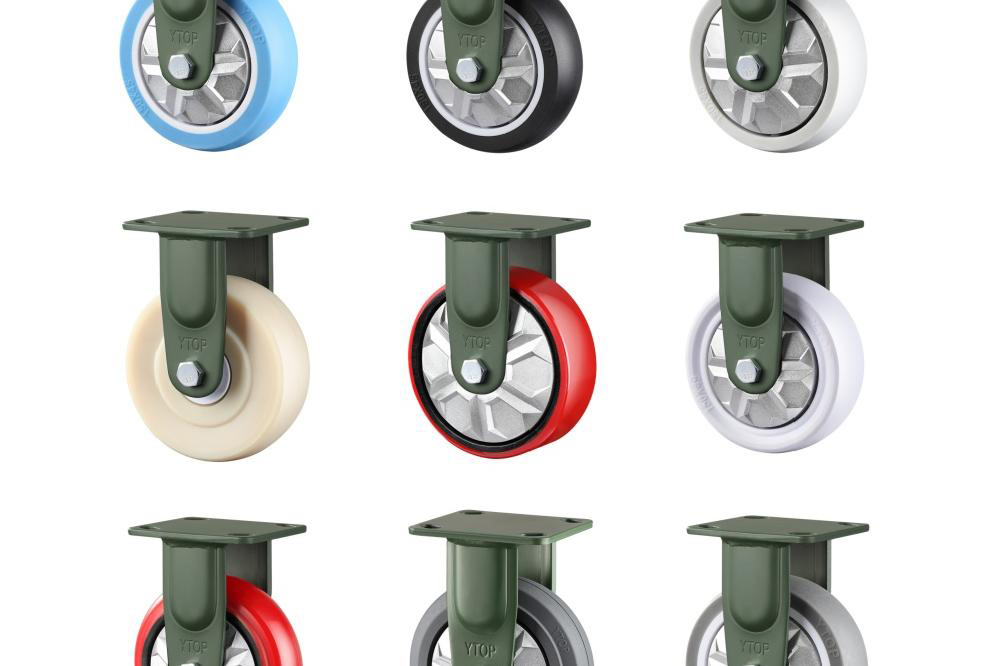
How a Fixed Caster Moves
Because there is no rotating swivel race between the frame and the fork, a rigid caster has nothing that can wobble, bind or wear out at the pivot. The load goes almost straight down through the fork legs into the wheel axle, and the wheel tracks true along the direction of travel. When a heavy load sits on four rigid casters, the platform behaves like a rail-guided cart: it resists side forces, resists drifting on sloped or oily floors, and stays where you stop it. For long, straight hauls down a warehouse aisle, fixed casters are unmatched.
The trade-off is maneuverability. A four-wheel cart on fixed casters can only move forward and backward. To change direction you must lift one end of the cart, drag it sideways, or drag the whole thing around in a wide arc. Indoors, in tight bays or around production machinery, this quickly becomes impractical and even dangerous.
- Straight-line tracking: excellent, with no wandering or shimmy.
- Stability under load: very high, since there is no pivot to deflect.
- Load capacity: highest, because load paths are short and direct.
- Structure: few moving parts, low cost, long service life.
- Steering: none on its own; direction is fixed.
Swivel Casters: Design and Characteristics
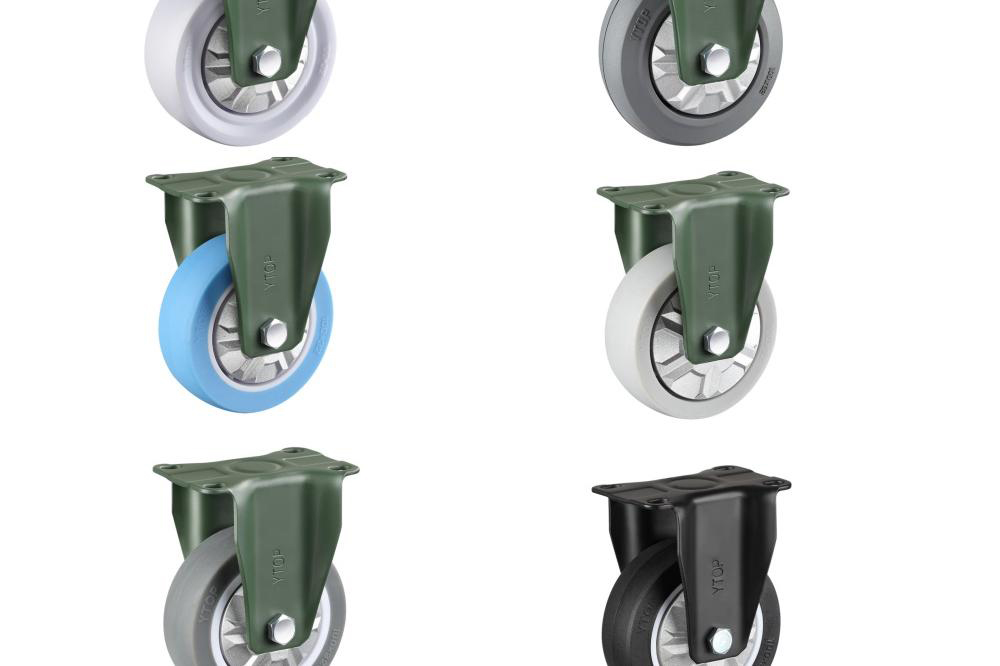
A swivel caster adds a rotating joint between the equipment frame and the wheel fork. Inside that joint is a swivel bearing race, usually two sets of hardened steel ball bearings running in curved raceways, separated by load-bearing balls. This race lets the fork and wheel spin a full 360 degrees around a vertical axis. The geometric detail that makes it work is the offset, or lead: the vertical swivel axis sits slightly ahead of the point where the wheel touches the floor. That offset makes the wheel trail behind the pivot, so it automatically aligns itself with the direction of travel the moment you push.
The Swivel Bearing Race Explained
On a cheap swivel caster, the race is a single row of balls in a shallow stamped raceway; under heavy, off-center loads the balls can dent the race, the swivel becomes stiff, and the wheel stops self-aligning. On a quality industrial swivel caster, the race is double-ball, heat-treated and sealed against dust and grease loss. The result is a caster that turns smoothly for years even when carrying several hundred kilograms. Because the swivel assembly adds parts, height and load offset, a swivel caster of the same size will almost always carry slightly less than its fixed equivalent. The rule of thumb is that a swivel caster loses roughly 10 to 20 percent of the published load capacity of the same-wheel fixed version, because part of the vertical load becomes a twisting moment on the swivel bearings.
- 360-degree turning: the wheel can spin in place and follow curved paths.
- Self-aligning: the offset makes the caster trail and follow push direction automatically.
- Maneuverability: excellent in tight spaces; a cart can turn within its own length.
- Structure: more complex, with a swivel race, washers and seals.
- Load capacity: slightly lower than the same-size fixed caster.
Fixed vs Swivel Casters: Detailed Comparison
Choosing between the two is not a matter of one being better; each dominates a different set of criteria. The table below summarizes the trade-offs engineers weigh when specifying a caster setup.
Side-by-Side Comparison
| Criteria | Fixed (Rigid) Casters | Swivel Casters |
|---|---|---|
| Turning ability | Only straight lines; no steering. | 360-degree rotation; turns on the spot. |
| Stability | Very high; tracks true, resists drift. | Good, but can wander or shimmy at speed or on uneven floors. |
| Load capacity | Highest; direct load path. | About 10-20% lower for the same wheel size. |
| Floor footprint for turning | Needs wide turning space. | Turns within its own length. |
| Structure & cost | Simple, fewer parts, lower price. | Complex swivel race, higher price. |
| Maintenance | Nearly none; only the wheel bearing. | Needs swivel race inspection and lubrication. |
| Best for | Long straight runs, heavy loads, rails. | General carts, tight aisles, frequent turning. |
In practice the biggest hidden difference is maintenance. A fixed caster essentially needs the wheel axle greased and little else. A swivel caster, by contrast, has a second rotating joint that can stiffen if water or dust gets past the seals, and a stiff swivel race is the most common reason a trolley suddenly becomes hard to steer. Budget for swivel bearing care from day one.
Combining Fixed and Swivel Casters: The 2+2 Configuration
Almost no industrial cart uses four identical casters. The winning compromise for the vast majority of four-wheel carts is two swivel casters and two fixed casters, arranged so the fixed casters sit in line with the direction of travel at one end, and the swivel casters sit at the other end near the handle or push point. This is known as a 2+2 configuration.
Why 2 Swivel + 2 Fixed Is the Industry Standard
With this layout, the two fixed casters act like a pair of rails that keep the cart from wandering in a straight line, while the two swivel casters let the operator steer. Pushing forward, the cart tracks straight and stable, much like a car with fixed rear wheels. Pulling back or pushing at an angle, the swivel ends pivot and the cart turns in a controlled arc. The 2+2 setup gives you roughly 80 percent of the stability of an all-fixed cart and 80 percent of the maneuverability of an all-swivel cart, at a lower cost than either extreme. It is the default recommendation for flat trolleys, platform carts, laundry carts and service trolleys.
The exceptions are important:
- All-swivel (4 swivel): best when the cart must turn within its own length, such as office chairs, medical beds, instrument stands and small mobile cabinets. The cost is reduced straight-line stability and a tendency to “crab” sideways when pushed fast.
- All-fixed (4 rigid): reserved for very heavy, rarely turned equipment that travels along defined paths, such as machine bases, furnace carts on rails, or dies moved along a straight production line.
- 2 swivel + 2 fixed with brakes: the all-purpose workhorse for industrial trolleys, where both steering and secure parking are required.
Caster Configuration by Equipment and Application
The right caster count and orientation follow directly from how the equipment is used. Below are the configurations most often specified.
Matching the Caster Setup to Your Equipment
- Office chairs and light stands: four swivel casters (often 5 on a star base), all without brakes. Maneuverability inside a small room matters far more than load.
- Two-wheel hand trucks and sack trucks: not applicable in the four-wheel sense; the unit tips between a walking position and a loaded rolling position.
- Flat trolleys and push carts: the classic 2 swivel + 2 fixed layout, with brakes on at least the two swivel casters.
- Industrial material-handling carts: 2 swivel + 2 fixed, with total-lock brakes, or all-fixed if the cart shuttles along a fixed line.
- Heavy machine bases and dies: all-fixed casters or 2+2 with heavy-duty swivels at one end, plus floor locks for parking under static load.
- AGV and automated platforms: specialized swivel or driven casters with precise swivel bearings; consult our engineering team before selecting.
Brake Options: Single, Double and Total Lock
Brakes are what let a movable piece of equipment stay put. Three brake types dominate:
- Single (side) brake: a foot pedal locks the wheel rotation only. The wheel stops turning, but the fork can still swivel, so the cart can still slide or rotate slightly. Cheap and simple; fine for light, level work.
- Double (dual) brake: locks both the wheel rotation and the swivel rotation at the same time. Once engaged, the caster is fixed in both axes, giving the cart a stable, defined orientation. This is the standard choice for industrial trolleys.
- Total lock / directional lock: a separate mechanism that freezes the swivel at 0 or 90 degrees. With swivels locked straight, a 2+2 cart behaves like an all-fixed cart for long straight hauls, and unlocks for cornering.
As a rule, fit brakes on the swivel casters at the push end, where the operator can reach them. Under HSE and warehouse safety rules, any cart over roughly 150 kg should have at least two braked casters, and equipment exposed to ramps, drains or vibration should use double brakes rather than single ones.
Caster Selection Checklist
Before you order, run through this checklist. It forces the decisions that usually get made too late.
Step-by-Step Buying Checklist
- Define the total weight: equipment plus load, then divide by the number of casters, and add a safety factor of at least 1.2 to 1.5.
- Decide straight-line vs turning needs: long fixed routes favor fixed casters; frequent turning favors swivels.
- Choose the layout: 2 swivel + 2 fixed for most carts; all-swivel for office and medical; all-fixed for rail-guided heavy loads.
- Specify brakes: single for light use, double for industrial trolleys, total-lock when long straight runs matter.
- Match the wheel material to the floor: rubber for protection and quiet, polyurethane for durability on concrete, nylon for chemical resistance.
- Check installation dimensions: mounting plate size, hole spacing, overall height and swivel radius.
- Verify the rated load of the swivel version: remember it is lower than the fixed version of the same wheel.
- Confirm the environment: temperature, moisture, oil, chemicals and wash-down frequency.
Frequently Asked Questions
What is the difference between a fixed and a swivel caster?
A fixed (rigid) caster holds the wheel in one direction and can only roll straight. A swivel caster has a rotating bearing race above the fork, letting the wheel pivot a full 360 degrees so the cart can turn and steer. Fixed casters are more stable and stronger; swivel casters are far more maneuverable.
How many swivel and fixed casters should a trolley have?
For most four-wheel push trolleys, the best configuration is two swivel casters and two fixed casters (the 2+2 layout), with the swivels at the handle end. This gives straight-line stability together with controlled cornering. All-swivel suits small, light furniture; all-fixed suits heavy, rail-guided equipment.
Do swivel casters have a lower load capacity than fixed casters?
Yes, typically by about 10 to 20 percent for the same wheel size. The vertical load creates a twisting moment on the swivel bearings, so a quality manufacturer publishes a separate, slightly lower rating for the swivel version. Always size the casters to the swivel rating when you use swivels.
Which brake should I choose for an industrial cart?
For industrial use, choose a double (dual) brake that locks both the wheel and the swivel, or a total-lock brake if the cart also runs long straight distances. A single side brake is acceptable only for light, indoor, level applications, because it leaves the fork free to rotate.
Can I mix fixed and swivel casters of different sizes?
It is best to keep all four wheels the same diameter and total height. Mixing sizes causes one wheel to carry more than its share of the load, leading to overload, flat spots and premature failure. If a non-standard height is unavoidable, have the supplier engineer the load distribution for you.
Related Reading
- Polyurethane vs Nylon Swivel Casters: Wear Resistance and Load Resilience
- What Core Parameters Need Attention in Industrial Caster Selection
- How to Calculate Industrial Caster Load Capacity: Dynamic vs Static Load
- How to Properly Use Industrial Casters to Extend Service Life
- How Are Industrial Caster Loads Graded: Light, Medium, Heavy and Extra Heavy
- Heavy Duty Casters (150-610kg)
- Medium Duty Casters (100-190kg)
- Contact Our Caster Engineers for a Tailored Selection
Post time: Sep-06-2025