
When buyers talk to a caster manufacturer, the phrase “offset distance” often stops the conversation. The parameter looks minor, yet it directly determines whether a cart steers lightly or stiffly, whether it runs straight under heavy load, and whether the swivel assembly feels precise or vague. It is a number that cannot be avoided in any swivel caster design, and understanding its logic is the difference between ordering by spec sheet and ordering the right caster.
Caster offset — also called caster lead — sounds technical, but the principle behind it is straightforward. Once you see how it works, the trade-offs become obvious, and you can discuss steering feel with a manufacturer on the right terms.
What Caster Offset (Lead) Actually Is
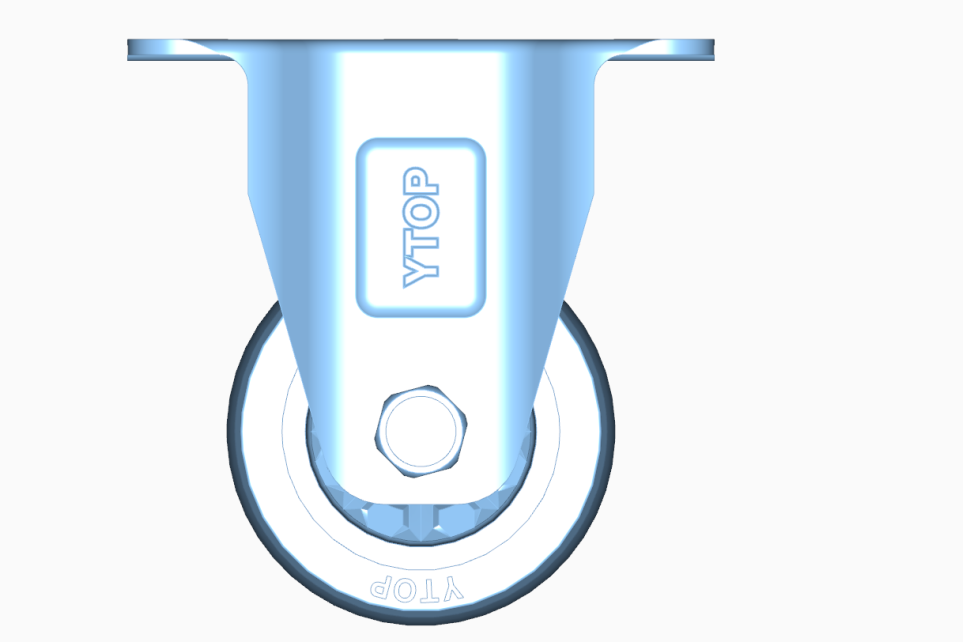
Caster offset is the horizontal distance between the swivel caster’s steering axis — the vertical line around which the bracket rotates — and the point where the wheel touches the floor. For a swivel caster to rotate 360 degrees, the steering axis cannot pass exactly through the wheel contact point. If it did, the wheel would only spin in place and could neither roll nor follow direction. A small gap between the vertical axis and the contact point must be left, and that gap is the offset.
This offset is the physical basis that lets a swivel caster turn. When the bracket rotates around the vertical axis, the wheel contact point sweeps a small circle around the axis. Floor resistance then pulls the wheel to align itself with the direction of travel, so the wheel automatically follows the push rather than fighting it. Without offset, the caster would behave rigidly in every direction; with offset, self-aligning steering becomes possible. Rigid, non-swivel casters by comparison have no offset at all, because their wheel is fixed in one direction and there is no vertical axis to offset — which is exactly why carts typically combine rigid casters at the rear with swivel casters at the front.
How Offset Size Changes the Steering Feel
The size of the offset brings a completely different steering feel, and buyers can sense the difference immediately. With a small offset, the steering axis sits close to the contact point: the wheel steers flexibly, a light push turns it, and control feels sensitive. The trade-off is stability. Under heavy load or higher speed, straight-line retention weakens and the caster is more likely to wander or shimmy.
With a large offset, the steering axis sits farther from the contact point: steering resistance rises slightly, but straight-line stability improves noticeably, the caster holds direction better, and heavy-load rolling feels more composed. So the choice is a trade-off, not a ranking. Small offset buys flexibility, large offset buys stability. Neither larger is better nor smaller is better — the right value depends entirely on how the caster will be used.
Matching Offset to Working Conditions
In practice, offset orientation changes with the job:
- Occasions that need frequent steering in narrow spaces — supermarkets, hospitals, turnover carts — benefit from a moderate, slightly small offset, prioritizing steering flexibility.
- Heavy-load, long-distance straight hauling — ports, workshop transport lines — benefits from a slightly larger offset, prioritizing straight stability and no deviation.
- High-speed moving equipment — AGVs and industrial tractors — needs the offset to be finely designed against speed, balancing flexibility and stability rather than picking an extreme.
Tell the manufacturer how often the cart turns versus how much it runs straight, and they can steer the offset design toward the right side of the trade-off. Ordering a standard series value without thinking about this usually leaves you either fighting heavy steering on a cart that rarely turns, or chasing wandering on a cart that almost never leaves a straight line.
You do not need to calculate the offset yourself, but you do need to understand its logic: small offset steers flexibly, large offset holds the line, and heavy load leans toward stability. During selection, describe your working conditions — more turning or more straight-line travel, how much load, how high the moving speed — and the manufacturer matches the offset design accordingly. Thinking through the trade-off behind the parameter is what lets you ask the right questions in the first place.
Heavy Load Amplifies the Offset Trade-off, and Structure Makes It Real
Under heavy-load scenarios, the effect of offset is amplified. A large load means large floor resistance at the contact point. If the offset is large, the torsion moment on the vertical-axis bearing grows, and steering becomes heavy and laborious. If the offset is too small, straight-direction stability under heavy load deteriorates, and the caster feels vague. Heavy-load swivel casters therefore require an offset design that sits in the balance point between these two ends, and it must be considered together with bracket strength. This is why professional manufacturers design offset separately by load grade rather than applying one universal value across the whole series.
Offset is a design parameter on a drawing, but good feel is delivered by structure. With the same offset value, different vertical-axis tolerances and rotating-part precision produce very different steering smoothness. When the vertical axis and rotating parts fit well, steering stays light with no play; when the structure is loose, the vertical axis shakes under heavy load, and no offset design can rescue the feel. YTOP Manganese Steel Casters greases its swivel rotating parts with molybdenum-disulfide lithium-based grease to keep steering smooth over time, designs brackets to heavy-load structures so the rotating mechanism does not deform under load, and treats the bracket surface with powder coating so the steering precision survives oily, dusty workshops longer. Offset is only worth as much as the structure that carries it.
Related Reading
Looking for more in-depth caster guides and industrial mobility resources? Explore these related articles:
- What Is a Universal Wheel? — Main applications of swivel caster wheels and where they are commonly used.
- Good vs Bad Casters — Key visual and structural signs that separate quality casters from low-quality alternatives.
- 10 Core Parameters — Essential parameters including offset and lead for caster selection.
- Caster Bearing Selection — Compare ball vs. sealed bearings for steering stability applications.
Explore our complete range of heavy-duty casters (150-610kg) and super heavy-duty casters (700-1600kg) for diverse industrial applications, or contact our engineering team for expert caster application knowledge and selection guidance.
Post time: Oct-21-2026