
When a single wheel has to support the weight of a printing press, a transformer, a stack of steel coils or an airport baggage tug, ordinary heavy-duty casters are simply not enough. The load is so large, and the consequences of a failed caster so serious, that a separate class of product has evolved: extra heavy duty industrial casters, sometimes called super heavy duty or ultra-heavy casters. This guide explains what they are, how they are built, where they are used, and how to specify them correctly.
What Are Extra Heavy Duty Industrial Casters?
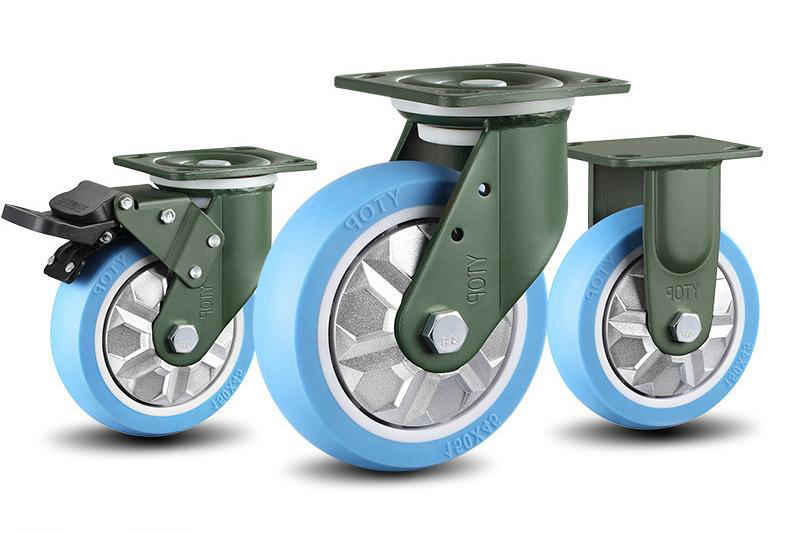
An extra heavy duty industrial caster is a wheel assembly engineered to carry extreme static and dynamic loads per wheel, typically from 700 kg up to 1,600 kg or more per caster. On a four-caster set that translates to a moving platform of 2.8 to 6.4 tonnes, and with dual-wheel configurations the total moving weight can rise well above that. These casters are not simply oversize versions of shop-floor wheels; they are precision-engineered structural components, designed and tested the way crane hooks or forklift forks are.
How They Are Classified
The caster market is usually divided by load per wheel. Light-duty casters cover roughly 35 to 80 kg, medium-duty about 100 to 190 kg, heavy-duty from 150 up to around 610 kg, and the extra heavy duty band starts at about 700 kg and extends to 1,600 kg and beyond. Once a project crosses the 700 kg-per-wheel threshold, buyers move from catalog hardware into engineered, made-to-order products: bracket thicknesses measured in millimetres of forged steel, wheel diameters of 200 mm and up, and bearings selected for both radial load and swivel moment. Safety factors of 1.25 to 1.5 become standard, because a caster failure at this load level is a safety incident, not just a service delay.
Structural Features of Extra Heavy Duty Casters
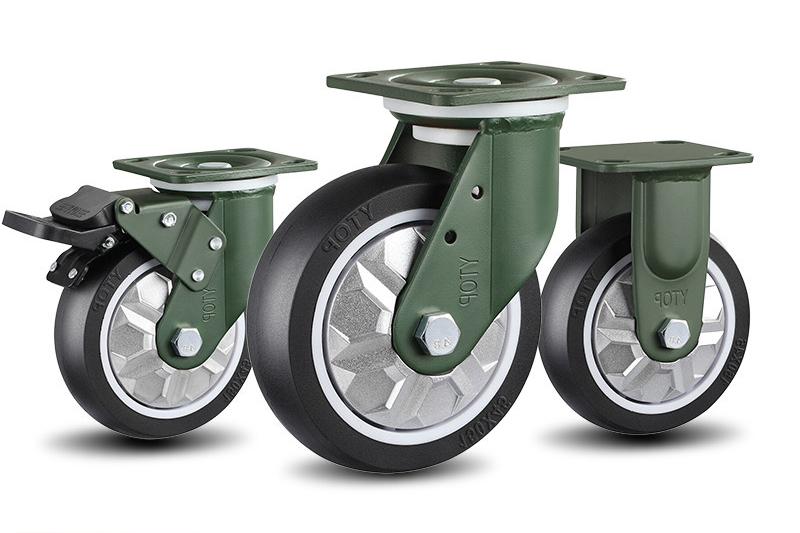
Every weakness in a caster is magnified at multi-tonne loads, so each structural part is upgraded. A typical extra heavy duty caster is built around several defining features.
Bracket, Wheels, Bearings and Welding
- Thickened, high-grade steel bracket: the fork and mounting plate are cut from 8 to 12 mm or thicker steel plate, often forged rather than stamped, to resist bending under point loads. Manganese steel, forged steel and ductile iron brackets are common.
- Large wheel diameter: wheels of 200 mm, 250 mm, 300 mm or more roll more smoothly over expansion joints, drains and minor floor damage, and reduce the pushing force needed to start a several-tonne load.
- Cast iron or polyurethane-on-steel wheel treads: solid cast iron wheels carry enormous loads and resist heat, while polyurethane (PU) treads bonded to cast iron centers protect floors while keeping high capacity. Soft rubber is generally unsuitable at these loads because it deflects and generates heat.
- Double-ball swivel races and tapered roller bearings: the swivel joint uses hardened, dual-row ball races; the wheel axle commonly uses tapered roller or double-row ball bearings that absorb both vertical load and side thrust.
- Robust welding and bolting: critical joints are robot-welded and often stress-relieved; mounting plates use extra-large bolt patterns, and many designs offer dual-wheel configurations to spread the load across two wheels side by side.
Core Application Areas
Extra heavy duty casters earn their place wherever very heavy equipment must still be moved periodically rather than permanently grouted to the floor.
Industry Use Cases
- Heavy machine tools and presses: injection moulding machines, stamping presses and CNC machining centres that must be moved for installation, maintenance or plant re-layout.
- Chemical and process equipment: reactors, mixing tanks, boilers and distillation skids, often in corrosion-resistant versions with powder-coated brackets.
- Power and electrical infrastructure: transformers, switchgear cabinets and generator sets that must be relocatable but rarely moved.
- Construction and formwork: heavy scaffolding towers, formwork carriages and construction elevators that move on rugged outdoor surfaces.
- Aerospace and defence: engine stands, tooling fixtures and aircraft dolly systems, where certification and traceability are essential.
- Ports, shipping and logistics: container dollies, heavy baggage tugs, coil cars and shipyard carts working on rough, salt-exposed concrete.
- Steel, automotive and mould shops: die carts, mould carriers and body-in-white transport vehicles carrying several tonnes per unit.
Design, Manufacturing and Load Testing
A reliable extra heavy duty caster is the product of a deliberate engineering process, not a catalog specification. The sequence usually runs material selection, wheel geometry, bearing selection, surface treatment and validation testing.
Materials, Surface Treatment and Testing
Material selection starts with the load and the environment: high-strength low-alloy steel for the bracket, forged steel or ductile iron for hubs, and cast iron, forged steel or PU-over-iron for the tread. Wheel design balances diameter (larger is easier to push but raises overall height) against width (wider wheels spread load and protect floors). Bearing selection pairs the axle bearing with the swivel race so neither becomes the weak point. Surface treatment for corrosive environments uses multi-stage powder coating, zinc plating or even hot-dip galvanising to survive salt spray and wash-down.
Critically, every batch undergoes load testing: static tests well above the rated capacity to check permanent deformation, and dynamic rolling tests over repeated cycles to confirm that the wheel, axle and swivel do not heat up, squeal or loosen. Reputable manufacturers provide test reports and a traceable batch record so the load rating on the nameplate is a proven figure, not a marketing one.
Flexibility vs Load: Extra Heavy Duty vs Standard Heavy Duty
There is always a trade-off between carrying more weight and moving it easily. Extra heavy duty casters win decisively on capacity, but they introduce trade-offs: heavier brackets raise the equipment’s centre of gravity, larger wheels raise overall height, and very stiff treads transfer more vibration and noise to the floor.
Side-by-Side Comparison
| Feature | Standard Heavy Duty Caster | Extra Heavy Duty Caster |
|---|---|---|
| Load per wheel | 150 – 610 kg | 700 – 1,600 kg+ |
| Bracket | Stamped or mildly forged steel | Thick forged/welded steel or ductile iron |
| Wheel diameter | 100 – 200 mm typical | 200 – 300 mm+ typical |
| Bearing type | Single ball or plain bearing | Tapered roller / double-ball swivel race |
| Push effort | Low; easy to push by hand | Higher; often electric drive or tow-tug assisted |
| Typical use | Warehouse carts, racks, trolleys | Machines, tanks, dies, port dollies |
The practical rule is simple: once the equipment exceeds roughly two tonnes per set, or once the floor is uneven outdoors, step up to extra heavy duty rather than overloading standard casters. Forcing a heavy-duty caster past its rating deforms the swivel race and axles, creating the most dangerous failure mode of all: a caster that still rolls but has lost its self-aligning ability.
Key Selection Parameters and Maintenance
Specifying extra heavy duty casters correctly means nailing down a short list of parameters that determine safety and service life. Get them wrong and even a premium caster will fail prematurely.
Sizing Checklist and Care Tips
- Rated load per caster: divide total weight by the number of casters (often 4), then apply a 1.25-1.5 safety factor; remember swivel versions carry slightly less than fixed versions.
- Wheel diameter and tread material: choose the largest diameter the installation height allows, and match the tread to floor protection requirements.
- Mounting height and hole pattern: confirm the mounting plate dimensions, bolt spacing and overall height against the equipment drawing.
- Swivel radius and offset: larger offset improves self-alignment but adds push effort; verify it fits around the frame edges.
- Brake type: at this load, double or total-lock brakes are mandatory; consider floor locks or jacking stands for long-term parking.
- Maintenance: grease the swivel race and axle bearing on a scheduled basis, inspect for flat spots, cracked welds and loose bolts, and replace any caster showing discoloration or play rather than waiting for it to fail.
Market Landscape and Future Trends
The extra heavy duty caster field is served by two groups: long-established international brands known for engineering documentation and global service, and increasingly capable specialised manufacturers that combine forged-steel fabrication, in-house load testing and competitive lead times. Buyers are no longer choosing by brand name alone; they ask for test reports, material certificates and traceability.
Leading Manufacturers and Innovation Directions
On the innovation side, three trends are reshaping the category. First, dual-wheel and tandem-wheel designs spread extreme loads across two treads, lower floor pressure and reduce deflection. Second, precision swivel technology borrowed from AGV and automated guided vehicle systems is making heavy platforms steerable and trackable by electric drive. Third, materials science continues to push polyurethane blends that run cooler, resist chemicals and protect epoxy floors while retaining cast-iron-level capacity. For plant engineers, the message is that extra heavy duty casters are no longer a commodity: they are a safety-critical component worth specifying with the same care as the equipment they support.
Frequently Asked Questions
What load range counts as extra heavy duty?
Extra heavy duty industrial casters typically carry 700 kg to 1,600 kg or more per wheel, which means a four-caster platform can move between roughly 2.8 and 6.4 tonnes, and more with dual-wheel designs. Below about 700 kg per wheel, standard heavy-duty casters are usually sufficient.
What wheels are used on extra heavy duty casters?
They usually use large-diameter wheels (200 to 300 mm or more) with solid cast iron, forged steel, or polyurethane treads bonded to cast iron centres. Soft rubber is rarely used at these loads because it deflects, overheats and wears quickly.
How many extra heavy duty casters does a machine need?
Most equipment uses four casters, but the total load should be divided by four and then multiplied by a safety factor of 1.25 to 1.5. For very uneven floors, where one caster may briefly carry most of the load, a higher factor or a fifth caster at the centre is recommended.
Can extra heavy duty casters be pushed by hand?
Up to a point. On smooth, level floors a properly sized large-diameter caster can be moved by hand, but for loads above a few tonnes most facilities use an electric tug, tow motor or motor-driven caster to keep push effort within safe ergonomic limits.
How do I maintain extra heavy duty industrial casters?
Follow a scheduled lubrication plan for the swivel race and axle bearings, inspect welds, mounting bolts and wheel treads regularly, watch for flat spots, vibration or play, and replace worn casters early rather than waiting for failure. Keep the rated load nameplate visible for every unit.
Related Reading
- Advantages of Dual-Wheel Structure for Ultra-Heavy-Load Casters: Force Analysis
- How Are Industrial Caster Loads Graded: Light, Medium, Heavy and Extra Heavy
- How to Calculate Industrial Caster Load Capacity: Dynamic vs Static Load
- What Scenarios Are Manganese Steel Casters Suitable For?
- How Much Load Can 8-Inch Heavy Load Casters Bear? Full Analysis
- Super Heavy Duty Casters (700-1600kg)
- Heavy Duty Casters (150-610kg)
- Contact Our Engineering Team for a Custom Load Rating
Post time: May-08-2024