
What Are Universal, Airplane, and One-Way Wheels?
Wheels look simple from the outside, but once you start choosing them for a cart, suitcase, trolley, or piece of equipment, the differences matter a lot. Three of the most confusing names buyers run into are universal wheels, airplane wheels, and one-way (rigid) wheels. They are not three brands or three price tiers; they describe three different ways a wheel is built to move. Pick the wrong one, and a cart becomes hard to push, a suitcase tips over on rough pavement, or a heavy trolley drifts sideways across the factory floor.
Defining the Three Wheel Types
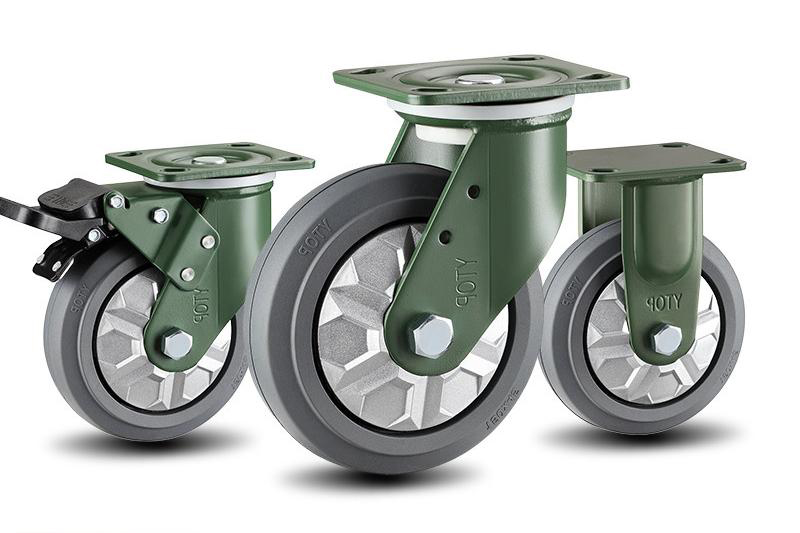
A universal wheel (also called a swivel caster) sits on a rotating fork that lets the wheel spin a full 360 degrees around a vertical axis. When you push the cart, the fork turns so the wheel automatically points in the direction of travel. An airplane wheel is a compact four-wheel cluster, usually four small wheels arranged in a square “eight-facet” layout inside a single housing; it is the little double-wheel cluster you see under modern hard-shell suitcases. A one-way wheel (also called a rigid or fixed caster) is locked to a straight axle: it rolls only forward and backward and cannot turn left or right on its own. Understanding what each one is designed to do is the fastest way to stop guessing.
Universal Wheels: 360-Degree Swivel and Flexible Steering
How Universal Wheels Work
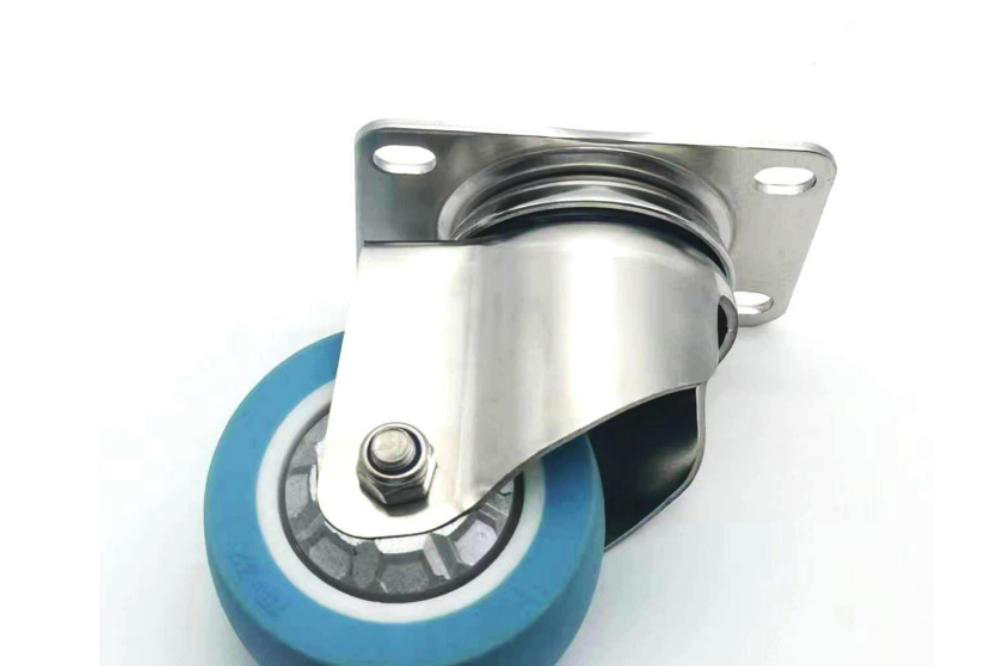
The defining feature of a universal wheel is the swivel bearing set under the fork. The wheel rotates around the horizontal axle as it rolls, while the entire fork rotates around the vertical swivel axis. Because the wheel sits slightly offset from the swivel axis (the “offset” or caster trail), the wheel naturally trails behind the direction you pull, exactly like the trailing wheel on a shopping cart. This is why a universal wheel feels like it “knows where to go” no matter which way you push.
Universal wheels come in many load classes. Light-duty models use plastic brackets and nylon or PP wheels; medium and heavy-duty models use stamped or steel brackets with ball or tapered bearings, and wheel faces of polyurethane, nylon, or rubber. The heavier the load you plan to move, the larger the wheel diameter and the more robust the swivel race should be.
Where Universal Wheels Excel
Universal wheels are the right choice whenever you need to turn corners, weave through aisles, back up, or reorient a cart without lifting it. Their sweet spots include office and lab equipment, serving trolleys, instrument stands, display racks, supermarket carts, and any cart that is pushed by hand in tight spaces. They also make loading and unloading in a narrow aisle far easier, because the operator can steer the cart in almost any direction from a standing position. The trade-off is that a cart with only universal wheels tends to wander and is hard to push in a dead straight line, which is why most practical carts mix them with rigid wheels.
Airplane Wheels: The Four-Wheel Luggage Cluster
Construction, Material, and Stability
An airplane wheel is not a wheel for aircraft. It is a compact caster cluster, most often four small polyurethane or TPR wheels arranged inside a single square housing, with the wheels contacting the floor at multiple points. The “eight-facet” name refers to the way the wheels are molded with multiple flat or faceted sections that spread the contact load. The wheels are usually made of soft rubber-like material (TPU, TPR, or soft PVC) rather than hard plastic or metal.
This design gives airplane wheels three useful traits. First, because four small wheels share the load in one housing, the cart sits very level and stable even on uneven tile or carpet. Second, the larger total contact area and soft rubber material roll quietly and do not scratch hard floors. Third, the multi-point contact absorbs small shocks, so a dropped suitcase does not tip the cluster over the way a single hard wheel might. The larger contact area also means slightly more rolling resistance, which is acceptable for the short, slow pushes a suitcase actually sees.
Why Luggage Relies on Airplane Wheels
Suitcases are the classic airplane-wheel application because they need to be pulled sideways, spun around, and parked upright on a hotel floor. A suitcase on four airplane-wheel clusters can be pushed in any direction, stands on its own when released, and rolls silently across tile and airport carpet. The same cluster design has spread to shopping baskets, rolling coolers, and small market carts where low noise, floor protection, and omnidirectional rolling matter more than carrying tons. Where airplane wheels struggle is heavy loads and rough outdoor ground: the small wheel diameter cannot bridge cracks, and the soft tread wears faster on concrete than a hard polyurethane wheel would.
One-Way (Rigid) Wheels: Straight-Line Strength
How Rigid Wheels Behave
A one-way wheel has no swivel fork at all. The wheel axle is fixed to the bracket, so the wheel can only roll forward and backward along the line it is pointed. Push the cart sideways, and the wheel skids instead of turning. This sounds like a limitation, but it is also the source of the rigid wheel’s strengths: there is no swivel race to wear out, no offset to create wobble, and the bracket can be built very simply and cheaply while carrying a very high load. Rigid wheels also track dead straight, which is exactly what you want when you are pushing several hundred kilograms down a warehouse aisle and have no interest in steering.
Hand Trucks, Bicycles, and Long-Haul Carts
You see one-way wheels wherever a straight, controlled path matters. Industrial hand trucks and platform trucks almost always use two rigid wheels at the rear and steer by lifting the front. Bicycle and trailer wheels are essentially large rigid casters. Heavy warehouse dollies, rail-guided carts, and long work tables that only travel between two fixed points rely entirely on rigid wheels because they are cheaper, more durable, and more stable under load than swivel wheels. The cost of that stability is zero turning ability on its own: a rigid wheel cart needs a human to lift one end and swing it around, or it must run on rails.
Head-to-Head: Universal, Airplane, and One-Way Wheels
Comparison Table
| Characteristic | Universal (Swivel) | Airplane Wheel Cluster | One-Way (Rigid) |
|---|---|---|---|
| Steering ability | Full 360 degrees | 360 degrees, via 4 small wheels | None; straight line only |
| Stability on flat floor | Good when mixed with rigid | Excellent, multi-point contact | Excellent, locked direction |
| Typical load per wheel | Light to heavy (35 kg – 1,600 kg) | Light (suitcase, basket class) | Light to very heavy |
| Noise level | Medium to quiet (depends on tread) | Very quiet, soft rubber tread | Depends on tread; metal is loud |
| Floor protection | Good with PU/rubber tread | Excellent, soft contact area | Poor with hard metal wheel |
| Best efficiency | Tight spaces, frequent turns | Slow, indoor, multi-directional | Long, straight, heavy runs |
| Typical use | Office carts, racks, equipment | Suitcases, baskets, coolers | Hand trucks, trailers, dollies |
Which Wins in Each Category
If steering freedom is the priority, universal and airplane wheels both win; the rigid wheel cannot compete. If raw load and durability are the priority, the rigid wheel wins because it has no swivel race to fail. If quiet, floor-friendly rolling is the priority, the airplane wheel cluster wins because of its soft, multi-point contact. No single wheel type is the best at everything, which is why real-world carts almost always combine them.
How to Choose: Selection Guide and Combination Schemes
The Classic Universal + Rigid Combination
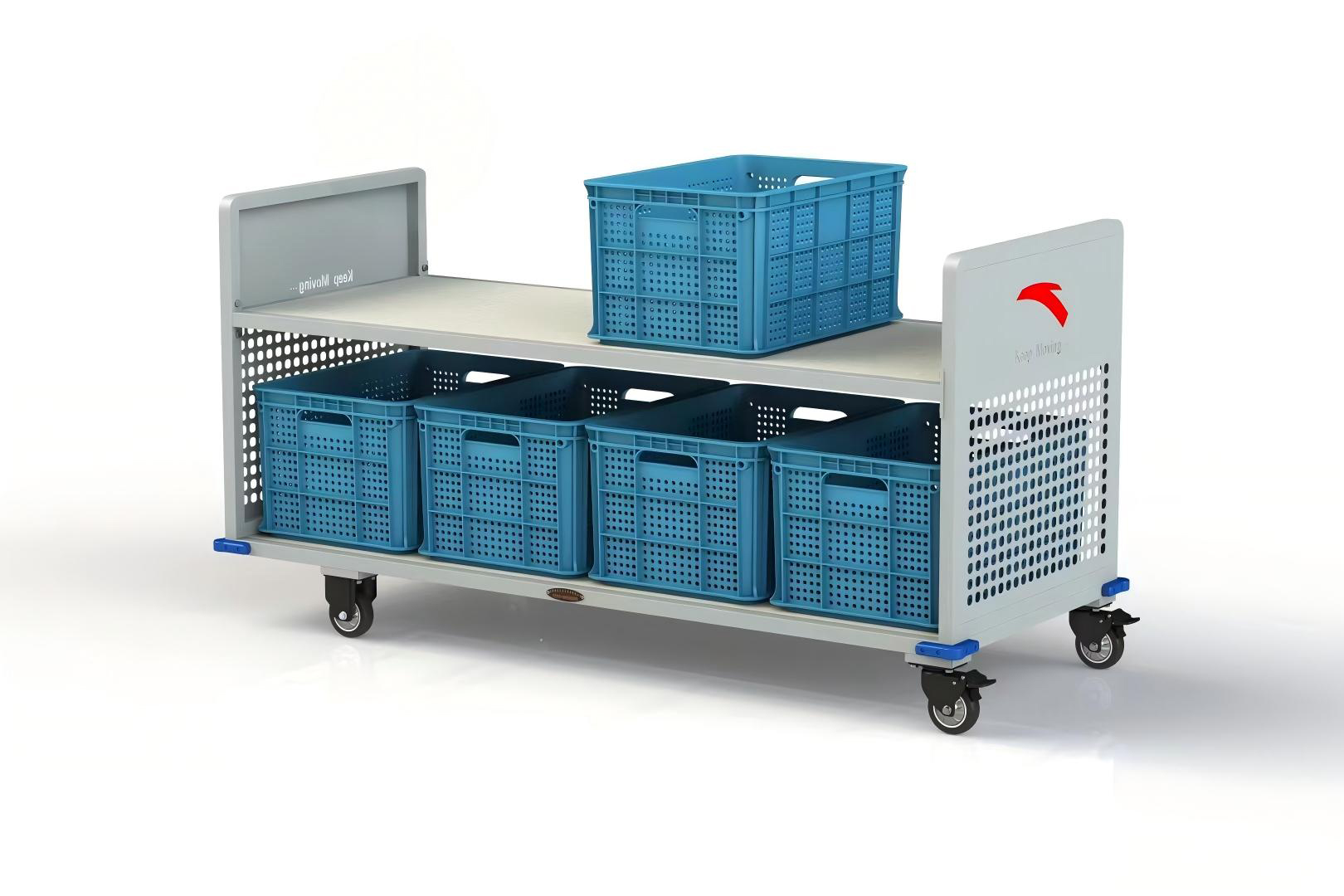
The most stable and maneuverable four-wheel cart uses two universal wheels and two rigid wheels. Place the rigid pair at the rear (or the end that follows the direction of travel) so it sets a straight course, and place the universal pair at the front so it steers. This gives you a cart that tracks straight under load but still turns at the front when you push it sideways. A cart with four universal wheels feels nimble but drifts; a cart with four rigid wheels will not turn at all. For very long or very heavy carts, a six-wheel layout with a middle swivel pair and two rigid end pairs spreads the load and keeps control. Match all wheels on the same cart by diameter and load rating, and always divide the total loaded weight by the number of wheels before choosing a rating.
Maintenance That Keeps Any Wheel Rolling
All three wheel types last longer with a few simple habits. Keep the swivel forks and wheel axles clear of hair, string, and packaging tape; clean them with a brush rather than hosing them down, which pushes grit into the bearings. Lubricate swivel races and axles once or twice a year with a suitable grease, and check that mounting bolts stay tight, because vibration is the number-one cause of loose brackets. Inspect the tread for flat spots, cracks, or embedded glass, and replace a wheel early if it wobbles or squeals; running on a damaged wheel quickly ruins the other wheels and the floor. For outdoor or wet use, choose brackets with powder-coated or plated finishes so the swivel race does not rust solid. Following these few steps keeps a wheel rolling smoothly through thousands of kilometers.
Frequently Asked Questions
What is the difference between a universal wheel and a swivel caster?
They are the same thing. “Universal wheel” is the common consumer and trade term for a caster whose fork rotates a full 360 degrees so the wheel follows the direction of travel. “Swivel caster” is the more technical engineering name. Both describe a wheel that turns left, right, forward, or backward rather than only rolling in one fixed direction.
Why do suitcases use airplane wheels instead of ordinary universal wheels?
An airplane wheel cluster puts four small soft wheels under one housing, so the suitcase sits flatter, rolls more quietly on tile and carpet, and resists tipping when it hits a seam. A single universal wheel carries the same load on one small contact point, which feels harsher and is more likely to tip over on uneven ground. The trade-off is that airplane wheels are lighter-duty and do not handle rough outdoor surfaces well.
Can I use all rigid (one-way) wheels on a rolling cart?
You can, but the cart will only roll in a straight line and will need to be lifted or swung to turn. That is fine for a fixed work table or a rail-guided dolly, but impractical for a hand-pushed cart. The standard solution is two rigid wheels for straight tracking plus two universal wheels for steering.
Which wheel type carries the heaviest load?
Generally the rigid (one-way) wheel, because it has no swivel bearing to weaken the bracket, followed by heavy-duty universal swivel casters built for the job. Airplane wheel clusters are the lightest-duty of the three and are not designed for industrial loads. Always size the caster rating to the total load divided by the number of wheels, with a safety margin.
How do I know when to replace my wheels?
Replace a wheel if the tread is worn flat, cracked, or chunked; if the wobble is visible when spun; if the swivel fork no longer turns freely; or if the mounting plate is bent. Do not wait for a complete failure, because a seized caster can overload the other three and make the cart tip. Replace wheels in matched sets of the same diameter and rating.
Related Reading
- What Is a Universal Wheel and Where Is It Mainly Used?
- In-Depth Understanding of the Structure of Casters
- What Are the Common Caster Specifications?
- Classification of Casters by Different Criteria
- Removal and Installation of Universal Wheels: An Easy-to-Follow Guide
- Medium Duty Casters (100-190 kg)
- Heavy Duty Casters (150-610 kg)
- Contact Us for Help Choosing the Right Wheels
Post time: Nov-14-2023