
A waste transfer station is the one industrial site where the load is unpredictable, the floor is often wet, and the ground is littered with things that cut. Casters here are not chosen for elegance; they are chosen for how long they survive being run over broken glass, wire and wet cardboard.
This article covers what actually destroys casters at a transfer station or a recycling plant, and the specification that holds up.
Five Conditions at a Transfer Station
Five conditions combine here, and each of them is unusual.
The floor carries debris. Broken glass, wire, strapping and crushed cans lie on the slab, so the wheel is rolling on a bed of sharp material rather than on concrete.
Water and leachate are present. Waste is wet, bins leak, and wash-down water carries organic material that is mildly corrosive and aggressively slippery.
Loads are heavy and uneven. A bin loaded with mixed waste is dense and badly balanced; the weight shifts as the bin is tipped.
The equipment is abused. Bins are dragged, bumped against compactors, and pushed over kerbs by loaders who have no reason to be gentle.
And the site is outdoors or semi-outdoors, so casters see rain, frost and grit in the same shift.
Debris Under the Wheel
The single largest cause of caster failure at a transfer station is debris, and the mechanism is worth understanding.
A wheel rolling over glass or wire does not crush it. It cuts it into the tread and carries it into the raceway, where it acts as a cutting tool against the track. The wheel then wears from the inside while the outside still looks serviceable.
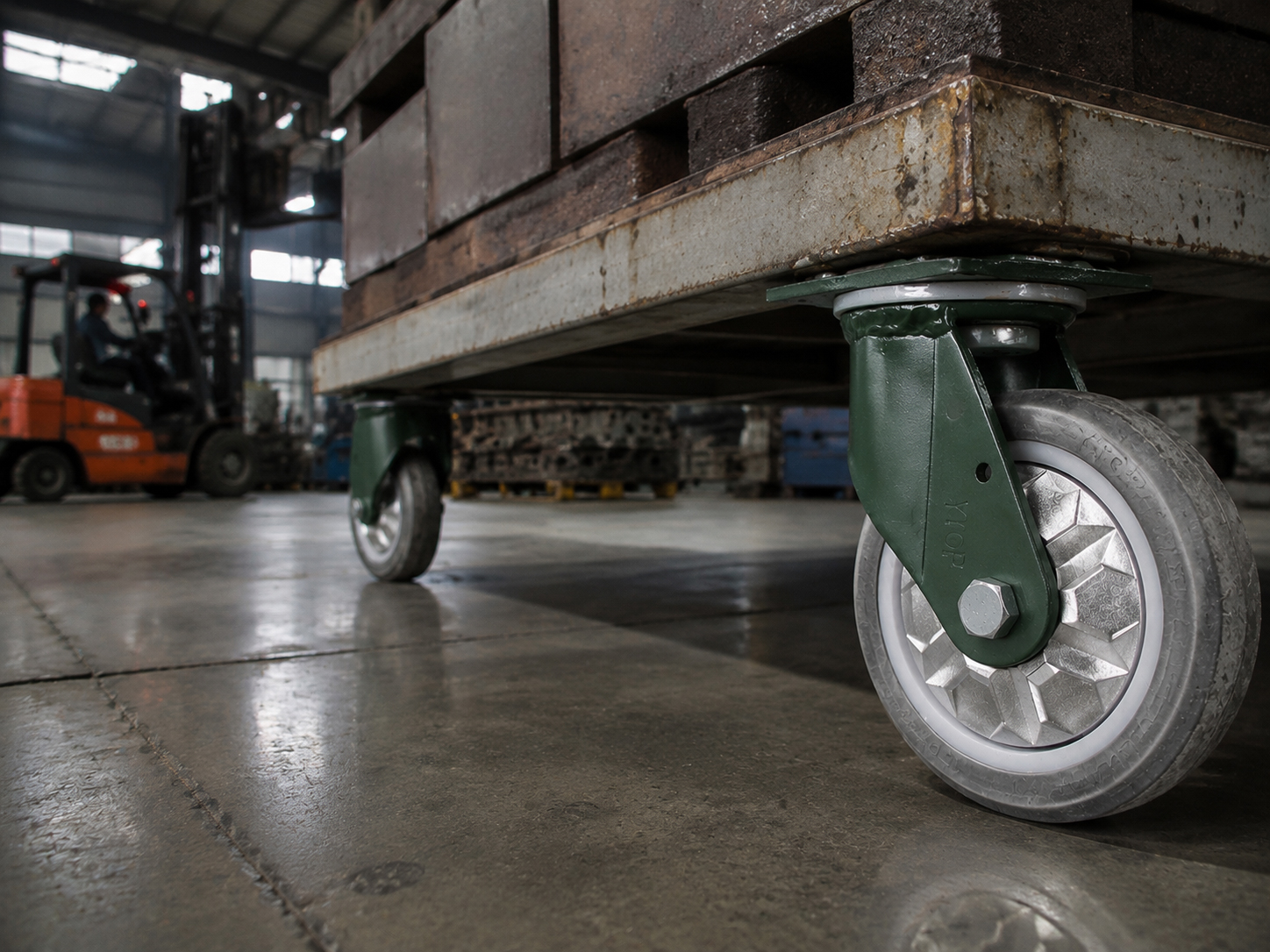
Two defences work. A hard tread — cast nylon or hard PU — resists cutting far better than soft rubber, which swallows the debris and then tears around it. And a sealed raceway with a metal shield stops what the tread has picked up from reaching the bearing.
Soft rubber has one genuine advantage here: grip on wet, greasy concrete. Where the site is wet but relatively clean of sharps, it is a defensible choice. Where there is glass on the floor, it is not.
Leachate, Wash-Down and Corrosion
Waste leachate is not water. It is acidic to neutral, full of organic acids and salts, and it stays on the caster after the surface has dried.
The result is predictable. Zinc plating fails at the plate edges where the coating is thinnest. Painted brackets rust around the swivel, which is the one place water cannot drain. And standard grease emulsifies, so the raceway runs with a wet paste instead of a lubricant.
Where bins are washed regularly, a stainless or hot-dip galvanised bracket is justified; where they are not, a heavy coated bracket with a sealed raceway will last if the joint is greased with a water-resistant grease.
Weight, Balance and Tipping
A waste bin is the worst-balanced load in industry. The mass is uneven, it shifts as the bin is emptied, and the centre of gravity is high because the bin is tall.
Three consequences follow for the caster.
The static rating is misleading, because when a bin is tipped, two casters take almost the entire load. Size on the worst single caster, not the average quarter.
Lateral loads are real, because bins are dragged sideways into position. A cast bracket with a thin wall does not survive that; a formed bracket with a heavier wall does.
And the top plate needs area, not just thickness, so the load spreads across the bin’s base plate instead of concentrating at four bolt points.
Wheel Choice for Waste Handling
Three options cover most transfer stations.
Cast nylon is the usual workhorse: hard enough to resist glass and wire, resistant to leachate, and quiet enough for an indoor tipping floor. It is the default for bins that move between the tipping hall and the container.
Cast iron or steel is the choice for the heaviest bins and for the yard where debris is worst. It does not cut and it does not embed, and it survives being run over a kerb. The cost is weight and floor damage.
Hard polyurethane is the compromise where the floor must be protected — for instance on a new epoxy tipping floor — or where noise matters. It resists cutting better than rubber but less well than nylon.
Pneumatic wheels appear occasionally on yard carts; they improve the ride on rough ground but are destroyed quickly by sharps, so they are rarely worth it here.
Compactors, Kerbs and Impacts
The compactor is where brackets break.
Bins are pushed into the compactor and bumped against its frame, so the caster takes a lateral impact at the fork every cycle. Over a shift that is hundreds of impacts, and over a year it is enough to fatigue a light bracket even though the wheel itself is fine.
Kerbs and ramps add vertical impact, and a bin pushed off a kerb lands on two casters with the full weight plus the drop.
What survives is a thick formed bracket, a larger plate, and a wheel with some compliance so the shock is partly absorbed. What does not survive is a welded bracket with a thin wall, however high its rated capacity.
Winter, Frost and Grit
Outdoor transfer stations have a winter problem that indoor plants do not.
Grit spread on ice is abrasive and it works its way into every joint. Frost makes nylon brittle, and a brittle wheel that takes an impact at minus ten degrees cracks rather than deflects.
Where the site operates through winter, a wheel compound that stays tough at low temperature is worth specifying, and the grit problem is best handled by cleaning joints rather than by any material choice.
Maintenance in a Hostile Site
Four habits cover most of the risk, and none of them requires a workshop.
Pick debris out of the tread and the fork at the end of each shift; on a transfer station floor this takes two minutes per bin and removes the main cause of bearing failure.
Clean and dry the joint before greasing. Greasing over grit or leachate produces a paste that accelerates wear.
Check for vertical play monthly. In a site with debris, a worn raceway does not recover.
Replace rather than repair once the bracket shows rust at the bearing seat or a crack at the fork; both mean the caster is no longer holding the wheel square.
Specification Checklist
Six questions settle a transfer station caster order.
What debris is on the floor — glass and wire, or only cardboard and film?
Is the bin washed, and is leachate present on the slab?
What is the worst single-caster load when the bin is tipped?
Is the bin dragged sideways, and does it hit the compactor frame?
Does the site operate through winter, with grit and frost?
Does the tipping floor need protecting, or is it already rough concrete?
Answer those and the usual outcome is a cast nylon or iron wheel on a thick formed bracket with a sealed raceway, a separate softer specification only for the wash bay, and a spare set kept on site. The recurring mistake at transfer stations is buying a general warehouse caster with a high load number and discovering that neither the tread nor the bracket was designed for debris and lateral impact.
Related Reading
Two guides that support the choices above:
- One-Piece or Welded Bracket: Which Is Better? — why bracket construction decides lateral impact survival.
- Scrap Standards for Worn Casters — when replacement is cheaper than another repair.
Explore our heavy-duty casters (150-610kg) and super heavy-duty casters (700-1600kg), or contact our engineering team with the debris, the load and the wash routine.
Post time: Nov-24-2026