
A foundry is one of the few places where a caster can be destroyed without ever being overloaded. The load is often within the rating, the floor is flat, and the cart moves fifty metres a day — and the caster still fails inside three months, because the environment attacks it from four directions at once: radiant heat, iron scale under the wheel, impact from falling scrap, and graphite dust in every joint.
This article explains what each of those does to a caster, which materials survive, and how to set a replacement rhythm that matches the heat cycle rather than the calendar.
Why a Foundry Is Different
Four conditions combine in a foundry that rarely appear together anywhere else.
Ambient temperature near the furnace area is high enough to soften standard tread compounds and thin standard grease. The floor carries iron scale, sand and shot-blast grit, which is both abrasive and electrically conductive. Loads arrive by crane and by drop, so carts take impact rather than gradual loading. And the air carries graphite and fine sand dust that enters any joint that is not sealed.
Each condition is survivable on its own. Together they mean a standard warehouse caster has a service life measured in weeks.
What Heat Actually Does
Heat does not usually melt anything. It degrades the two materials that make a caster work quietly.
Grease loses viscosity and drains out of the raceway, so the swivel runs dry and the track begins to wear from the first shift. Polyurethane tread softens and takes a permanent set under a parked load, which turns into a flat spot that thumps on every revolution. Nylon holds its shape better but becomes brittle over long exposure and can crack at the fork contact.
The practical limit for standard PU is around 60 to 70 degrees Celsius continuous. Above that, a high-temperature grade or a different compound is required, and above roughly 120 degrees the choice narrows to phenolic, cast iron or a purpose-built high-temperature wheel.
Iron Scale Under the Wheel
Scale is small, hard and angular. A wheel rolling over it does not crush it; it cuts it into the tread and carries it into the bearing.
Two consequences follow. The tread wears in a pattern of scratches rather than evenly, and the debris that reaches the bearing acts as lapping compound, wearing the raceway from inside. This is the single most common reason a foundry caster fails with plenty of tread left.
The countermeasures are a harder tread that resists cutting, a sealed or shielded raceway, and a cleaning routine that removes scale from the joint rather than greasing over it.
Impact, Not Load, Breaks Forks
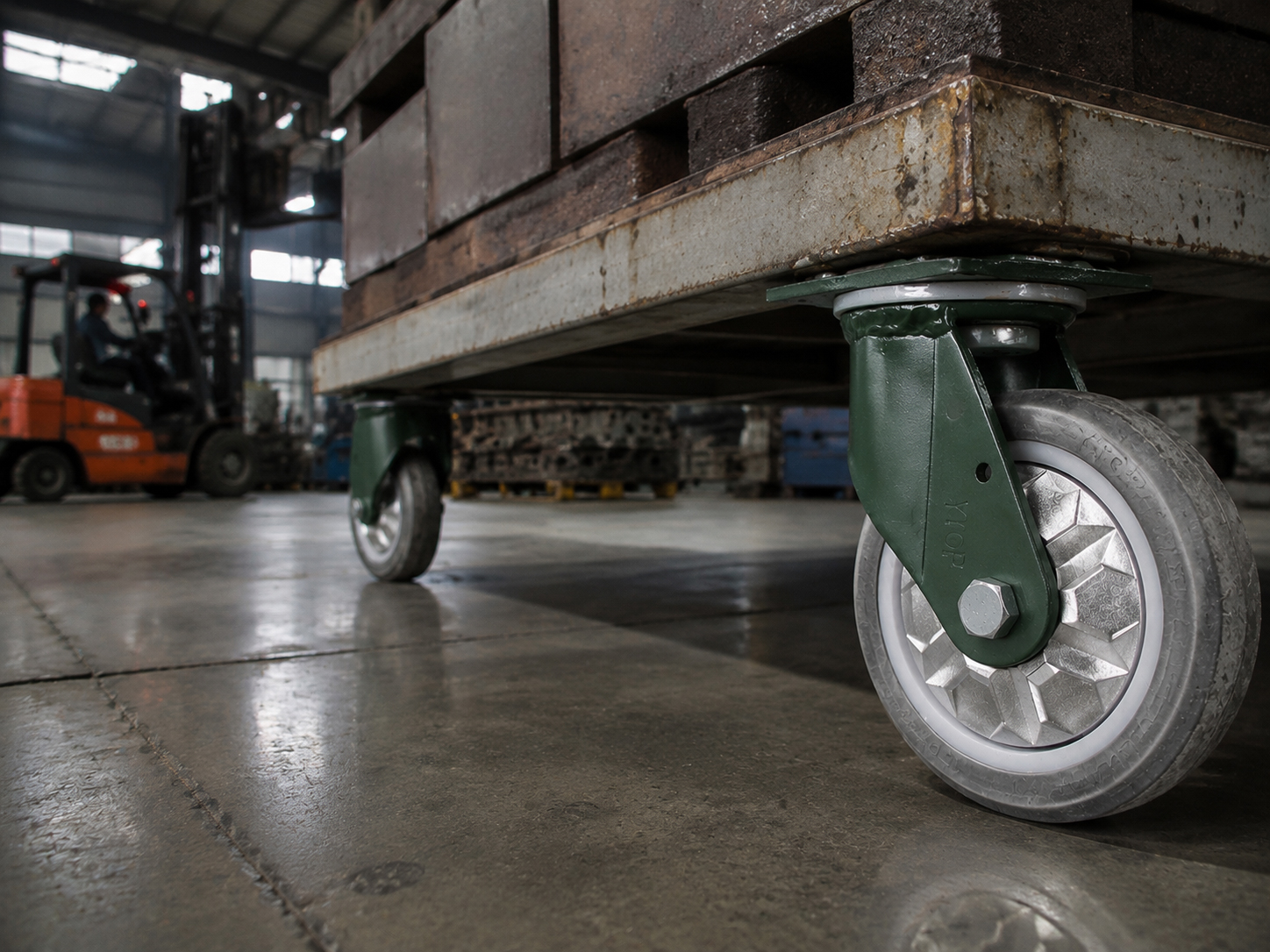
A foundry cart is loaded by crane, and the load is often dropped the last few centimetres. That drop is an impact, and an impact is several times the static load even when the mass is unchanged.
The result is not usually a broken wheel. It is a bent fork, a cracked top plate, or a raceway that has brinelled under repeated shock. All three show up as a cart that no longer tracks straight.
Specifying a higher static capacity does not solve this. What solves it is a thicker fork, a one-piece formed bracket rather than a welded one, and a wheel that absorbs some of the energy instead of transmitting all of it to the plate.
Choosing the Wheel Compound
Three compounds cover most foundry applications, and the choice is driven by temperature more than by load.
Cast iron is the default for hot areas and heavy loads. It does not soften, it resists cutting by scale, and it rolls over debris instead of embedding it. The cost is weight, noise and floor wear, and it should not be used where the floor is finished or where the cart must be quiet.
High-temperature phenolic sits between iron and polymer: lighter than iron, harder than standard nylon, and stable to higher temperatures than PU. It is the usual choice for carts that move between the furnace area and cooler parts of the plant.
High-temperature polyurethane is worth considering only where the floor is sensitive and the temperature stays within its rated range. Standard PU in a foundry is a false economy.
Diameter matters as much as compound. A larger wheel rolls over scale and slag instead of cutting into it, and it turns fewer revolutions for the same distance, so the raceway accumulates less wear per shift. Where deck height allows, going up one wheel size is a cheaper reliability improvement than going up a capacity class.
Bearings, Seals and Grease
Three details decide whether the raceway survives the dust.
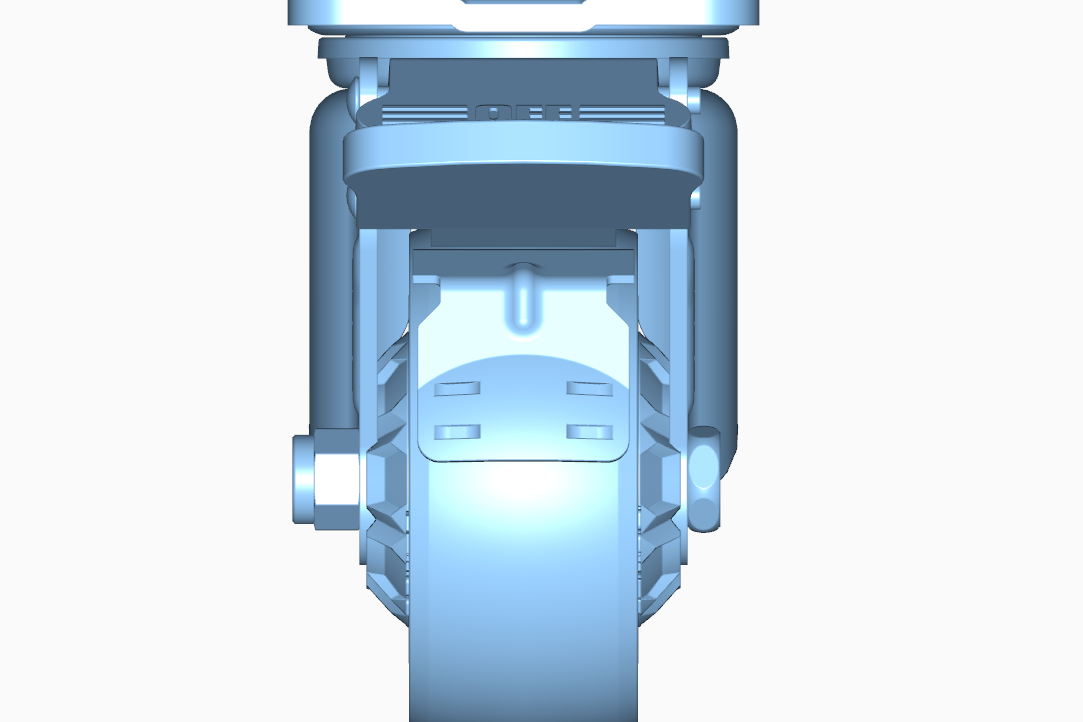
A sealed or shielded raceway, rather than an open ball track, keeps scale out of the most loaded joint in the caster. A high-temperature grease retains viscosity where standard lithium grease has already drained away. And a metal shield rather than a polymer one survives radiant heat and hot debris.
Where the caster has a grease nipple, the maintenance interval should be tied to heat exposure, not to calendar time: a caster near the furnace needs attention far more often than an identical one in the dispatch area.
Stainless, Coatings and What They Do Not Fix
Foundries often ask for stainless casters as a default. Stainless helps with corrosion, which matters in wet areas and in plants that wash down equipment, but it does not solve heat, scale or impact.
Two distinctions are worth knowing. A stainless housing with a standard bearing is still a standard bearing, so the raceway fails exactly as it would in a painted caster. And a zinc or powder coating protects the outside of the fork from rust but does nothing for the joint where the scale actually enters.
Where corrosion is the real problem — wash-down areas, coolant, condensation — specify stainless housing with a sealed raceway and a compatible grease. Where heat and scale are the problem, specify the wheel compound, the grease and the seal, and accept a coated carbon steel bracket as adequate.
Loading and Unloading Points
The caster is not equally loaded around the route. In a foundry, the load is applied and removed at one or two points, and those are where failures cluster.
Three practical measures help. Put the heaviest casters under the load-bearing end of the cart rather than distributing them evenly. Fit a shock-absorbing caster at the loading end where the drop occurs. And mark the loading position on the floor, so that operators stop dropping the load onto the same two casters every cycle.
If a particular caster position fails repeatedly while the others last, the answer is usually at the loading point rather than in the caster specification.
A Maintenance Rhythm That Matches the Plant
Foundry maintenance works best when it follows production, not the calendar.
Check casters at every furnace reline and at every shift change in the hot zone. Wipe or blow scale out of the swivel joint before greasing, then grease until clean grease appears. Replace rather than re-grease once the fork shows vertical play, because a worn raceway in a dusty plant will not recover.
Keep a small stock of the two or three caster types the plant actually uses. In a foundry the difference between a ten-minute swap and a two-day wait is usually whether the spare was on the shelf.
Signs a Caster Must Be Replaced, Not Repaired
Four conditions are terminal. Vertical play in the swivel, a fork that is visibly out of line, a crack anywhere in the plate or the fork, and a tread that has hardened and cracked rather than worn smooth.
Each of those means the assembly has already absorbed damage that a new wheel cannot undo. Fitting a wheel into damaged hardware buys a few weeks and risks a load dropping at an inconvenient moment.
Specification Checklist
Six lines cover a foundry caster order.
Maximum ambient temperature at the hottest point on the route, not the average workshop temperature.
Worst-case load including impact, which is the dropped load rather than the static one.
Floor condition: scale, sand, slag, or clean concrete, because this decides the tread and the seal.
Wheel compound and diameter, chosen for temperature first and obstacle crossing second.
Bracket type: formed one-piece rather than welded, with a wall thickness suited to impact.
Maintenance access: whether a grease nipple is reachable in service, and who will use it.
Get those six right and the caster stops being a consumable. Get them wrong and the plant buys the same caster four times a year, which is the pattern most foundries recognise.
One last point on ordering. Foundry conditions vary by bay, not by plant, so a single caster specification across the whole site usually ends up either over-engineered in the dispatch area or under-engineered at the furnace. Splitting the order into a hot-zone caster and a general-area caster is normally cheaper overall and gives maintenance a clear rule for which spare goes where.
Related Reading
Two guides that support the choices above:
- One-Piece or Welded Bracket: Which Is Better? — why bracket construction decides impact survival.
- Caster Tread Hardness: Shore A and Shore D — how hardness maps to cutting, floor wear and rolling effort.
Explore our heavy-duty casters (150-610kg) and super heavy-duty casters (700-1600kg), or contact our engineering team with the temperature, the floor and the impact conditions.
Post time: Nov-18-2026