
A commercial laundry looks like a wet version of a warehouse: flat floor, moderate loads, short movements, and the same carts running the same routes every shift. Yet casters there are replaced far more often than the load rating suggests, and the reasons are almost never the ones operators blame.
This article covers the four conditions that decide caster life in a laundry or textile plant — detergent chemistry, tunnel heat, lint winding, and continuous wet floors — and the specification that follows from them.
Four Conditions That Decide Caster Life
Water on its own is not the problem. Water plus detergent is.
Laundry chemistry is alkaline, often chlorinated, and frequently hot. It attacks the tread compound from the outside and the grease from the inside, and it removes the film that protects a painted bracket. A caster rated for “wet environments” is usually only rated for clean water.
Steam and tunnel heat are the second condition. A tunnel washer or an ironer discharges heat and moisture into the floor area, so the caster sits in warm humid air for most of its life. Standard grease emulsifies and drains; standard seals harden.
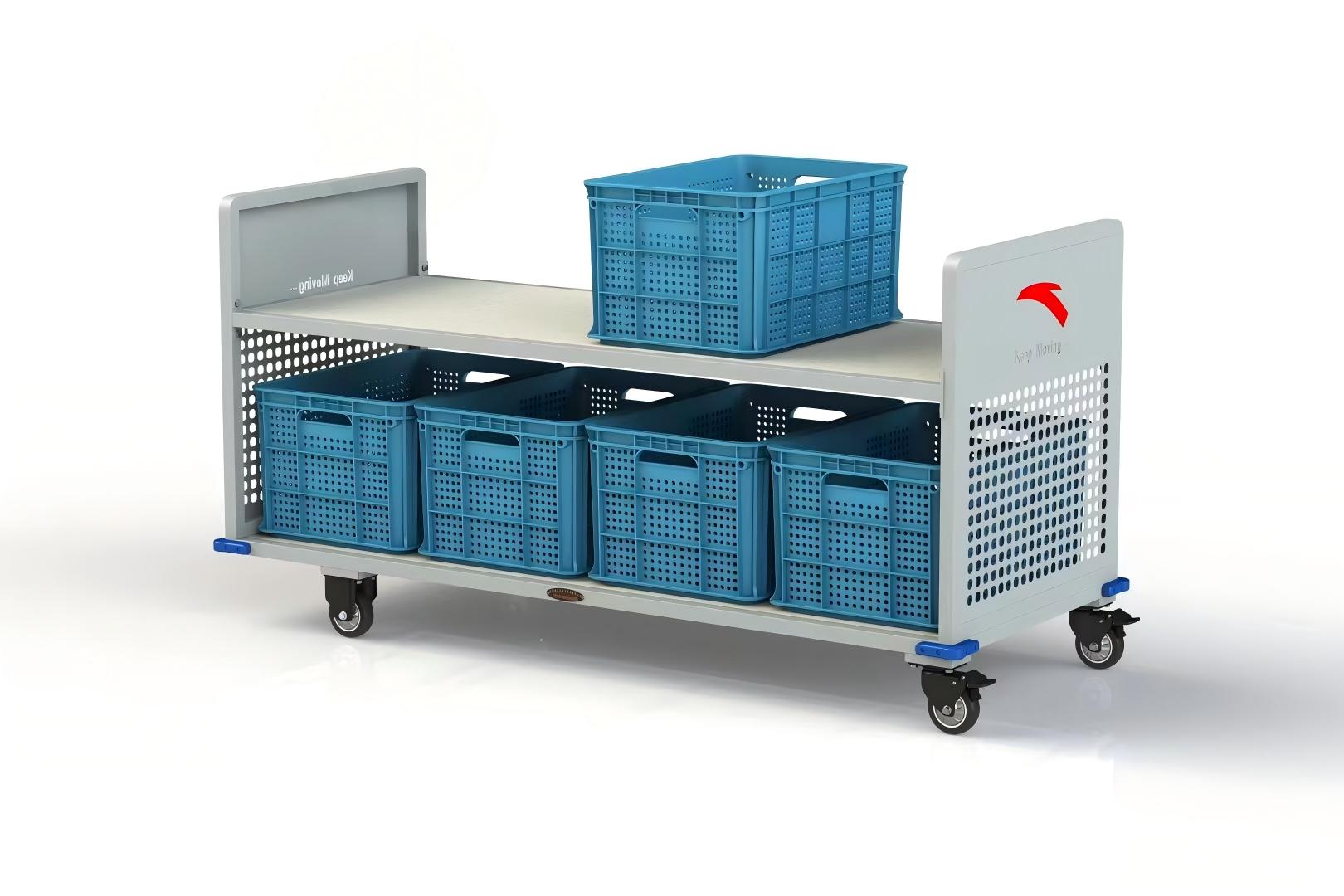
Lint is the third, and it is the one that surprises people. Lint does not abrade the wheel; it winds. A fibre that catches on the axle or between the fork and the wheel builds a sleeve that gradually locks the wheel, and the operator’s response — pushing harder — is what finally breaks the bracket.
Continuous wet floor is the fourth. A wet floor lowers friction, which sounds helpful until the cart is loaded and the swivel no longer steers; the caster skids instead of turning, and the load goes sideways.
Detergent, Chlorine and What They Attack
Three parts of a caster are exposed to wash chemistry, and each fails differently.
The tread compound swells, hardens or chunks depending on the chemistry. Natural rubber and TPR do worst in hot alkaline wash; polyurethane resists better but not universally; nylon and polypropylene are the most chemically inert of the common treads but are harder and noisier.
The grease emulsifies. Once water reaches the raceway, the lubricant turns milky and stops protecting the track; the caster then wears from the inside while the outside still looks new.
The bracket finish fails. Painted and zinc-plated brackets develop rust at the edges and around the swivel, which is cosmetic until the rust reaches the bearing seat.
Lint: the Winding Failure
Lint winding is a mechanical problem with a mechanical solution, and it is worth fixing before it costs a shift.
Fibre catches wherever there is a gap between a rotating part and a stationary one: the axle ends, the space between the fork legs and the wheel, and the swivel gap on the fork top. Once a few strands catch, the sleeve grows quickly, and the wheel stops turning while the cart keeps moving.
Three measures reduce winding. A caster with tighter axle and fork clearances gives lint less to catch on. A wheel with a smooth, closed hub face — rather than an open hub with exposed spokes — stops fibre entering from the side. And a scheduled cleaning that cuts accumulated lint off with a blade, rather than pulling it, removes the sleeve before it tightens.
Where carts run through the folding and packing area, a daily two-minute check on the axle ends is cheaper than a weekly caster replacement.
Wet Floors and Steering
On a wet floor, a swivel caster behaves differently in two ways.
Rolling resistance drops, so the cart accelerates more easily but also runs away on any slope. More importantly, the swivel needs a small amount of friction to turn; on a wet, smooth floor the wheel can skid instead of pivoting, so the cart pushes sideways rather than following the handle.
Two practical answers. A tread with a genuine wet grip — soft rubber or a siped PU — recovers some of that friction. And a cart with two fixed and two swivel casters, rather than four swivels, tracks predictably even when the floor is wet; four swivels on a wet floor is the arrangement that produces the sideways slide operators complain about.
Linen Carts, Bulk Bags and Repeated Pushing
The load in a laundry is not heavy, but it is handled constantly. A linen cart at 150 to 250 kg pushed several hundred times a shift puts more total work into the caster than a 600 kg cart moved twice a day.
That changes the priorities. Rolling effort matters more than static capacity, so a larger diameter and a lower rolling-resistance tread reduce operator fatigue across a shift. A wheel of 125 to 150 mm rolls over floor drains, thresholds and hose without stopping, where a 100 mm wheel catches and requires a push.
Where carts are also tipped or dragged, the bracket takes lateral loads that a purely vertical rating does not describe. A formed bracket with a thicker wall survives this; a light welded bracket does not.
Choosing the Wheel Compound
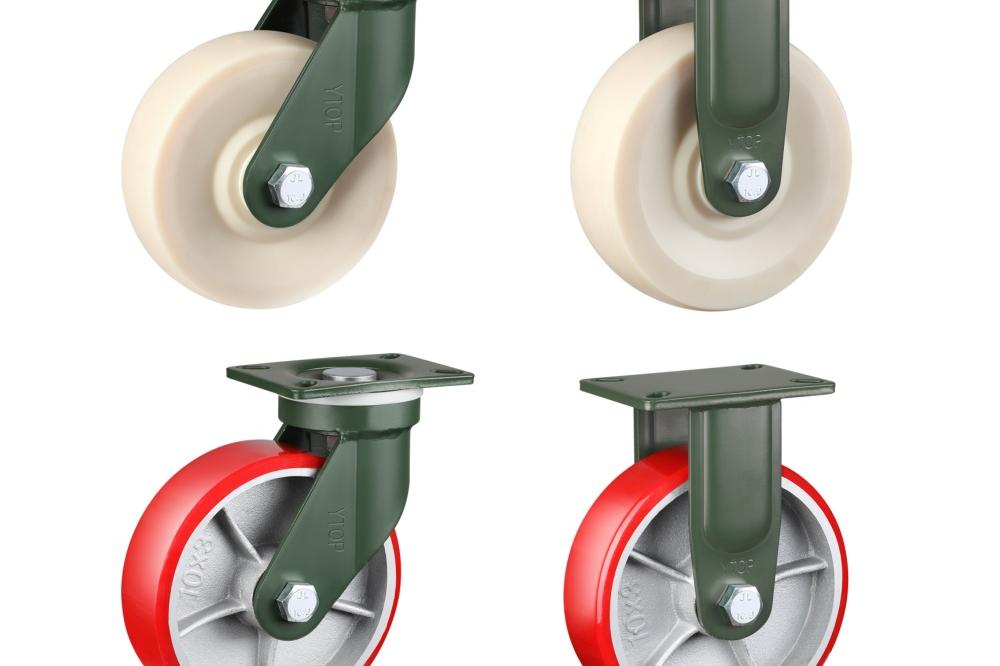
Three compounds cover most laundry applications, and the choice is driven by chemistry and floor condition.
Polyurethane is the usual default: good wet grip, quiet, non-marking on the vinyl and coated floors typical of a linen store, and reasonable resistance to mild detergent. It is the wrong choice where chlorinated wash chemistry is present at temperature.
Nylon or polypropylene is the chemically resistant option. It handles hot alkaline wash and chlorine far better than rubber or PU, and it does not mark floors. The cost is noise and a harder ride over thresholds, which matters on tiled floors.
Rubber and TPR give the best grip on wet floors and the quietest roll, but they are the least resistant to hot wash chemistry and the most likely to leave marks on light floors.
In practice, most plants end up with a split specification: PU or rubber on the clean linen side and in the packing area, and nylon in the soiled side where wash chemistry is concentrated.
Bearings and Seals in Steam
The raceway is where a laundry caster fails first, because warm humid air defeats standard protection.
A sealed raceway with a water-resistant grease is the baseline. An open ball track in a steam area will not last a quarter. Where the caster runs close to the ironer or a tunnel discharge, a stainless housing is worth the cost, not because the load demands it but because the condensation does.
Greasing practice matters as much as the grease. Pushing new grease into a joint already full of wash water mixes the two and produces an emulsion that protects nothing. Clean and dry the joint first, then grease.
Brakes Near Wash Tunnels and Slopes
Laundry floors drain, which means they slope. A loaded linen cart parked on a drain slope will move, and a cart that moves while being loaded is how people get hurt.
Brakes should act on the wheel, and should be fitted to all four casters on any cart that gets parked under load. A swivel-only lock prevents turning but not rolling, which is the opposite of what is needed on a slope.
Maintenance Rhythm
Four habits cover a laundry plant.
Cut lint off the axle ends daily, rather than pulling it, so the sleeve never forms.
Dry and re-grease the swivel joints weekly in the wet areas — cleaning first, greasing second.
Check for vertical play at the swivel every month; in a wet environment a worn raceway does not recover.
Replace rather than repair once the bracket shows rust at the bearing seat, because the seat is no longer holding the bearing square and the caster will steer badly from then on.
Buying Checklist
Six questions settle a laundry caster order.
Which chemistry, at what temperature and concentration — named, not described as “detergent”?
How close does the cart run to the ironer or tunnel discharge, and is there condensation on the floor?
What lint load is in the air, and where does fibre catch on the current casters?
Is the floor wet most of the shift, and is it sloped toward drains?
What is the cart weight, and how many times per shift is it pushed?
Does the cart come near clean linen, which decides whether the tread must be non-marking?
Answer those and the specification is straightforward: sealed raceway, water-resistant grease, chemical-resistant tread on the soiled side, high-grip non-marking tread on the clean side, and a diameter large enough that the cart does not catch on drains and thresholds.
Related Reading
Two guides that support the choices above:
- Stainless Casters for Washdown and Corrosive Environments — housing, seals and grease for wet service.
- The Principle of Anti-Wrap Caster Design — why fork and wheel spacing stops fibre winding round the axle.
Explore our heavy-duty casters (150-610kg) and super heavy-duty casters (700-1600kg), or contact our engineering team with the chemistry, the floor condition and the cart weight.
Post time: Nov-19-2026