
Leveling feet — also called adjustable support feet or equipment support feet — are installed at the bottom of industrial equipment. A threaded screw raises and lowers the body to support the machine and fine-tune its installation height. They sit under machine tools, conveyor lines, power distribution cabinets, testing tables, packaging machines, and experiment bench frames across virtually every workshop. Nobody notices them in daily operation, yet whether a machine stands level and stays put often depends entirely on this small component.
Workshop floors are never perfectly flat. Every stage of floor construction — pouring, leveling, curing — leaves errors, and a height difference of a few millimeters between the four corners of one machine is common. When equipment sits directly on the floor, the four support points carry uneven loads, the frame twists, and over time the machine body deforms; for precision equipment, the consequence shows up directly in machining and testing data. Leveling feet exist to bridge exactly this gap between floor and equipment, providing leveling, support, and fixation in one component.
How Leveling Feet Are Constructed
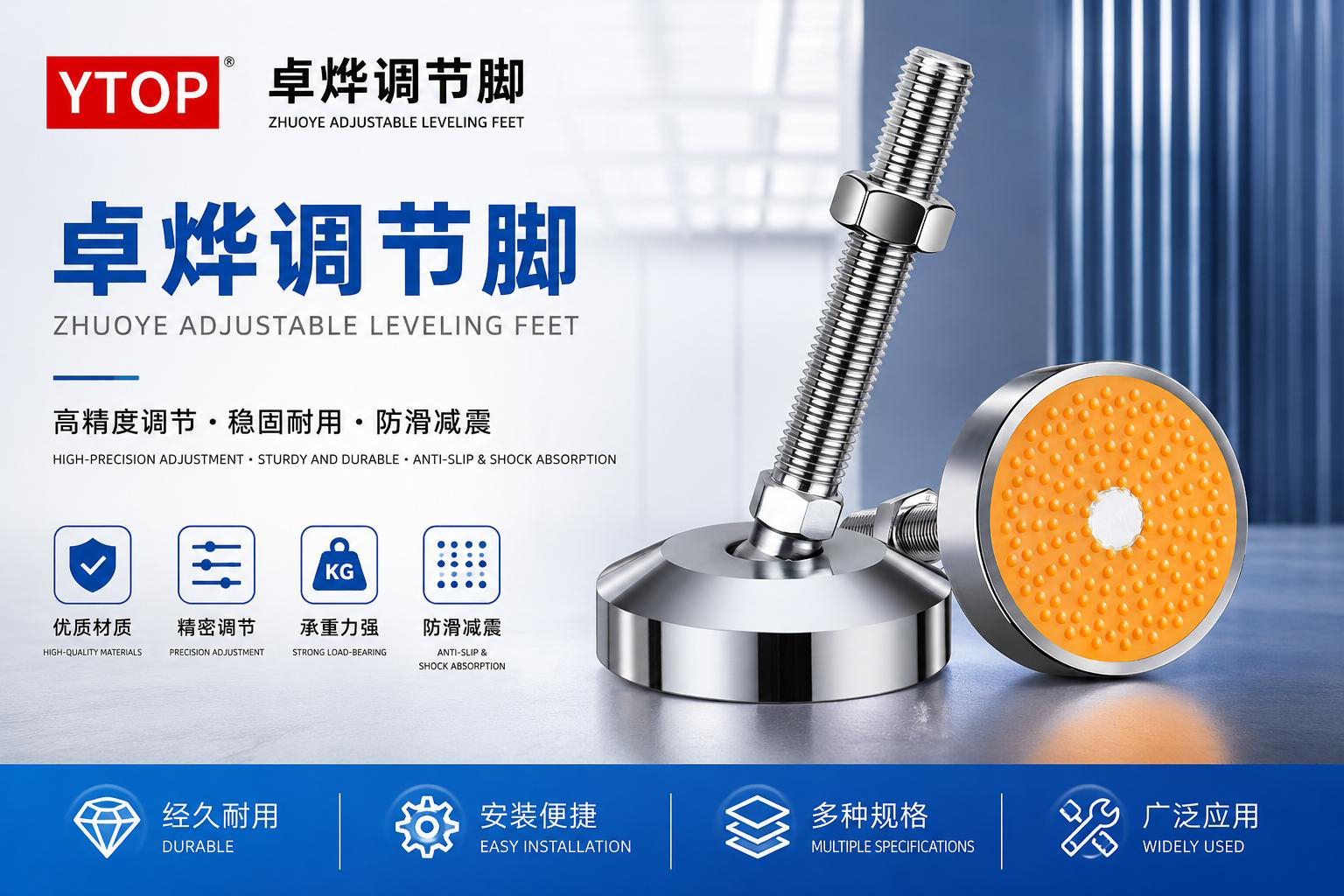
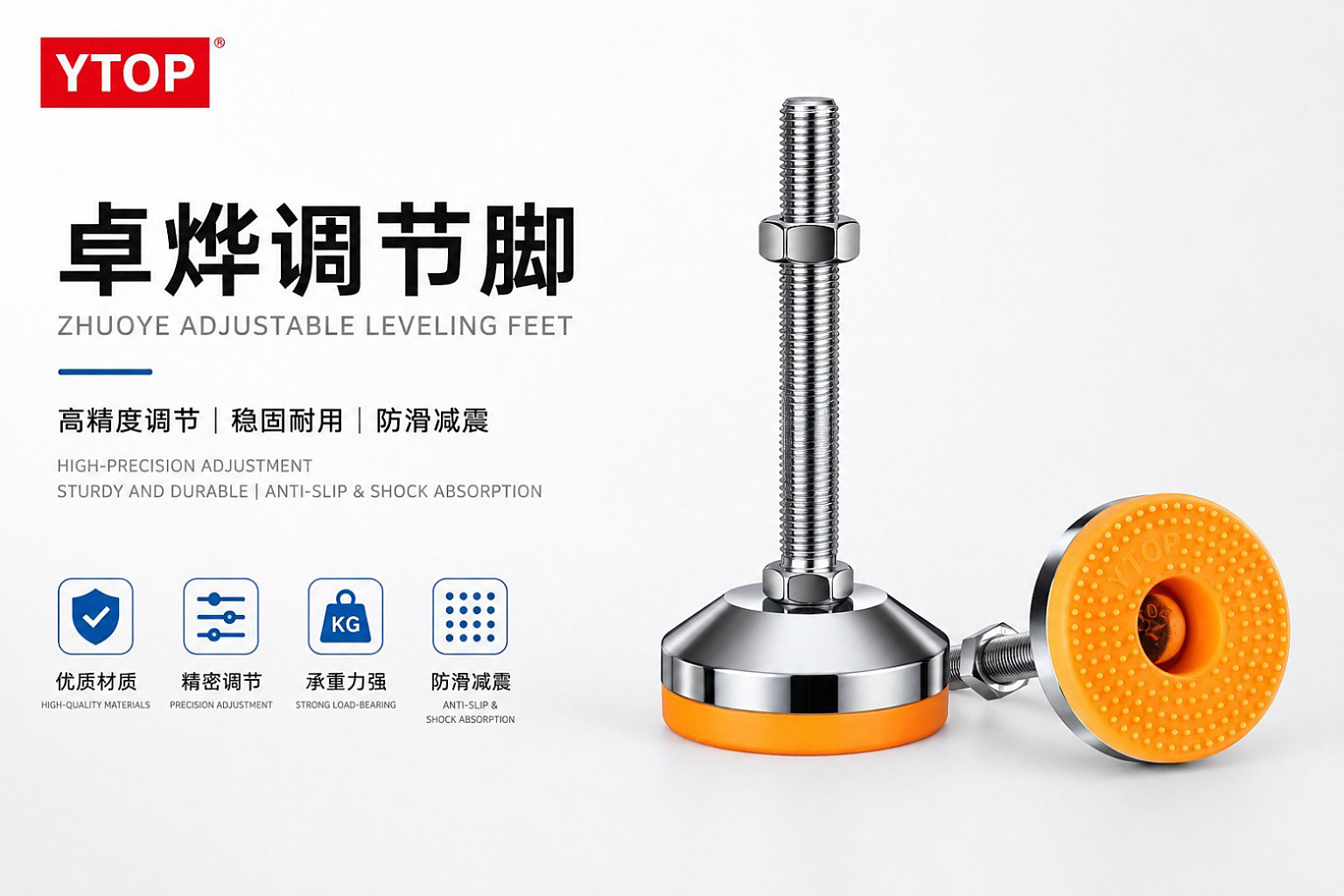
The structure is simple but every part earns its place. The screw is a threaded metal rod — rotating it changes the support height, and it is the core of the adjustment function. The base is the surface that contacts the floor; round and square versions both exist, and a larger footprint spreads the load to reduce pressure per unit area. The lock nut fixes the height after adjustment and prevents the screw from loosening under equipment vibration. Many products add a rubber or elastic anti-slip pad under the base, which increases friction and softens hard metal-to-floor contact.
Material choice follows the working environment. Galvanized carbon steel — screw and base plated against rust — is the most common option for ordinary workshops. Where humidity or corrosive media are present, stainless steel is the direct choice. The contact face between the base and the equipment’s bottom plate is generally machined flat to guarantee an even fit and stable load transfer.
Why Equipment Cannot Do Without Leveling Feet
Four practical reasons, all observed at real installation sites, explain why leveling feet are indispensable. First, floors are naturally uneven — this is the fundamental reason leveling feet exist, and elevation differences across one workshop floor are a given. Second, equipment vibrates and drifts during operation. Machine tools, stamping presses, fans, and conveyor belts all vibrate when running; unanchored equipment slowly “walks” over time, which misaligns production lines and, in safety-relevant cases, becomes a genuine hazard. Leveling feet, through their anti-slip pads and locking structure, hold equipment firmly in position.
Third, installation surfaces are often not flat. When equipment is mounted on steel platforms, rack bottoms, or uneven concrete floors, a fixed-height leg cannot land evenly — only a leveling foot with adjustment stroke can absorb the difference. Fourth, production lines need height connection: adjacent machines and conveyor surfaces must align at the same height. Because every machine carries its own manufacturing tolerance, installers rely on leveling feet to fine-tune each unit individually and level the entire line.
The Leveling Step Cannot Be Skipped
For precision equipment, levelness directly determines machining accuracy and whether test values are trustworthy. For load-bearing equipment, even force distribution across support points extends the life of both the frame and the floor. For production-line equipment, smooth height connection prevents material jamming and pile-up. In short, proper leveling is not a cosmetic step — it is load engineering. A machine that appears level to the eye can still be out by a millimeter at one corner, and on a vibration-sensitive application that is enough to distort measurements or accelerate wear on a single support point.
How to Select and Install Leveling Feet
Selection starts with five parameters compared against the actual working conditions: per-foot load, adjustment stroke, base size, material, and mounting method. Estimate per-foot load by dividing the equipment’s total weight by the number of support feet and multiplying by a safety factor of 1.5 to 2. The stroke must be enough to absorb the floor’s height differences — measure the actual height variation on site rather than guessing. Soft floors call for large bases to spread pressure; humid or corrosive environments call for stainless steel; and the mounting method (bolt-through, threaded stud, or weld plate) must match the equipment’s bottom plate.
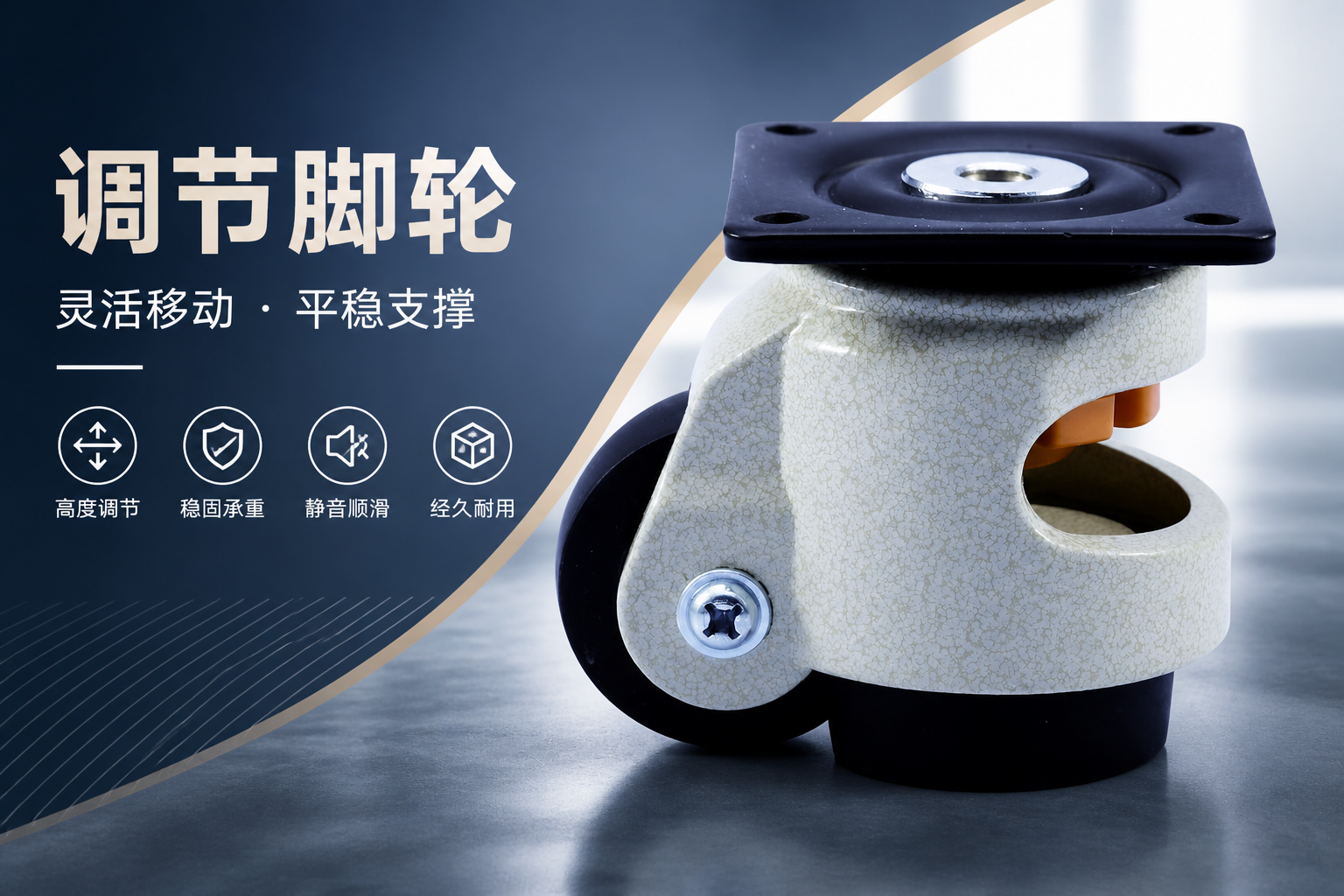
During installation, do not skip the leveling procedure: position the equipment, set the leveling feet to mid-stroke so that adjustment range is available in both directions, use a spirit level to adjust corner by corner, lock each foot after the height is set, and re-measure once after locking, because the lock nut can shift the height slightly. Ten extra minutes during installation saves hours of rework later. For equipment that must also move periodically, a leveling caster that combines a leveling foot with a swivel caster in one assembly is worth comparing — it supports the load when stationary and rolls when needed, eliminating repeated jacking.
Treat leveling feet as part of a complete support plan rather than a standalone purchase. Manufacturers that serve the industrial movement and support market — such as YTOP Manganese Steel Casters with its leveling feet, floor locks, casters, and leveling casters — let you compare the whole set together, which substantially reduces specification-matching problems.
Related Reading
Looking for more in-depth caster guides and industrial mobility resources? Explore these related articles:
- What Is a Floor Brake? — Features and application scenarios of floor lock casters for equipment stabilization.
- What Problems Do Floor Locks Solve? — How floor lock casters prevent unintended movement and improve workplace safety.
- Low Center of Gravity Casters — Stable and durable low-profile caster solutions for equipment with limited mounting height.
Explore our complete range of heavy-duty casters (150-610kg) and super heavy-duty casters (700-1600kg) for diverse industrial applications, or contact our engineering team for expert caster application knowledge and selection guidance.
Post time: Oct-14-2026