
The Caster Material Divide: Plastic or Metal?
When a buyer opens a caster catalog, one of the first decisions is not size or brake, but material. Should the casters be plastic, or should they be metal? The answer almost never comes down to which material is “better” in absolute terms; it comes down to which material matches your load, your floor, your environment, and your maintenance habits. Pick a plastic caster for a 500 kg machine, and it will crack within weeks. Pick a plain steel caster for a hospital ward, and it will squeal down the corridor and scratch the floor. This guide breaks down what plastic and metal casters actually are, compares them on the specs that matter, and gives you a simple way to decide.
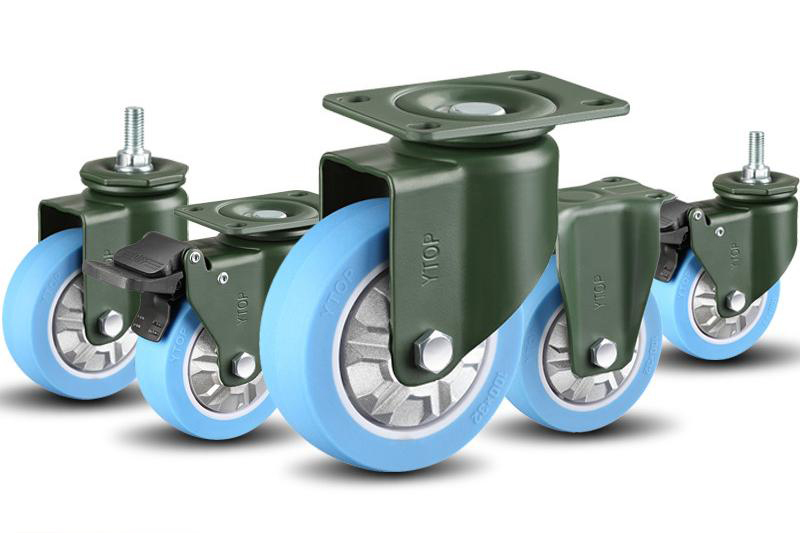
What “Plastic” and “Metal” Really Mean
Be careful with the labels. In caster terms, a “plastic caster” usually means the wheel is plastic (PP, nylon, or TPR) on a lighter bracket, while a “metal caster” usually means the wheel is steel, cast iron, or steel covered with rubber. The bracket (the fork) is almost always metal on industrial casters regardless of wheel material. So the real comparison is between a polymer wheel and a metallic wheel — and between the light-duty brackets that usually pair with plastic wheels and the heavy-duty brackets that usually pair with metal wheels. Once you read it that way, the choice becomes much clearer.
Plastic Casters: Lightweight, Quiet, Floor-Friendly
PP, Nylon, and TPR Wheel Faces
Plastic casters are not one material. Polypropylene (PP) is the cheapest, lightest option, good for light indoor loads and general furniture. Nylon (PA6 / PA66) is stiffer and far more wear-resistant than PP, and is the workhorse for medium-duty carts, trays, and light AGV applications. TPR (thermoplastic rubber) and TPU are elastomers that feel like soft rubber but are molded like plastic: they roll quietly, grip the floor, and do not mark tiles or wood. “Plastic caster” can therefore mean anything from a cheap furniture wheel to a quiet medical trolley wheel, so always ask which polymer the tread is made of.
Plastic wheels are inherently light, which makes the cart easy to start and stop by hand. They do not rust at all, so they work in damp kitchens, cleanrooms, and medical wash-down areas where steel would corrode. They are also the cheapest option up front, which makes them attractive for high-volume, light-duty equipment.
Strengths and Weaknesses
The strengths of plastic casters are low rolling weight, low noise, good floor protection (especially TPR/TPU), natural corrosion resistance, and low cost. The weaknesses are load limits and heat. A standard PP or nylon wheel struggles above roughly 100-190 kg per wheel depending on size, softens and deforms at higher temperatures, and can crack under impact or if overloaded. Hard plastic wheels also slide rather than grip on wet floors, and they can scuff or mark soft flooring if the tread is too hard. They are indoor, temperature-controlled, light-to-medium duty tools — excellent there, risky outside that box.
Metal Casters: Load, Heat, and Durability
Steel and Cast Iron Wheels
Metal casters use wheels made of forged steel, cast iron, or (for the toughest duty) machined steel with sealed ball bearings. A plain metal wheel has almost no elasticity: it rolls hard, carries enormous load, survives high temperatures and weld splatter, and does not absorb water or chemicals. That is why foundries, steel mills, and heavy rail carts almost always run on solid steel or cast iron wheels. A heavy-duty or super-heavy-duty metal caster can carry hundreds to thousands of kilograms per wheel with the right bracket.
The cost of that strength is everything else. A bare steel wheel is loud on concrete, it scratches and marks most floors, it offers almost no shock absorption, and it needs lubrication and protection from rust. Uncoated cast iron will rust in damp or wash-down environments, and a steel wheel rolling over a chip of metal on the floor can leave a black mark on epoxy flooring. Metal casters also start harder under low-speed push because the contact patch is so rigid, and they transfer more vibration to the load.
Strengths and Weaknesses
The strengths of metal casters are extreme load capacity, high-temperature resistance, impact and abrasion toughness, and long life under punishing conditions. The weaknesses are noise, floor damage, lack of cushioning, weight, the need for periodic lubrication, and the need to prevent rust (usually through paint, plating, or powder coating). Metal is the right answer when the load, heat, or debris on the floor would destroy a plastic wheel, and it is the wrong answer for a quiet office or a clean tiled room.
Multi-Dimensional Comparison
Side-by-Side Table
| Factor | Plastic Caster | Metal Caster |
|---|---|---|
| Load capacity per wheel | Light to medium (35-190 kg typical) | Medium to very heavy (150-1,600 kg+) |
| Wear resistance | Good (nylon/TPU); PP wears faster | Excellent on hard floors; can mark them |
| Rolling noise | Very low (TPR/TPU) | High with bare metal wheels |
| Shock absorption | Some (elastomers); none (hard nylon) | Almost none |
| Temperature resistance | Limited (softens or brittles at extremes) | Excellent for heat; cold does not harm steel |
| Chemical / moisture resistance | Very good; does not rust | Good only if coated; bare metal corrodes |
| Up-front cost | Low | Higher |
| Wheel weight | Light | Heavy |
| Maintenance | Minimal; no rust | Periodic lubrication; rust prevention |
| Best environment | Indoor, clean, light-medium load | Industrial, outdoor, heavy, hot or dirty |
How to Read the Table
The pattern is consistent. Plastic wins on quiet, light, clean, indoor, cost-sensitive work. Metal wins on heavy, hot, dirty, outdoor, high-impact work. The biggest trap is treating the decision as brand loyalty: a “plastic is better” buyer who puts nylon wheels under a machine that weighs half a ton will be back next month, just as a “steel is stronger” buyer who bolts bare cast iron wheels onto a hospital bed will get complaints the first night shift. Match the material to the load and the floor, not to the price tag.
Application Scenarios: Where Each One Belongs
Plastic Casters for Office, Medical, and Indoor Light Loads
Plastic (and especially TPR/TPU-elastomer) casters are the standard choice for office chairs, computer stands, medical instrument carts, laundry trolleys, supermarket checkout stands, display racks, and food-service trays. They roll quietly, do not scratch tile or vinyl, are easy to start by hand, and tolerate the mild dampness of kitchens and wards without rusting. If your cart stays indoors, stays on a smooth floor, and stays under about 190 kg per wheel, a good plastic or elastomer caster will almost always be the better daily experience.
Metal Casters for Industrial, Outdoor, and Heavy Loads
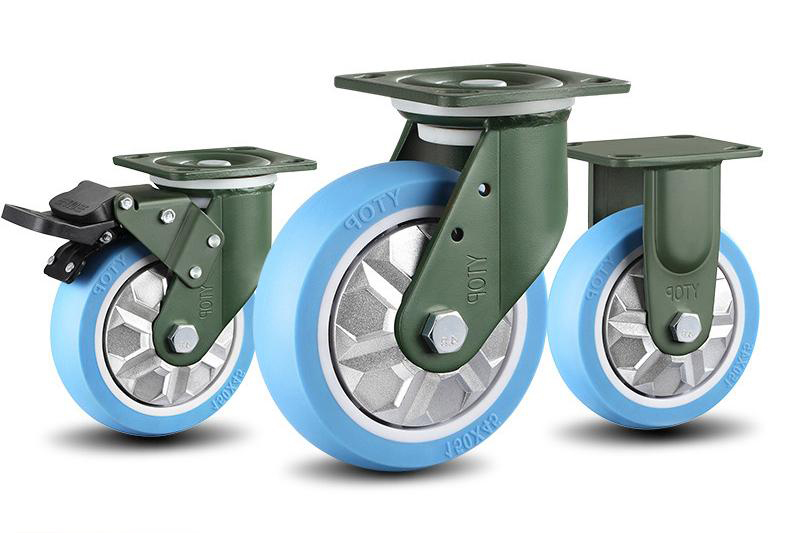
Metal casters belong where the work is rough: factory carts carrying molds, drums, or fabricated parts; outdoor dollies on gravel or cracked asphalt; foundry or welding stations exposed to heat and weld splatter; rail and platform trucks; and any application where one wheel carries several hundred kilograms. Steel or cast-iron wheels survive the debris, the heat, and the abuse that would shatter a plastic wheel, and their brackets stay rigid under loads that would bend a light stamped frame. If you are pushing heavy steel across a concrete yard, reach for metal.
The Middle Ground: Plastic-Coated (Encased) Metal Casters
When a Covered Wheel Wins
Very often the right answer is neither a pure plastic wheel nor a bare metal wheel. A plastic-coated or rubber-covered caster puts a steel or cast-iron core inside a tread of polyurethane, rubber, or nylon. The metal core carries the load and the shock, while the soft outer tread gives quiet rolling, floor protection, and grip. This is the classic “industrial silent heavy-duty” wheel: it will carry hundreds of kilograms, roll smoothly on epoxy, and stay quiet on a workshop floor. If your load is heavy but you need a quiet, floor-friendly, non-marking roll, a covered metal caster is usually the smartest buy — it solves the real problem instead of forcing you to choose between strength and quiet.
Decision Tree and Maintenance Advice
A Simple Way to Decide
Ask four questions in order. First, how much does the loaded equipment weigh per wheel? If it is over about 190 kg, lean metal. Second, what is the floor like? Smooth tile, vinyl, or wood wants an elastomer tread; rough concrete or gravel wants metal or a hard polyurethane cover. Third, is it hot, cold, oily, or chemical-exposed? Heat and weld splatter point to metal; moisture and chemicals point to plastic or coated-corrosion-resistant brackets. Fourth, does the operator care about noise? If yes, choose a soft tread even on a heavy-duty core. If none of these push you firmly to one side, a polyurethane-covered heavy-duty caster is the safe middle choice.
Maintenance That Pays Off
Plastic casters need the least: keep the tread clean, check the mounting bolts, and watch for cracked or flattened wheels when the load approaches the rating. Metal casters need a little more: lubricate the swivel race and axle on a scheduled interval, inspect the coating for chips, touch up any bare paint before it rusts, and keep the tread free of wrapped wire or swarf. In wet or outdoor areas, prefer plated, galvanized, or powder-coated brackets and stainless fasteners so the bracket does not seize. In both cases, replace wheels in matched sets of the same diameter and rating — mixing a new plastic wheel with three worn metal ones guarantees a cart that pulls to one side.
Frequently Asked Questions
Are plastic casters weaker than metal casters?
Per wheel, yes in most cases: plastic wheels typically handle 35-190 kg each, while steel or cast-iron wheels can handle hundreds to over a thousand kilograms. But within the light-duty range a well-made nylon or TPR wheel is perfectly reliable, and it is quieter and cheaper than a metal one. Choose by rated load, not by material assumption.
Do plastic casters scratch floors?
Hard nylon or PP can scuff soft surfaces under heavy load, but TPR and TPU elastomer wheels are designed to be non-marking and floor-friendly. If floor protection matters, specify a soft elastomer or polyurethane tread rather than a hard plastic or bare steel wheel.
Can metal casters be used indoors quietly?
A bare steel or cast-iron wheel is loud on concrete and tile. To use a metal caster indoors quietly, choose a polyurethane or rubber-covered wheel: the steel core carries the load, and the soft outer tread rolls quietly without marking the floor.
How long do plastic casters last compared to metal ones?
In light indoor duty, good plastic and metal casters both last a long time; plastic is not automatically shorter-lived. In heavy, hot, or abrasive duty, plastic deforms or cracks much sooner, while a well-lubricated, coated metal caster keeps going for years. Match material to the duty cycle for a fair lifespan comparison.
Which is cheaper, plastic or metal casters?
Up front, plastic casters are almost always cheaper. But they are typically light-duty: if you overload them or run them in the wrong environment, early replacement makes them more expensive over time. Calculate the total cost of ownership — purchase price plus expected service life plus downtime — before deciding on price alone.
Related Reading
- What Is the Difference Between Rubber Casters and Nylon Casters?
- Which Material Performs Better: Nylon or Polyurethane Casters?
- In-Depth Understanding of the Structure of Casters
- What Are the Common Caster Specifications?
- Difference Between PP Casters and TPR Casters
- Light Duty Casters (35-80 kg)
- Heavy Duty Casters (150-610 kg)
- Contact Us for Material Selection Help
Post time: May-15-2025