
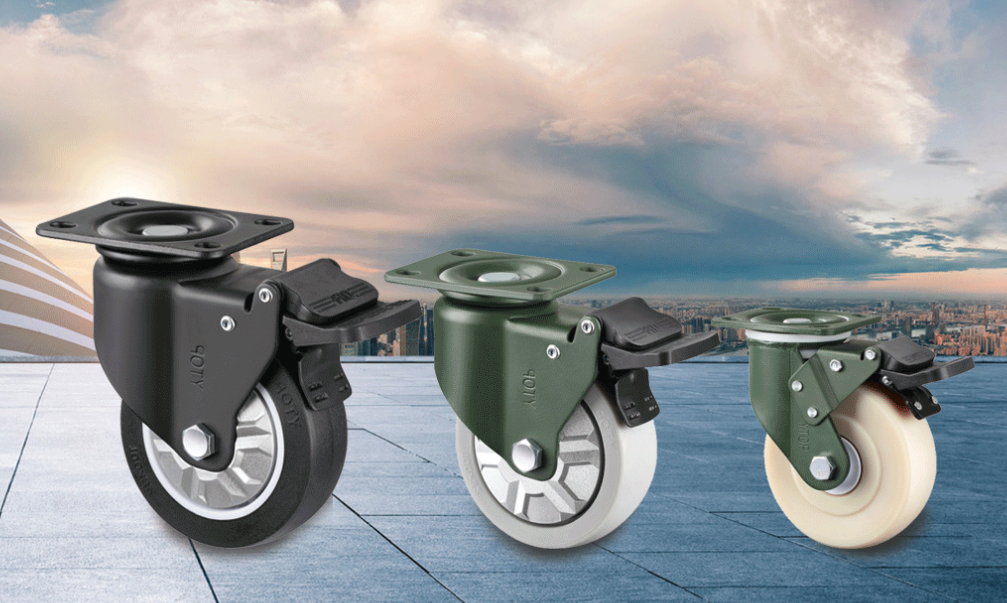
In industrial material handling, the configuration of industrial casters directly dictates a cart’s
maneuverability, load tracking, and ergonomic efficiency. Selecting the right combination of swivel
casters and rigid casters ensures seamless warehouse logistics.
Common Industrial Caster Layout Configurations
3-Swivel Caster Balanced Layout for Light Loads and Tight Corridors
Perfect for light load capacity demands and tight corridors. It delivers unmatched multi-directional
agility, though straight-line tracking requires effort. Adding a directional brake to one caster resolves
tracking issues, though tip-over stability must be monitored.
4-Swivel Caster Flexible Configuration for Confined Spaces
Engineered for confined spaces and narrow aisles. Utilizing four uniform swivel casters allows total
lateral freedom. Equipping two wheels with directional brakes significantly improves tracking control
during long straight hauls.
2-Swivel and 2-Rigid Classic Combination for Platform Trucks
The industry-standard setup for commercial platform trucks and towing operations. Combining two swivel
and two rigid casters delivers precise tracking, heavy-duty support, and predictable cornering, though
turning radius is slightly wider.
4-Rigid Diamond High-Low Pattern for Straight-Line Stability
Features four fixed wheels where the center pair is slightly taller. This diamond alignment ensures
effortless straight-line movement and allows the cart to pivot effortlessly on its center axis, despite minor
rocking on uneven floors.
2-Swivel and 2-Rigid High-Low Alignment for Heavy-Duty Towing
Optimized for heavy-duty towing tugs. The elevated center rigid wheels provide great tracking stability
and fixed-point rotation capabilities, but require careful design to minimize rocking risks.
Heavy Duty Multi-Wheel Reinforced Layout for Extreme Payloads
Designed for extra-long chassis and extreme payloads. Combining four swivel and two center rigid
wheels guarantees supreme heavy duty caster performance, maximum load distribution, and stable
tracking control.
Related Reading
Looking for more in-depth caster guides and industrial mobility resources? Explore these related articles:
- What is a Caster Wheel — Complete guide to caster wheels.
- Main Components — What are the main components of a caster?
- Types of Caster Wheels — Explore various caster wheel types.
- Wheel Bearings — Different caster wheel bearing types.
- Six Bearing Types — Six common caster bearing types.
Explore our complete range of heavy-duty casters (150-610kg) and super heavy-duty casters (700-1600kg), or contact our engineering team for expert guidance.
Related Reading
Explore more caster layout, wheel type selection, and mobility guides:
- Caster Popularization: Fixed Wheel, Movable Wheel, Brake Wheel Differences — Learn about caster wheel type differences including fixed, swivel, and brake wheel layout considerations.
- Differences Between Universal and Fixed Wheels — Learn about universal vs fixed wheel differences including mobility and layout strategy.
- Caster Selection Guide: Fixed Casters/Swivel Casters — Learn about caster selection guide including fixed and swivel caster layout configurations.
- How to Choose a Cart for Carrying Heavy Loads! — Learn about heavy load carrying cart selection including caster layout and mobility considerations.
- How to Use a Handcart — Learn about handcart use including caster layout, mobility, and control techniques.
Explore our complete range of layout-optimized heavy-duty casters (150-610kg) and medium-duty casters (100-190kg) with fixed and swivel options, or contact our engineering team for expert caster layout strategy and mobility optimization guidance.
Post time: Jul-06-2026