
Choose the wrong floor brake material and the trouble is immediate and practical: either the load capacity is insufficient and the housing deforms, or it rusts quickly and the pressing mechanism seizes. Material selection is not a matter of finding the shiniest picture — it should be judged at three separate layers: the main structure for rigidity, the key components for locking reliability, and the surface treatment for environmental resistance. Work through them in the order of load, environment, and locking frequency, and the right configuration follows naturally.
The Main Structure: Cast Iron, Carbon Steel, Stainless Steel
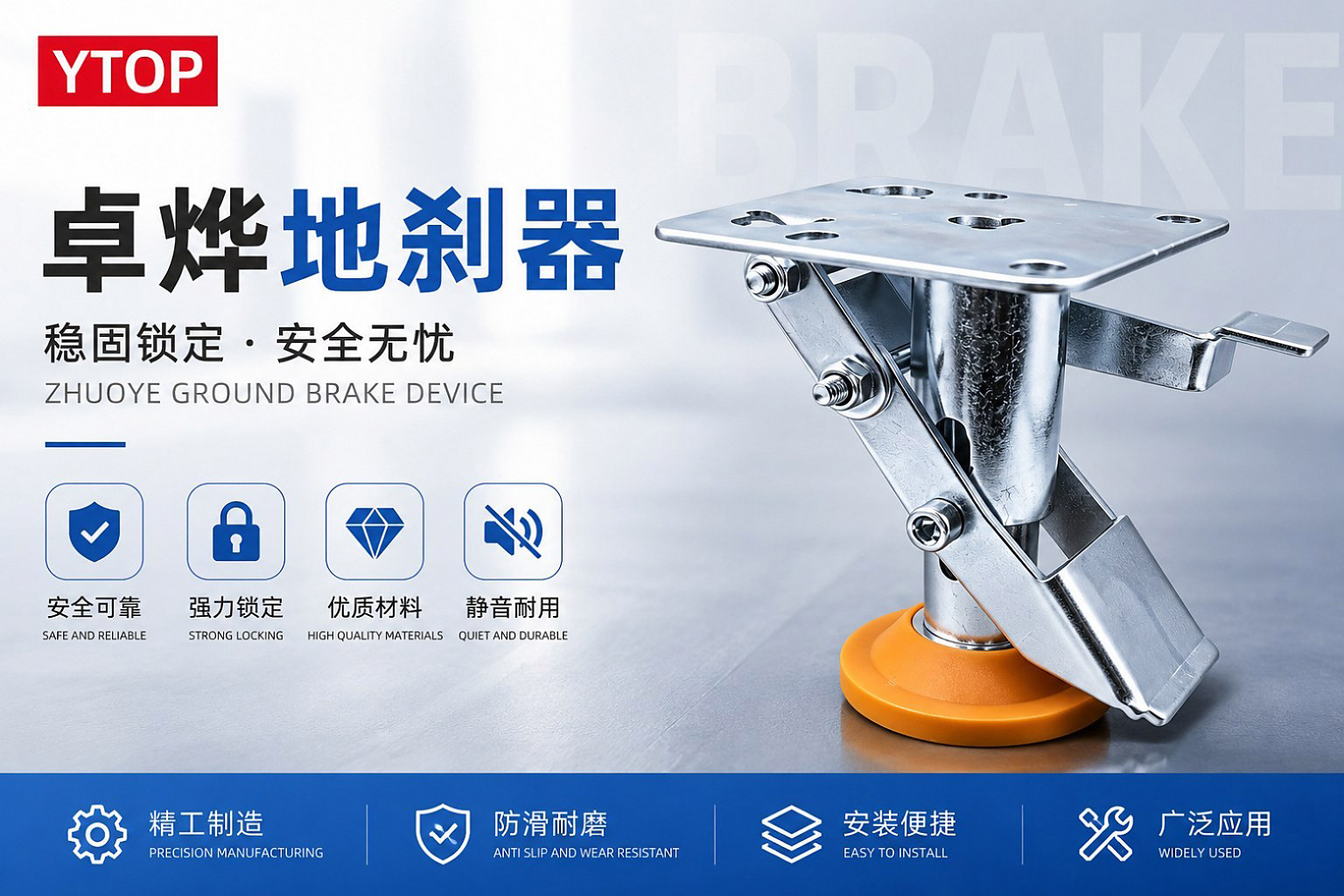
The main body of a floor lock is the set of base, load-bearing structure, and pressing mechanism, and three materials dominate the market. Cast iron offers good rigidity, decent vibration damping, and moderate cost, which makes it the default for conventional workshop equipment and medium-to-high load scenarios; its weaknesses are weight and brittleness — it cannot take severe impact. Carbon steel, whether welded or stamped, brings strength and toughness that suit heavy-load and frequently locked applications; its disadvantage is that it relies entirely on surface treatment for rust prevention, and thin stamped parts depend on structural design for stiffness. Stainless steel, in grades such as 304 and 316, is corrosion resistant and easy to clean, fitting food, medical, chemical, and coastal humid environments; it is expensive, and under the same envelope its load capacity is somewhat below carbon steel.
Key Components and the Floor-Gripping Pad
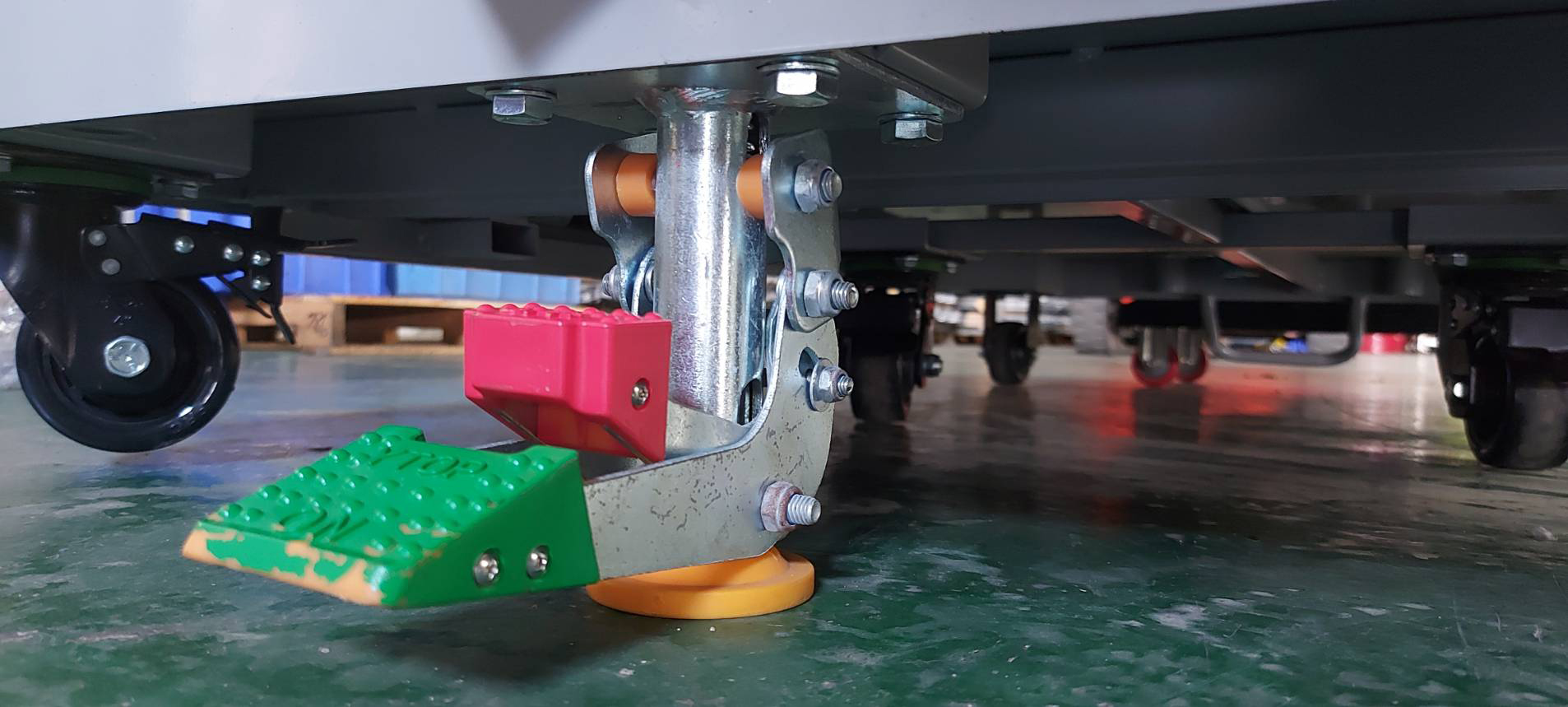
The pressing and drive mechanism should be wear-resistant: carbon steel with surface hardening is sufficient for general use, a stainless-steel mechanism fits wash-down environments, and aluminum parts — light but weak — belong only in light-load positions. The pad is the component that actually grips the floor, and its material directly determines grip and service life. Rubber pads grip strongly on concrete and epoxy floors; PU pads wear well and resist oil, suiting oily and rough floors; nylon pads protect smooth floors from scratching in non-high-temperature use; metal pads survive high temperature and welding splatter and rely on geometry rather than friction for anti-slip. Springs and pins are easy to overlook but decisive for return reliability: choose springs with good fatigue life and pins that are surface-hardened, with small wear clearance. These small parts look insignificant, and that is exactly why they should not be skimped on. The pedal and linkage deserve a note of their own. A floor lock pressed by foot several hundred times a day wears the linkage fast, so a hardened drive mechanism and an enlarged, non-slip pedal pay back quickly; a workstation locked once a shift needs nothing more. Whatever the frequency, the pedal must be operable from the floor without the operator bending under the equipment, and the released position must leave enough ground clearance for the caster to roll.
Surface Treatment Matches the Environment

Corrosion protection grades for the main metal parts divide by environment, and there is no reason to choose the most expensive treatment everywhere — or the cheapest everywhere. The table below summarizes the usual matching.
| Surface Treatment | Corrosion Resistance | Typical Environment |
|---|---|---|
| Galvanizing | General | Dry workshops |
| Powder coating or spray painting | Better | Conventional workshops |
| Zinc-nickel alloy plating | Good | Humid and coastal areas |
| Stainless steel natural surface | Excellent | Food, medical, chemical |
Beyond the table, direct scenario matching saves guesswork. An ordinary machinery workshop calls for carbon steel or cast iron plus galvanizing or powder coating plus rubber pads. A heavy-load assembly area needs a welded carbon-steel structure, a thickened base, and wear-resistant PU pads. A high-frequency locking workstation benefits from a hardened drive mechanism and an enlarged pedal. Food and beverage lines use 304 stainless steel with food-grade rubber pads; medical equipment uses stainless steel with easy-to-clean pads; coastal or hot-humid warehousing uses zinc-nickel alloy or stainless steel with weather-resistant pads.
Four Misconceptions to Avoid
The load capacity ranking under the same specification is roughly this: quality carbon steel and cast iron are comparable, ordinary stainless steel is somewhat weaker, and aluminum is the weakest. When high load and corrosion resistance are both needed, choose a stainless-steel structure but enlarge the specification accordingly. For example, a wash-down cart that also carries a heavy load is rarely satisfied by a standard stainless-steel unit at the same envelope; buyers who try to save money by shrinking the size usually find the lock deflecting under load and releasing itself after a few days. One rule of thumb covers everything: the main-body material is chosen for load capacity, and the surface treatment for environment — judge the two separately.
Several misconceptions are worth correcting. “Stainless steel must be stronger than carbon steel” is wrong: 304 may not match quenched-and-tempered carbon steel in strength, and it costs more — you choose it for corrosion resistance, not strength. “A shiny finish means good material” means nothing; ask whether the main body is stamped, welded, or cast. “Surface treatment is optional” fails in humid environments, where galvanized parts and properly protected parts diverge after months of use. “Pads can be matched casually” is the costliest mistake of all — the pad is the front line of the locking effect, and a wrong pad causes slipping, wear, and lock failure. Describe the working conditions and the floor clearly, and manufacturers like YTOP Manganese Steel Casters will configure materials by those conditions rather than guessing for you.
Related Reading
Looking for more in-depth caster guides and industrial mobility resources? Explore these related articles:
- What Is a Floor Brake? — Features and application scenarios of floor lock casters.
- What Problems Do Floor Locks Solve? — How floor locks prevent unintended movement in industrial environments.
- Single vs Dual Brake Casters — Compare braking mechanisms to choose the right caster brake for your application.
- Manganese Steel vs Ordinary Steel — Construction quality comparison for floor brake caster frames.
Explore our complete range of heavy-duty casters (150-610kg) and super heavy-duty casters (700-1600kg) for diverse industrial applications, or contact our engineering team for expert caster application knowledge and selection guidance.
Post time: Oct-10-2026