
When specifying casters for a trolley, workbench, hospital bed, shopping cart or industrial rack, one of the first decisions buyers face is wheel material. PP casters and TPR casters are two of the most common choices on the market, yet they behave very differently under load, on different floors and across temperature ranges. Choosing the wrong material can mean premature wheel failure, floor scratching, rolling noise complaints or unexpectedly low load capacity. This guide from YTOP (Zhuoye) breaks down the material science behind polypropylene and thermoplastic rubber casters, compares them across nine performance dimensions, and gives you a practical decision framework so you can select the right wheel with confidence.
What Are PP Casters and TPR Casters?
PP (Polypropylene) Casters at a Glance
Polypropylene (PP) is a semi-crystalline thermoplastic polymer produced from propylene monomers. In caster manufacturing, PP is injection-moulded into wheel centres and full wheel bodies, often with a colour additive that gives wheels their signature milky white, grey or blue finish. PP is prized for being lightweight, rigid, dimensionally stable and highly resistant to acids, alkalis and solvents. It is the default choice for cost-sensitive industrial and material-handling applications where load capacity and chemical resistance matter more than silent rolling.
TPR (Thermoplastic Rubber) Casters at a Glance
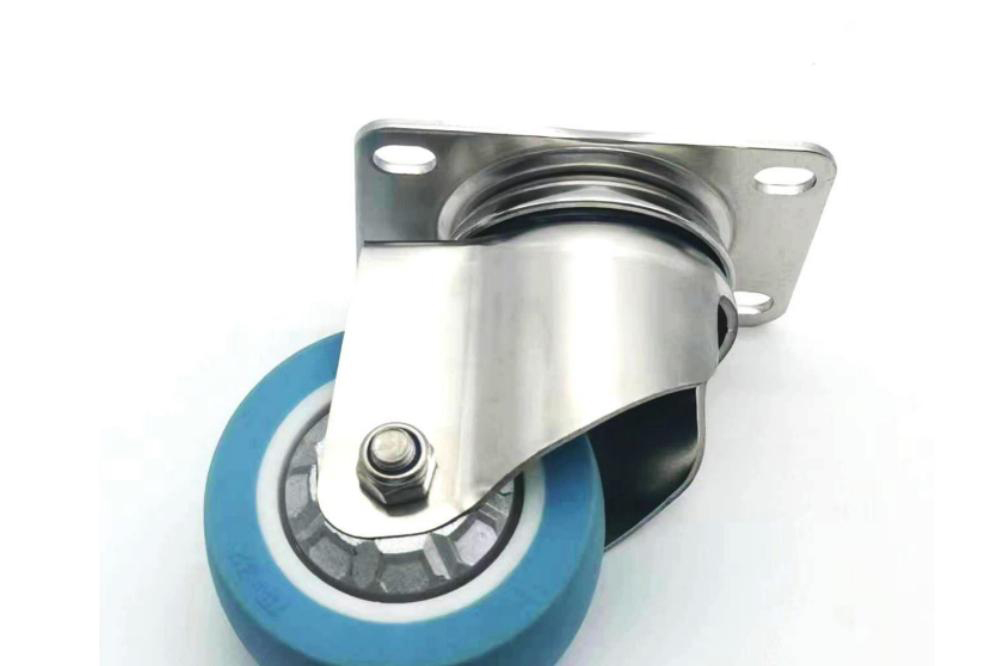
Thermoplastic rubber (TPR), also referred to as thermoplastic elastomer (TPE), is a blend of rubber-like polymers and thermoplastics that can be melted, injection-moulded and recycled like plastic while retaining the elastic, non-marking feel of rubber. TPR caster wheels usually combine a hard PP or nylon core with an outer tread layer of TPR, producing a wheel that rolls quietly, grips slightly and leaves no scuff marks on delicate floors. TPR is the go-to material for medical equipment, office furniture, hotel housekeeping carts and display racks where operator comfort and floor care are priorities.
PP Material Properties: Strengths and Limitations
Mechanical and Physical Characteristics
PP wheels are hard, stiff and dimensionally stable, typically measuring Shore D 70–85 on the hardness scale. They roll with low initial resistance because the contact patch is small and the material does not deform under load. PP has a high strength-to-weight ratio and resists fatigue, which means wheels keep rolling smoothly even after tens of thousands of cycles in a warehouse. Its main weaknesses are brittleness at low temperatures (it becomes brittle below roughly 0°C) and a relatively high coefficient of surface abrasion on rough concrete, which can leave visible wear marks on the wheel itself.
Chemical, Thermal and Processing Behaviour
PP has excellent resistance to water, oils, greases, alcohols, weak acids and weak alkalis, which is why it dominates chemical processing plants, food packaging lines and laundry facilities. Its continuous service temperature ranges from about -10°C to +80°C, with short excursions up to 100°C possible. PP is processed by injection moulding at relatively low temperatures, which keeps unit cost down and makes it easy to mould into complex wheel geometries with hubs, bearings and mounting holes in a single shot.
TPR Material Properties: Strengths and Limitations
Mechanical and Physical Characteristics
TPR is a soft, elastomeric material, typically measuring Shore A 60–90. The soft tread deforms under load, creating a wider contact patch that absorbs vibration, dampens rolling noise and grips smooth floors. TPR wheels are noticeably quieter than PP wheels, often reducing audible rolling noise by 10–15 decibels on tile and epoxy floors. They also cushion sensitive equipment against bumps in the floor. The trade-off is higher rolling resistance, slightly lower dynamic load capacity per wheel size, and higher hysteresis heat build-up at sustained high speeds.
Chemical, Thermal and Processing Behaviour
TPR resists water, alcohols and dilute aqueous solutions well, but it is less tolerant of strong oils, fuels and aromatic solvents than PP. Its service temperature range is similar, roughly -20°C to +80°C, and it generally remains more flexible than PP in cold storage environments. TPR is co-injection moulded over a rigid core, which adds processing steps but produces a bonded tread that will not peel under normal use.
Head-to-Head: Nine-Dimensional Comparison
Performance Metrics That Matter Most
- Hardness: PP is Shore D 70–85 (hard); TPR is Shore A 60–90 (soft to medium).
- Abrasion resistance: TPR treads wear more evenly and grip better; PP wears faster on rough floors but is more scratch-resistant to surface grit.
- Load capacity: For the same wheel diameter and bracket, PP wheels typically carry 10–20% more dynamic load than TPR because the hard wheel does not deflect.
- Noise level: TPR rolls at roughly 40–55 dB; PP can reach 60–70 dB on hard floors.
- Floor protection: TPR is non-marking and will not scuff tile, marble, epoxy or polished concrete; PP can leave scuff marks on soft PVC and polished surfaces.
- Temperature resistance: PP loses impact strength near 0°C; TPR stays flexible below freezing. Both handle up to about 80°C continuously.
- Chemical resistance: PP is superior against acids, alkalis and solvents; TPR is fine for water-based cleaning but should be avoided around fuels and oils.
- Price: PP wheels are generally 20–40% cheaper than equivalent TPR wheels because of simpler tooling and shorter cycle times.
- Processing: PP is single-shot injection moulded; TPR requires a hard core plus an over-moulded tread, adding cost but enabling the two-layer construction.
Rolling Resistance and Vibration Damping
PP wheels roll with minimal effort on smooth, flat floors because the hard contact point stays small. TPR wheels, by contrast, flatten slightly under load, increasing rolling resistance but also absorbing cracks, expansion joints and small debris. In practice, this means a loaded cart on PP casters feels light to push in a warehouse, but on a hospital corridor the same cart with TPR casters will feel smoother, quieter and gentler on both the floor and the patient being transported.
Application Scenarios: Where Each Material Wins
Industrial, Warehousing and Heavy-Load Uses: Choose PP
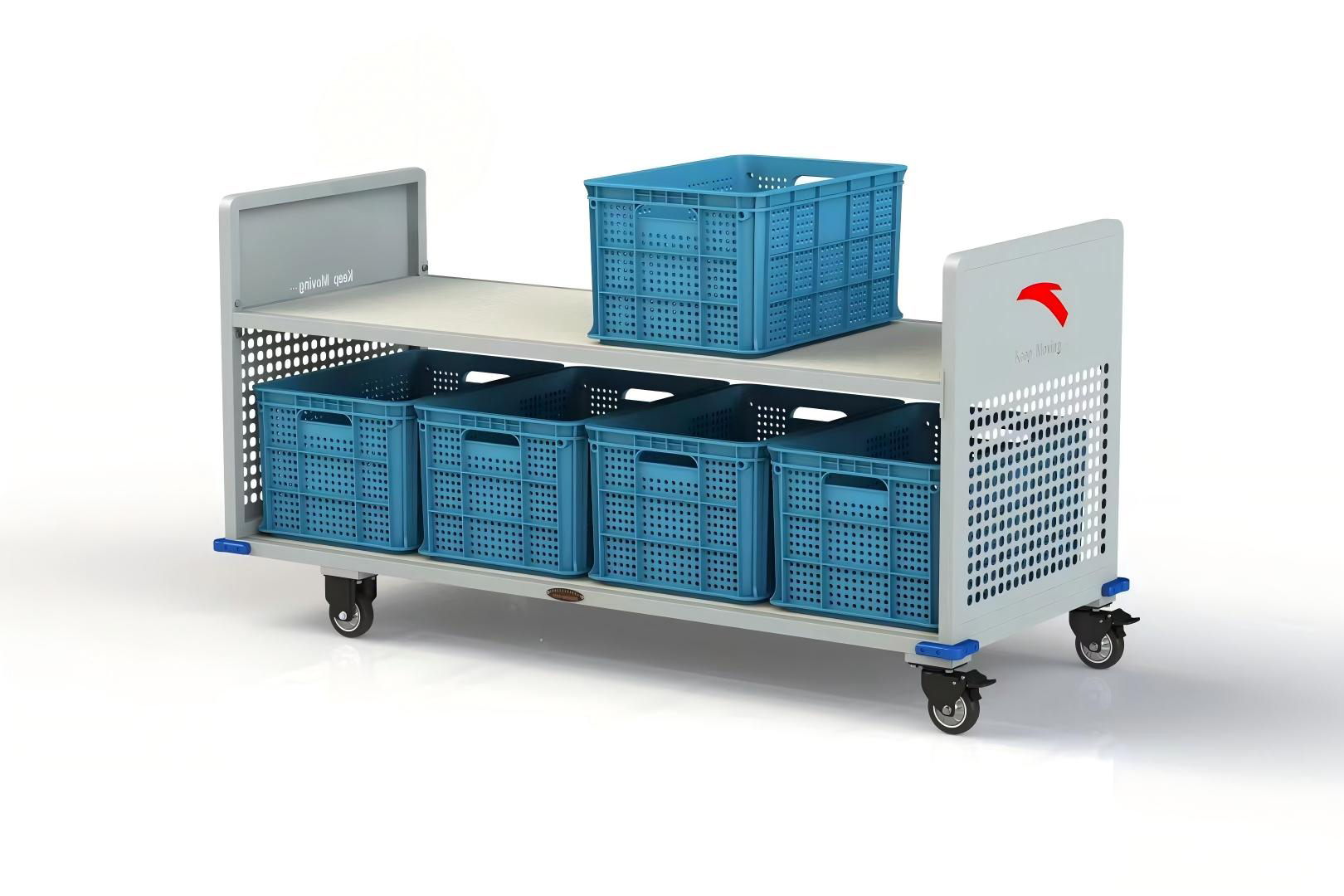
PP casters excel in factories, warehouses, logistics centres and chemical plants. Their high load capacity, low rolling resistance and outstanding chemical resistance make them ideal for heavy duty casters rated from 150 kg to 610 kg per wheel, and they pair naturally with steel brackets for shelving racks, material trolleys, drum carts and assembly-line fixtures. On rough concrete where scuff marks are irrelevant and cost matters, PP is the rational choice.
Medical, Office and Indoor Quiet Uses: Choose TPR
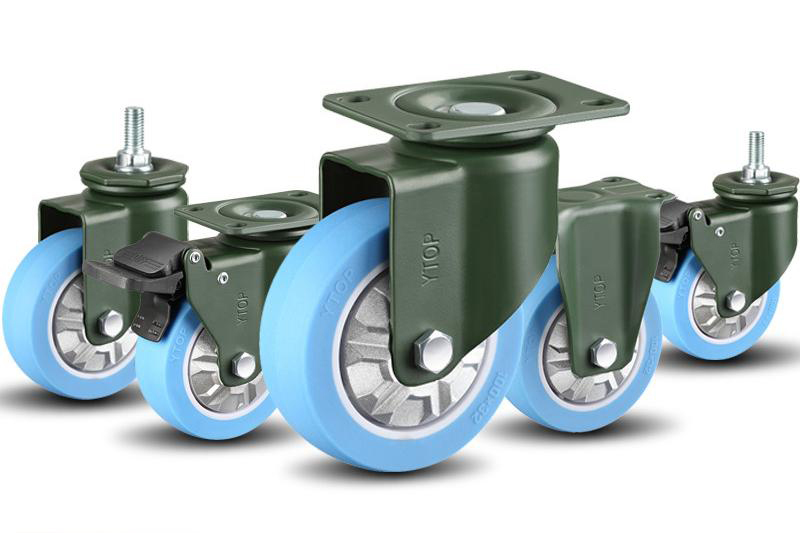
TPR casters are the standard for medical beds, anaesthesia carts, instrument trolleys, office chairs, hotel luggage carts, restaurant service stations and retail display stands. Their silent rolling, non-marking tread and gentle floor protection match environments where noise and floor aesthetics matter. For lower load requirements, TPR wheels are frequently used in our light duty casters (35–80 kg) and medium duty casters (100–190 kg) ranges.
How to Choose: A Practical Decision Guide
Three Questions to Ask Before You Buy
- What is the floor material? Polished tile, marble, epoxy or vinyl? Lean TPR. Rough concrete, paved yard, outdoor paving? Lean PP.
- What is the total load and number of wheels? Divide the total load by the number of wheels and add a 1.5–2 safety factor. If the per-wheel load exceeds 150 kg, PP is usually the more economical route.
- What is the environment like? Around oils, acids, alkalis or solvents? Choose PP. Around sensitive patients, customers or offices where noise is prohibited? Choose TPR.
A Hybrid Worth Considering
For mixed-use carts that operate both outdoors and indoors, many specifiers choose a nylon or PP core wheel with a polyurethane (PU) tread. PU sits between PP and TPR in performance, offering higher load capacity than TPR and better floor protection than bare PP. If neither PP nor TPR seems right, a PU tread may be the compromise you need—ask YTOP for a sample before committing to volume.
Maintenance Tips for PP and TPR Casters
Everyday Care That Extends Wheel Life
Both materials benefit from the same basic care: keep wheels clear of fibres, hair and debris; wipe treads after exposure to chemicals; inspect bearing grooves every three months; and lubricate sealed ball bearings sparingly only if the manufacturer recommends it. PP wheels should be checked for crazing or yellowing after prolonged UV exposure—if the surface becomes chalky, replace the wheels. TPR wheels should be inspected for flat spots after long periods of stationary storage under load; rotate the cart periodically if it will not move for weeks.
Frequently Asked Questions
Are PP casters suitable for outdoor use?
PP casters can be used outdoors on hard paved surfaces, but they should be protected from prolonged direct sunlight, because UV exposure gradually embrittles polypropylene. TPR wheels, with their elastomeric tread, generally handle outdoor temperature swings better but may degrade faster under oils and fuels.
Do TPR casters mark floors?
No. TPR is formulated to be non-marking, which is why it is preferred on tile, marble, epoxy and polished concrete. PP wheels can leave scuff marks on soft PVC flooring, so confirm the floor material before specifying.
Which material is cheaper, PP or TPR?
PP wheels are typically 20–40% cheaper than equivalent TPR wheels because they are single-material injection mouldings, while TPR requires a rigid core plus an over-moulded soft tread.
Can PP and TPR casters carry the same weight?
For the same wheel diameter, hub size and bracket rating, PP wheels usually carry 10–20% more dynamic load because they do not deflect. Always check the published load rating of the complete caster, not just the wheel material.
What temperature range do these casters handle?
Both PP and TPR casters typically perform from approximately -20°C to +80°C for continuous use. PP loses impact strength near freezing, while TPR stays flexible—but at the hot end, neither should be used continuously above 80°C.
Related Reading
- What Is the Difference Between Rubber Casters and Nylon Casters?
- Plastic Casters vs Metal Casters: Which Is Better for You?
- Which Material Performs Better: Nylon or Polyurethane Casters?
- What Are the Common Caster Specifications?
- In-Depth Understanding of the Structure of Casters
- Explore YTOP Medium Duty Casters (100–190 kg)
- Explore YTOP Light Duty Casters (35–80 kg)
- Contact YTOP (Zhuoye) for Expert Caster Selection
Post time: Apr-07-2024