
When choosing the right caster wheels for your industrial or commercial application, the BR rubber casters vs TPR casters debate is one of the most critical decisions you will face. Both materials offer excellent elasticity, floor protection, and noise reduction, yet they differ significantly in durability, load capacity, temperature resistance, and cost. This comprehensive guide breaks down the key differences between BR rubber and TPR caster wheels, helping you make an informed decision that optimizes performance, extends service life, and reduces total cost of ownership.
Understanding BR Rubber Casters
What Is BR Rubber?
BR (Butadiene Rubber) is a highly elastic synthetic polymer material that exhibits reversible deformation under stress. At room temperature, BR rubber remains flexible and can produce large deformations under relatively small external forces, returning to its original shape once the force is removed. As an amorphous polymer with a low glass transition temperature (Tg), BR rubber maintains excellent elasticity across a wide temperature range. Its molecular weight typically exceeds several hundred thousand, giving it superior mechanical properties compared to thermoplastic alternatives.
Key Properties of BR Rubber Casters
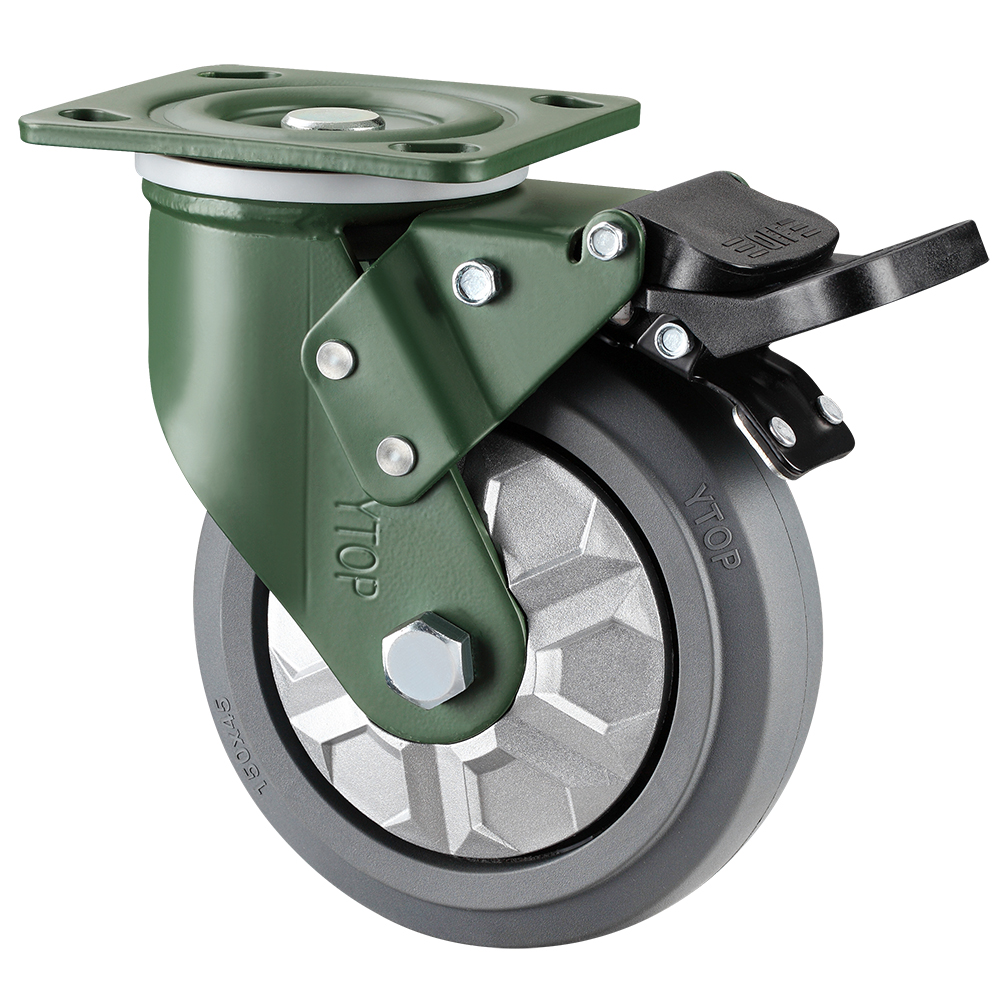
BR rubber casters are manufactured through a vulcanization process that cross-links polymer chains, creating a durable, resilient material. The key advantages include excellent abrasion resistance, outstanding impact resistance, and high load-bearing capacity. BR rubber wheels typically operate effectively in temperatures from -40°C to +120°C, making them suitable for demanding industrial environments. The material also demonstrates superior tensile strength and fatigue resistance compared to thermoplastic elastomers.
Understanding TPR Casters
What Is TPR Material?
TPR stands for Thermo-Plastic Rubber, also known as thermoplastic elastomer. It is a thermoplastic soft rubber material that offers elasticity without requiring vulcanization. TPR can be directly processed and molded through injection molding, extrusion, or blow molding, making it highly versatile and cost-effective to manufacture. Most TPR materials are based on SBS (Styrene-Butadiene-Styrene) substrates, with SEBS-based variants offering improved aging and temperature resistance.
Key Properties of TPR Casters
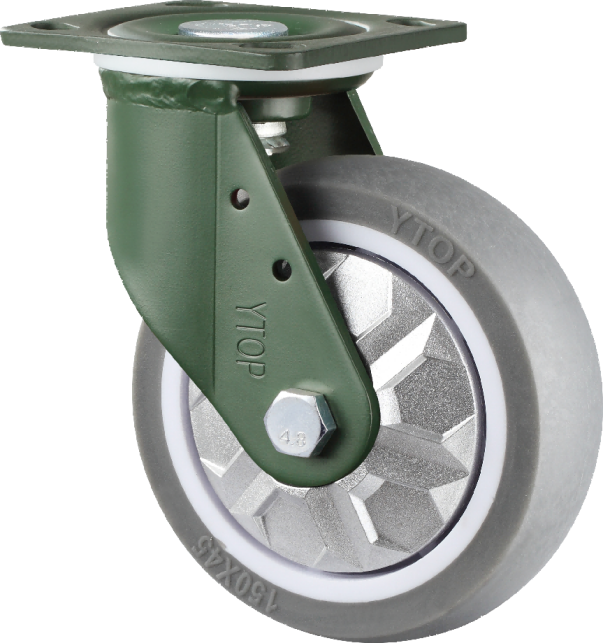
TPR casters offer a unique combination of softness and flexibility that exceeds traditional rubber. The material can be formulated across Shore hardness 5A to 100A, allowing customization for specific applications. TPR provides excellent environmental characteristics, with low levels of hazardous substances such as phthalates and nonylphenol, meeting ROHS, REACH, and EN71-3 standards. However, TPR typically has lower tensile strength, fatigue resistance, and mechanical performance compared to vulcanized BR rubber.
BR Rubber Casters vs TPR Casters: Head-to-Head Comparison
Durability and Wear Resistance
When comparing BR rubber casters vs TPR casters, durability is a primary differentiator. BR rubber offers superior abrasion resistance and longer service life under heavy load conditions. The vulcanization process creates a cross-linked molecular structure that resists wear, tearing, and deformation over time. TPR, while softer and more comfortable to roll on, tends to wear faster under continuous heavy use, particularly on rough or abrasive surfaces. For high-cycle industrial applications, BR rubber typically outlasts TPR by a significant margin.
Load Capacity and Performance
BR rubber casters generally support higher load capacities than TPR casters of the same wheel size. The cross-linked structure of vulcanized rubber distributes weight more effectively, enabling BR rubber wheels to handle loads from 150kg to over 600kg per wheel. TPR casters, while adequate for light to medium duty applications (35-190kg), may experience permanent deformation or flat spotting under sustained heavy loads.
Temperature and Chemical Resistance
BR rubber operates effectively across a broader temperature range (-40°C to +120°C) compared to standard TPR (-45°C to +90°C). While SEBS-modified TPR can extend temperature resistance to 75-80°C, BR rubber still offers better performance in high-temperature environments. In terms of chemical resistance, BR rubber shows better resistance to oils and solvents, while TPR may degrade faster when exposed to certain chemicals.
Noise Reduction and Floor Protection
Both materials excel at noise reduction and floor protection. TPR softer formulation provides slightly quieter rolling performance and gentler floor contact, making it ideal for office environments, hospitals, and hotels where noise minimization is critical. BR rubber, while still quiet, may produce marginally more noise due to its higher density, but it compensates with superior grip and traction on smooth surfaces.
Application Scenarios: Which Material Should You Choose?
When to Choose BR Rubber Casters
BR rubber casters are the preferred choice for heavy-duty industrial applications, including manufacturing equipment, material handling carts, freight containers, and warehouse logistics. They excel in environments with rough floors, heavy loads, temperature extremes, or chemical exposure. If your application involves continuous operation, high cycle counts, or outdoor use, BR rubber provides the durability and reliability needed for long-term performance.
When to Choose TPR Casters
TPR casters are ideal for light to medium duty applications where floor protection and quiet operation are priorities. Common use cases include office furniture, medical equipment racks, retail display stands, and hospitality carts. TPR softer rolling feel and cost-effective manufacturing make it an excellent choice for environments where the floor finish must be preserved and noise levels must remain low.
Selection Guide: Making the Right Choice
To choose between BR rubber and TPR casters, evaluate your specific application requirements: assess the maximum load per wheel, operating temperature range, floor surface conditions, noise sensitivity, and budget constraints. For heavy loads (>200kg per wheel), rough surfaces, or outdoor use, BR rubber is the clear winner. For light loads, smooth floors, and noise-sensitive environments, TPR offers excellent value. Always consult with a caster engineering specialist to validate your selection.

Cost Analysis and ROI
Upfront Cost vs Long-Term Value
While TPR casters offer lower upfront costs, BR rubber casters often provide superior long-term value. When evaluating total cost of ownership, consider replacement frequency, downtime costs, and maintenance requirements. BR rubber wheels typically require fewer replacements and less frequent maintenance, offsetting their higher initial purchase price. For applications where downtime is costly, the reliability of BR rubber quickly justifies the investment.
Application-Specific Cost Considerations
In low-cycle, light-duty applications, the cost difference may not justify selecting BR rubber. However, for high-frequency use cases such as warehouse order picking, manufacturing line transport, and material handling systems, BR rubber extended service life reduces both replacement costs and labor expenses associated with caster swaps. Always calculate the total cost per month of service rather than comparing purchase prices alone.
Technical Specifications Comparison
Hardness and Shore Scale
BR rubber casters typically range from Shore A 60A to 90A, with 75A being the most common formulation for industrial wheels. TPR casters offer a wider hardness range from Shore A 5A to 100A, allowing manufacturers to tune the material for specific grip and cushioning requirements. In practice, a 75A BR rubber wheel and a 75A TPR wheel may feel similar to the touch, but the cross-linked structure of BR rubber provides significantly better resilience under load.
Rolling Resistance Coefficient
The rolling resistance coefficient (RRC) determines how much force is needed to push a loaded cart. BR rubber wheels typically have an RRC of 0.015-0.025 on smooth concrete, while TPR wheels range from 0.012-0.020. While TPR may roll slightly easier, the difference is negligible for most applications, and BR rubber superior durability often compensates for marginally higher rolling effort.
Impact Absorption and Shock Dampening
Both materials excel at absorbing impacts, but BR rubber tends to distribute impact energy more uniformly across the wheel surface. This makes BR rubber wheels particularly valuable for transporting fragile equipment across rough floors or expansion joints. TPR, being softer, may absorb smaller vibrations better but can bottom out under severe impacts.
Maintenance and Longevity Tips
Proper Caster Maintenance
To maximize the service life of either BR rubber or TPR casters, regularly inspect wheel tread for uneven wear or embedded debris. Keep swivel bearings properly lubricated using lithium-based grease. Clean wheels with mild soap and water, avoiding harsh solvents that may degrade the material. For outdoor applications, inspect for UV-induced cracking at least quarterly.
Storage and Shelf Life
Store unused caster wheels in a cool, dry environment away from direct sunlight. BR rubber wheels typically have a shelf life of 5-7 years when properly stored, while TPR wheels may start to degrade after 3-5 years due to thermoplastic material characteristics. Always rotate stock to ensure older wheels are used first.
Frequently Asked Questions
Which lasts longer, BR rubber or TPR casters?
BR rubber casters typically last 30-50% longer than TPR casters under heavy-duty conditions due to their cross-linked molecular structure and superior abrasion resistance. However, for light-duty applications, TPR may offer comparable service life at a lower cost.
Are TPR casters suitable for outdoor use?
Standard TPR casters are not recommended for prolonged outdoor exposure, as UV radiation and temperature fluctuations can accelerate material degradation. SEBS-modified TPR offers improved weather resistance, but BR rubber remains the better choice for outdoor applications.
Can BR rubber casters protect hardwood or epoxy floors?
Yes, BR rubber casters provide excellent floor protection. The material natural elasticity absorbs shocks and distributes weight evenly, preventing scratches, dents, and marks on hardwood, epoxy, and polished concrete floors.
What is the cost difference between BR rubber and TPR casters?
TPR casters are generally 15-30% cheaper than equivalent BR rubber casters due to simpler manufacturing processes. However, BR rubber longer service life often results in a lower total cost of ownership over the caster lifecycle.
Related Reading
- 📚 Application of Common Materials in Casters — Comprehensive analysis of caster wheel material characteristics including BR rubber and TPR.
- 📚 Difference Between Rubber and Polyurethane Casters — Compare rubber vs PU for heavy-duty industrial applications.
- 📚 Characteristics of Inflatable Rubber Wheels — Learn about rubber caster wheel design and performance.
- 📚 How to Choose Casters: Practical Selection Guide — Step-by-step caster selection based on real application scenarios.
- 📚 Caster Selection Strategy: Material and Brand — Expert guidance on choosing the right caster material and manufacturer.
Explore our complete range of heavy-duty casters (150-610kg) with BR rubber wheels and medium-duty casters (100-190kg) with TPR options, or contact our engineering team for expert caster material selection guidance.
Post time: May-13-2024