
A cold storage warehouse sets demands on equipment that a normal-temperature workshop never does. Minus twenty to minus thirty degrees Celsius is routine, floors frost over and turn slippery, metal parts turn brittle at low temperatures, and ordinary grease freezes until bearing rotation resistance spikes. Electric forklifts moving frozen goods in this environment need wheels that cope with three problems at once: low temperature, heavy load, and a slippery floor. Ordinary workshop wheels typically fail even one of these tests. This guide breaks down the three challenges, explains what low-temperature tread, grease, and brackets need to deliver, and lists the parameters to give the supplier.
The Three Challenges Cold Storage Poses to Caster Wheels
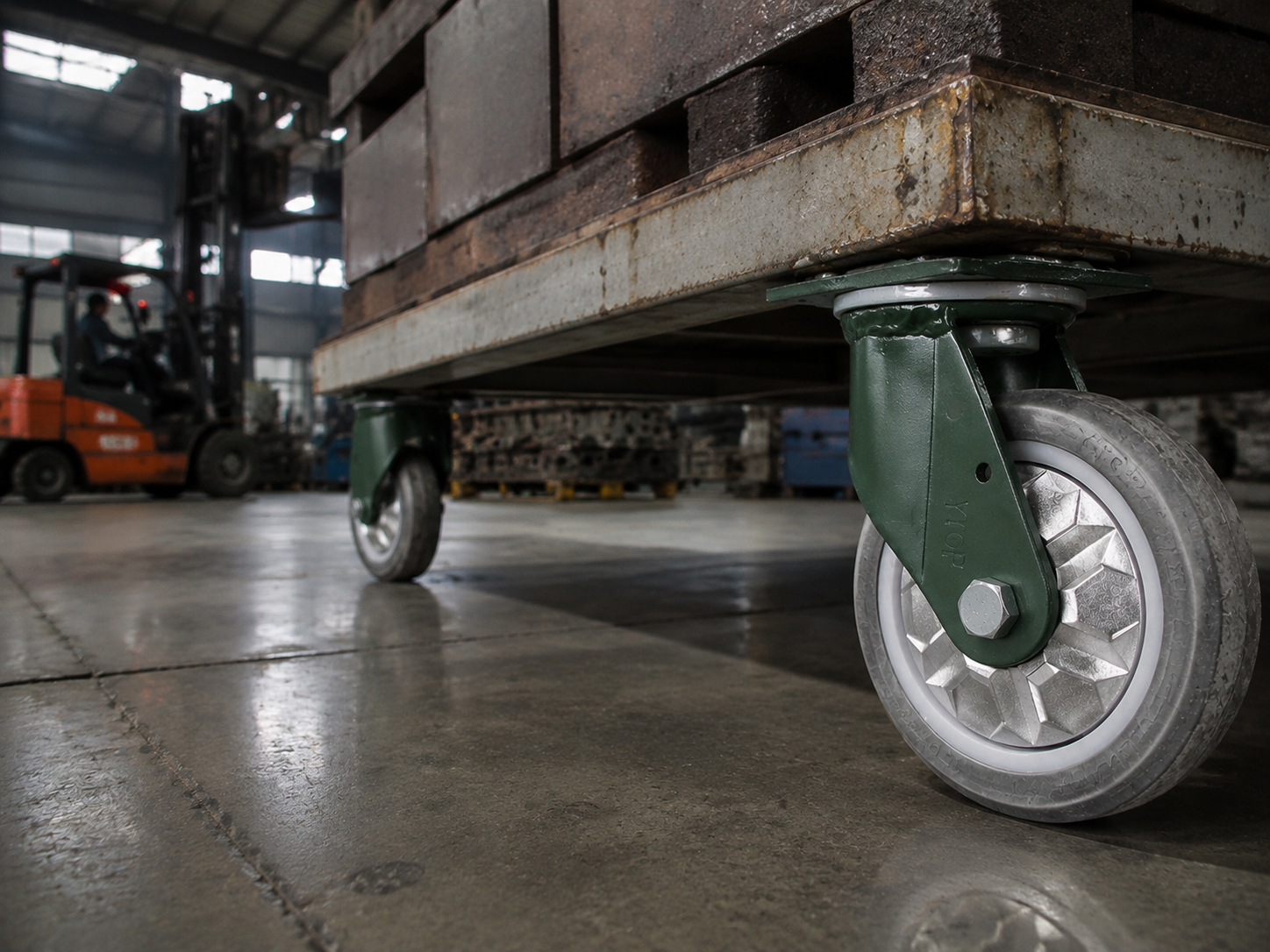
The cold storage test on wheels can be separated into three distinct problems. Low-temperature embrittlement comes first: sub-zero temperatures turn ordinary rubber treads hard and brittle, and once elasticity is lost the tread cracks and fails; metal parts also become more brittle and fracture more easily under impact. Lubrication freezing comes second: ordinary grease solidifies in the cold, bearing rotation resistance rises sharply, and wheels that look perfectly fine on the surface may not budge at all — a frozen bearing takes the whole equipment down.
Floor frosting is the third problem: frost layers and condensation leave floors wet and slippery, and when wheel grip is insufficient the wheels spin and slip — and slipping while moving frozen pallets is a genuine safety hazard. With all three problems present at the same time, a standard workshop caster rarely survives even one of them, which is why cold storage fleets that reuse ordinary wheels spend far more on replacements and downtime than on the wheels themselves.
Tread Material: Keeping Elasticity Below Freezing
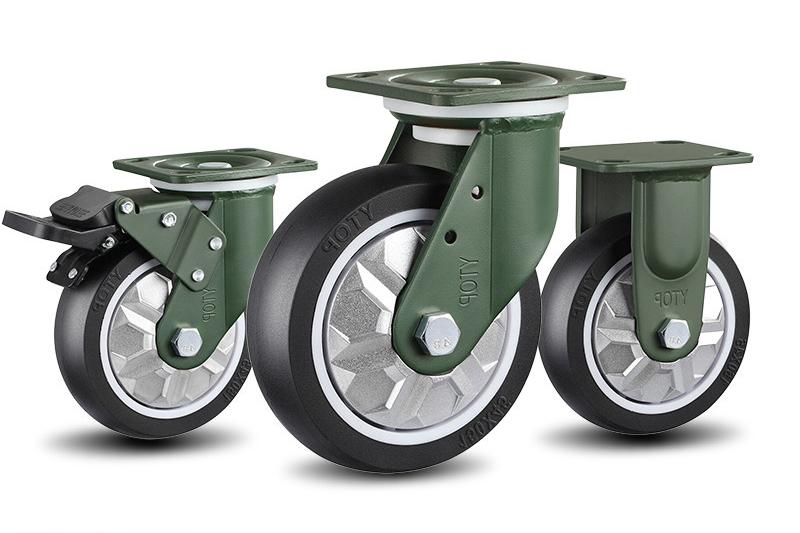
The core requirement for a cold storage tread is to keep its elasticity at low temperature. A low-temperature-resistant tread stays soft and flexible below zero, does not harden or crack, and rolls stably without slipping. During selection, confirm the tread material’s low-temperature limit and match it to the actual cold storage temperature: for a minus 25 degrees warehouse, the tread’s low-temperature rating must cover that point. Temperatures differ between warehouses — minus 18 and minus 35 degrees impose different requirements on tread material, and the ratings cannot be mixed.
Treads also need sufficient anti-slip performance. Frost and condensation make the floor wet, and inadequate grip means the wheels spin; slipping while handling frozen product can tip the cargo over. In a cold storage environment, anti-slip is a safety requirement, not an optional extra — the tread compound, hardness, and floor finish should be verified together before the wheels are specified, and a test run on the actual frosted floor is worth more than any catalog figure.
Grease and Brackets: The Easily Overlooked Failure Points

Whether wheels start smoothly in cold storage hinges on lubrication. The wide-temperature behavior of molybdenum-disulfide lithium-based grease matters here: it resists high temperature and is also unlikely to freeze at low temperature, so bearings keep rotating smoothly in cold storage conditions. Cold storage forklifts start and stop frequently; if the grease low-temperature performance is inadequate, startup resistance is enormous, as though the wheel were glued to the floor. This point is easily missed because tread and bracket may look fine, while a frozen bearing stops the whole cart. Confirm with the supplier the grease’s minimum usable temperature and its low-temperature lubrication effect.
Brackets carry boxed and palletized frozen loads, which are far from light, so the bracket must hold strength stability at low temperature without deforming under load, and its structure must not suffer brittle fracture under repeated impact. A grade-8 powder-coated bracket surface resists moisture and corrosion: cold storage looks dry, but the repeated cold-heat cycling of entry and exit generates condensation and defrost water, and the smooth film makes frost and condensation easy to wipe off, which keeps wheel cleaning and maintenance straightforward.
Selecting by Temperature Range and Load
For cold storage forklift wheels, low-temperature adaptability ranks first in the selection order: a low-temperature-resistant tread maintains elasticity and prevents slipping, wide-temperature grease prevents bearing freezing, the bracket carries stably in the cold, and a powder-coated surface resists moisture and rust. Provide the manufacturer with the cold storage minimum temperature, the handling load, the floor condition, and the entry-exit frequency, and select the wheels against low-temperature operation standards rather than normal-temperature workshop specifications. Load rating also deserves attention: heavy-duty caster lines built for pallet-scale loads are the right starting point, and derating advice should be requested for continuous-duty cold operation, because low temperature reduces both tread elasticity and effective bearing life.
YTOP Manganese Steel Casters confirms cold storage selections against the specific temperature range and load requirement rather than applying normal-temperature specifications directly. When the warehouse temperature, load, and floor condition are supplied, the matched tread compound, wide-temperature grease, and heavy-duty bracket can be specified together — the combination, not any single component, is what keeps a cold storage forklift rolling through a long winter of duty. For customers sizing pallet loads, the YTOP Heavy Duty Casters (150-610kg) product range is the practical starting point for this class of work.
Related Reading
Looking for more in-depth caster guides and industrial mobility resources? Explore these related articles:
- Dual-Wheel Structure Advantages — Learn how dual-wheel caster structures improve stability and load distribution in cold storage environments.
- Manganese Steel vs Ordinary Steel — Compare caster construction quality to understand why YTOP casters outperform ordinary alternatives.
- How to Calculate Load Capacity — Dynamic vs. static load ratings for low-temperature forklift applications.
- Heavy Duty Casters Range — Explore YTOP’s heavy-duty caster products built for cold storage and freezer environments.
Explore our complete range of heavy-duty casters (150-610kg) and super heavy-duty casters (700-1600kg) for diverse industrial applications, or contact our engineering team for expert caster application knowledge and selection guidance.
Post time: Oct-13-2026