
Selecting casters starts with calculating load capacity — this is the first step of procurement. If calculated wrong, wheels being scrapped early is the light consequence; wheel failure during handling causing tipping over affects both equipment and personnel safety.
But load capacity is not as simple as looking at one number. Industrial caster load capacity is divided into static load and dynamic load, with great differences between the two, and using the wrong standard during selection is a common pitfall.
The Difference Between Static Load and Dynamic Load

Static load is the maximum weight a wheel can bear in a stationary state. Equipment parked and not moving, with all weight pressing on the wheels — this is static loading. The characteristic of static load is no impact, no vibration, with load stably distributed on the wheels.
Dynamic load is the load a wheel can bear during movement. When moving, wheels must both bear load and roll, with much more complex working conditions. Dynamic load includes various additional loads such as rolling resistance, steering torque, ridge-crossing impact, and vibration caused by uneven floors. Dynamic load is usually only about half of static load, or even lower.
The most common selection error: using static load as daily usage load for selection. A wheel rated at 500kg static load may have only 200-250kg dynamic load. If the equipment’s actual operating load is close to the static rated value, the wheel is already overloaded under dynamic working conditions. Wheels running under overload will have significantly shortened lifespan, and both bearings and brackets bear loads beyond the design range.
Three Practical Factors Affecting Load Capacity
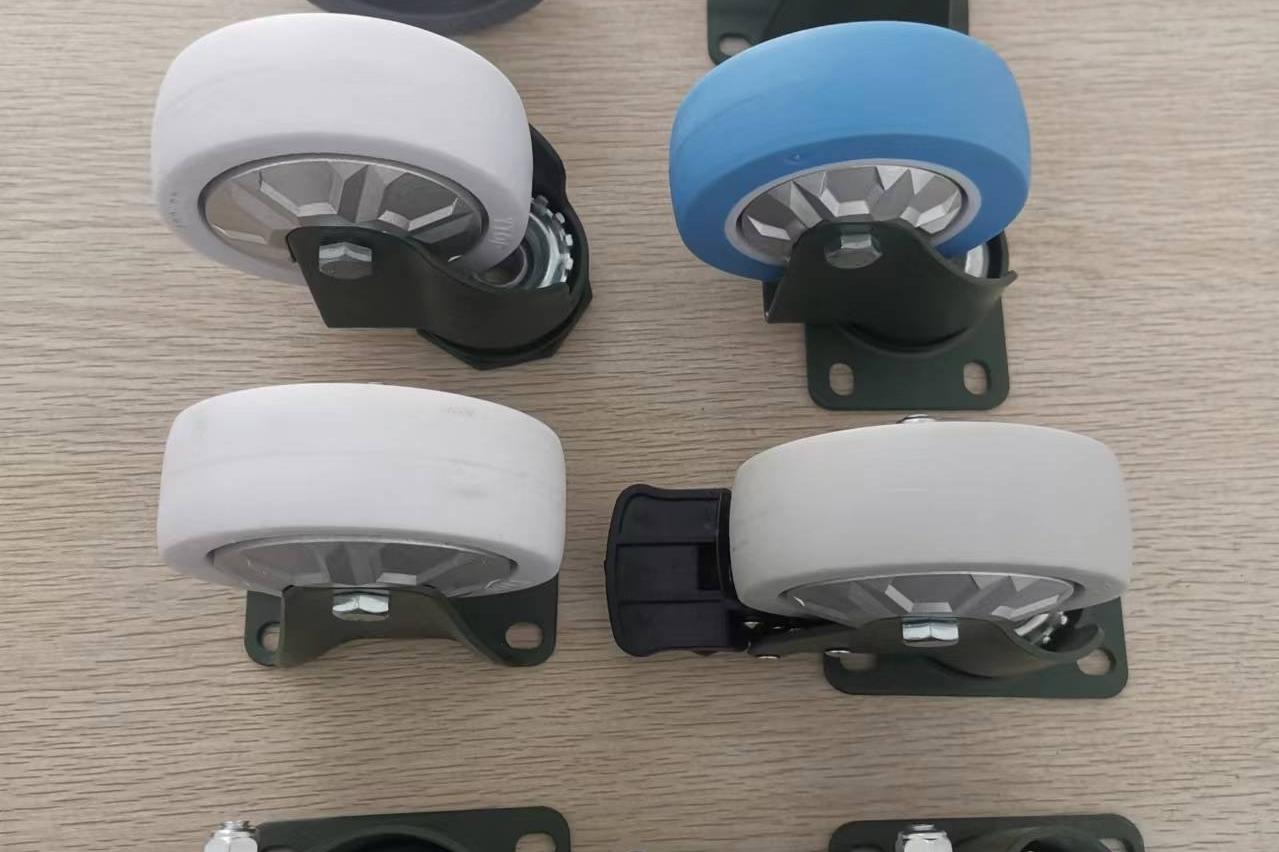
Besides the dynamic/static difference, actual load capacity is also affected by three factors:
Number of wheels and force distribution. The weight of four-wheel equipment is not evenly distributed to each wheel. Uneven floors, center of gravity offset, and equipment vibration all cause individual wheels to bear more weight. A common empirical algorithm is total weight divided by number of wheels, then multiplied by a safety factor to compensate for uneven force. For example, an 800kg equipment with four wheels, distributing 200kg per wheel then multiplying by a safety factor of 1.3-1.5, the per-wheel selection baseline should be 260-300kg.
Usage working conditions. The actual load impact on wheels differs greatly between flat workshop floors and outdoor complex road surfaces. The instantaneous impact force when crossing thresholds and ditches may be several times the static load. The impact load coefficient is generally valued according to working conditions: low value for flat floors, high value for rough roads.
Speed and frequency. Wheels used at high speed and high frequency will have actual load capacity discounted from the rated value. Frequent start-stops and long-time continuous operation cause faster bearing temperature rise and fatigue accumulation, and selection should leave more margin.
An Estimation Example

Demonstrate the calculation logic with numbers. Assume an equipment with total weight 1000kg, borne by four wheels, selected according to dynamic load caliber:
1. Per-wheel base load: 1000 ÷ 4 = 250kg
2. Add uneven force coefficient: under dynamic load conditions valued at 1.3-1.5 times, take 1.4, 250 × 1.4 = 350kg
3. Add impact coefficient: relatively flat workshop floor take 1.1, 350 × 1.1 = 385kg
4. Round up to specification grade: select 500kg-grade dynamic load wheels
The key to this calculation is: using dynamic load caliber, not static. If selected according to static load, 1000 ÷ 4 = 250kg, and it looks like 250kg-grade wheels are sufficient, but in actual operation after uneven force and impact combined, per-wheel actual load may approach 400kg, and 250kg-grade wheels are severely overloaded under dynamic conditions.
Common Load Calculation Misconceptions
Selecting wheels only by static load. Daily operation is dynamic working conditions, should select according to dynamic load caliber. This is the most common error and also the main cause of early wheel failure.
Forgetting uneven force. Equipment will not perfectly evenly bear force. Among four wheels, one may bear 30-50% more load than the average. Without considering this coefficient, the selection baseline is too low.
Ignoring impact coefficient. The instantaneous impact when crossing thresholds and ditches may be several times the static load. It’s okay not to consider impact for flat-floor selection, but working conditions with thresholds and ditches must add impact coefficient.
Not leaving margin. Long-term full-load or near-full-load operation significantly shortens wheel lifespan. Leaving 20-30% margin during selection gives better wheel lifespan and stability.
Related Reading
- Heavy Duty Industrial Casters (150-610kg)
- Super Heavy Duty Casters (700-1600kg)
- 10 Core Parameters for Caster Selection
Post time: Sep-21-2026