
Most caster failures we are asked to diagnose are not load failures. They are floor failures. A cart that is perfectly specified on paper starts to judder at every doorway, the wheels flat-spot within a few months, the brackets crack at the mounting plate, and the operator blames the casters. In reality the casters have been doing something they were never designed to do: climbing, dropping, twisting across lips and joints hundreds of times a day, often with a load far heavier than the wheels were matched to.
Uneven floors, thresholds and floor transitions are one of the most common reasons a caster specification goes wrong, and one of the least discussed. This guide is a practical sequence for anyone replacing casters on a cart, trolley, rack or mobile machine that has to cross from one surface to another.
The Real Problem Is Usually Not “Rough Floor”
When a customer says the floor is uneven, they usually mean one of five different things, and each one loads the caster differently. Getting this diagnosis right is the difference between buying a better caster and buying the same caster twice.
Step and lip heights. A tile edge standing 8 mm proud of a concrete floor is a vertical obstacle. Every crossing produces an impact, and the wheel, fork and swivel raceway absorb it in that order. Ten millimetres is unremarkable for a 200 mm wheel and brutal for a 75 mm one.
Gaps and joints. Expansion joints, drainage slots, dock leveler hinges and grates create a gap the wheel can drop into. Gaps are worse than bumps for small wheels, because a wheel narrower than the gap falls in and stops dead against the far edge instead of rolling over it.
Slopes and ramps. A 2 percent slope is invisible to the eye and noticeable to a loaded cart. On long ramps the operator ends up holding back the load continuously, which is a brake problem rather than a wheel problem.
Surface texture. Rough concrete, exposed aggregate, gravel and metal grating all increase rolling resistance and generate vibration. Vibration is what destroys bearings and shakes loose fasteners, not the load itself.
Floor condition changes over time. A floor that was flat when the casters were specified may now have a 15 mm step where a slab has settled, or a curled edge where a repair patch meets the original surface.
Rule One: Wheel Diameter Beats Everything Else
If you can only change one thing on a cart that has to cross obstacles, change the wheel diameter. Climbing ability scales with the ratio of obstacle height to wheel radius, so a larger wheel reduces the effort required far more effectively than any change in tread compound.
Our working rule of thumb for manually pushed equipment is that the obstacle should not exceed roughly one third of the wheel diameter. That means a 75 mm wheel handles a 25 mm lip at best, a 125 mm wheel handles about 40 mm, and a 200 mm wheel handles around 65 mm. Beyond that ratio the operator is effectively dragging the cart over a step, and the swivel assembly takes a shock load every time.
A useful second rule is to look at the gap rather than the bump. The wheel should be wider than the largest gap it will cross. On carts that run over drainage channels or dock hinges, a 50 mm wide wheel crossing a 30 mm gap is fine; the same wheel crossing a 60 mm gap will jam.
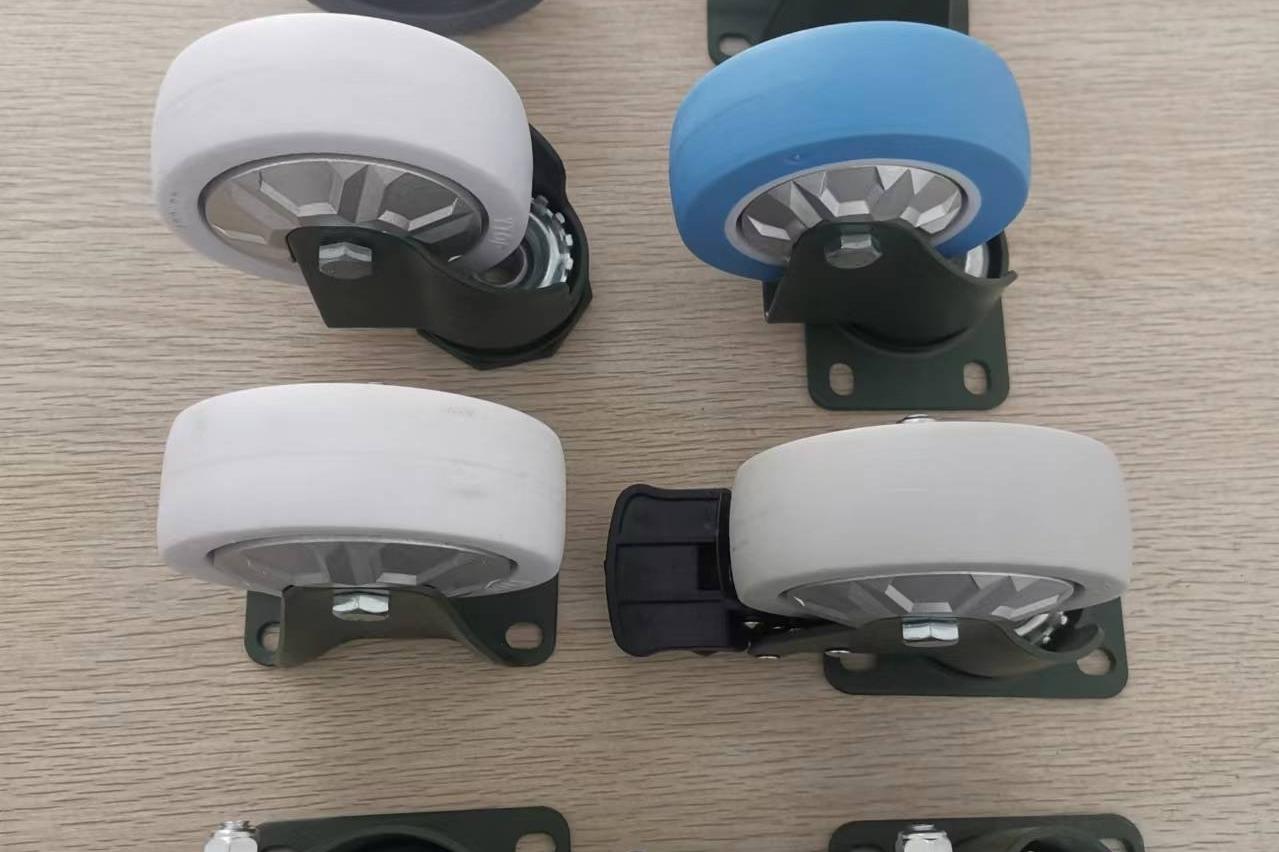
There is a cost to going larger: a bigger wheel raises the deck height, adds weight, and needs more clearance under the cart. On low-profile equipment the answer is usually to fix the floor rather than to fit a wheel that no longer fits the machine.
It is worth putting a number on the effect, because operators rarely describe the problem as a diameter problem. The horizontal pull needed to lift a wheel over a step rises roughly in proportion to the step height divided by the wheel radius, so halving the wheel radius roughly doubles the effort at the same step. That is why a 100 mm wheel that feels fine on a flat aisle becomes a two-person job at a 20 mm tile lip under a 300 kg load. The wheels are not weak; they are simply too small for the geometry the operator is asking them to handle.
Wheel Material and Tread Shape
Once the diameter is realistic, material decides how the cart behaves over the transition. There is no best material, only a best compromise for the surfaces in the route.
Polyurethane (PU) and TPU. High load capacity, low rolling resistance, and a tread that resists flat-spotting. On smooth floors they are the efficient choice. Over lips and joints they transmit shock rather squarely into the fork, so they need a wheel large enough to roll rather than hit.
Rubber and TPR. Softer compounds deform over small obstacles instead of stopping at them, which makes them forgiving on rough concrete and tile edges. The trade-off is higher rolling resistance and more heat build-up in continuous towing.
Nylon and engineering plastics. Hard, low-friction and dimensionally stable, but unforgiving. A hard wheel on a stepped floor is loud, and the shock goes straight into the bearing and the mounting plate.
Pneumatic and cushion tyres. The best obstacle absorption available, and the reason they dominate outdoor and yard equipment. They need maintenance and are unsuitable where sharp debris or floor hygiene rules are present.
Tread shape matters as much as the compound. A rounded, slightly crowned tread rolls over a lip more easily than a square-edged one, while a flat tread puts more rubber in contact with the floor when the load is heavy. For floors with a consistent direction of travel, a wheel with a slight radius at the edge is worth asking for.
Bearings, Forks and the Parts That Fail First
Impact energy has to go somewhere. On a cart crossing ten thresholds an hour, the first parts to show the cost are usually the ones you cannot see.
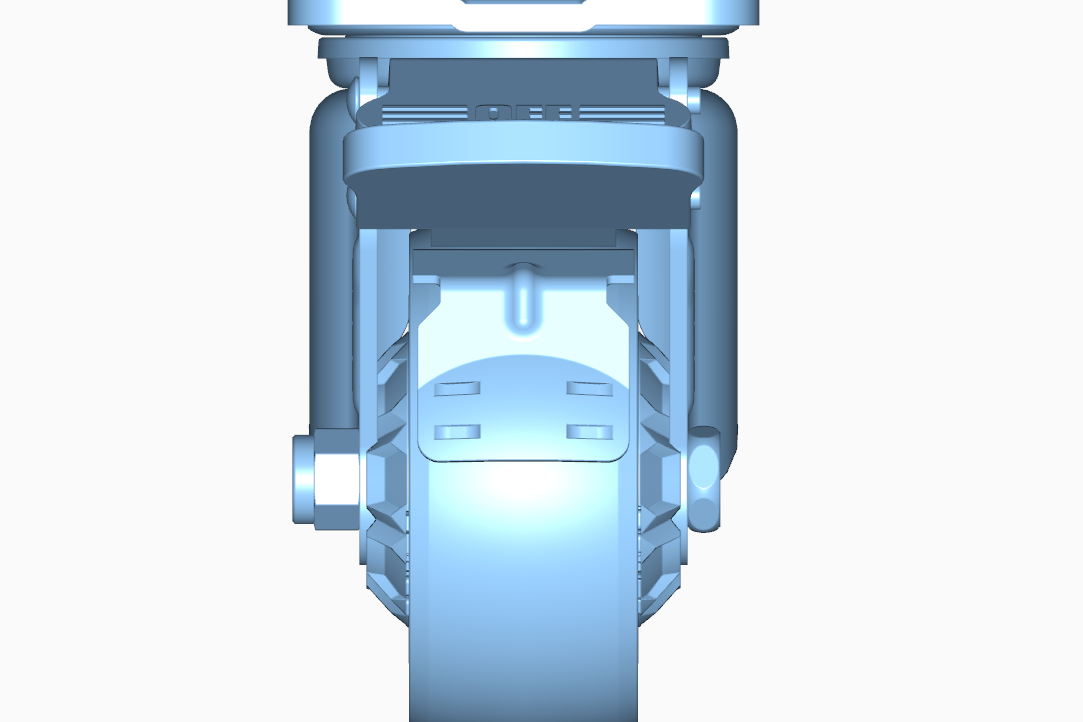
Swivel raceways. Every impact arrives off-axis at the swivel. A double-ball raceway distributes that load across two rows and lasts noticeably longer than a single-row design on stepped floors, which is why we recommend it for anything crossing transitions regularly rather than occasionally.
Fork thickness and leg stiffness. Thin stamped forks flex under impact, and flexing eventually cracks at the bend. Pressed steel forks with a heavier gauge, or forged forks on very heavy equipment, are the honest answer for impact-heavy routes.
Axle and bearing type. Roller bearings tolerate shock better than plain bushings; sealed precision ball bearings roll more freely but dislike dirt. On floors with grit and grit-filled joints, a shielded bearing with a grease nipple usually outlasts a sealed bearing that cannot be re-greased.
Mounting plate and fasteners. Impact works bolts loose. Thread-locking compound and a plate that matches the machine’s existing hole pattern are cheap insurance; a plate that is too small for the load concentrates stress at two holes and cracks the deck.
Swivel Behaviour, Brakes and Slopes
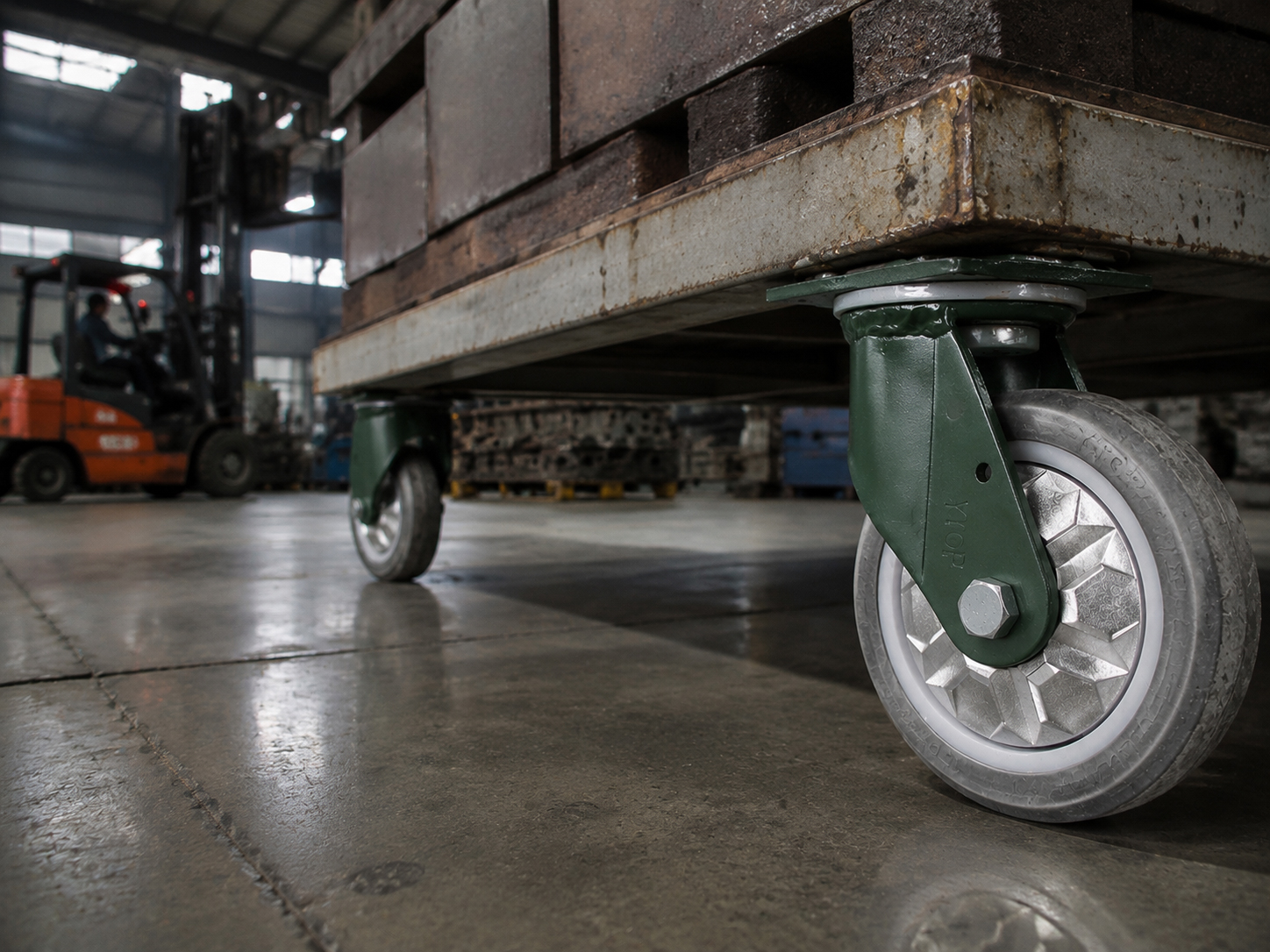
On uneven floors the swivel does more work than on smooth ones, and the way it is set up changes the feel of the whole cart.
A larger offset makes a caster easier to steer but less stable at speed; a smaller offset tracks straighter but needs more effort to turn. Where a cart has to be pushed across a threshold and then turned immediately, a medium offset with a well-lubricated raceway is the practical compromise.
Brakes deserve more attention than they usually get on sloped routes. A total-lock brake that locks both the wheel and the swivel is what stops a cart rotating on a ramp when the operator lets go; a wheel-only brake leaves the cart free to spin about its own axis. If the route includes any ramp longer than a few metres, specify total-lock on at least two casters, and check the brake pedal is reachable from the handle position the operator actually uses.
Directional-lock casters are worth considering where a cart must travel straight along a production line but still be steerable elsewhere. They remove much of the side-loading that uneven floors put into the swivel.
Sometimes the Floor Is the Cheaper Fix
Before specifying a larger, softer, more expensive caster, check whether the transition can be removed. Three fixes cost less than a set of casters and solve the problem permanently.
Threshold ramps. A simple tapered plate over a step converts a vertical impact into a short slope. For a doorway with a 15 mm lip, a 300 mm long ramp reduces the climb angle to something any 100 mm wheel manages without drama.
Joint and gap covers. Steel or rubber covers over expansion joints and drainage slots remove the drop-in failure mode entirely, and also stop debris collecting in the gap.
Local floor repair. Grinding a curled slab edge flush, or filling a hollow with a suitable repair mortar, is often a one-day job. It is worth doing on the two or three transitions a cart crosses most often rather than on the whole floor.
Where the floor cannot be changed, the pragmatic approach is to route the cart around the worst transitions and accept a slightly longer path. Operators do this instinctively; specifying the casters for the route they actually take is more useful than specifying for the route on the drawing.
A Practical Specification Checklist
Before ordering, walk the route with the cart as it will be loaded, and record the following. It takes twenty minutes and prevents most repeat purchases.
Measure the highest step and the widest gap on the route, in millimetres, in both directions of travel. Note the steepest slope and its length. Identify the floor materials involved and whether any are wet, oily or gritty. Estimate the real loaded weight, then apply a safety factor for uneven floors: on stepped routes we suggest derating the stated capacity by around 25 percent, because impact loads are not captured by a static rating.
Decide which casters swivel and which are fixed, and where total-lock brakes are needed. Confirm the mounting plate pattern and the deck height available. Finally, ask for the wheel diameter in writing, because that number, more than any other, determines whether the cart rolls over the transition or fights it.
If you can send us the route measurements and the loaded weight, we will match a wheel diameter, tread and bearing combination to the floor rather than to the catalogue page.
Related Reading
Two guides that pair well with this one, for the material and hardness decisions behind the wheel you choose:
- Caster Wheel Material Comparison: Rubber, PU and Nylon — how the three main compounds differ in shock absorption, rolling resistance and floor protection.
- Caster Tread Hardness: Shore A and Shore D Selection Guide — how to read hardness figures and match them to the surface the cart runs on.
Explore our heavy-duty casters (150-610kg) and super heavy-duty casters (700-1600kg) for stepped and rough-floor routes, or contact our engineering team with your route measurements and loaded weight for a matched specification.
Post time: Nov-11-2026