
A shipyard and a port terminal have one thing in common that no factory does: salt. Salt is in the air, on the ground, and dissolved in the water that every cart rolls through. A caster that would last five years in an inland plant is finished in eighteen months on a quay.
This article covers what salt actually does to a caster, why capacity ratings are often irrelevant here, and how to specify for a shipyard, a quay or a marine fabrication shop.
Why Marine Environments Are Different
Four conditions define a shipyard or port.
Salt air corrodes everything. Sea air carries chloride, which attacks zinc and steel even when the surface appears dry; corrosion starts in the crevices where water does not drain.
The floor is often steel plate. Quays and shipyard working areas are frequently laid with steel deck plate, which is slippery when wet and which wears tyre and wheel compounds differently from concrete.
Loads are heavy and violent. Steel sections are dropped, skids are dragged, and blocks are moved with cranes, so the caster sees impact rather than gradual loading.
And the ground can be uneven by design: rail tracks embedded in the quay, drainage grates, expansion joints and the lip of a dock edge.
What Salt Corrosion Actually Does
Corrosion in marine service is not a decorative problem. It fails casters in three places.
It fails the bracket at the plate edge and around the swivel, where the coating is thin or cut. Rust there does not stay cosmetic: it lifts the coating, admits water, and eventually attacks the bearing seat.
It fails the raceway. Chloride reaches the track through any gap in a seal, and once inside it holds moisture against the steel instead of letting it drain, so the raceway corrodes from the inside.
It seizes the brake mechanism. Brake springs and pins rust faster than the rest of the caster, and a brake that does not release is worse than no brake.
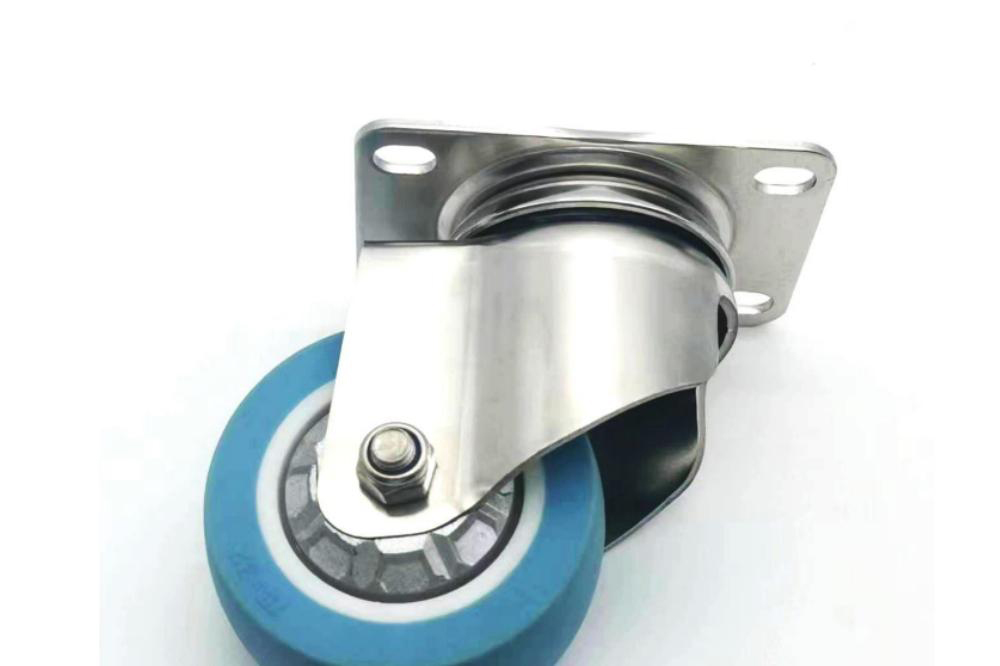
The practical answer is a stainless housing or a hot-dip galvanised bracket on any caster that is exposed regularly, plus a sealed raceway, plus a grease that tolerates moisture.
Steel Plate Floors and Wet Grip
Steel deck plate changes the wheel specification twice over.
Grip first. Wet steel plate has very low friction, and a hard nylon or iron wheel will skid rather than swivel on it. A softer rubber or soft PU tread recovers grip, which matters most when a heavy cart is being turned in a confined space.
Wear second. Ironically, steel plate is less abrasive than concrete in normal rolling but it is harder on a soft tread when the wheel skids, because skidding wears a flat on the tread in a single afternoon. The compromise most yards use is a soft PU tread: enough grip to avoid skidding, enough hardness not to flat-spot instantly.
Impact From Cranes and Skids
Shipyard loads are set down, not placed.
A steel section lowered by crane onto a trolley lands with a shock that is several times its static weight, and that shock goes straight into the top plate and the fork. Over a season, that is what bends brackets and cracks plates, while the wheel itself remains perfectly serviceable.
Where that is the duty, three details matter more than capacity: a thick formed bracket rather than a welded one, a larger top plate to spread the load, and a wheel with some compliance so the shock is partly absorbed rather than fully transmitted.
Wheel Choice for Quay and Shipyard
Four options, and the choice depends on whether grip or wear dominates.
Soft PU is the usual compromise: good grip on wet steel plate, reasonable abrasion resistance, and no marking of finished surfaces. It is the default for carts that move between the yard and the fabrication shop.
Rubber gives the best wet grip and the quietest roll, and is the choice for the yard where skidding is the main risk. It wears faster on abrasive concrete and is the least resistant to oil and solvent in a fabrication shop.
Cast nylon and iron resist wear and impact well but skid on wet plate and are the wrong choice wherever the cart must be turned on steel decking.
Stainless-housed casters with PU wheels are the compromise for wash-down and deck areas, where the housing must survive but the tread must still grip.
Rail Tracks, Grates and Dock Edges
A quay is full of features that stop small wheels.
Embedded rail tracks present a groove that a narrow wheel drops into and a wide wheel bridges. Drainage grates present slots. Dock edges present a lip. Expansion joints present a step.
The rule that resolves all of them is diameter: a 200 mm wheel bridges a rail groove and rides over a grate slot that a 100 mm wheel falls into. Where deck height allows a larger wheel, that single change removes more failures than any material upgrade.
At the dock edge, the caster is not the safety device. A physical stop or a chock is, and no caster specification substitutes for one.
Seals, Grease and Wash-Down
Salt water is the hardest case for a seal, and there are three practical points.
A metal shield survives better than a polymer one in a yard where debris and impact are routine. A double seal is worth the cost where carts are hosed down.
Grease must tolerate water. Standard lithium grease emulsifies and then stops protecting; a water-resistant grease keeps the seal working and the track covered.
And greasing frequency should follow exposure, not calendar: a caster that is hosed daily needs attention weekly, while one in a covered store does not.
Brakes in a Marine Yard
Brakes fail earlier here than anywhere else, because the mechanism is a collection of small steel parts in a salt atmosphere.
Two rules follow. Prefer a brake that acts directly on the wheel rather than a swivel lock, since a wheel brake holds a cart on a quay gradient. And check that the brake releases fully after every wash-down: a partially seized brake drags the wheel and flat-spots the tread within a few shifts.
Where carts are parked outdoors, the brake should be left released and the cart chocked, because a brake left engaged in salt air seizes faster than one left free.
Maintenance Rhythm
Four habits cover most of the risk in marine service.
Rinse with fresh water after salt exposure, and dry the joint rather than leaving it wet — rinsing removes chloride, drying removes the conditions for corrosion.
Inspect the bracket edges and the swivel for rust lifting the coating at every monthly check; that is the earliest visible sign of trouble.
Exercise the brakes weekly so the mechanism does not seize.
Replace rather than repair once the bearing seat is pitted, because a pitted seat will not hold a new bearing square.
Specification Checklist
Six questions settle a marine caster order.
How often is the caster exposed to salt water rather than salt air?
Is the floor steel plate, concrete, or a mix, and is it wet for most of the shift?
What is the worst impact, and is the load dropped by crane?
Does the route cross rail grooves, grates or dock lips?
Is the cart hosed down, and with fresh or sea water?
Does the cart need a brake that holds, and is the mechanism accessible for checking?
Answer those and the specification usually resolves to a stainless or hot-dip galvanised bracket with a double-sealed raceway, a soft PU tread for grip on wet plate, and a diameter large enough to bridge the rails and grates. The recurring mistake in shipyards is treating corrosion as a cosmetic issue and buying a painted bracket, then replacing the whole caster within two years because the raceway corroded from the inside out.
Related Reading
Two guides that support the choices above:
- Stainless Casters for Washdown and Corrosive Environments — housing, seal and grease selection for salt service.
- How Salt Spray Testing Works — what the test hours actually tell you about a coating.
Explore our heavy-duty casters (150-610kg) and super heavy-duty casters (700-1600kg), or contact our engineering team with the exposure, the floor and the impact conditions.
Post time: Nov-21-2026