
A quarry or an aggregate plant is the harshest caster environment in ordinary industry. The floor is rock, the load is rock, and the debris on the ground is rock that has already broken one machine and will happily break a wheel. Nothing about a warehouse caster prepares you for it.
This article covers the four conditions that destroy casters at a crusher, a screening plant or an ore handling bay, and the specification that survives them.
Why Aggregate Sites Break Casters
Four conditions separate a quarry from every other plant.
The surface is loose stone. Gravel, crushed aggregate and spillage sit on top of the slab, so the wheel never rolls on a flat plane; it rolls on a layer of loose, angular material that shifts under load.
The debris is angular and hard. Aggregate fines and crushed rock cut tread rubber the way sandpaper cuts wood, and they do it continuously rather than occasionally.
Impact is routine. Skips are loaded by loader bucket, rock falls from conveyors, and carts are pushed against stockpiles. Every one of those is a shock load far above the static weight.
And it is outdoors, in all weather, on gradients, with wash-down water standing in the low points of the yard.
Rolling on Loose Stone
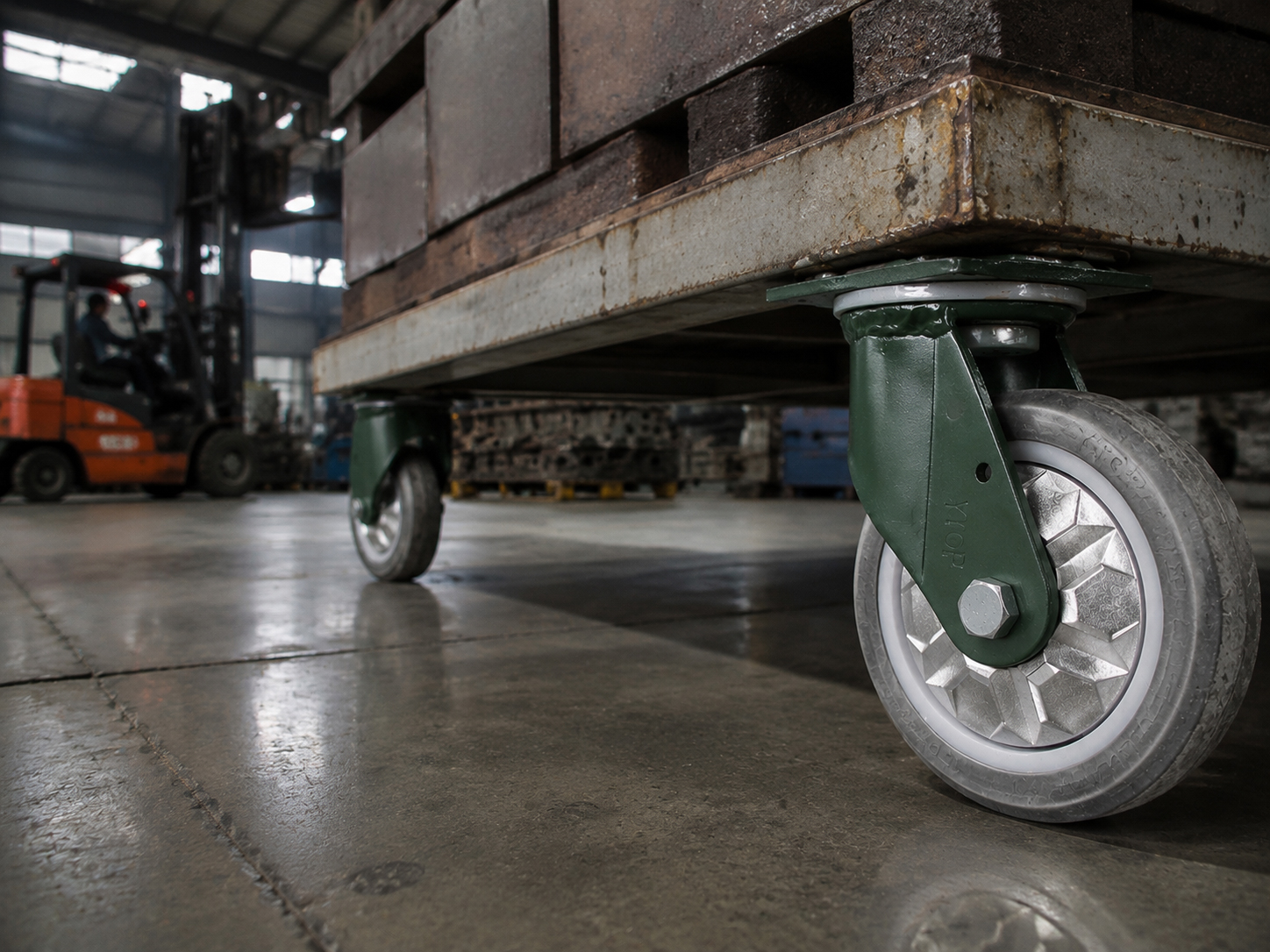
A solid wheel on loose aggregate behaves differently from a solid wheel on concrete, and the difference decides the wheel size.
The wheel sinks until the bearing area equals the load, then pushes a bow wave of stone ahead of it. That bow wave is the extra rolling resistance, and it grows sharply as the wheel gets narrower and smaller.
Two parameters reduce it. Width spreads the load so the wheel floats rather than cuts a rut. Diameter lets the wheel climb out of the rut it has made instead of being trapped by it. On a stockpile apron, a 200 mm wheel at 50 mm width does work that a 125 mm wheel at 40 mm simply cannot do.
Abrasion: What Aggregate Fines Do to a Tread
Aggregate fines are not dust. They are small angular chips, and they wear a tread in two ways.
They cut. A soft rubber or PU tread loses material in a pattern of scratches that deepens into grooves; the tread is still there, but its effective thickness drops and the wheel becomes progressively smaller and less round.
They embed. A soft tread picks up chips and presses them into the surface, and those embedded chips then act as cutting tools against the tread itself.
The answer is hardness plus diameter. Cast nylon, cast iron and hard polyurethane resist cutting far better than soft rubber; larger diameter means fewer revolutions for the same distance, so less wear per shift.
Where noise and floor protection matter — which in a quarry they usually do not — a softer tread is defensible. Where they do not, hardness wins on cost per kilometre.
Impact: Skips, Buckets and Stockpiles
Impact, not load, breaks brackets in an aggregate plant.
A skip loaded from a bucket takes the last part of the drop as a shock. A cart pushed into a stockpile takes a lateral blow at the fork. And a cart that rolls into a kerb at speed transfers all of that into the top plate.
The failures that follow are a bent fork, a cracked plate, and a brinelled raceway. All three show up as a cart that no longer tracks straight, which operators often describe as “the wheels are worn out” when the wheels are fine.
What survives this is a thick-walled formed bracket rather than a welded one, a larger plate area to spread the shock, and a wheel that absorbs some energy instead of passing all of it to the bearing.
Wheel Choice on Site
Four options cover quarry work.
Cast iron and cast steel wheels are the default for the heaviest skips and the hottest or most abrasive positions. They do not cut, they do not embed chips, and they roll over rubble. The cost is weight, noise and the fact that they damage any finished surface they touch.
Cast nylon is the workhorse: hard enough to resist fines, lighter than iron, and quiet enough to use indoors at a screening plant. It is the usual choice for carts that move between the yard and the plant building.
Hard polyurethane sits below nylon on abrasion resistance but above it on floor protection and noise, and is worth considering for the workshop area where floor condition matters.
Pneumatic wheels are for the one case where the ground is too loose for anything solid — a sand or fines stockpile — and they bring their own failure modes: punctures, pressure loss and a much shorter life in abrasive conditions.
Bearings, Seals and Grit
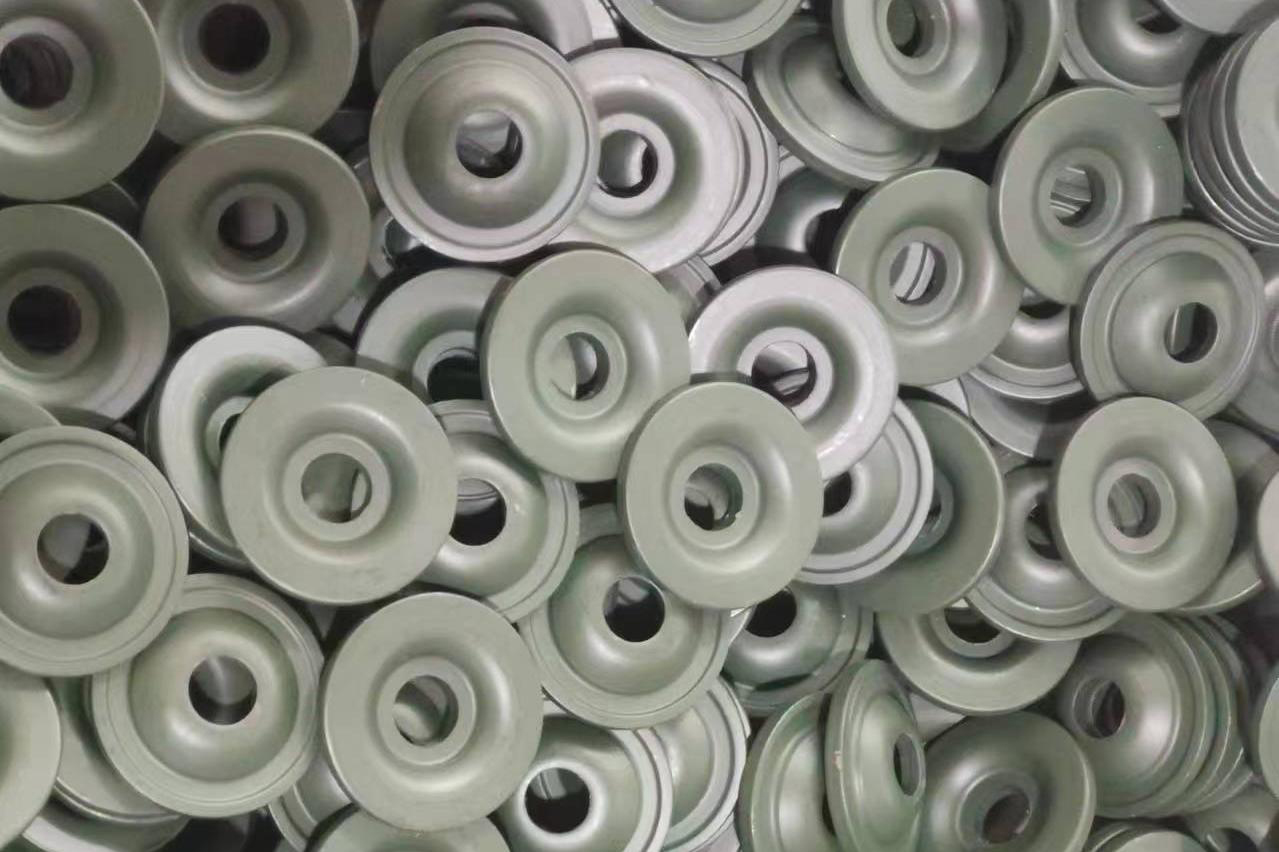
The raceway is where a quarry caster dies, and grit is the reason.
Aggregate fines that reach the bearing act as lapping compound: they wear the track from the inside while the outside still looks serviceable. A sealed raceway with a shielded joint is the baseline, and a metal shield rather than a polymer one survives the debris better.
Greasing helps only if the joint is clean first. In an aggregate plant, greasing over grit produces a paste that accelerates wear, which is the single most common maintenance error at a screening plant.
Weather, Water and Gradients
Quarry yards are outdoors, and that adds three problems.
Wash-down water and rain pool in the low points, so casters stand in water. A sealed raceway survives that; an open one does not, and a bracket that is not galvanised will rust from the plate edge inward.
Gradients concentrate weight. On a ramp to a stockpile, two casters carry most of the load and the other two are nearly unloaded, so the caster sized on the average share is the one that fails.
Frost and sun affect polymer wheels: a nylon wheel becomes brittle in prolonged sub-zero conditions, and a PU wheel left loaded in summer sun takes a permanent flat spot.
Maintenance on an Aggregate Site
Four habits cover most of the risk.
Clean the joints with dry air or a brush before greasing, never grease over grit.
Inspect the fork for straightness when the cart starts tracking to one side; a bent fork is usually the first visible sign of impact damage.
Check for vertical play monthly; a worn raceway in this environment does not recover, and the load starts riding unevenly from then on.
Replace wheels on a measured wear basis rather than on appearance: in a quarry a tread can look intact while having lost a third of its thickness, which changes both diameter and rolling effort.
Specification Checklist
Six questions settle an aggregate site caster order.
What is the ground — slab, compacted hardcore, loose gravel, or spillage over slab?
What is the worst single-caster load, including the transfer caused by gradients?
How is the cart loaded, and is the load dropped rather than placed?
What is the abrasiveness of the debris the wheel actually rolls through?
Does the caster stand in water or wash-down runoff?
What is the replacement history on similar carts, and what failed?
Answer those and the typical outcome is a large cast nylon or iron wheel of 200 mm or more, on a thick formed bracket with a sealed raceway, with a separate softer specification only for the workshop floor. The recurring error at aggregate sites is buying a warehouse caster because it has the right load number, and then replacing it four times a year while the bracket quietly bends in between.
Related Reading
Two guides that support the choices above:
- One-Piece or Welded Bracket: Which Is Better? — why bracket construction decides impact survival.
- Caster Tread Hardness: Shore A and Shore D — what hardness means when the ground is loose stone.
Explore our heavy-duty casters (150-610kg) and super heavy-duty casters (700-1600kg), or contact our engineering team with the ground condition, the impact and the debris.
Post time: Nov-21-2026