
Nursery and greenhouse work is the opposite of a clean factory. The floor is soil or gravel, the air is saturated, irrigation water runs across the aisles, and every trolley is pushed in and out of a polytunnel several times a day. Casters that would last years indoors are consumed in a season.
This article covers the conditions that matter on a nursery — soft ground, mud, fertilizer salts, and the constant indoor-outdoor transition — and the caster choices that survive them.
Why Nursery Work Destroys Casters
Four conditions combine in a greenhouse or a nursery yard, and none of them appears in a standard industrial caster rating.
The surface is not a floor. It is soil, gravel, sand, or a geotextile membrane over compacted ground, and each of those has a different effect: soil sinks, gravel rolls, and membrane catches a small wheel.
Water is everywhere, but it is not clean water. Irrigation water carries fertilizer salts and sometimes iron, which corrodes the bracket and attacks the grease.
The trolley spends its life moving between a humid 25-degree tunnel and a cold yard, so condensation forms inside the raceway every day.
And the load is not dead weight. Potted plants are watered on the trolley, so a bench that leaves the potting area at 120 kg can arrive at the display area at 160 kg, with the water sitting high in the pot rather than low in the tray.
Soft Ground and Sinkage
On soil or sand, the limit is not capacity but ground pressure. A narrow, hard wheel digs in; a wide, softer wheel floats.
Two parameters control sinkage: wheel width and wheel diameter. Width spreads the load over more ground, and diameter reduces the depth of any rut the wheel has to climb out of. On a nursery aisle, going from a 100 mm by 30 mm wheel to a 125 mm by 40 mm wheel often matters more than doubling the load rating.
Where the ground is genuinely soft — a sand yard, a freshly tilled bed — a pneumatic or semi-pneumatic wheel is the only option that reliably rolls. A solid wheel, however wide, will cut a rut and then follow it.
Mud, Irrigation Water and Fertilizer Salts
Water on a nursery is not the same problem as water in a washdown area, because the chemistry differs.
Fertilizer salts are the main corrosion driver. A nitrate or phosphate solution left on a zinc-plated bracket attacks the coating within a season, and the rust that follows spreads under the plating rather than sitting on top of it.
Mud is the second driver, and it is a mechanical one: wet soil packs into the swivel gap and the axle, dries hard, and then acts as an abrasive. A caster that is stiff in the morning and free by midday is usually carrying a dried mud plug, not a worn raceway.
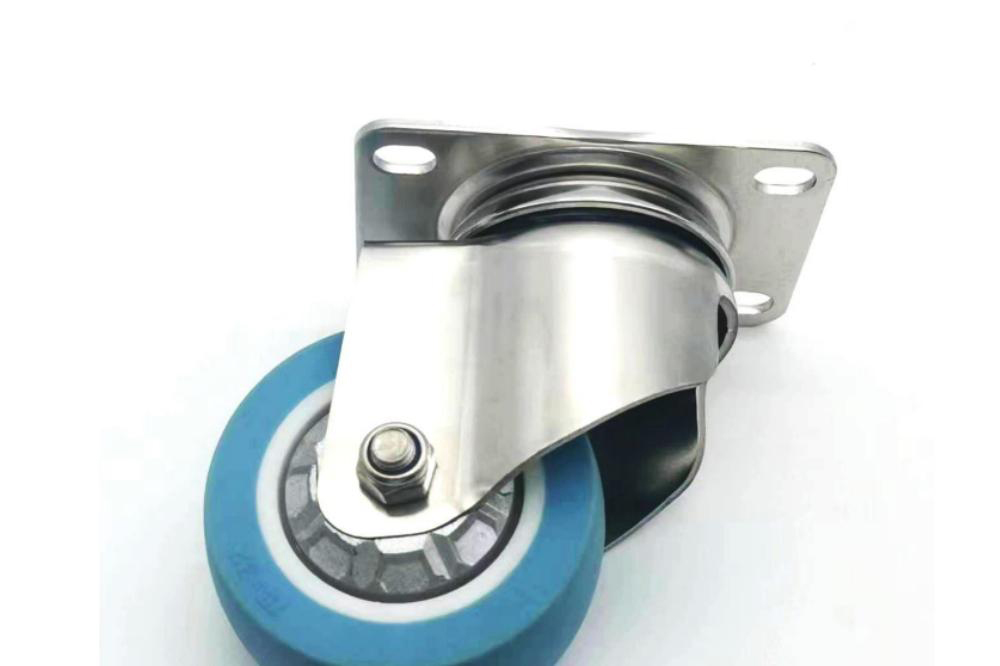
Three countermeasures: a stainless or heavily coated bracket where irrigation water runs, a sealed raceway so that mud cannot enter, and a wash-down routine that removes soil before it dries rather than after.
Danish Trolleys, Trays and Bench Carts
The standard nursery workhorse is the Danish trolley: four swivel casters, a light frame, and shelves loaded with trays. Its caster requirements are specific.
Every caster on a Danish trolley swivels, which makes the trolley manoeuvrable in a narrow aisle but unstable at speed on gravel. Where the trolley is moved long distances along an aisle, two fixed casters at one end make it track straight and remove most of the sideways skid.
The frame is light and the loads are moderate, so a high capacity rating is wasted. What matters is a caster that does not catch on the membrane or on the lip of a concrete path, which again comes back to diameter.
Brakes are worth fitting where trolleys stand on a yard slope or on a loading ramp, because a loaded Danish trolley on gravel has very little resistance to rolling once it starts.
Choosing the Wheel
Four options cover nursery work, and the right answer depends on the surface more than the load.
Pneumatic and semi-pneumatic wheels are the choice for soil, sand and gravel. They absorb surface irregularities and spread load, and they are the only type that reliably crosses a soft bed.
Soft polyurethane works on packed gravel, concrete paths and membrane-covered aisles. It resists fertilizer salts better than rubber and does not mark concrete.
Nylon and polypropylene are chemically inert and cheap, and they are a reasonable choice for indoor benching areas with hard floors. On soft ground they sink.
Rubber gives the best grip on wet concrete and the quietest roll, but it is the compound most affected by prolonged fertilizer exposure.
Bearings and Condensation
The indoor-outdoor cycle is the detail most often missed.
A trolley that leaves a 90 percent humidity tunnel in the evening and stands in a cold yard overnight will condense water inside any open bearing. Repeat that daily for a season and the raceway is permanently wet, which is worse than being permanently dry because the grease never re-forms a film.
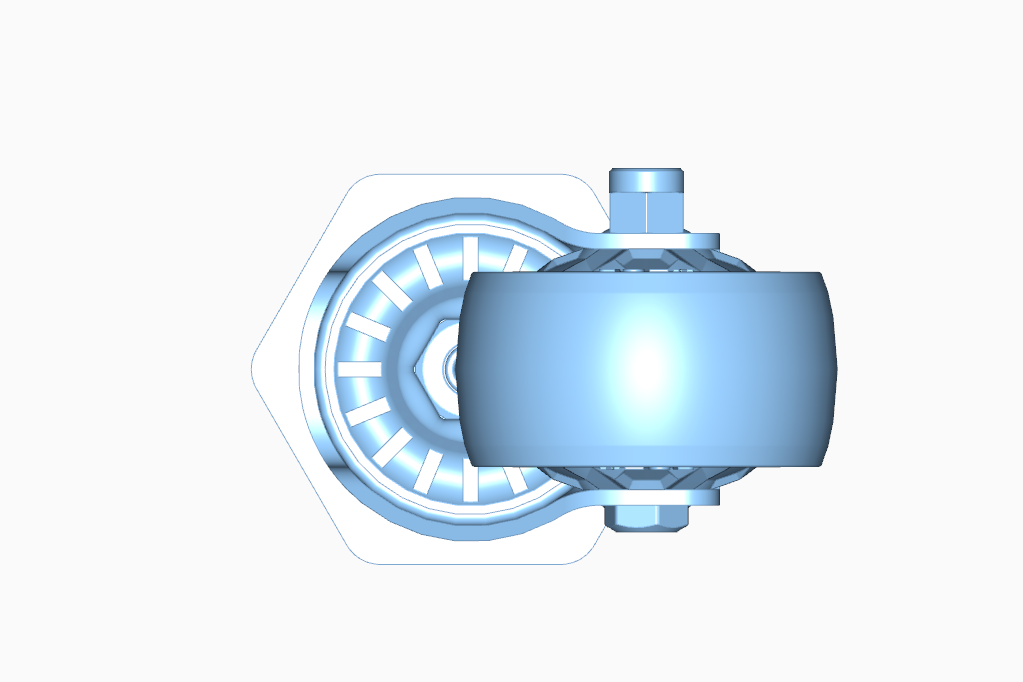
A sealed raceway with a water-resistant grease is the baseline. Where the trolley is washed with a hose, a stainless housing is justified. And where the trolley alternates daily, greasing at the start of the warm shift — not the end — gives the grease a chance to spread before condensation forms.
Slopes, Ramps and Gravel Paths
A nursery yard is rarely flat. Between the potting shed, the tunnels and the sales area there are usually a slope, a ramp over a kerb, and a gravel path.
Each of those needs a different behaviour from the caster. On a ramp, brakes that act on the wheel are essential, and they should be on all four casters. On a kerb, a larger wheel climbs rather than stopping dead against the step. On gravel, a pneumatic wheel floats where a hard one digs in.
The most common specification error is choosing one caster for the whole site. A trolley that works in the tunnel and on the yard almost always needs a different wheel from one that never leaves a concrete aisle.
Load Changes With Watering
Potted plants get heavier after watering, and the extra weight sits high.
A trolley rated at 120 kg empty may carry 160 kg wet, and because the water is in the pot rather than at the base of the tray, the centre of gravity rises. That combination changes how the trolley behaves on a slope far more than the extra 40 kg suggests.
Two rules follow. Rate the caster for the wet load, not the dry one. And on a trolley carrying tall pots, prefer a lower deck and a wider wheelbase rather than a higher capacity caster, because stability comes from geometry, not from rating.
Cleaning and Maintenance Without Water Damage
Nursery maintenance has to remove soil without introducing more water into the raceway.
Scrape or brush dried mud off the fork and axle before washing, rather than hosing it into the joint. Where a hose is used, dry the caster afterwards and re-grease, because water left inside a sealed raceway is worse than no grease at all.
Check the swivel by lifting the trolley and turning the fork by hand. A caster that turns freely but feels gritty has mud or sand in the track; one that is stiff from the first push has a dried plug at the swivel gap.
In a nursery, casters are usually replaced on a seasonal rhythm rather than on condition: the fleet is renewed before the spring peak, because a failure during dispatch week costs more than a set of wheels.
Specification Checklist
Six questions cover most greenhouse and nursery applications.
What surface does the trolley actually cross — soil, gravel, membrane, concrete, or a mix?
What is the wet load, including water in the pots, rather than the dry load?
Does the trolley stand outdoors overnight, which means condensation inside the raceway?
Is the site washed with a hose, and is fertilizer carried in the irrigation water?
Are there slopes, kerbs or ramps on the normal route?
Is the fleet renewed seasonally, or run to failure?
Get those right and the specification usually resolves to one of two types: a large soft wheel with a sealed raceway for yard and tunnel work, and a smaller PU or nylon caster for indoor benching on hard floors. Trying to make one caster do both is how nurseries end up replacing wheels twice a year.
Related Reading
Two guides that support the choices above:
- Choosing Caster Material by Floor Material — how concrete, tile and soft ground change the wheel choice.
- Stainless Casters for Washdown and Corrosive Environments — bracket, seal and grease selection for wet service.
Explore our heavy-duty casters (150-610kg) and super heavy-duty casters (700-1600kg), or contact our engineering team with the surface, the wet load and the route.
Post time: Nov-19-2026