
A grain elevator is a dusty place by nature, and that dust is not just a housekeeping problem: in the right concentration it is an explosion hazard. That single fact changes almost every material handling decision inside a mill, including the choice of caster.
This article covers casters for grain elevators, feed mills, seed plants and flour mills, with emphasis on dust, abrasion and the electrical classification that governs what can be put on the floor.
Five Conditions in a Grain or Feed Plant
Grain handling combines abrasion, dust and weight in a way few other industries match.
Dust is combustible. Grain dust, flour dust and feed dust all fall into the combustible dust categories that drive hazardous area classification, and any equipment in the zone has to be suitable for it.
The product is abrasive. Grain carries silica grit, and a wheel rolling through a spill grinds that grit into its own tread and into the floor.
Loads are dense. A tote of feed, a pallet of bagged flour or a seed box is heavier than it looks, and it is often moved on a small cart.
Floors are rough. Concrete with expansion joints, patched areas and, near the pits, steel grating.
And the environment is seasonal: humid in harvest, cold in winter, with condensation on everything in between.
Dust, Static and Hazardous Area Rules
The first question in a grain plant is not which wheel, but whether a caster belongs in that zone at all.
Inside a classified dust zone, equipment has to be suitable for the zone. A standard caster with a nylon wheel is an insulating plastic component that can accumulate static charge, and a discharge in a dust cloud is exactly the ignition source the classification exists to prevent.
The practical consequences are three: use conductive or dissipative wheels and casters in classified areas so charge has a path to earth, verify that the cart frame is bonded to the caster and to the floor, and keep standard casters out of the zone rather than hoping the dust never reaches ignition concentration.
Outside the zone — in the warehouse, the bagging hall, the loading area — the ordinary rules apply, but the boundary is a real boundary. A cart that crosses it should be specified for the strictest area it enters.
Abrasion and Grit on the Tread
Grain grit destroys wheels faster than load does.
Silica dust embedded in a soft tread acts as an abrasive layer between wheel and floor, so the wheel wears itself and the floor at the same time. A rubber tread in a grain hall develops a glazed, grit-loaded surface within a few weeks and then rolls badly and marks the concrete.
Hard treads resist this better because grit cannot embed deeply. Cast nylon, hard polyurethane and cast iron all hold up far longer than rubber in a grain environment, and the trade-off in noise and floor protection is worth accepting.
Diameter matters as much as hardness. A larger wheel rolls over a spill and a joint instead of ploughing through them, and in an abrasive environment that difference in wear is substantial.
Dense Loads and Rough Floors
The loads are modest individually but dense, and the floors are the worst in any industry.
A 500 kg pallet of bagged feed on four casters puts 125 kg on each, which sounds comfortable until the cart hits a joint at walking speed. The dynamic multiplication on a rough concrete floor is two to three times the static figure, so the right way to size is on the worst single caster with the dynamic factor applied.
Expansion joints, patches and pits are the three floor features that stop a small wheel. A 200 mm wheel crosses all three; a 100 mm wheel catches on all three.
Steel grating near a pit is a different problem: the wheel must be wide enough not to drop between bars, and hard enough not to be cut by the edges.
Wheel Choice for Grain and Feed
Three options cover the work, and one is usually wrong.
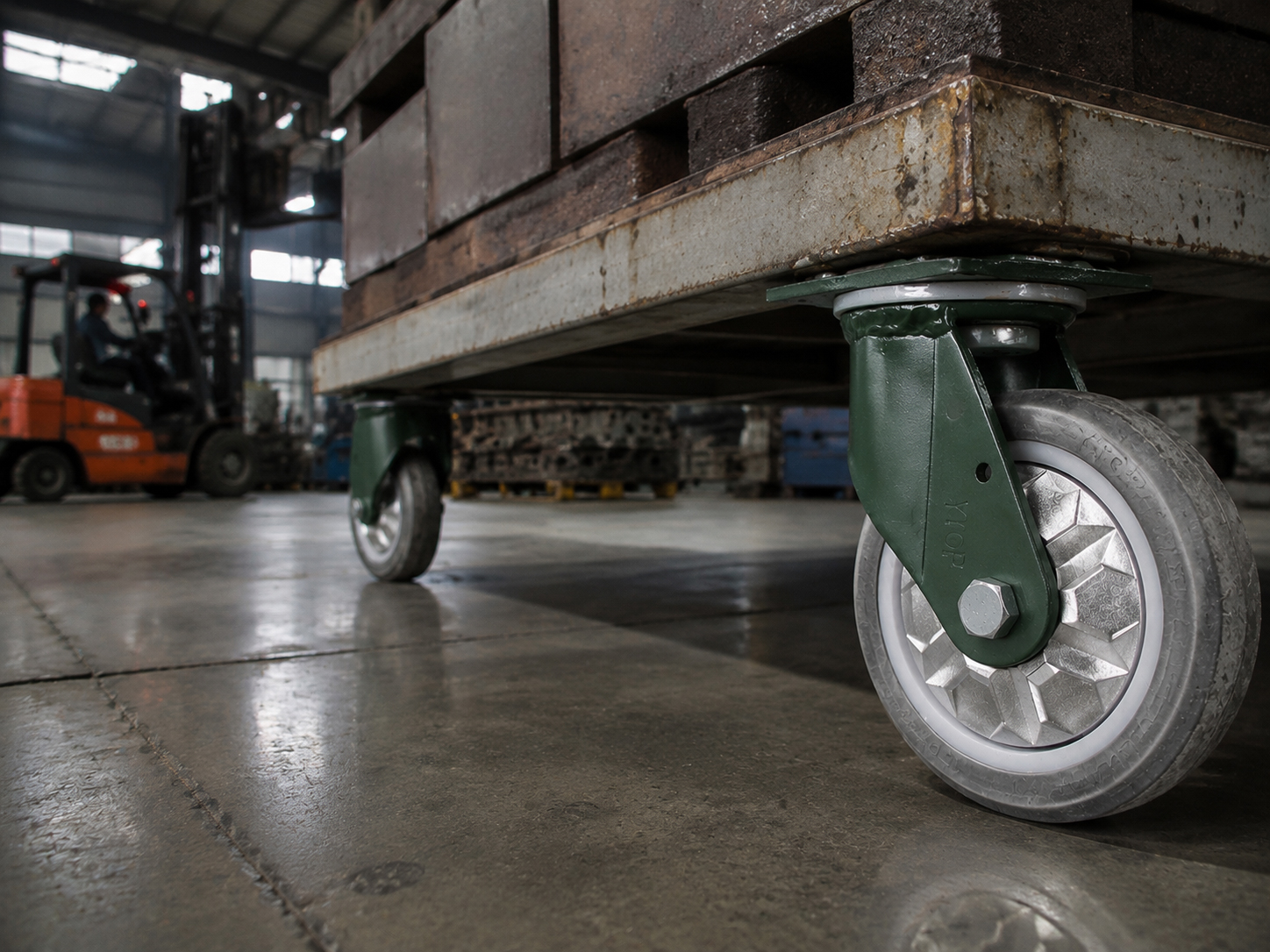
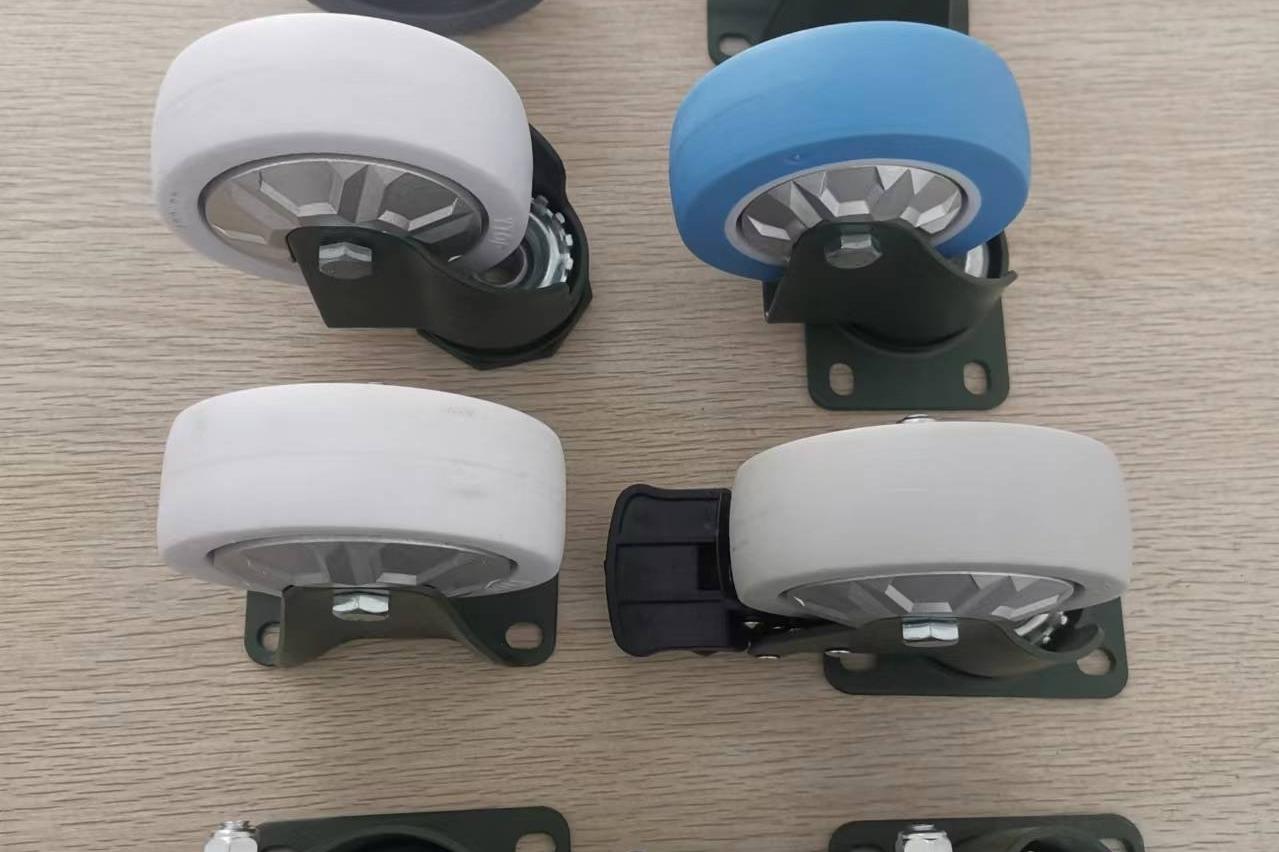
Cast nylon is the default: hard, abrasion-resistant, unaffected by grain dust and humidity, and rolls well on concrete. It is the sensible choice for bagging hall carts, tote trolleys and warehouse work.
Cast iron or forged steel suits the heaviest pallets, the pit area and any location where a wheel may meet grating. It is effectively immune to grain abrasion, at the cost of weight and a hard ride.
Hard polyurethane is the compromise for finished floors and for carts that also leave the plant onto a paved yard, where grip matters more than abrasion resistance.
Rubber is the wrong default here. Its grip advantage is irrelevant on dry concrete, and its wear rate in grain dust is the worst of any tread.
Bearings, Seals and Dust Ingress
Dust ingress, not load, is what ends the life of a grain plant caster.
Fine dust enters an open raceway and mixes with grease into a paste that no longer separates the rolling elements from the track. The joint then wears rapidly and starts to bind, which the operator notices as a cart that suddenly will not steer.
A sealed raceway with a metal shield is the baseline in any dusty area. Where a caster runs through a spill regularly, a double seal is worth the cost.
Greasing practice matters: clean the joint before adding grease, because pushing fresh grease into a dust-filled raceway simply packs the dust deeper.
Seasonal Humidity, Condensation and Winter
Grain plants see both extremes within one year.
In harvest humidity, condensation forms on cold metal whenever the air warms, and an open raceway collects that water daily. A sealed joint and a water-resistant grease prevent the corrosion that follows.
In winter, a hard nylon wheel becomes more brittle and an impact at low temperature can crack rather than deflect. Where a plant runs through winter in an unheated building, a compound that stays tough in the cold, and a rule against leaving a loaded cart outdoors overnight, both help.
Brakes, Pits and Grates
Two locations in a grain plant demand brakes without argument.
Near a pit or a dump grate, a cart that rolls is a cart that falls in. Brakes acting on the wheel on all four casters are the minimum, and a physical stop at the pit edge is the real restraint — no caster specification substitutes for edge protection.
On a loading dock, a chock or a wheel brake is the difference between a cart that stays and a cart that follows a pallet off the edge. A total-lock brake, clamping wheel and swivel, is the right choice for anything positioned at a dock.
Maintenance Rhythm
Four habits cover most of the risk.
Clean the joint at the end of each shift in the bagging hall, where dust accumulates fastest.
Inspect treads for embedded grit weekly and pick it out rather than letting it glaze the surface.
Check all four casters for even contact after any floor repair; a patched slab is rarely level with the original.
Replace once the joint binds or the tread is glazed through, because neither condition can be corrected by maintenance.
Specification Checklist
Six questions settle a grain plant caster order.
Is the location inside a classified dust zone, which decides conductive wheels and bonding?
How much grain dust and grit is on the floor, and how is it cleaned?
Does the route cross expansion joints, pits or steel grating?
What is the worst single-caster load with a dynamic factor for a rough floor?
Does the cart cross from a dusty hall to a clean warehouse?
Is the cart ever parked at a pit edge or a dock, which means brakes on all four wheels?
Answer those and the usual outcome is two specifications: a conductive or dissipative caster with a sealed raceway for classified areas, and a large cast nylon or iron wheel on a heavy bracket for the bagging hall, warehouse and yard. The recurring mistake in grain plants is treating dust as a cleaning issue and buying a caster that is strong, cheap and completely unsuitable for the zone it stands in.
Related Reading
Two guides that support the choices above:
- Why Workshop Carts Are Hard to Push — bracket, diameter and lubrication explained.
- Caster Bracket Material Explained — what the bracket must survive in an abrasive plant.
Explore our heavy-duty casters (150-610kg) and super heavy-duty casters (700-1600kg), or contact our engineering team with the dust zone classification and floor conditions.
Post time: Nov-28-2026