
There are three ways to move something that weighs more than a person can push: put it on a wheeled frame, put it on a transfer dolly, or put it on skates. They look similar, they solve different problems, and choosing the wrong one is one of the commonest reasons a plant ends up with casters that keep failing or equipment that will not stay aligned.
This article covers all three, starting with the case that is most often specified by mistake: a conveyor line that has to be movable but must also stay level.
Moving a Conveyor Line
Most conveyor frames are fixed. The ones that are not fall into two groups: lines that are moved between product changeovers, and lines that need occasional repositioning for cleaning, maintenance or layout changes.
For the first group, casters are a design feature. The frame is built with casters retracted or with legs that can be raised, and the line moves as a complete unit. This only works if the frame is designed as a rigid box. A conveyor frame is long and relatively narrow, and if it is flexed even slightly while being pushed, the sections will not line up when they are put back down.
For the second group, casters are a retrofit. Here the usual error is fitting casters to a frame that was designed to sit on feet. The frame then carries its load through points it was never reinforced for, the sections twist, and the line no longer runs true.
Load Path on a Conveyor Frame
A conveyor spreads product weight along its length, but a caster concentrates it at one point. The frame has to carry that concentrated load without deflecting, which usually means casters directly under the main longitudinal members, not on the cross members at the edge.
Two practical consequences follow. First, the caster spacing should be short enough that the span between them does not sag under the heaviest product load — a rule of thumb is that the unsupported span should not exceed about one third of the frame length for a line carrying dense product. Second, the casters must be adjustable in height, or the frame must be shimmed at each caster, because four rigid casters on an uneven floor will always load two of them and leave two hanging.
The height adjustment is not cosmetic. If a conveyor line is out of level by even a few millimetres over its length, product slides to one side, guide rails have to be re-set, and the line runs with constant corrections. Level it at the casters, then check it again after the line has been moved and re-loaded.
Transfer Dollies
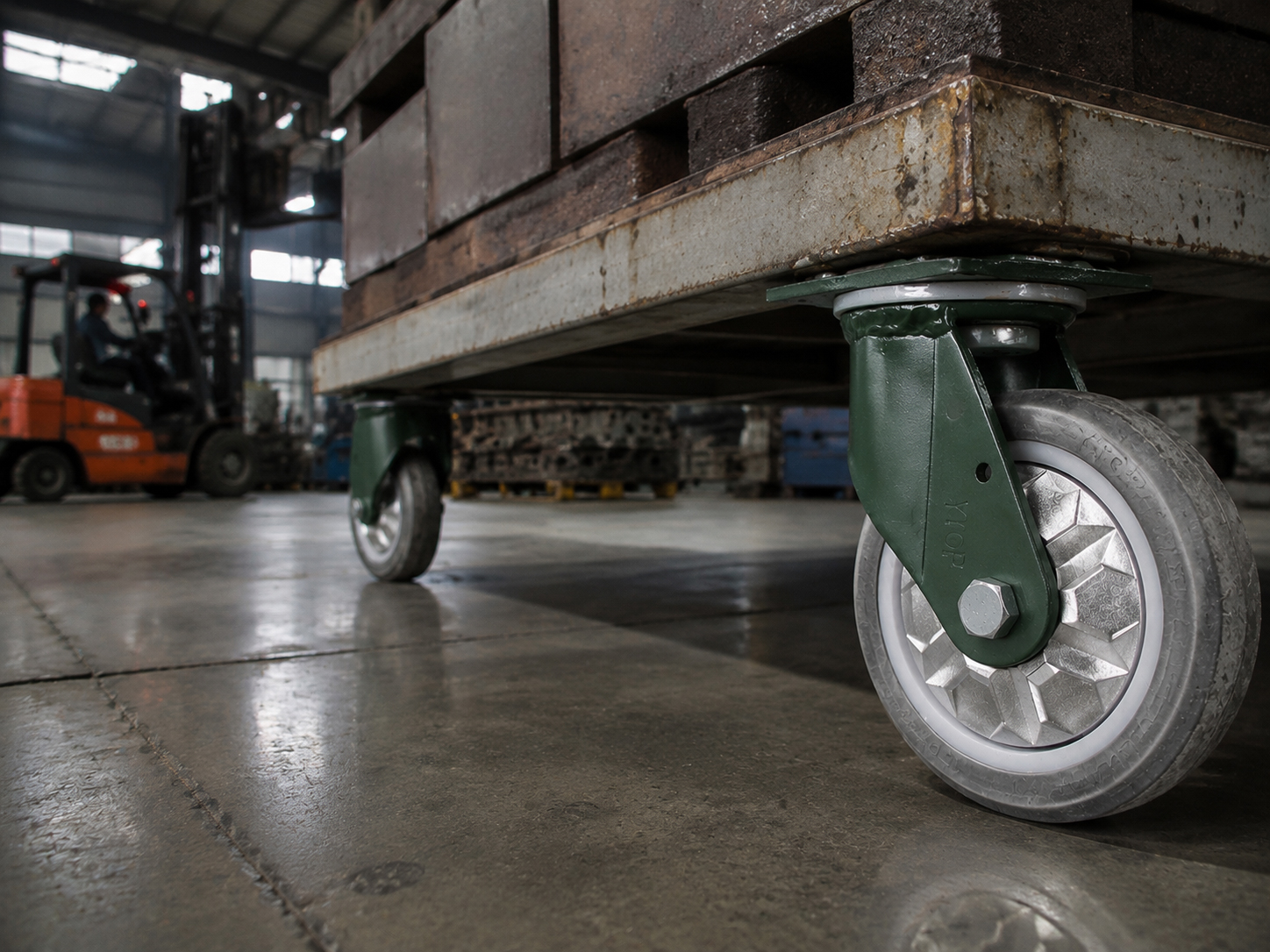
A transfer dolly is a low platform on four casters, used to move a load that is too heavy or too awkward for a hand cart, and too small a job for a forklift. Dies, fixtures, motors, gearboxes and fixtures on pallets all travel this way.
The design constraints are different from a cart. The deck is low, often only 100 to 150 mm from the floor, so the caster height budget is tight and the wheel diameter is small. Small wheels on a heavy load mean high rolling resistance and poor performance over floor joints, which is why dollies are usually specified with a harder tread and a larger wheel than the deck height would suggest.
Capacity is the next constraint. A dolly carrying a 600 kg die on four casters carries 150 kg per caster only if the load is centred. In practice the load is never centred, and one caster may take twice its share. Specify on the worst-case corner, and specify a raceway that can take the side loads that appear when a loaded dolly is steered by hand.
Finally, a dolly has no handle and no brake. Once it is loaded and moving, the only way to stop it is to stop pushing it, which is why dollies are usually restricted to flat floors, short distances and two-person operation.
Machine Skates
A skate is not a caster. It is a low-profile roller assembly that goes under a machine, usually two or four at a time, and it is used for one-off moves rather than continuous handling.
Skates carry far more load than casters of the same height because they use rollers instead of wheels, and because they are not designed to swivel — direction changes are made by rotating the load or by using a steering skate. That is also their limitation: a skate cannot be steered like a caster, and it has no suspension, so a floor joint becomes an impact rather than a bump.
The practical rule is that skates are for the move, casters are for the process. If a machine will be repositioned every week, fitting casters or a wheeled base is usually cheaper over a year than repeatedly rigging skates, and it removes the risk of a machine coming off a skate mid-move.
Comparing the Three Families
Castors on a frame are the right answer when the equipment moves as part of normal operation, when the move is frequent, and when the frame can be designed for it. They give continuous mobility, steering and braking, and they keep the equipment at working height.
Dollies are the right answer when the load is heavy, the move is occasional, and the floor is flat. They are cheap, they can be built in a workshop, and they put the load low, which is safer than a high cart.
Skates are the right answer when the load is very heavy, the move is a one-off, and there is no room for wheels. They are a rigging tool, not a handling system.
Steering Geometry
Four swivel casters on a rectangular frame do not steer well. Each caster tries to turn about its own axis, and the result is a frame that follows the direction of push with a lag, and that shimmies at speed.
The standard fix is to make two casters fixed and two swivel, with the fixed pair leading in the normal direction of travel. The fixed pair defines the track, and the swivel pair follows it. On a conveyor frame that is pushed sideways as often as forwards, the fixed pair should be at the end that is normally pushed from.
For dollies, a three-point arrangement — two fixed, one swivel — is often better than four swivel, because it removes the fight between casters and gives a predictable turning circle. Where the load must rotate on the spot, four swivel is correct, but the casters need a raceway with enough thrust capacity to take the side loads that rotation produces.
Floors, Joints and Thresholds
Expansion joints, dock plates and cable covers are where casters on moving equipment fail. A small wheel dropping into a joint and being pulled out again is an impact, and impacts are what destroy raceways and crack fork plates.
Three measures help. Increase wheel diameter so the wheel bridges the joint rather than dropping into it. Use a tread that absorbs impact rather than transmitting it. And keep the load low and the speed down — a dolly pushed at walking pace over a joint survives where one pushed briskly does not.
Where the route includes a ramp or a lip, casters are the wrong tool unless the equipment has brakes that can hold on a slope. A loaded dolly on a 3-degree ramp will roll away from a standing person, and no caster specification will prevent that.
Safety Points That Get Missed
Pinch points are the first. A swivel caster’s fork rotates through a full circle, and anything within that circle at floor level — a foot, a cable, a pallet edge — can be trapped. Fitting a swivel lock or a direction lock removes the hazard on equipment that only needs to travel straight.
Stability is the second. A dolly or a conveyor frame on casters has a higher centre of gravity than the same load on the floor, and the effective wheelbase shrinks when the casters swivel. Wide spacing and low deck height are the cheapest stability improvements available.
Braking is the third. On equipment that is loaded and left, four casters should have brakes, and the brakes should be on the casters the operator can reach. A brake on the far side of a conveyor frame will not be used.
Specification Checklist
Before specifying casters for a conveyor line, a dolly or a wheeled machine base, answer six questions.
What is the worst-corner load, including the load shift that happens when the equipment is pushed from one end?
How many casters are fixed and how many swivel, and in which direction is the equipment normally pushed?
What is the floor like along the route — joints, thresholds, ramps, coatings, swarf?
What wheel diameter will bridge the obstacles on that route without raising the deck beyond its design height?
Does the equipment need to be levelled after each move, and are the casters adjustable enough to allow it?
Who will operate it, and can they reach the brakes from the operating position?
Answering these six before the order is placed is the difference between a line that can be moved and re-levelled in twenty minutes and one that has to be re-aligned every time it is pushed back into position.
Related Reading
Two guides that support the choices above:
- Low Centre of Gravity Casters — why deck height and wheelbase decide stability on wheeled equipment.
- Anti-Wrap Caster Design — how caster spacing and fork geometry keep cables and debris out of the wheel.
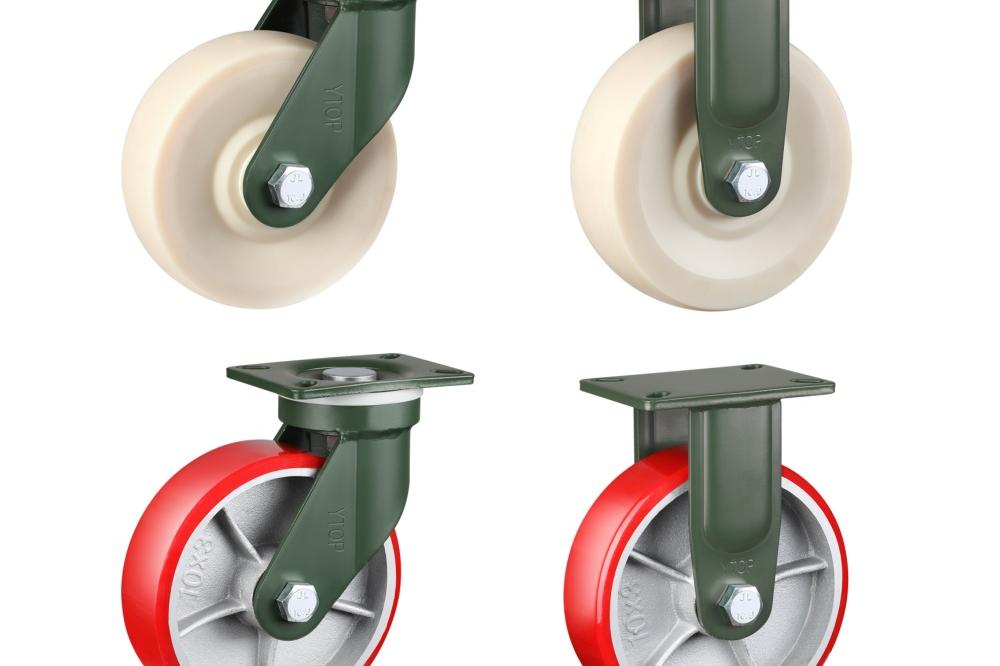
Explore our heavy-duty casters (150-610kg) and super heavy-duty casters (700-1600kg) for dollies and movable frames, or contact our engineering team with the load, the route and the floor.
Post time: Nov-16-2026