
An assembly line cart does not carry much, but it moves constantly and it stops in exactly the same place every cycle. That combination, light load plus repeated start and stop at a fixed position, is what makes assembly and kitting carts a different caster problem from a storage trolley.
We are asked about this configuration often, because a cart that feels fine in a trial becomes tiring within a shift, or starts drifting out of position after the casters have run a few months. This guide covers what to specify for line-side kitting carts, sub-assembly trolleys and changeover carts.
The Duty Profile of a Line-Side Cart
Three characteristics define the duty, and each of them changes the caster choice.
The load is light but unevenly distributed. A kitting cart might carry 80 kg of small components, but those components sit in bins at one end, so one or two casters carry most of the weight. Specifying four casters at 25 percent each is the mistake we see most often on this type of cart.
The motion is short and frequent. A line-side cart may travel only five metres between the supermarket and the station, but it does that forty times a shift, with a turn at each end. Distance is low, cycle count is high, and every cycle loads the swivel raceway.
The parking position is fixed. The cart is pushed into a marked position at the line and must stay there while the operator works from it. That means the caster is being asked to hold a position, not just to roll, and it is asked to do so hundreds of times a day.
Why Line Carts Feel Heavy to Push
Operators rarely complain that a kitting cart is too heavy to lift. They complain that it will not start moving, or that it fights them at the turn.
Most of that resistance comes from three places. Small wheels on a floor with joints, drains or tactile strips produce a high rolling resistance at every transition. Soft treads deform under a static load and develop a flat spot at the parking position, so the first push of every cycle has to roll the cart off that flat spot. And a swivel that has lost its grease, or that is loaded unevenly, needs a noticeable force to break away from straight.
The practical fix is usually not a bigger caster but the right one: a slightly larger wheel, a tread that does not take a set, and a swivel with a proper thrust bearing rather than a plain washer.
Wheel Size for Marked Lanes and Floor Transitions
Assembly halls usually have better floors than warehouses, but they also have more interruptions: cable covers, compressed air drops, floor marking tape, drainage channels and the raised edges of floor plates.
Measure the tallest obstacle on the cart’s actual route rather than the average. A 100 mm wheel will roll over a 5 mm cable cover without complaint and will stop dead on a 12 mm one. If the route crosses a channel or a plate edge, 125 mm or 150 mm wheels are the practical minimum, and the extra 25 mm of height is usually available under a cart deck.
Wheel width matters as much as diameter on this type of cart. A narrow wheel concentrates load and marks soft flooring; a wider tread spreads the load and rolls more smoothly over small debris. For carts that operate on sealed concrete with occasional swarf, a 32 to 40 mm tread width is a reasonable default.
Tread Material and Debris in the Bearing
Assembly areas generate a specific kind of debris: small fasteners, swarf from drilling and tapping, plastic chips, and the dust from cardboard and foam packaging.
Two tread materials cover most cases. Polyurethane is quiet, non-marking and resistant to flat-spotting, which suits painted line areas and epoxy floors. Nylon and engineering plastics roll easily and resist abrasion, but they transmit more noise and are unforgiving on damaged floors.
Whichever tread is chosen, the bearing is the part that suffers. Fine metal particles work into a plain bearing quickly and turn a smooth wheel into a rough one within weeks. For assembly environments we normally recommend a sealed or shielded bearing on swivel casters, and a maintenance interval that includes clearing debris from the swivel gap.
A simple check tells you whether this is happening: lift the cart and spin a wheel by hand. If it grinds rather than hums, debris or a dry bearing is already at work.
Layout: Tracking Straight into a Fixed Position
The layout decision on a line cart is about repeatability rather than manoeuvrability.
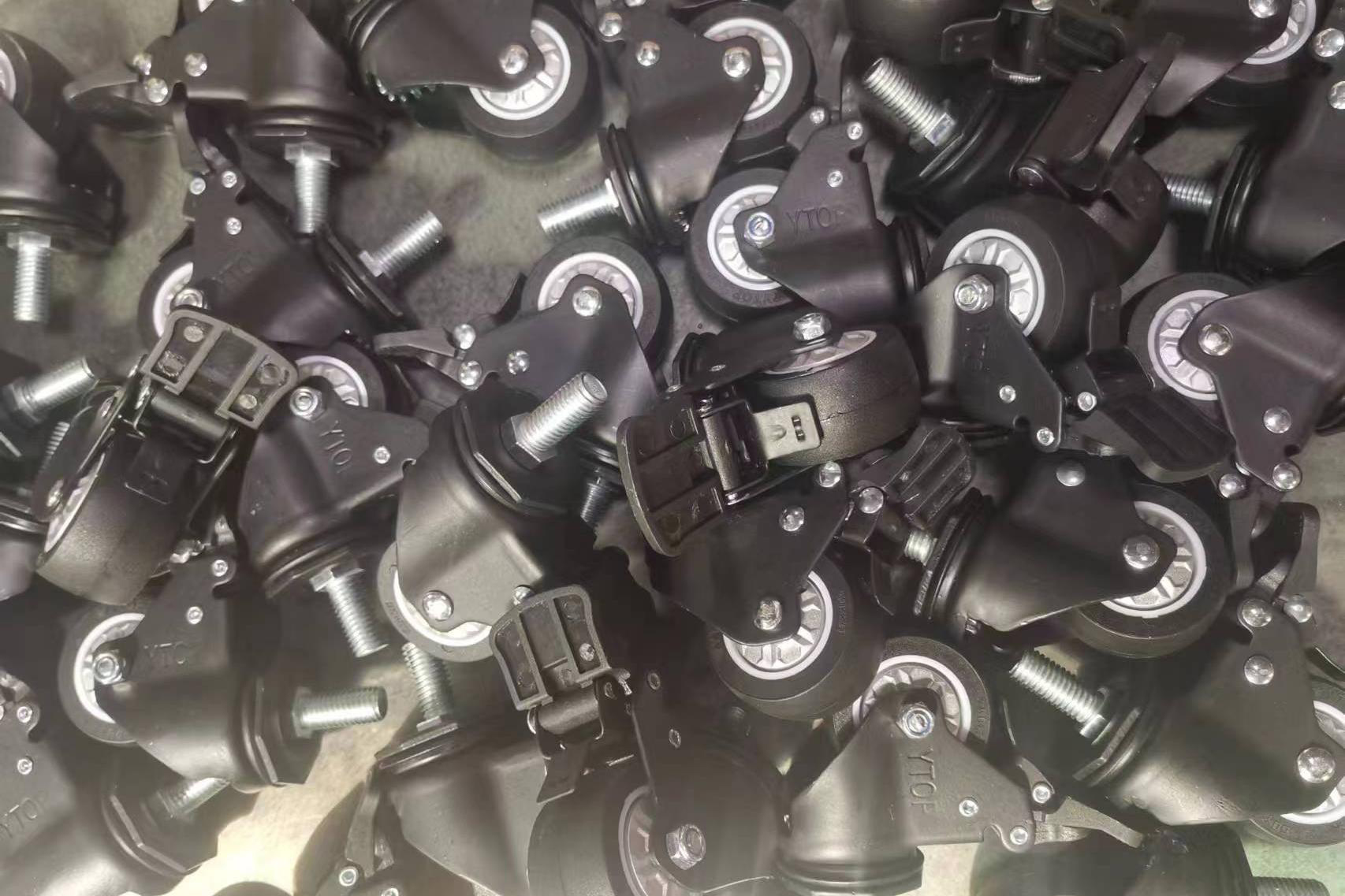
Two swivel and two fixed is the standard for a cart that is pushed down a lane and parked at a marked position. It tracks straight with almost no steering input, which means the operator can push with one hand while carrying a tote.
Four swivel suits carts that are turned in place, loaded from both sides, or moved into tight cells. The trade is that the cart will not track straight at speed; it wanders, and the operator corrects constantly.
Two swivel with directional lock and two fixed is the configuration we recommend for mixed duty: the cart tracks straight on the lane, and the lock can be released when the cart has to be turned in a cell. It costs slightly more per caster and removes most of the daily friction.
A detail that matters more than most specifications: put the fixed pair under the end the operator pushes from, and the swivel pair at the leading end. The reverse arrangement produces a cart that steers from the wrong end and feels unstable at exactly the moment the operator is moving fastest.
Braking at the Line
A cart parked at a station is loaded and unloaded all shift, and every one of those operations is a chance for it to roll away from the marked position.
At least two casters, on the diagonal, should have brakes. On carts that are loaded at height, a total-lock brake that stops both wheel and swivel is worth the extra cost: a wheel-only brake lets the cart pivot when someone leans on the top shelf or drops a tote onto it.
Position the pedals where the operator’s foot naturally lands when standing at the cart, not under the deck. A brake that requires bending down is a brake that is never applied, and an unapplied brake is the same as no brake at all.
Changeover Carts and Quick-Release Mounting
Where a line changes over frequently, carts are often swapped rather than re-loaded. Two caster features make that easier.
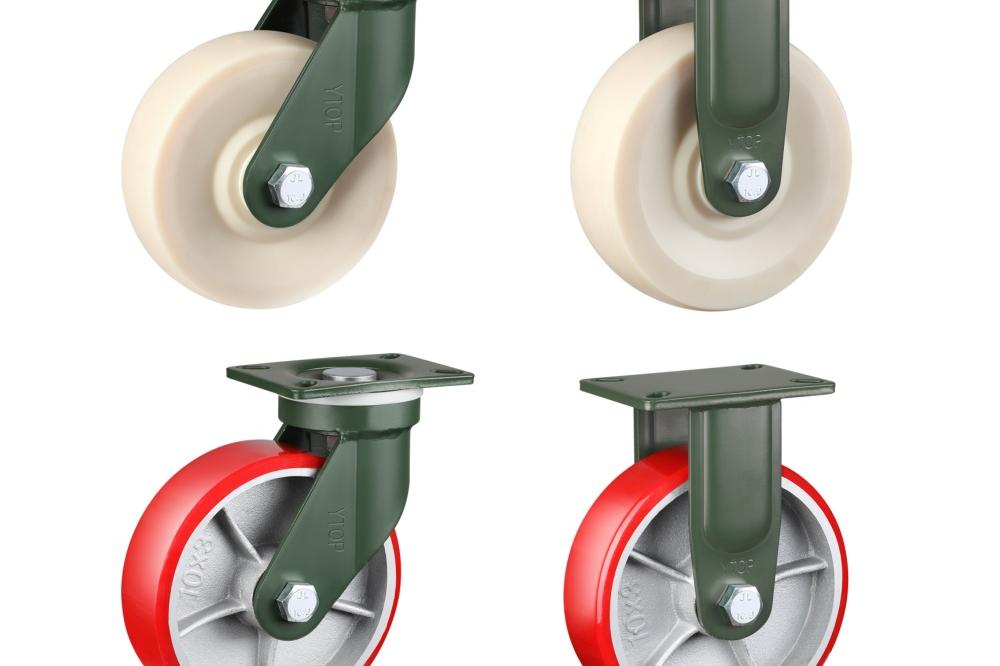
A threaded stem or a quick-release plate lets a caster be changed without dismantling the cart frame, which matters when a cart is taken out of service for a wheel change during a shift.
Identical mounting patterns across the fleet mean a spare caster from one cart fits another. Mixed patterns turn a five-minute wheel change into a search for the right part, and in practice the cart stays out of service until someone orders it.
Kitting Carts and Tooling Trolleys Are Not the Same Cart
The two are often bought from the same supplier and specified identically, which causes trouble later.
A kitting cart is primarily a mobile shelf: it rolls quietly, brakes at a station, and carries bins whose weight changes several times a shift. Height and footprint dominate its design, and its casters are usually 75 to 100 mm, mounted on a plate that spreads load across the deck.
A tooling trolley is closer to a fixture. It holds dies, fixtures or heavy parts that stay on it, and it may move only at changeover. Its casters are larger and stronger, and the frame is usually welded rather than bolted, because the casters are loaded in torsion when the trolley is pushed sideways into a cell.
Putting a light kitting caster under a tooling trolley produces a plate failure within months. Putting a heavy tooling caster under a kitting cart produces a noisy, hard-to-steer cart that operators stop using. Keeping the two types separate in the maintenance register, with a different caster model for each, is the simplest way to avoid both.
Specification Checklist
Before ordering casters for assembly or kitting carts, confirm the loaded weight and the worst-corner share, the number of cycles per shift and the parking pattern, the tallest obstacle and the narrowest gap along the route, the floor finish and the debris present, whether the cart must track straight or turn in place, and where the brake pedal needs to be for the operator to use it.
Then standardise: one caster model per cart type, recorded in the maintenance system, with a small stock of spares on site. Assembly lines tend to accumulate carts over years, and a fleet with three different wheel diameters will roll badly and wear unevenly.
If you send us the cart types, station layout and floor conditions, we will propose a standard caster specification for each type so the fleet stays consistent as the line changes.
Related Reading
Two guides that support the layout and wheel-size decisions above:
- Industrial Caster Arrangement Strategy — how swivel and fixed combinations change the way a cart steers and parks.
- Caster Wheel Diameter: Large vs Small — obstacle crossing height and the pushing force each diameter demands.
Explore our heavy-duty casters (150-610kg) and super heavy-duty casters (700-1600kg) for line-side carts and changeover trolleys, or contact our engineering team with your station layout for a specification review.
Post time: Nov-14-2026