
AGV casters serve three core functions in automated material handling systems: supporting the weight of equipment and cargo, executing movement and steering actions, and maintaining operational stability. Casters are the only contact point between an AGV and the floor; all weight is transferred to the ground through the casters, and all motion commands are executed by them. Caster performance directly affects an AGV’s load capacity, positioning accuracy, battery efficiency, and safety reliability.
The Specific Role of Casters in an AGV System

Breaking down an AGV, its core systems include the navigation system (telling the AGV where to go), the control system (deciding how to get there), the drive system (providing power), and the caster system (executing motion). Casters may seem like the most basic component, but they are the execution endpoint of all upper-level systems.
In terms of load bearing, the AGV’s own weight plus cargo weight is entirely transferred to the floor through the casters. The load capacity of the casters determines how much weight the AGV can carry. If caster load capacity is insufficient, the tread may flatten and deform at best, or the bracket may deform and cause the AGV to tip over at worst.
In terms of motion execution, an AGV’s forward movement, reverse movement, and steering are ultimately all realized through the casters. Drive wheels provide power, driven wheels roll passively, and swivel wheels adapt to direction changes. The rolling resistance, steering resistance, and friction coefficient of the casters directly affect the AGV’s motion performance.
In terms of stability, AGVs are affected by acceleration and deceleration, centrifugal force during turns, and uneven floors during operation. The wheel diameter, tread material, and bracket rigidity of the casters determine the AGV’s vibration amplitude and stability. If the casters are unstable, cargo on the AGV may shift or even fall off.
In terms of cushioning, the tread material of casters (especially polyurethane and rubber) has a certain degree of elasticity, which can absorb impacts caused by minor floor irregularities. This cushioning effect protects precision components on the AGV, such as navigation sensors and controllers, as well as the cargo being transported.
How Caster Performance Affects Overall AGV Performance
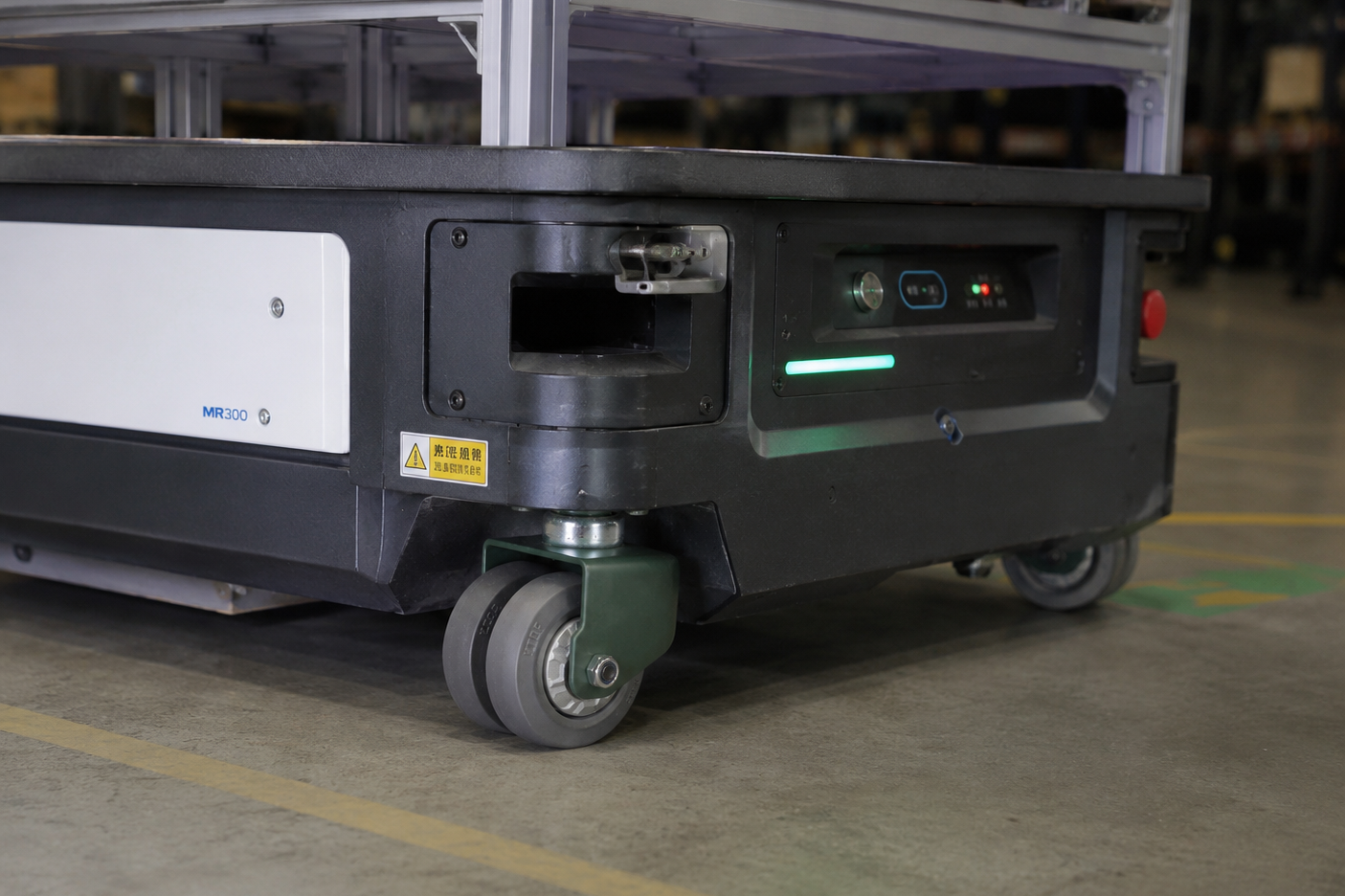
Impact on battery life. The greater the rolling resistance of the casters, the more torque the AGV motor needs to output to overcome that resistance, and the faster the battery drains. Reducing caster resistance is one effective means of extending AGV battery life. Casters with high resistance can shorten AGV battery life by 10% to 20%.
Impact on navigation accuracy. The AGV navigation system calculates travel distance through encoders. If the caster diameter decreases due to wear, a discrepancy will arise between encoder readings and actual travel distance. Tread slippage can also cause odometry errors.
Impact on docking accuracy. AGVs require precise positioning when docking, typically within ±10mm. The steering resistance and self-centering characteristics of the casters affect the AGV’s positioning accuracy in the final few centimeters.
Impact on noise. AGVs typically operate in workshops where people work, and noise directly affects the working environment. Casters are one of the main noise sources of an AGV; tread material, bearing type, and bracket structure all affect noise levels.
Impact on safety. If a caster suddenly fails while the AGV is operating under load — for example, the tread detaches or the bearing seizes — it may cause the AGV to lose control or tip over, resulting in cargo damage or safety accidents. Caster reliability is the foundation of safe AGV operation.
How to Evaluate Caster-System Compatibility During Selection
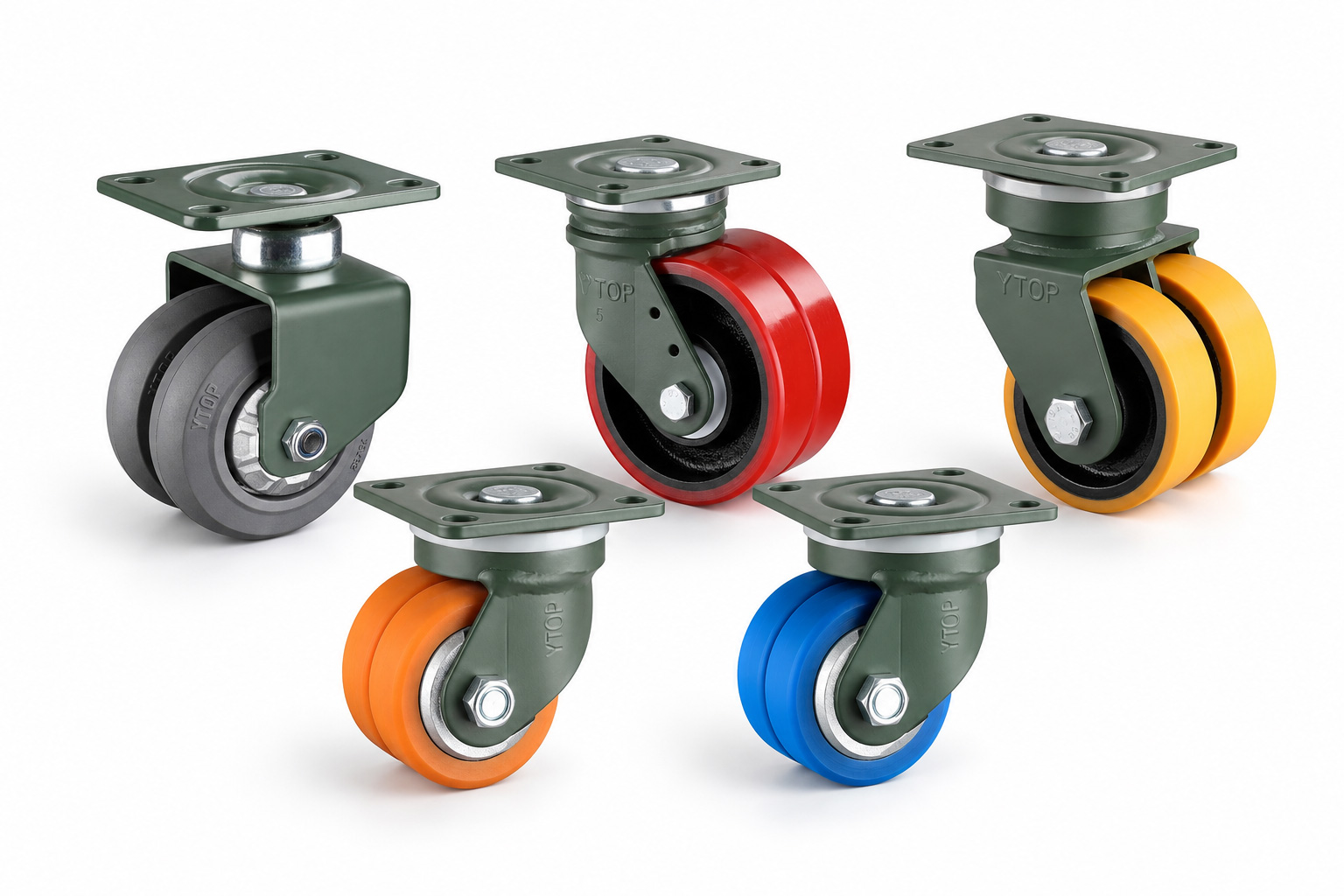
Selecting AGV casters is not about picking an individual component; it requires evaluating the compatibility between the casters and the entire AGV system.
Match with the navigation system. If the AGV uses magnetic navigation, docking accuracy requirements are relatively lenient, and caster selection can be somewhat relaxed. If laser navigation or visual navigation is used, accuracy requirements are high, and the resistance consistency and diameter stability of the casters become more important.
Match with the drive system. The power and torque of the drive motor must match the rolling resistance of the casters. If caster resistance is high but motor power is insufficient, the AGV will be unable to move or will accelerate slowly.
Match with load requirements. The rated load capacity of the casters should include a safety margin. Generally, selection should be based on 1.3 to 1.5 times the actual per-wheel load, taking dynamic loads and impact loads into account. Working load is recommended not to exceed 75% of the rated load capacity.
Match with the operating environment. Floor material (epoxy flooring, concrete, anti-static flooring), ambient temperature, humidity, and cleanliness all affect caster selection. For example, cleanrooms require low-dust treads, and cold storage requires low-temperature-resistant treads.
During the AGV system selection phase, system compatibility of casters is more important than the parameters of individual casters. If further confirmation of caster specifications is needed, parameters such as total machine weight, operating speed, floor conditions, and navigation accuracy requirements can be provided to the caster manufacturer to obtain a matched product solution. Zhuoye manganese steel casters offer multiple configuration options in terms of load rating, tread material, and bracket structure, and can serve as one reference option during AGV system selection.
Common AGV Caster Types and Wheel Layouts
An AGV rarely uses identical casters at every position. A typical vehicle combines three functional wheel types, each with a different job:
- Drive wheels connect to the motor and gearbox. They provide traction and transmit torque, so their tread must balance grip (to prevent slip during acceleration and braking) against low rolling resistance. Drive wheels are usually solid polyurethane bonded to a steel or aluminum hub.
- Load (driven) wheels carry weight but are not powered. They roll passively and are often mounted in fixed (rigid) brackets to keep the AGV tracking straight.
- Swivel casters and balance wheels swivel to follow steering changes or act as stabilizers that prevent tipping on six-wheel and omnidirectional platforms.
Wheel layout follows the steering scheme. A three-wheel differential-drive AGV uses two drive wheels plus one swivel caster; this is simple and cost-effective for light loads. Four-wheel designs add fixed load wheels for higher capacity and better straight-line stability. Six-wheel layouts (two drive wheels plus four swivel or balance wheels) spread heavy loads across more contact points, while vehicles fitted with integrated drive-steer wheels can turn in place or move sideways for the tightest docking situations. Choosing the layout first, then specifying each wheel role, prevents under-specifying the passive wheels that carry most of the weight.
Why Polyurethane Dominates AGV Treads
The vast majority of AGV drive and load wheels use polyurethane rather than nylon, rubber, or steel, and the reasons are directly tied to how AGVs operate:
- Floor protection: polyurethane does not scratch epoxy or polished concrete floors and can be formulated as non-marking, which matters in facilities shared with workers.
- High load at a small diameter: polyurethane offers a high load-to-size ratio, letting designers keep wheel diameter and therefore the AGV chassis height compact.
- Controlled grip and rebound: a hardness of roughly 90 to 95 Shore A, typical for AGV wheels, provides enough traction for acceleration and braking while keeping rolling resistance low to save battery.
- Wear and chemical resistance: polyurethane outlasts rubber under continuous duty and resists chunking, oils, and many industrial chemicals.
- Low noise: it runs noticeably quieter than nylon or cast iron on hard floors.
Nylon wheels are chosen mainly where floor protection is less important and moisture or chemical exposure is high; steel or cast-iron wheels are reserved for very heavy, low-speed tow vehicles running on concrete.
Key Technical Parameters to Specify
Providing the following parameters up front avoids most AGV caster mismatches:
- Per-wheel load (kg) and total vehicle weight including maximum payload;
- Wheel diameter and tread width, which set contact pressure and floor loading;
- Tread material and hardness (Shore A), plus whether non-marking or anti-static (conductive) grades are required;
- Bearing type (precision ball bearings are standard for smooth, low-resistance rolling) and hub bore size;
- Maximum travel speed and duty cycle (continuous versus intermittent), since high-speed continuous duty demands higher-grade compounds and bearings;
- Mounting interface (top plate, stem, or custom bracket) and swivel offset for caster wheels;
- Operating environment: floor type, ambient temperature range, humidity, and any cleanroom or cold-storage requirements.
Installation and Maintenance for Reliable Operation
Even correctly specified casters underperform or fail early without proper installation and upkeep:
- Torque all mounting bolts to the manufacturer specification and re-check them after the first operating hours, because vibration can loosen fasteners.
- Keep swivel head races and wheel bearings lubricated on the recommended schedule; seized bearings spike motor current and can trigger AGV fault codes.
- Inspect the tread regularly and replace wheels once wear reaches the specified limit or the diameter changes enough to affect odometry accuracy.
- Clear debris (strapping band, metal swarf, wrapping film) from wheel paths, as these are a common cause of flat spots and bearing damage.
- Replace drive wheels in matched sets so that rolling diameters stay equal, preventing the AGV from pulling to one side.
Frequently Asked Questions
How long do AGV caster wheels last?
Service life depends on load, speed, floor condition, and duty cycle. Polyurethane AGV wheels commonly last several thousand operating hours in clean indoor facilities; abrasive floors, heavy loads, and continuous high-speed operation shorten that considerably. Tracking tread wear on a fixed schedule is more reliable than relying on a generic replacement interval.
Can I replace one AGV wheel at a time?
For passive load wheels this is possible, but drive wheels should be replaced in matched pairs. A new wheel paired with a worn one has a different effective diameter, which causes differential-drive navigation errors and makes the vehicle veer off its programmed path.
Do AGV swivel casters need brakes?
Usually not while the vehicle is operating, because braking is handled by the drive system. Manual locks are useful only for maintenance, when an AGV is pushed by hand, or on manually operated transfer carts that share the same caster platform.
Related Reading
- AGV Caster Selection: Complete Guide for Material Handling
- Heavy Duty Industrial Casters (150-610kg)
- Low Center of Gravity Casters: Stable and Durable
Post time: Sep-18-2026