
Outdoor use is where caster specifications quietly fall apart. A caster that behaves perfectly on a polished warehouse floor spends its first winter outside and comes back with a seized swivel, a cracked bracket, a flat-spotted wheel or a bearing full of grit. None of this is a manufacturing defect. It is a mismatch between an indoor product and four conditions that rarely get written into the specification: water, sunlight, abrasive ground and temperature swings.
This guide covers what each of those conditions actually does to a caster, which part fails first, and how to choose wheels and bearings for equipment that lives in a yard, a garden, a construction site or an unheated outdoor store.
What “Outdoor” Really Means for a Caster
Outdoor is not one environment. It is a combination of four stresses that act at the same time, and the combination is what breaks parts.
Water. Rain, washdown, condensation and standing water attack the finish on the bracket before they reach the wheel. Once water sits inside the swivel raceway, grease emulsifies, corrosion starts at the ball track and the swivel becomes stiff, then noisy, then seized.
Ultraviolet light. UV degrades polymer wheels and rubber tyres. The symptom is a chalky surface, surface cracking and a tread that hardens and loses grip long before the wheel is worn out.
Abrasive ground. Gravel, grit, sand and broken asphalt do two things: they increase rolling resistance, and they work their way into bearings. A sealed bearing that never needs greasing indoors may be the wrong choice where fine grit is present every day.
Temperature swings. A caster stored in an unheated shed may see freezing nights and summer heat in the same year. Materials expand and contract at different rates, grease thickens in the cold, and tyre pressure changes with temperature.
There is also the human factor: outdoor equipment is pushed over curbs, dropped off tailgates and left standing in the rain, so impact loads and standing water are routine rather than exceptional.
Water and Corrosion: The Bracket Fails Before the Wheel
The single most useful thing to understand about outdoor casters is that the wheel is usually the most weather-resistant part of the assembly. The bracket, the raceway and the fasteners are where corrosion starts.
Standard painted or plated brackets are adequate for occasional outdoor use and inadequate for daily exposure. Where equipment is outside every day, the practical options are hot-dip galvanised, zinc-plated with a proper passivation layer, powder-coated with a corrosion-resistant system, or stainless steel for washdown and coastal sites.
Our own approach is to test finishes rather than assume them. In a neutral salt spray test, a properly applied coating system holds up far longer than a thin decorative plating, and the difference shows up as rust at the raceway and around the axle rather than as an obviously faded bracket.
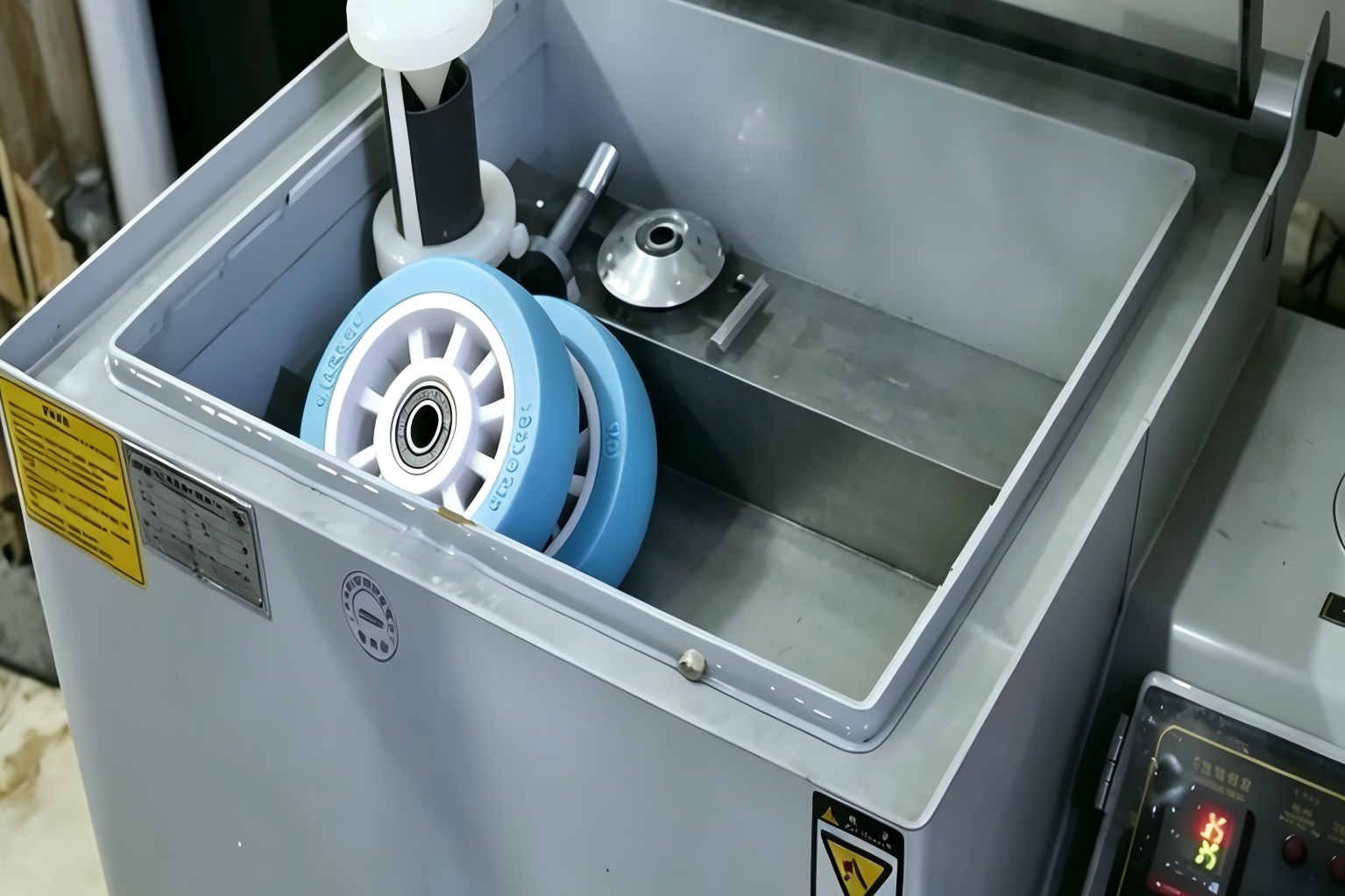
Two details matter as much as the finish. First, the swivel raceway needs a grease that resists water rather than one chosen purely for low friction. Second, the axle and nut should be the same material family as the bracket; a stainless axle in a zinc-plated fork simply moves the corrosion to the fork’s thread.
Sun, Heat and Cold: What Degrades First
UV damage is slow, cumulative and easy to miss until the wheel starts behaving badly.
Natural rubber tyres are the most vulnerable common material. They harden, crack and lose elasticity, which on a cart means less shock absorption exactly when the ground is roughest. Polyurethane and TPU are noticeably more UV-stable, and black compounds generally outperform bright colours because the pigment package is more resistant.
Where equipment sits in direct sun for years, the specification should include a UV-stabilised compound rather than a standard one, and the wheel should be inspected for surface crazing at each service interval rather than only for wear.
Cold brings a different set of problems. Standard grease thickens and the swivel becomes stiff in freezing weather, which operators notice as a cart that suddenly will not steer. Low-temperature grease and, on very cold sites, a bearing arrangement that tolerates it are the fixes. Pneumatic tyres also lose pressure in cold weather, so a pre-season pressure check belongs in the maintenance routine.
Ground Contact: Pneumatic Versus Solid Wheels
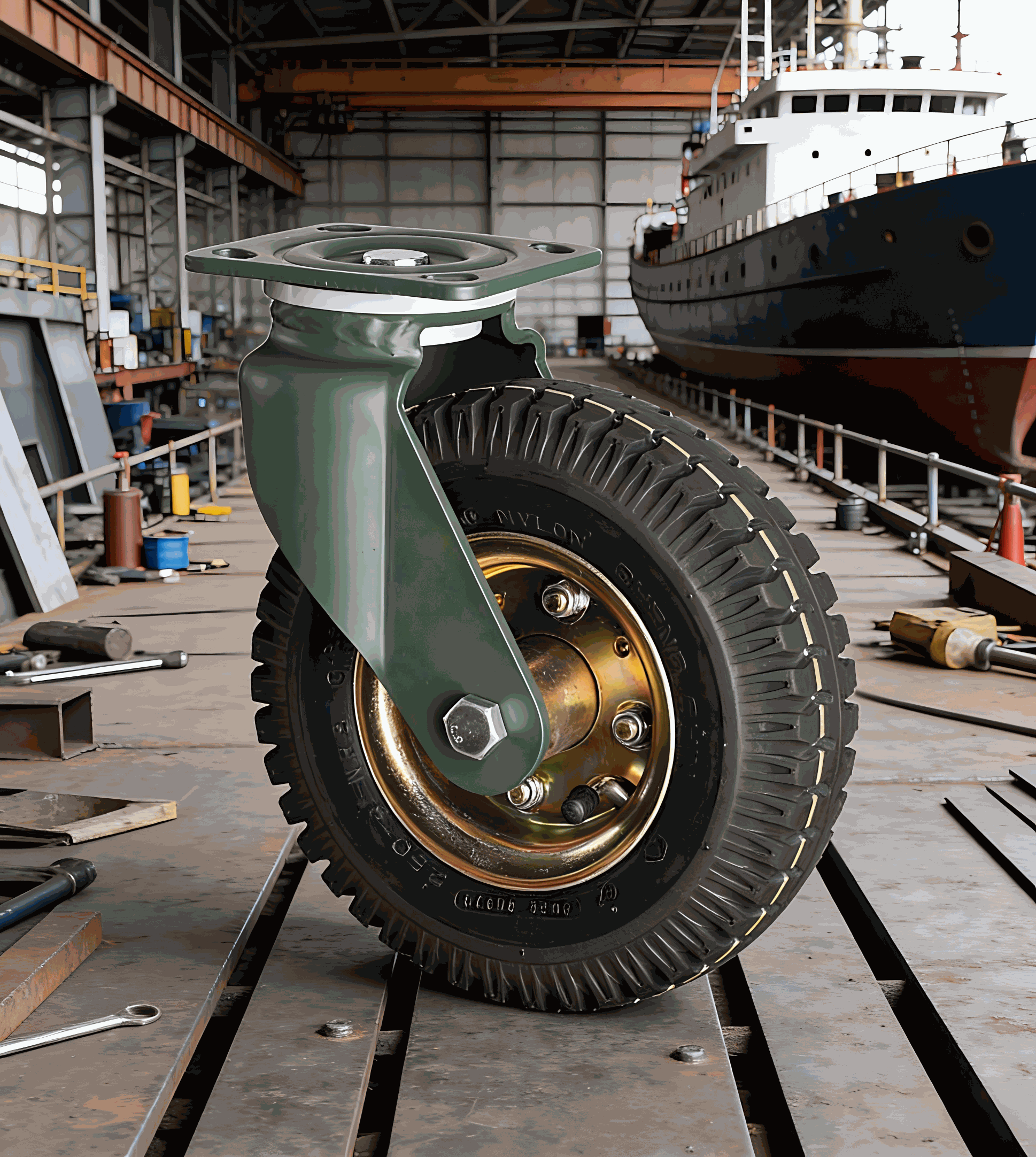
On gravel, grass, packed earth and broken asphalt, the wheel is doing suspension work as well as rolling work. This is the one place where a pneumatic or cushion tyre is usually the right answer rather than a compromise.
Pneumatic tyres absorb bumps that would otherwise be transmitted straight into the bracket, and they roll over loose gravel and soft ground with far less effort. They are the standard choice on outdoor carts, yard equipment and mobile machinery. The cost is maintenance: pressure checks, puncture repair and a load rating that depends on correct inflation.
Solid rubber and PU wheels need no maintenance and cannot puncture, which makes them the better choice for paved yards, concrete aprons and hard standing. On loose gravel they are noticeably harsher and slower.
Hard plastic and nylon wheels work on smooth outdoor concrete but are a poor match for grit and roots; they transmit every bump and are noisy on paving.
Wheel width matters outdoors in a way it does not indoors. A wider tread spreads the load on soft ground and bridges small gaps and grate edges instead of dropping into them. On outdoor equipment we generally look for a tread wide enough that the wheel cannot fall into the largest gap on the route, which on yards and loading areas often means 40 mm or more.
Bearings and Sealing for Grit and Washing
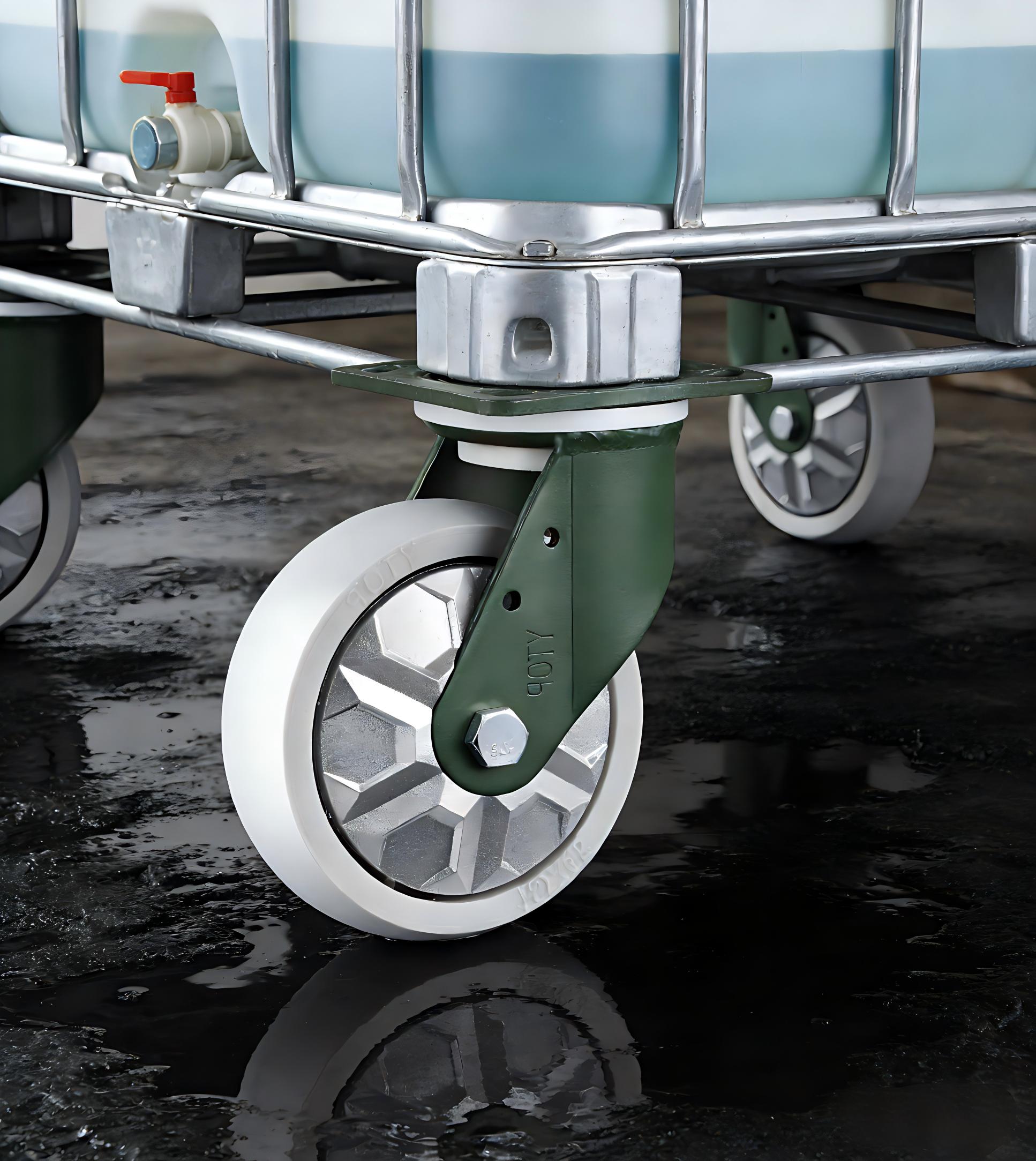
Indoor bearing advice does not transfer outdoors. A sealed precision bearing rolls beautifully but cannot be re-greased, and once grit enters it is finished. A shielded roller bearing with a grease nipple looks less sophisticated and lasts longer in a yard.
Where equipment is washed down with a hose, the bearing choice must tolerate water. Sealed bearings rated for washdown, or a design that keeps water out of the raceway while still allowing re-greasing, are the practical options. Hosing a cart down and then leaving it wet is the fastest way to destroy an ordinary bearing.
Two small specification details repay their cost outdoors. A dust cap or thread guard over the axle keeps grit and fibres out of the wheel bore, and a wheel with a solid hub rather than an open one gives water far less opportunity to reach the bearing.
Specifying an Outdoor Caster: A Short Checklist
Six questions are enough to turn an indoor caster order into an outdoor one.
First, how many hours per day is the equipment outside, and is it stored outside overnight? Second, what is the ground: paving, concrete, gravel, grass, or a mix? Third, is there standing water, washdown or coastal salt air? Fourth, what is the temperature range across the year, including storage? Fifth, what is the real loaded weight and how is the load distributed across the four casters, remembering that outdoor routes include curbs and drops? Sixth, does the equipment need brakes that work on slopes?
Two rules of thumb help. Derate capacity where the route includes kerbs, potholes or drops, because impact is not captured by a static load figure. And always specify the finish and the bearing in writing; “outdoor caster” alone tells you nothing about whether the bracket will still be intact after two winters.
Brakes, Storage and Routine Care
Outdoor equipment spends most of its life standing still, and that is when brakes and storage habits do the damage.
Brakes on slopes and uneven ground. A wheel-only brake holds the cart along one axis and leaves it free to rotate about the swivel. On a cambered yard or a sloped apron, that rotation is exactly what an operator does not want while loading. Total-lock brakes that lock both the wheel and the swivel are the practical choice for any outdoor equipment parked on uneven ground, and they should be fitted on at least two casters, ideally diagonally opposite.
Standing water. Equipment left outside in the rain collects water on the deck and around the casters. Water sitting in the swivel raceway is worse than water passing over it, because it has time to work into the grease. Where equipment must be stored outside, a slight slope on the parking area, or simply parking it on hard standing rather than on grass, makes a measurable difference to swivel life.
Seasonal checks. Four checks once a year cover most outdoor failures. Look for rust at the raceway and around the axle rather than on the bracket face. Spin each wheel and listen for grit. Check pneumatic pressures before the season changes rather than after the tyre has run soft for a month. And check that brake pedals still engage fully; grit in the mechanism is a common reason a brake that worked in autumn does not hold in spring.
Re-greasing. A grease nipple on the swivel and axle is the cheapest long-term investment on outdoor casters, because it turns a sealed-for-life component into one that can be maintained. Where grit is present daily, re-greasing twice a year will usually extend swivel life well beyond the warranty period.
Storage and UV. A caster that sits in direct sun for years ages from the outside in. If equipment is parked in the open, expect the wheel surface to harden before the tread wears out, and inspect for crazing rather than only for remaining tread depth.
When a Standard Caster Is the Right Answer
Not every outdoor application needs a premium specification, and overspecifying wastes money. Equipment that is moved outside occasionally, stored under cover and used on paved surfaces is well served by a standard galvanised bracket with a PU wheel. The specification only needs to escalate when exposure is daily, the ground is loose, or water and salt are present.
The failure pattern to watch for is the opposite: an indoor-grade caster on equipment that is genuinely outside every day. That shows up first as a stiff swivel, then as rust at the raceway, then as a wheel that will not roll straight. By the time the operator reports it, the bracket is usually past saving.
If you can tell us the ground type, the exposure hours and the temperature range, we will specify the finish, wheel and bearing together rather than one at a time.
Related Reading
Two more guides for the two decisions that dominate outdoor specifications, corrosion protection and rough-ground durability:
- What Is 8-Level Powder Coating? A Corrosion Protection Guide — how coating grades are classified and what they mean for brackets exposed to weather.
- Casters for Mine and Tunnel Transport — impact-resistant solutions for the harshest ground conditions.
Explore our heavy-duty casters (150-610kg) and super heavy-duty casters (700-1600kg) for outdoor equipment, or contact our engineering team with your ground type, exposure hours and temperature range.
Post time: Nov-11-2026