
Transport vehicles in mine tunnels are a completely different usage scenario from carts in ground-level workshops. Tunnel floors are uneven, covered with gravel, and damp with standing water. Transport vehicles, fully loaded with ore, bounce back and forth, and the wheels bear not steady loads but continuous impact.
The Test of Tunnel Conditions on Wheels
The mine tunnel environment tests wheels in all aspects:
Impact. Tunnel floors are pitted, and transport vehicles crossing ridges and ditches subject wheels to repeated impact. The brackets and treads bear instantaneous large loads, not static weight. This impact load places high demands on the bracket’s fatigue strength and the tread’s impact resistance. Wheels that pass static load testing may quickly develop problems under impact conditions.
Dampness. Standing water and seepage are common in tunnels, and wheels operating in humid environments require high corrosion protection. Standing water may contain minerals and chemical components, making it more corrosive than pure water.
Dust. Coal dust and rock dust fill the air, and fine particles enter bearings, wearing rotating parts. Dust mixed with standing water forms mud, which enters wheel set gaps more easily than dry dust.
Impact under fully loaded conditions is the most damaging to wheels among these tests. The impact load on wheels when crossing a ridge empty versus fully loaded differs by several times.
Bracket Impact Resistance
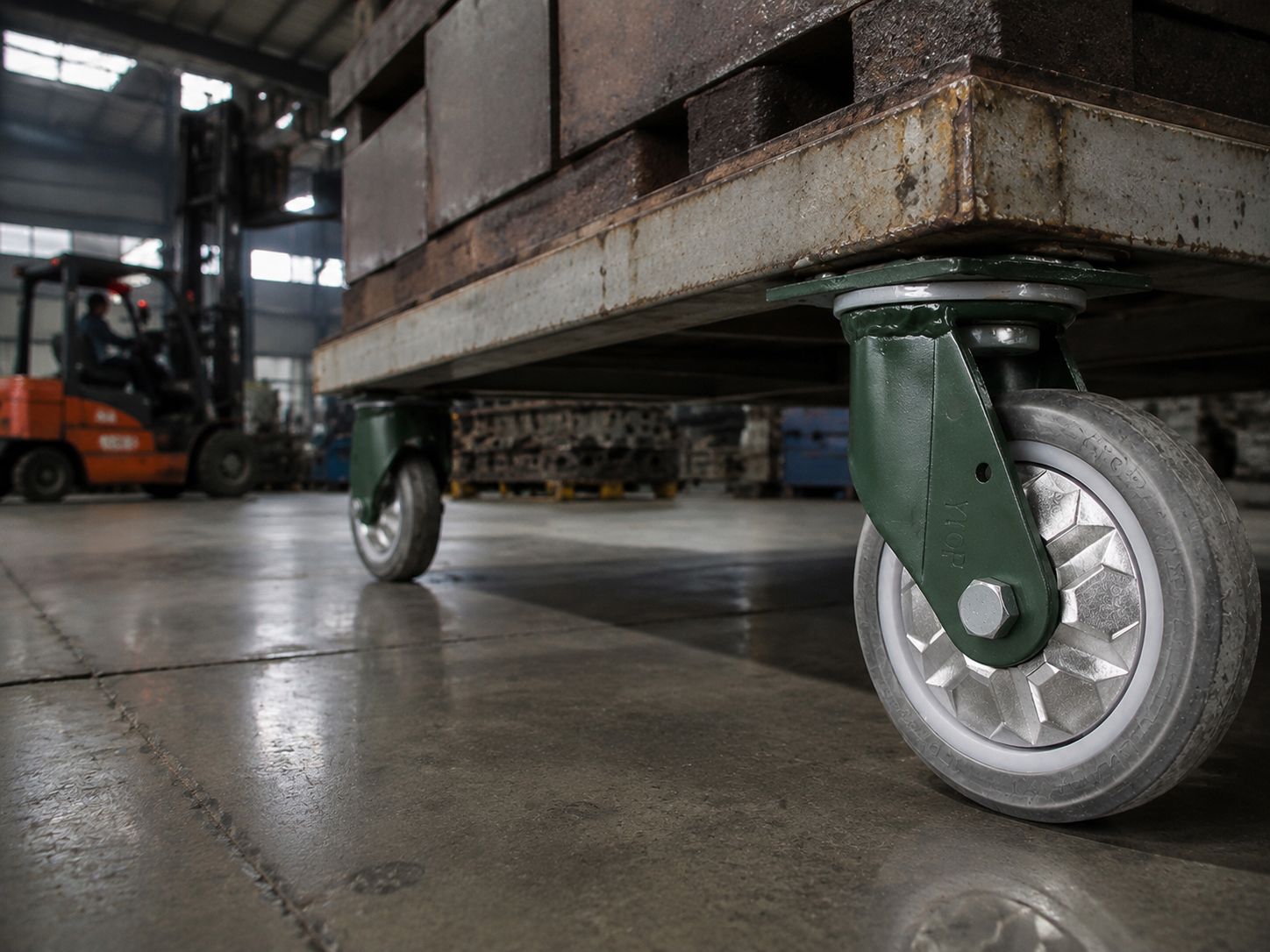
For impact resistance, first look at the bracket.
Under impact load, if the bracket material has insufficient strength and toughness, it is prone to deformation or even fracture. Selecting bracket material with high strength and good toughness ensures the bracket does not bend or crack when crossing ridges and ditches, and the wheel set remains stable. The material’s fatigue strength must also be sufficient, so cracks do not accumulate under long-term repeated impact.
The material selection logic for brackets differs under impact conditions versus static load. Both are “able to bear load,” but static load mainly looks at yield strength, while impact conditions look at impact toughness and fatigue strength. Materials with high strength but poor toughness are prone to brittle fracture under impact; those with good toughness but insufficient strength are prone to deformation. Both indicators need to be satisfied simultaneously.
Wheel Diameter and Wheel Body Structure
If the bracket holds up, the wheel body structure must also keep up.
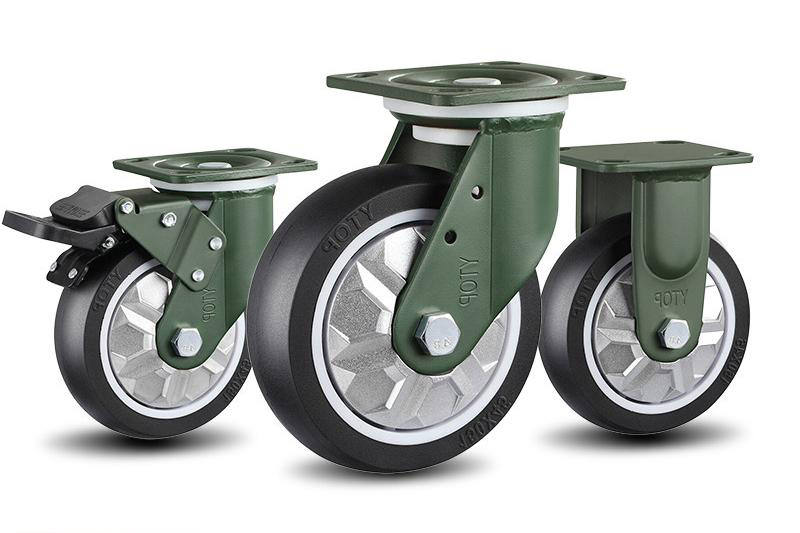
Choose a large wheel diameter. Large wheel diameters provide gentler impact when crossing ridges, strong road adaptability, and better passability on gravel floors. When small wheel diameters cross ridges, impact force is directly transmitted to the bracket and bearing, causing greater damage. Wheel diameter selection must also consider tunnel space constraints — tunnel height and width are limited, and wheel diameter cannot exceed the range allowed by mounting space.
The wheel body structure should be thick. Thickened hub and base plate design disperses and conducts impact force, rather than concentrating it at a single stress point. Thick structures generally have longer lifespans in impact environments than lightweight designs. Lightweight designs have advantages on flat floors, but in impact environments like tunnels, structural strength is more important than weight.
Corrosion Protection and Sealing
Tunnels are damp, so corrosion protection and sealing cannot be skipped.
Brackets use the plastic layer of a powder coating process for corrosion protection, so standing water and seepage do not directly contact metal. Bearings should use sealed structures so dust and moisture cannot enter. Paired with molybdenum disulfide lithium-based grease, rotating smoothly is maintained under heavy load and impact.
Tunnel standing water may contain acidic minerals, which are more corrosive to metal than ordinary standing water. The integrity of the powder coating layer is even more important in this environment, because once the coating is damaged and the substrate is exposed to acidic standing water, rusting will be rapid.
Braking Safety
Tunnel transport also has a requirement that cannot be ignored: braking.
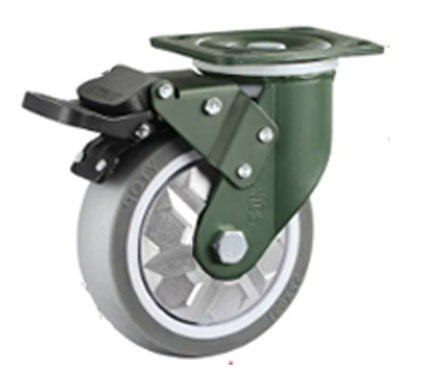
Tunnels have slopes and slippery floors, and a transport vehicle rolling away is an accident. Dual-brake design, with simultaneous braking on both sides, can stabilize heavy-load transport vehicles even on slopes. Braking reliability in tunnels is far more important than on flat ground — rolling away on flat ground may just bump into equipment, but rolling away on a slope can cause casualties.
Brake system selection must consider the tunnel slope angle and floor slipperiness. The steeper the slope and the slipperier the floor, the higher the braking force requirement.
Information to Confirm During Selection
For mine tunnel transport vehicle wheel selection, provide the following information to the manufacturer:
• Transport vehicle load and single-trip load
• Tunnel floor conditions (gravel, standing water, slope)
• Transport frequency and single-trip distance
• Slope angle and braking requirements
Zhuoye manganese steel casters have a corresponding product line for heavy-load impact-resistant conditions, and specifications need to be confirmed during selection based on specific tunnel road conditions and load. Wheels in tunnels are only qualified if they can withstand impact and dampness — the cost of lost ore output from one broken wheel far exceeds the price difference of the wheel itself.
Related Reading
Looking for more in-depth caster guides and industrial mobility resources? Explore these related articles:
- Super Heavy-Duty Casters: Dual-Wheel Structure Advantages — How twin-wheel spreading reduces ground pressure and extends service life under extreme loads.
- How to Determine the Load Capacity of Casters — Step-by-step method for calculating per-wheel load and selecting the right capacity rating.
Explore our heavy-duty casters for demanding industrial conditions, or contact our engineering team for custom impact-resistant caster recommendations.
Post time: Nov-03-2026