
Replacing a caster should be a five-minute job. It becomes a two-week problem when the replacement arrives and does not fit, or fits and leaves the equipment standing crooked. Almost every one of those failures comes down to a dimension that was estimated rather than measured.
This article is the measuring procedure we use when a customer sends us a single photo of an old caster and asks what it is. Six dimensions are enough to identify almost any caster, and the same six are enough to order a replacement that fits first time.
Why Replacements Fail
Three causes account for most failed replacements, and none of them is the caster itself.
The first is height. A replacement that is 10 mm shorter or taller than the original changes the equipment’s standing height. On a four-caster trolley that means the load shifts onto two casters, the frame twists, and one caster may carry twice its intended share.
The second is the mounting interface. A plate that is the right size but has holes at a slightly different pitch cannot be made to fit; the bolts will not align, and enlarging the holes weakens the plate.
The third is the thread. A stem caster is often ordered by diameter alone, and then the pitch turns out to be different from the socket.
Six Dimensions to Measure
The list is short: wheel diameter, wheel width, overall height, mounting type, mounting dimensions, and the load the caster carries.
Each has a specific way to measure it, and each has a trap. The sections below take them in the order we ask for them.
Wheel Diameter and Width
Measure the wheel diameter across its face, not along the tread crown, and measure the width at the tread, not at the hub. Both numbers matter: diameter sets the obstacle-crossing ability and the rolling resistance, and width sets the floor pressure and whether the wheel will fit inside the fork.
A worn wheel reads smaller than its original diameter. That is not a problem for identification as long as you note it: a caster with a 100 mm wheel worn down to 96 mm is still a 100 mm caster, and ordering a 96 mm replacement will leave the equipment 4 mm low.
Overall Height
Overall height is the distance from the floor to the underside of the mounting plate, with the caster standing on a flat surface. This is the number that must match, and it is the one most often skipped.
On a stem caster, overall height is measured from the floor to the point where the stem stops entering the socket — usually the top of the fork or a shoulder — not to the tip of the stem. Measuring to the tip gives a number that is too large by exactly the length that is buried in the leg.
Mounting Dimensions
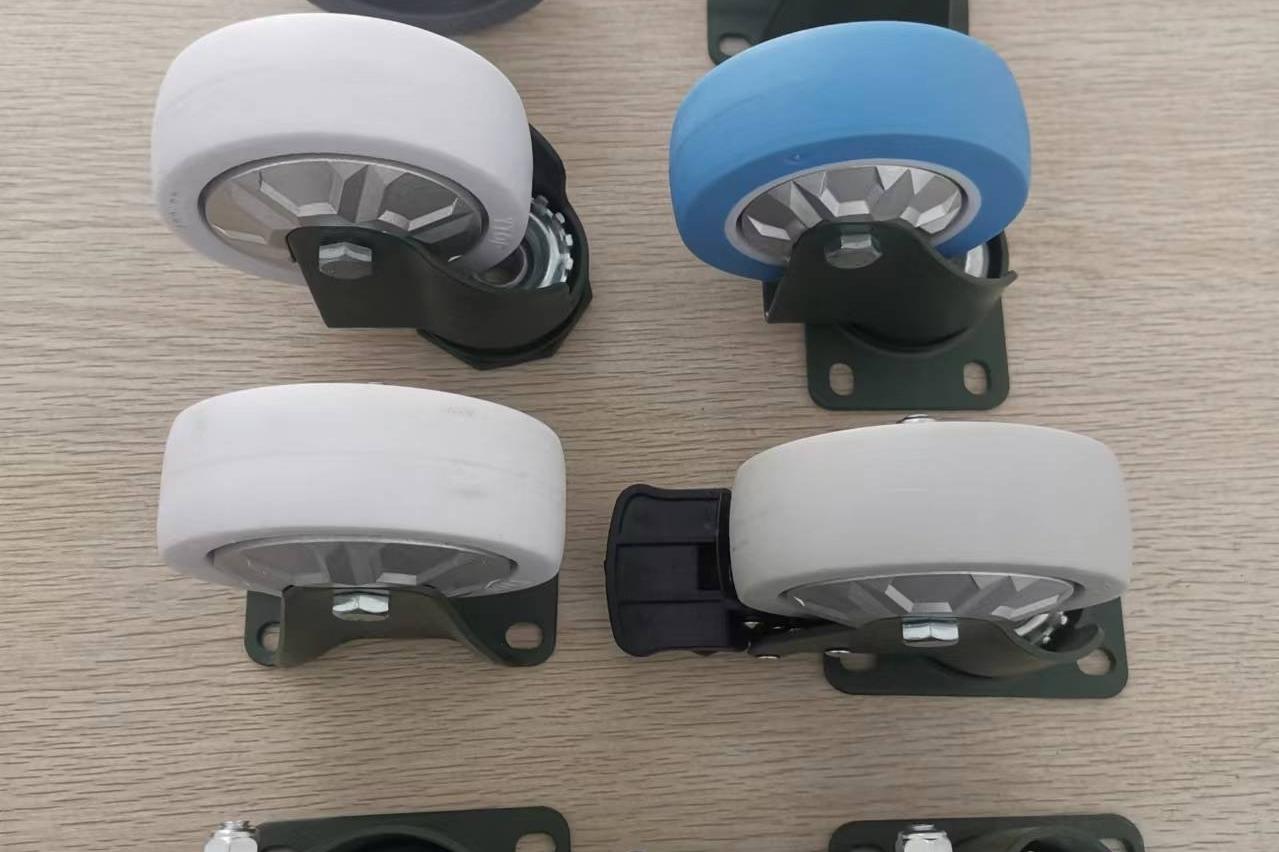
For a plate caster, three numbers identify the plate: the plate length and width, the bolt hole spacing, and the bolt hole diameter. Measure the spacing between hole centres, not between the outer edges of the holes, and measure both directions — a rectangular plate has two spacings and they are rarely equal.
For a stem caster, the equivalent numbers are the thread diameter, the thread pitch and the usable insertion length. Measure the thread diameter across the crests with a caliper, not across the flanks.
Identifying the Thread
Thread pitch is the hard one, and guessing it is expensive. Three methods work.
A thread pitch gauge, which is a set of toothed leaves, is the fastest and most reliable. Lay the matching leaf along the thread and check that the teeth seat in every groove. Most workshops already own a set for bolt work.
If there is no gauge, compare against a known fastener. Hold an M10 x 1.5 bolt against the stem, or hold two stems together and look for light between the threads. Mismatched pitches show an obvious gap even when the diameters are identical.
Last, measure over a known number of threads. Count ten threads, measure the distance from crest to crest across those ten, and divide by ten. That gives the pitch within a few hundredths of a millimetre, which is enough to tell 1.25 from 1.5 from 1.75.
Confirming the Load
The load per caster is rarely written on the old caster. Two approaches work in practice.
Weigh or estimate the equipment and divide by the number of casters, then multiply by a factor for uneven distribution. On a rectangular four-caster frame with a load that is not centred, one caster can take twice the average. Using 1.5 to 2 times the nominal share is a reasonable starting assumption.
Or read the original specification. Most industrial casters carry a capacity marking on the fork, the plate or a stamped tag. If the marking has worn off, the wheel diameter and plate size usually indicate the capacity class, which is why measuring them first is worthwhile.
Measuring Without Removing the Caster
Sometimes the caster cannot come off: the bolts are seized, the equipment is in service, or the thread is locked with compound. Four of the six dimensions can still be taken in place.
Wheel diameter can be measured with a caliper across the tread while the caster is on the floor, as long as the caliper jaws clear the fork. Wheel width can be read from the fork gap if the wheel is visible. Overall height can be taken from the floor to the underside of the plate with a depth gauge or a straight edge and a rule. Plate size and hole spacing can be measured from underneath, or by placing a sheet of paper over the plate and rubbing a pencil across the bolt heads.
Thread pitch is the one that usually requires removal, unless the stem is exposed above the socket. If it is, a pitch gauge still works in place.
Common Sizes and What They Tell You
Caster sizes cluster, and the cluster tells you the application class before you measure anything else.
A 50 mm wheel on a plate around 50 x 50 mm is a light furniture or display caster, typically 30 to 50 kg per caster. A 75 mm wheel on a 70 x 60 mm plate is general equipment duty, 60 to 100 kg. A 100 mm wheel on a 90 x 70 mm plate is a workshop trolley caster, 100 to 150 kg. A 125 to 150 mm wheel on a 100 x 85 mm or larger plate is heavy trolley and rack duty, 150 kg and above.
Stem casters follow a similar pattern with M8 on the smallest, M10 through the mid range, and M12 or M16 on larger equipment. If the measured wheel and plate fall outside these clusters, the caster is likely application-specific — a hospital bed caster, a scaffold caster or a low-profile dolly caster — and the original specification is worth tracking down rather than substituting.
Why Height Has to Match Exactly
A caster set works as a plane. If one caster is shorter than the other three, the equipment tilts and that caster carries less than its share while the opposite pair carries more. On a trolley this shows up as a frame that rocks, or as one caster that squeals and fails early.
The correct approach is to replace all four at once when they are the same age, or to match the height of the originals exactly when replacing one. If the exact height is unavailable, the next size up can be used only if all four are changed together and the equipment can tolerate the extra height.
The same logic applies to the mounting pattern. Two plates that look identical but differ by 2 mm in hole pitch are not interchangeable, and drilling them out to fit is a false economy: the plate is the load path, and an elongated hole concentrates stress at the bolt.
When to Replace the Wheel and When to Replace the Caster
A worn tread, a flat spot or a chunk missing from the wheel is a wheel problem. The fork, the stem and the raceway can stay.
A loose fork, vertical play in the swivel, a bent stem, a cracked plate or a brake that no longer holds is an assembly problem, and replacing the wheel will not fix it. In that case the whole caster goes.
Recording the Specification
Write the result as a single line before ordering, and a wrong shipment becomes almost impossible.
For a plate caster, the line reads: wheel diameter x width, overall height, plate size, hole spacing, load per caster, tread material, brake type.
For a stem caster: wheel diameter x width, overall height, thread diameter x pitch, usable insertion length, load per caster, tread material, brake type.
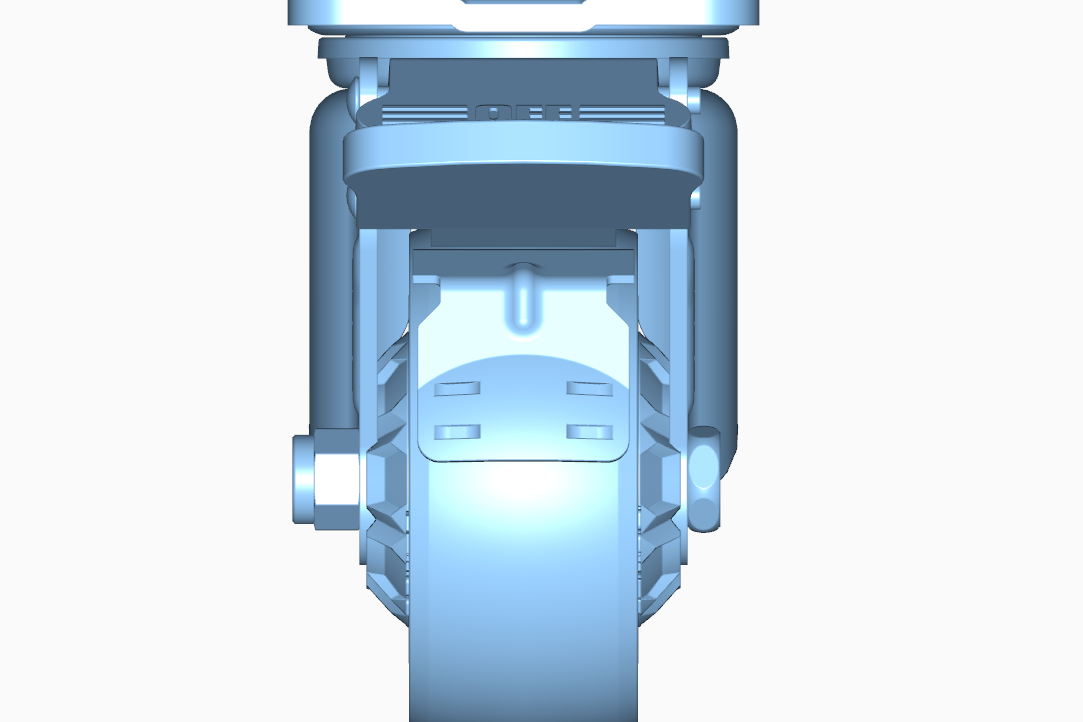
Photograph the old caster next to a ruler with the fork facing the camera. That single photo resolves most remaining ambiguity, including whether the fork is offset or centred and whether the brake is on the wheel or the swivel.
Send that line and that photo to a supplier and the reply should be a part number, not a question. If it is a question, the specification was incomplete — and it is far cheaper to find that out before the shipment than after.
Related Reading
Two guides that continue this topic:
- Threaded Stem Casters: Thread, Length and Load — how to specify a stem caster so the socket and the thread match.
- How to Determine Caster Load Capacity — calculating the worst-corner load that the replacement has to carry.
Explore our heavy-duty casters (150-610kg) and super heavy-duty casters (700-1600kg), or contact our engineering team with your measurements and a photo of the original.
Post time: Nov-17-2026