
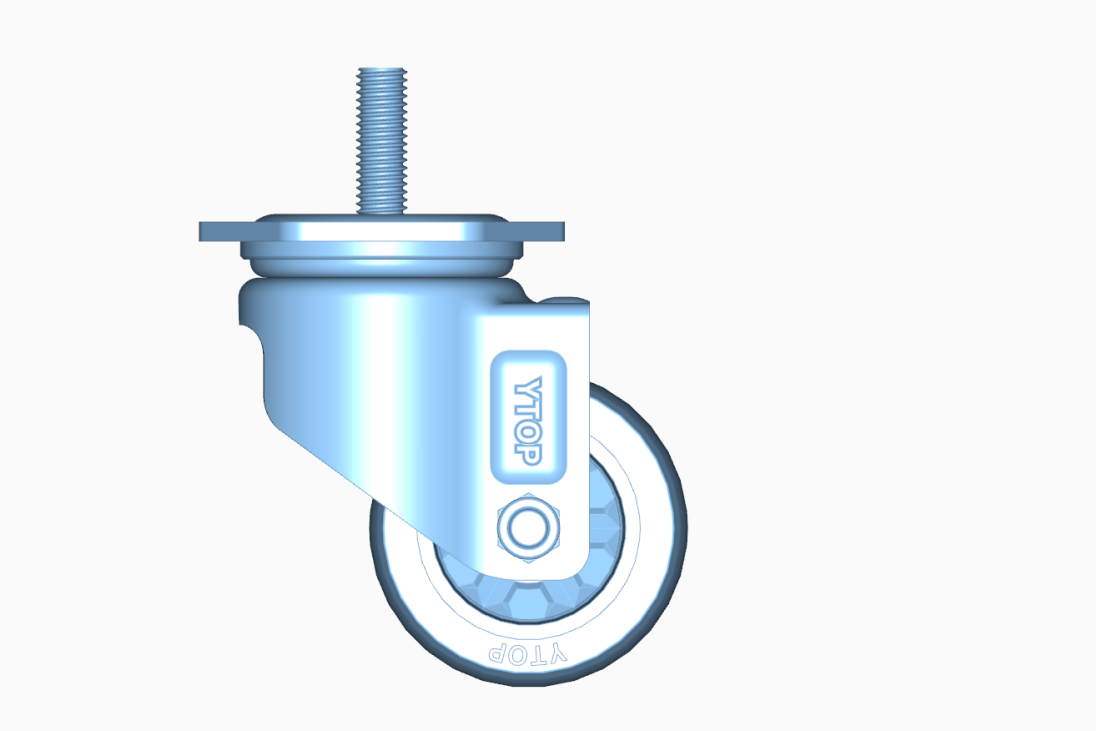
A threaded stem caster is the simplest way to add mobility to equipment that already has a leg, a tube or a socket: you do not weld a plate on, you do not drill four holes, you screw the caster in. That convenience is also where most of the problems start, because the thread has to match exactly, and the length has to be right for both the socket and the load.
This article covers the three numbers that decide whether a stem caster works — thread size, stem length and load — and the mistakes that make a correct-looking caster fail in service.
When a Stem Beats a Plate
Plate casters bolt onto a flat surface with four fasteners. Stem casters screw into a single threaded socket, or through a hole with a nut on the other side.
The stem wins in three situations. The equipment has legs or tubes rather than a flat frame, such as shelving, desks, display stands and light machine bases. There is no room for a plate and four bolt heads. And the caster has to be fitted after the equipment is built, often by the end user rather than in a factory.
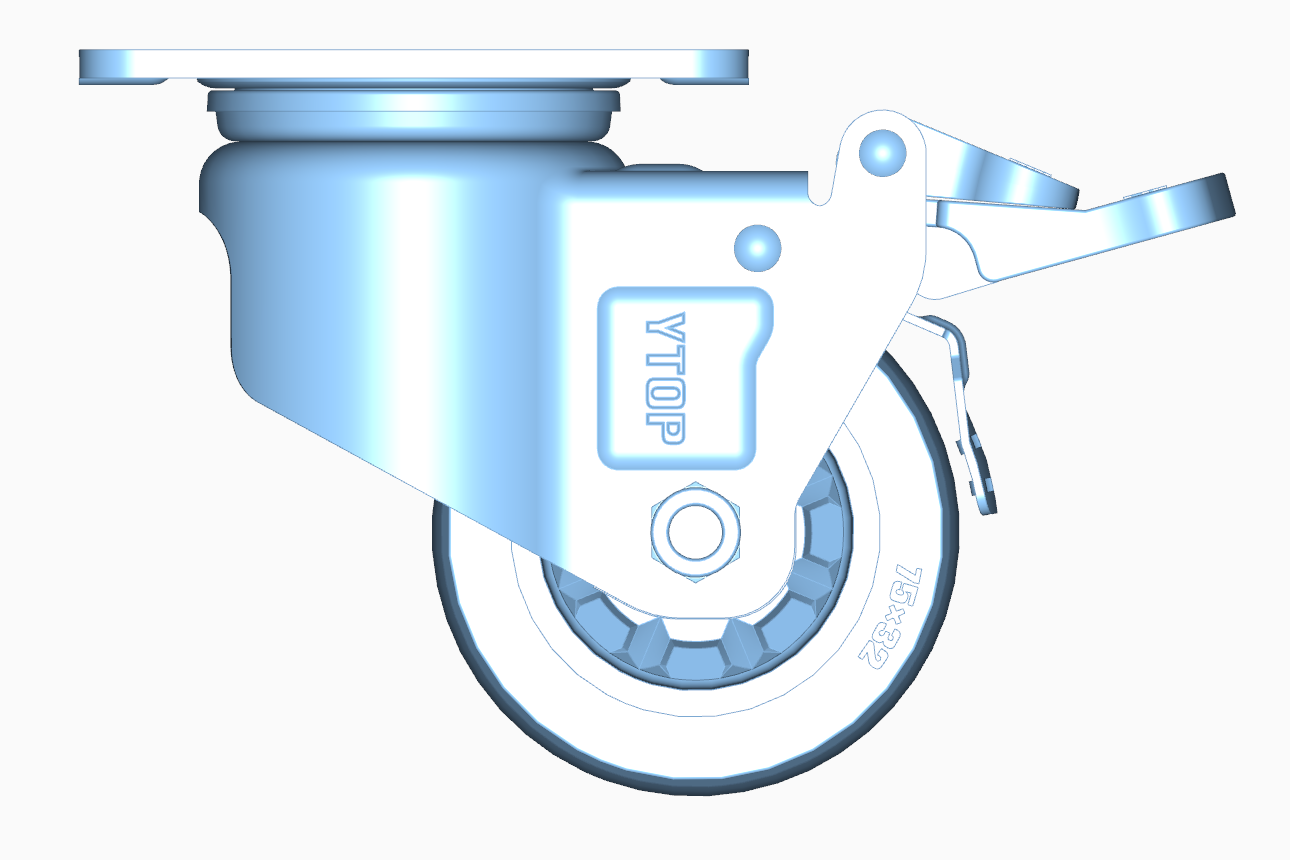
It loses in three others: heavy loads, because a single threaded joint is a smaller load path than four bolts; applications that need the caster offset to be adjustable for levelling; and anything where the operator needs a large brake pedal, since stem casters usually carry a smaller brake.
Thread Size: The Number That Has to Match
A thread is defined by two things: the nominal diameter and the pitch. M10 x 1.5 means a 10 mm major diameter with a 1.5 mm pitch. Both parts matter. An M10 x 1.25 will start in an M10 x 1.5 hole and then bind, and a 3/8-16 UNC will not enter an M10 hole at all even though the diameters are close.
The common metric sizes on industrial casters are M8, M10, M12 and M16. Light furniture and display fittings often use M8; general equipment and shelving use M10; heavier racks, machine bases and larger trolleys use M12 and M16. Fine pitches are used where vibration loosening is a risk or where the wall thickness of the socket is limited.
Imperial threads still appear on imported equipment and on older machines. The ones you will meet are 5/16-18, 3/8-16 and 1/2-13 UNC, plus occasional UNF variants. A 3/8-16 and an M10 x 1.5 are within a fraction of a millimetre in diameter, which is exactly why people force them and strip the socket.
The practical rule is to identify the thread from the equipment side, not from the old caster. Measure the major diameter with a caliper and check the pitch with a thread gauge or by comparing against a known bolt. If the equipment is new and the socket is clean, a thread gauge takes ten seconds and removes all doubt.
Stem Length: Three Different Numbers
Buyers routinely order the wrong length because three different lengths get called “stem length”.
Overall stem length is the full length of the threaded rod from the fork to the tip. Threaded length is the part that is actually threaded, which may be shorter than the overall length when there is an unthreaded shoulder. Usable insertion length is how far the stem can enter the socket before the fork or a shoulder stops it.
What the equipment needs is the usable insertion length to be at least as long as the socket depth, and the thread to engage fully through it. What the caster needs is enough unthreaded or clear length so that the fork does not bottom out on the leg before the thread is fully engaged.
The failure modes are predictable. Too short, and the stem engages only a few threads: the joint rocks, the thread wears, and the caster eventually pulls out under load. Too long, and the stem bottoms out inside the leg or hits an internal component, so the caster stands off and the equipment rocks on the stem tip instead of seating on the leg.
Five Mistakes We See on Stem Casters
Forcing a mismatched thread. An M10 stem pushed into a 3/8-16 socket will go in for two or three turns and then seize. The socket is usually the part that is damaged, and it is far harder to repair than the caster is to replace.
Counting the threaded length as the insertion length. A stem with 40 mm of thread and a 25 mm shoulder cannot enter a 60 mm socket, however long it looks on the drawing.
Ignoring socket wall thickness. A 1.5 mm wall tube will ovalise under a loaded M12 stem long before the caster reaches its rated capacity, and once the socket is oval the caster will never sit straight again.
Fitting a stem caster to a towed piece of equipment. Towing puts a horizontal force at floor level, which becomes a bending moment at the stem. Use a plate caster with four bolts, or a caster designed for towing.
Replacing only the wheel on a worn assembly. If the stem is worn, the fork is loose or the raceway has play, a new wheel inside the old hardware will fail the same way within weeks.
Sockets, Legs and Tube Walls
The caster is only half of the joint. The other half is the socket, and it is often the part nobody measures.
Three checks are worth doing before ordering. Measure the internal thread depth, not the visible depth of the hole. Check whether the socket is welded into a hollow section or pressed into sheet metal, because the two behave very differently under load. And check whether the socket is centred on the leg, since an offset socket puts a bending load into the leg as well as the stem.
Where there is no socket and the caster will go through a hole with a nut, the hole needs a shoulder to bear on. A caster hanging on its thread in an oversized hole will always sit at an angle, and it will always wear out early.
Load and Stem Diameter
Stem diameter and load capacity are related but not in the way most people assume. The thread does not carry the load in shear; it carries it through the friction and engagement of the threads inside the socket, and through whatever the socket itself is mounted to.
As a working guide, M8 stems suit light equipment up to roughly 40 to 50 kg per caster, M10 up to around 80 to 100 kg, M12 up to around 150 kg, and M16 for heavier machine bases. These are not catalogue ratings; they are the point at which a normal steel socket starts to be the limiting factor rather than the caster.
Two things override that guide. A thin-walled tube socket will deform long before the caster is loaded to its rating, so check the socket, not just the caster. And a load that is offset from the caster axis — a shelf that overhangs, a machine with its mass at the front — turns into a bending moment at the stem, which is a different and much lower limit than pure vertical load.
Installation Details That Decide Life
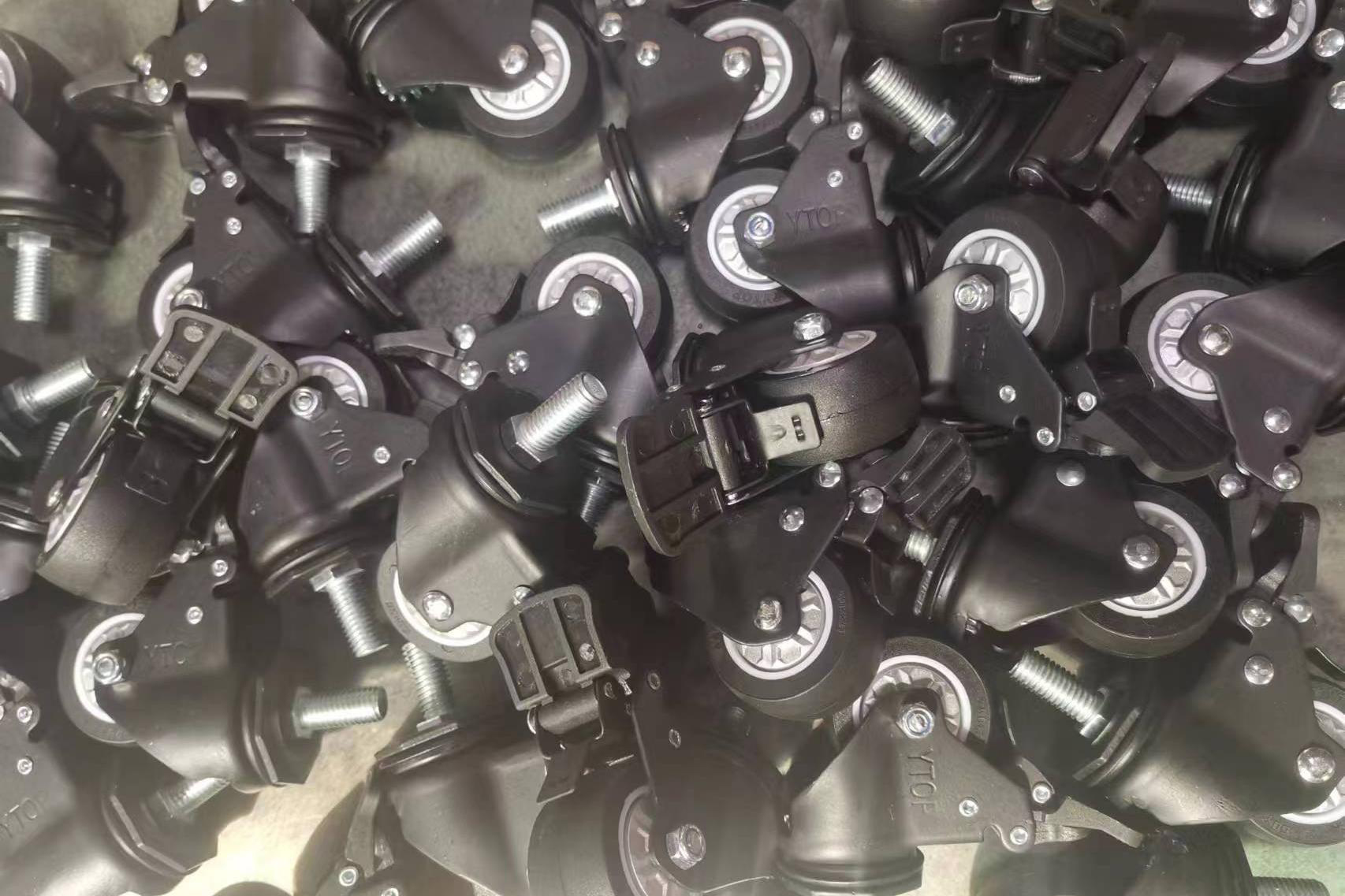
Four details separate a stem caster that lasts from one that works loose in a month.
A washer under the nut, or between the fork and the leg, spreads the clamping load and protects the surface. A thread-locking compound on the stem stops vibration from unwinding the joint; medium-strength compound is enough, and it still allows removal. A jam nut, where the design allows it, gives a mechanical lock that survives shock loads better than any adhesive. And a check of the tightening torque matters most on the smaller sizes, where it is easy to strip an M8 socket with a long spanner.
Where the caster is fitted through a hole rather than into a socket, the hole diameter has to clear the thread but not the shoulder, so the caster centres on the shoulder rather than hanging on the thread. An oversized hole is a very common cause of a caster that sits at an angle.
Stem or Plate: The Decision in Practice
Choose a stem caster when the equipment already has a threaded socket or a leg that can take one, when the load per caster is within the ranges above, and when the caster will be fitted or replaced by a user rather than a fabricator.
Choose a plate caster when the load is heavy, when the mounting surface is a flat frame that can take four bolts, when the caster needs to be levelled or shimmed individually, or when a large brake is needed. Plate mounting is also the better choice on anything that will be towed, because the four-bolt pattern resists the side loads that a single stem transmits straight into the socket.
How to Write the Specification
A stem caster order should carry six lines, and a supplier can fill in the rest.
Thread: nominal diameter and pitch, in the form M10 x 1.5, plus the thread standard if it is imperial.
Usable insertion length: the depth of the socket, and the thread length that will engage in it.
Overall height: from floor to the mounting face, because this fixes the equipment height and cannot be changed later.
Load per caster: the worst corner, not the average.
Wheel: diameter, tread material and whether it must be non-marking.
Brake: whether one is needed, and whether it must lock the wheel only or the swivel as well.
With those six lines, a wrong shipment becomes almost impossible. Without them, the two numbers most often left out are the pitch and the usable insertion length — and those are the two that cause returns.
Related Reading
Two guides that go with this one:
- Flat Base, Stem and Top Hole Mounting Designs — how the three mounting types differ in load path and application.
- How to Determine Caster Load Capacity — the per-caster load calculation behind every specification.
Explore our heavy-duty casters (150-610kg) and super heavy-duty casters (700-1600kg), or contact our engineering team with your socket dimensions and thread specification.
Post time: Nov-17-2026