
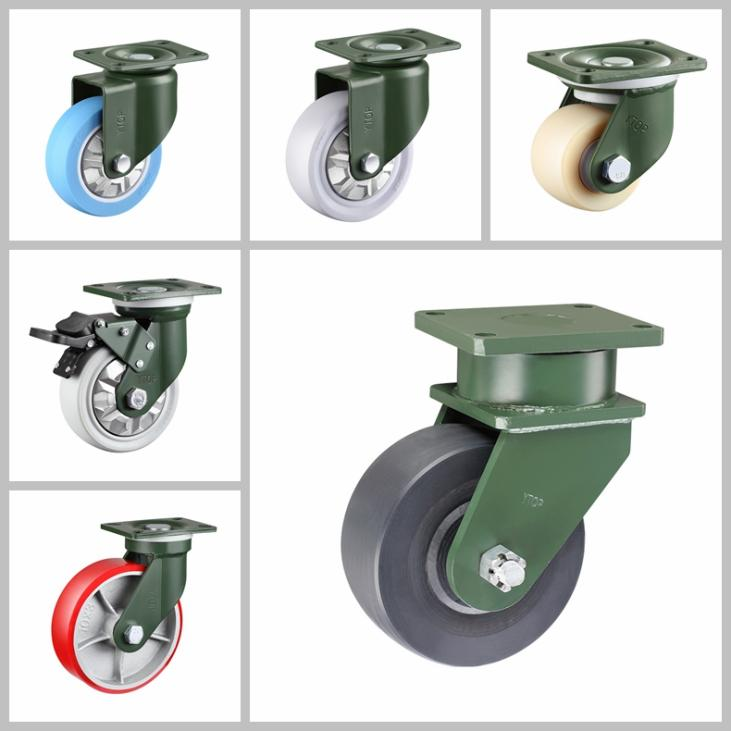
Casters are categorized from material properties, the conventional materials are rubber, polyurethane, nylon, PVC and other materials; categorized from the use of the environment, generally divided into high temperature resistance, room temperature, low temperature resistance.
Rubber: Rubber is a common caster material with excellent anti-wear and cushioning properties. Rubber casters provide good friction and non-slip effects and are suitable for a variety of indoor and outdoor surfaces. They are commonly used on office furniture, carts and light equipment.
Polyurethane (PU): Polyurethane is a material with high strength and abrasion resistant properties. Polyurethane casters are able to withstand heavier loads and provide good slip resistance on a variety of surfaces. They are commonly used for heavy equipment, industrial machinery and .
Nylon (PA): Nylon casters offer good abrasion and chemical resistance. They have a low coefficient of friction for a wide range of surfaces, making them excellent for smooth and quiet movement. Nylon casters are commonly used in warehousing equipment, transportation vehicles and industrial applications.
Polyvinyl Chloride (PVC): PVC is a common plastic material used in the manufacture of low-cost and lightweight casters.PVC casters are suitable for low load and smooth floor applications such as furniture and office equipment.
Polyethylene (PE): Polyethylene casters are lightweight, corrosion-resistant, and have a low coefficient of friction for indoor and outdoor use. Polyethylene casters are commonly used for carts, furniture and lightweight fixtures.
Polypropylene (PP): Polypropylene casters offer high strength and stiffness and good abrasion resistance. They are suitable for a variety of industrial applications and equipment such as factory vehicles and logistics equipment.
Related Reading
Explore more caster material type and comparison guides:
- Application of Common Materials in Casters — Comprehensive analysis of caster material types and applications.
- Rubber vs Nylon Casters: Which is Better? — Detailed comparison of rubber and nylon caster material types.
- Polyurethane vs Nylon Swivel Casters — Complete comparison of PU and nylon caster material types.
- PP vs TPR Casters: Material Comparison — Learn about PP and TPR caster material types and characteristics.
- Advantages of Nylon Casters and Applications — In-depth look at nylon caster material type and applications.
Explore our complete range of heavy-duty casters (150-610kg) and medium-duty casters (100-190kg) with various material type options, or contact our engineering team for expert caster material type selection guidance.
Post time: Dec-29-2023