
Wind turbine components are among the largest things moved indoors, and the casters under them are among the most abused. A blade mould half weighs several tonnes, a tower section cannot be lifted by a forklift, and the floor of a blade factory is covered in resin, glass fibre dust and gelcoat drips.
This article covers what a caster has to survive in blade and tower manufacturing, and where a caster is the wrong tool altogether.
Five Conditions in Wind Component Manufacturing
The environment is specific and severe.
Loads are extreme and uneven. A blade mould, a root insert fixture or a tower flange ring can be ten times heavier than the heaviest general industrial cart.
The floor is concrete, long and slightly uneven, and it carries resin, gelcoat and glass fibre dust that enter every joint.
Travel distances are long. A mould is moved the length of a hall, often dozens of times through the layup, cure and demould cycle.
Glass fibre dust is abrasive and it is everywhere; it acts like a fine grinding compound inside a raceway.
And handling is slow and precise, because a mis-steered mould damages the part and the tooling.
Where a Caster Is the Wrong Tool
The most useful advice for this industry is where casters stop being appropriate.
Above roughly two tonnes per unit, a caster-based solution stops being efficient. Rolling on steel rollers, skates, air bearings or a rail-mounted transfer car is the normal engineering answer, and fitting casters to a 12-tonne mould because it is convenient is how floors and casters get destroyed.
The practical threshold is simpler: if the load needs more than four casters at the top of the standard range, or if a single caster would exceed the range at all, the movement method should change rather than the caster.
Casters remain the right answer for tooling carts, resin drum trolleys, fabric roll carts, gelcoat bins, root insert fixtures and the small transfer frames that feed the mould. That is where the specification below applies.
Extreme Loads and Load Sharing
Where casters are used under heavy fixtures, the load-sharing question dominates.
A four-caster frame on an uneven floor does not share load evenly. On a concrete slab with a 3 mm dip, two casters carry the fixture and two carry nothing, and the two that carry it are loaded at double the calculated figure. Add the dynamic factor of a mould being pushed over a joint and the real load on one caster can be three times the static quarter-load.
Three measures make a heavy fixture safe: a spring-mounted or equalising caster arrangement so all four stay in contact, a larger top plate so load spreads across the frame rather than four bolt points, and a specification margin of at least 1.5 on the worst single caster.
Resin, Gelcoat and Glass Fibre Dust
The contamination load in a blade hall is worse than in most foundries.
Resin is sticky when fresh and hard when cured. It bonds grit into the raceway and then grinds it against the track with every revolution. Gelcoat drips create hard spots on the floor that a soft wheel absorbs and a hard wheel ignores.
Glass fibre dust is abrasive on its own, and it is fine enough to enter an unsealed joint and stay there. Mixed with resin it forms a grinding paste that wears a raceway out in months rather than years.
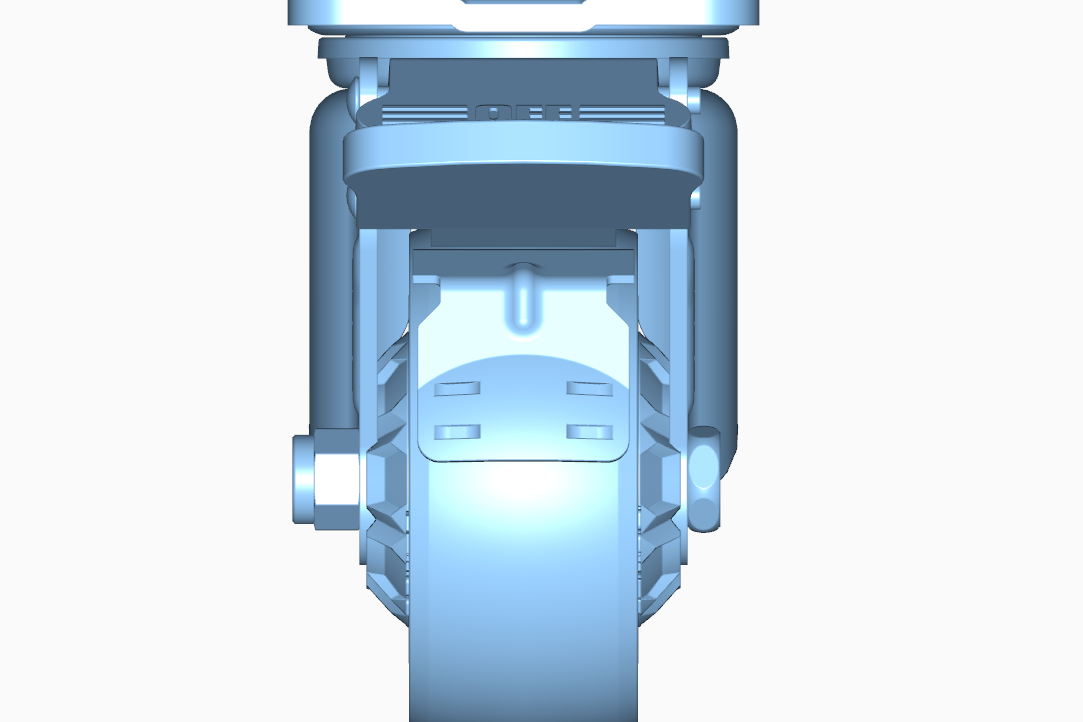
The countermeasures are a sealed raceway with a metal shield, a tread that does not absorb resin — polyurethane and nylon rather than rubber — and a cleaning routine that brushes the joint before greasing rather than after.
Wheel Choice for Blade and Tower Halls
Three options cover most of the work.
Cast nylon is the general default: hard, resin-resistant, unaffected by glass fibre dust, and it rolls well on a long concrete floor with low resistance. The trade-off is noise and a hard ride over joints.
Cast iron or forged steel suits the heaviest fixtures and the transfer frames where a soft tread would deform under a point load. It tolerates resin and dust completely, and it is the only sensible choice where gelcoat hard spots are common.
Hard polyurethane is the compromise where a finished floor or a coated mould surface must be protected and the load is moderate. It resists resin better than rubber but not as well as nylon.
Rubber has no place in a blade hall: it absorbs resin, softens with heat in a curing area, and wears quickly on an abrasive floor.
Long Travel, Heat and Curing Areas
Blade halls are long, and curing areas are warm.
Over a long travel distance, rolling resistance becomes the dominant force and the dominant wear. A hard tread at a larger diameter rolls with less resistance and generates less heat than a soft tread at a small diameter, so the caster that is easiest to push over a hundred metres is the hard, large one.
Curing areas reach 40 to 70 degrees Celsius in the vicinity of a mould under an infrared bank. A tread that softens at that temperature deforms permanently under load, and a grease that thins runs out of the raceway. Heat-resistant grease and a tread rated above the local temperature are both worth specifying.
Steering Precision Under a Mould
A mould is steered by hand or by a tow tractor, and precision matters because the clearance between mould and floor is small.
A caster with a large swivel offset steers predictably but swings wide; a small offset tracks tightly but is harder to control. Under a long mould, a mix works best: swivel casters at the tow end and rigid casters at the trailing end, so the frame follows the tow direction instead of fighting it.
Brakes matter here as much as steering. A mould frame left on a slight slope will creep, and a creep into a curing oven wall is expensive. Brakes acting on the wheel, on all casters, are the baseline for any fixture left in position.
Maintenance in an Abrasive Hall
Four habits cover most of the risk.
Brush the joint clean at the end of every shift; glass fibre dust does not wait for a weekly routine.
Inspect the track for resin build-up during greasing, because a raceway with cured resin in it will not be fixed by more grease.
Check all four casters for even contact after any floor repair, since a 2 mm change turns a four-wheel load into a two-wheel load.
Replace once the tread shows flat spots or the bracket shows wear at the axle bore; in an abrasive hall neither condition improves.
Specification Checklist
Six questions settle a wind component caster order.
What is the fixture weight, and does it exceed the point where rollers or a transfer car should replace casters?
What is the worst single-caster load when the floor is uneven and the frame is moving?
How much resin, gelcoat and glass fibre dust is on the floor, and who cleans it?
How warm is the caster when the fixture sits in a curing area?
How far does the fixture travel per cycle, which decides diameter and hardness?
Is the fixture ever parked on a slope or near an oven wall, which means brakes on all four wheels?
Answer those and the usual outcome is a clear split: steel rollers or a transfer car for the moulds themselves, and large cast nylon or iron casters on sealed raceways for the tooling carts, resin trolleys and insert fixtures around them. The recurring mistake in blade factories is scaling a caster up to a load it was never meant to carry, then blaming the caster when the floor cracks and the mould drifts.
Related Reading
Two guides that support the choices above:
- How to Determine the Load Capacity of Casters — why the worst single caster governs a heavy fixture.
- Caster Tread Hardness: Shore A and Shore D — choosing between nylon, PU and rubber for an abrasive hall.
Explore our heavy-duty casters (150-610kg) and super heavy-duty casters (700-1600kg), or contact our engineering team with the fixture weight and the floor conditions.
Post time: Nov-26-2026