
Warehouse carts do not fail from heavy loads so much as from constant movement. An order-picking cart in a distribution centre can travel 15 to 25 kilometres in a single shift, cross dock plates and expansion joints hundreds of times, and be pushed by a different person every hour. That duty profile demands a different caster from the one used on a machine-shop trolley that moves twice a day.
This guide covers the four cart types found in warehousing, what each one needs from its casters, and the selection points that decide whether a fleet runs quietly for years or needs wheels replaced every quarter.
Four Cart Types, Four Different Caster Problems
Order-picking carts. Light, tall and narrow, with shelves or totes. The load is usually under 150 kg, but the cart is in motion almost all shift. The caster problem here is rolling resistance and noise rather than capacity; a cart that needs a firm push becomes an ergonomic complaint within a week.
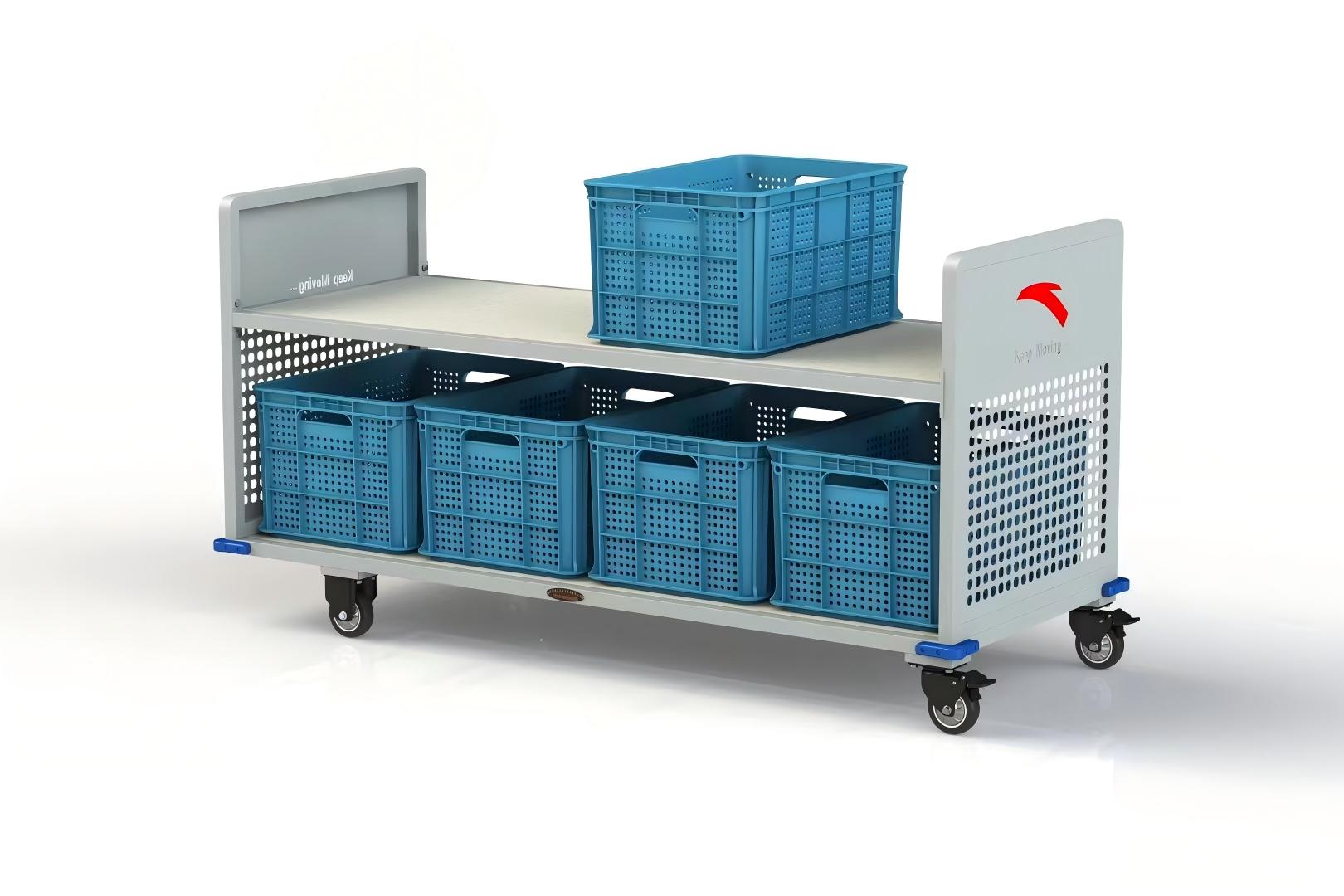
Bin and tote carts. Plastic crates on two or three shelves, moved between pick faces and packing benches. The load is moderate and the centre of gravity is low, but the carts are often pushed in trains, which puts lateral load on the leading and trailing casters.
Cage and wire-container carts. Heavy, bulky loads in a wire frame, often moved with a pallet truck or towed. These need large wheels, high capacity and a mounting arrangement that spreads load across the frame rather than through four small plates.
Shelf and stock carts. Multi-tier units used to replenish pick faces. Loaded weight can reach 400 kg or more, and the tall frame means any caster play is amplified into visible sway at the top shelf.
Load and Duty: the Two Numbers That Matter
Two figures decide the specification, and both are frequently estimated wrongly.
The loaded weight is the cart plus stock, at its heaviest, distributed as it actually is rather than as it was designed. A shelf cart with heavy cases on the top tier carries a higher centre of gravity than the drawing suggests, and the casters see that as a lateral load when the cart turns.
The duty is the more important of the two in warehousing. A cart running 20 km a shift accumulates the same wheel wear in a month that a workshop cart accumulates in several years. That changes the economics: a slightly more expensive wheel with a better bearing is often the cheaper choice over a three-year horizon, because the fleet stops consuming wheels.
Both numbers should be written into the cart specification, not just the caster order, so that the next procurement round does not silently downgrade to a cheaper caster that cannot survive the duty.
Wheel Diameter for Real Warehouse Floors
The floor in a distribution centre is rarely the smooth, flat surface assumed in a catalogue. Four conditions dominate.
Expansion joints and floor plate transitions. Concrete slabs move, and the joints between them develop lips of 5 to 15 mm. A 100 mm wheel manages a 5 mm lip without drama and fights a 15 mm one. Where joints are widespread, 125 mm or 150 mm wheels are the practical minimum.
Dock levelers and loading plates. The hinge line of a dock leveler is a deliberate gap, and the plate edge is a deliberate step. Carts crossing it several times a shift need a wheel wide enough to bridge the hinge gap and large enough to ride the edge.
Resin and epoxy floors. Smooth and quiet, which is good for rolling resistance, but any grit on the surface acts like an abrasive between the wheel and the floor. Soft treads wear quickly on epoxy; hard treads last but transmit noise.
Floor drains, cable covers and mat edges. These create narrow gaps that a small wheel drops into. If the route includes them, measure the widest gap rather than the average.
A useful specification habit is to state the wheel diameter in the cart drawing rather than leaving it to the supplier. Diameter, more than any other caster parameter, determines whether the cart rolls over the floor or fights it all shift.
Wheel Material: PU, Nylon or Rubber
Most warehouse carts run on polyurethane, and for good reasons: it is quiet on concrete and epoxy, it does not mark floors, it resists flat-spotting under a static load, and it carries high loads for its size.
Nylon and engineering plastics roll more freely and wear longer on abrasive floors, but they are noisy and hard, which matters in a picking aisle where dozens of carts run at once. They suit smooth concrete in high-mileage applications where noise is not the constraint.
Rubber and TPR are quiet and grip well, but they have higher rolling resistance and deform under sustained load. On a cart that is pushed 20 km a shift, that resistance is felt by every operator, every hour.
The choice is therefore a trade between three things: noise, rolling effort and wear life. In most distribution centres the balance lands on PU for picking and bin carts, and on larger PU or nylon wheels for cage carts.
Layout: Two Swivel and Two Fixed, or Four Swivel
Picking aisles are narrow, and the layout decision affects both effort and damage.
Two swivel and two fixed tracks straight, which is what an operator wants when pushing a loaded cart down a long aisle. It also reduces lateral load on the casters, because the cart cannot wander into racking.
Four swivel is better where carts are turned frequently in tight spaces, or where they are loaded and unloaded from either end. It costs more effort to keep straight at speed and tends to drift when pushed hard.
Swivel with directional lock gives a picking cart the ability to track straight on the aisle and turn freely at the pick face. For fleets that work both long runs and tight turns, it removes most of the daily frustration and reduces rack strikes.
Whatever the layout, the fixed casters should be at the end the operator pushes from, and the swivel pair at the leading end. Getting this backwards makes a cart that feels unstable at exactly the moment the operator is moving fastest.
Brakes, Locking and Aisle Safety
A picking cart is parked and loaded dozens of times a shift, and each of those moments is a chance for the cart to move when it should not.
At least two casters should have brakes, on the diagonal. On carts loaded at height, a total-lock brake that stops both wheel and swivel is worth the small extra cost, because a wheel-only brake leaves the cart free to pivot when someone leans on a shelf or drops a case onto it.
Brake pedals should be reachable without bending under the cart. Operators do not use brakes they have to hunt for, and an unused brake is the same as no brake. Where carts are pushed in trains, the brake on the lead cart should be operable while the train is coupled.
Directional locking casters also function as a safety device in aisles: with the swivel locked, a cart pushed hard cannot suddenly turn into a rack end, which is one of the most common causes of both product damage and injury in a picking area.
Noise, Wear and Fleet Economics
Two indirect costs dominate the economics of a warehouse caster fleet, and neither appears on the purchase order.
The first is noise. Sixty carts running on hard wheels in an enclosed aisle produce a constant roar that raises fatigue and makes instructions harder to hear. PU on a smooth floor is markedly quieter than nylon, and the difference is large enough that operators notice it without being told.
The second is the replacement cycle. A cheap caster that lasts six months on a high-mileage picking cart costs more than an expensive caster that lasts three years, once labour, downtime and procurement are counted. The calculation is not the price of the caster but the cost per thousand kilometres of cart travel.
Flat spots are the most common wear pattern in warehousing, and they are caused by parking rather than by rolling. A loaded cart left in one position overnight develops a flat band on each wheel, which then thumps at every turn. Moving parked carts a metre once a day, or specifying PU rather than a soft rubber compound, prevents most of it.
Specifying Checklist for Warehouse Carts
Before ordering a fleet, confirm the loaded weight per cart and the worst-corner share, the distance travelled per shift, the floor conditions along the route including joints and dock plates, the largest gap the wheels must bridge, the noise constraint in the working area, and the brake and locking requirements for the way the carts are parked and loaded.
Then set a standard: one caster model per cart type, recorded in the maintenance system, with spares held on site. Fleets drift when every replacement is bought separately, and a fleet of mixed casters with different diameters rolls badly and wears unevenly.
If you send us the cart types, loaded weights and floor conditions, we will propose a standard caster specification for each type so the fleet stays consistent as it grows.
Related Reading
Two guides that support the fleet-level decisions in this article:
- Caster TCO: Why Cheap Wheels Cost More — how to compare casters on cost per year of service rather than purchase price.
- How to Choose Silent Casters — reducing noise in enclosed aisles and picking areas.
Explore our heavy-duty casters (150-610kg) and super heavy-duty casters (700-1600kg) for cage and shelf carts, or contact our engineering team for a standard specification across your cart fleet.
Post time: Nov-13-2026