
A data center looks like the easiest place in the world for a caster: smooth floors, light loads, air conditioning. Then the technician lifts a floor tile, and the caster drops six millimetres into the void.
Raised access floors, rack weights, vibration limits and static control change what a caster has to do. This article covers the real constraints of moving racks, UPS cabinets, CRAC units and battery strings inside a live data hall.
Raised Access Floors Break Point Loads
The floor is the first problem, and it is a structural one rather than a surface one.
A raised floor is a grid of 600 mm panels sitting on pedestals, with a design point load per panel that is surprisingly modest. A rack weighing 1,200 kg on four casters is spreading 300 kg onto each contact patch, and if two casters sit on the same panel the panel is loaded well beyond its rating. Panels crack, pedestals move, and the whole floor loses its level.
The countermeasure is spreading the load. Larger wheels do not help here; wider contact patches plus more casters, or a purpose-built rack-moving dolly with a spread base, do. Where a rack has to be moved across panels, run it on a pallet truck or a rack dolly rather than on the rack’s own casters.
The tile gaps are the second half of the problem. A 100 mm wheel drops into a tile joint, and once it is in, it needs a push to climb out. A 150 to 200 mm wheel bridges the joint. Where a cart crosses the hall regularly, a small ramp plate at the doorway saves both the caster and the technician’s back.
Vibration and the Equipment Inside the Rack
Hard wheels transmit every floor joint as a shock, and the load on the cart is not the only thing that cares.
Spinning disks, tape libraries and precision instruments inside a rack are sensitive to shock and to continuous high-frequency vibration. A hard nylon wheel on a tiled floor produces a characteristic rumble at walking speed that is audible in the hall and measurable on an accelerometer.
For rack-moving equipment, a slightly softer tread with a shock-absorbing caster at the load end reduces transmitted vibration. Heavier racks also roll more smoothly on a larger diameter, because a larger wheel crosses a joint at a shallower angle.
Weight, Height and the Rack’s Own Footprint
Rack cabinets are tall, narrow and heavy, and that combination is a stability problem rather than a load problem.
A full 42U rack can reach 1,000 to 1,500 kg, with the centre of gravity high up. Any caster with a small offset, or any wheel that catches on a tile edge, will tip that load. A low mounting height, a wide track between casters and a larger swivel offset all help; a narrow base with the casters set inboard does not.
Height matters as much as load. A rack levelled by casters has to sit at the same height as the floor’s finished level, and the caster’s overall height has to match the rack’s feet, or the rack will lean on its stabilization feet and the casters will take no weight at all.
Static Control in a Data Hall
Data halls are not cleanrooms, but static still matters.
Dry air in a chilled hall, synthetic carpet in the staging area and a technician in insulated shoes all build charge. A non-conductive wheel holds that charge and discharges it into the rack frame at the wrong moment.
Two measures cover it: a conductive or dissipative wheel where the cart handles electronics directly, and a grounding strap on the technician or the cart. Anti-static casters are not a substitute for proper grounding; they are one part of the path.
Cooling Units, UPS Cabinets and Battery Strings
Three equipment types dominate, and each behaves differently on casters.
CRAC and CRAH units are heavy, roughly cubic, and move rarely — usually only during commissioning. They are moved on rollers and skates, with casters fitted afterwards for levelling. Casters here need load capacity and a brake, not silence.
UPS cabinets and switchgear are dense, tall, and often moved on a pallet truck. Their own casters, where fitted, need a rigid wheel and a strong brake because the cabinet is never meant to roll once installed.
Battery strings and energy storage modules are the heaviest per unit volume and the most sensitive to impact. A dropped battery module is a fire risk, not just a damage risk, so shock-absorbing casters and a positive brake are both justified here.
Wheel Choice for a Data Hall
Three options fit, and the choice follows the floor and the load rather than the room.
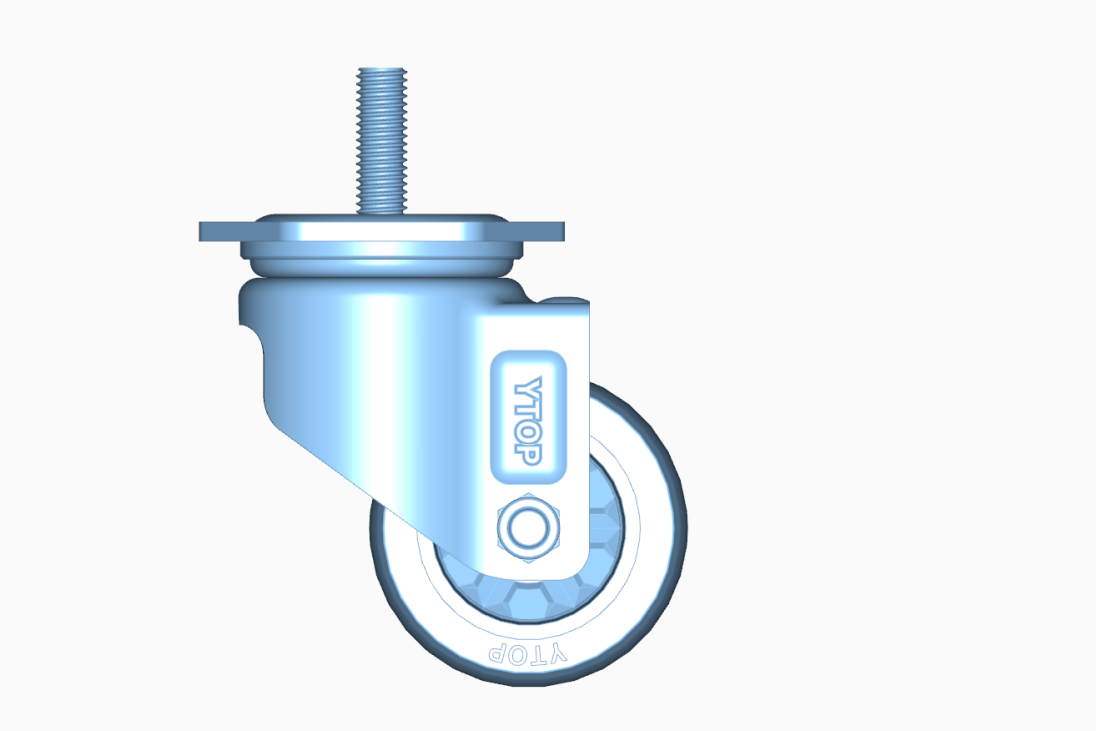
Soft polyurethane is the default for rack dollies and staging carts: quiet on tiles, non-marking, good grip, and gentle on joints. It is the right tread for anything that carries a running rack.
Hard nylon or polypropylene suits fixed installation casters and levelling feet, where the equipment does not move and a firm base is wanted. It is the wrong choice for a cart that crosses the hall repeatedly.
Elastic rubber gives the best vibration isolation and the quietest roll, at the cost of higher rolling resistance on a heavy rack. It is the choice where the load contains spinning disks and the hall is quiet.
Brakes, Ramps and Safe Movement
Movement inside a live hall is a procedure as much as a mechanical task.
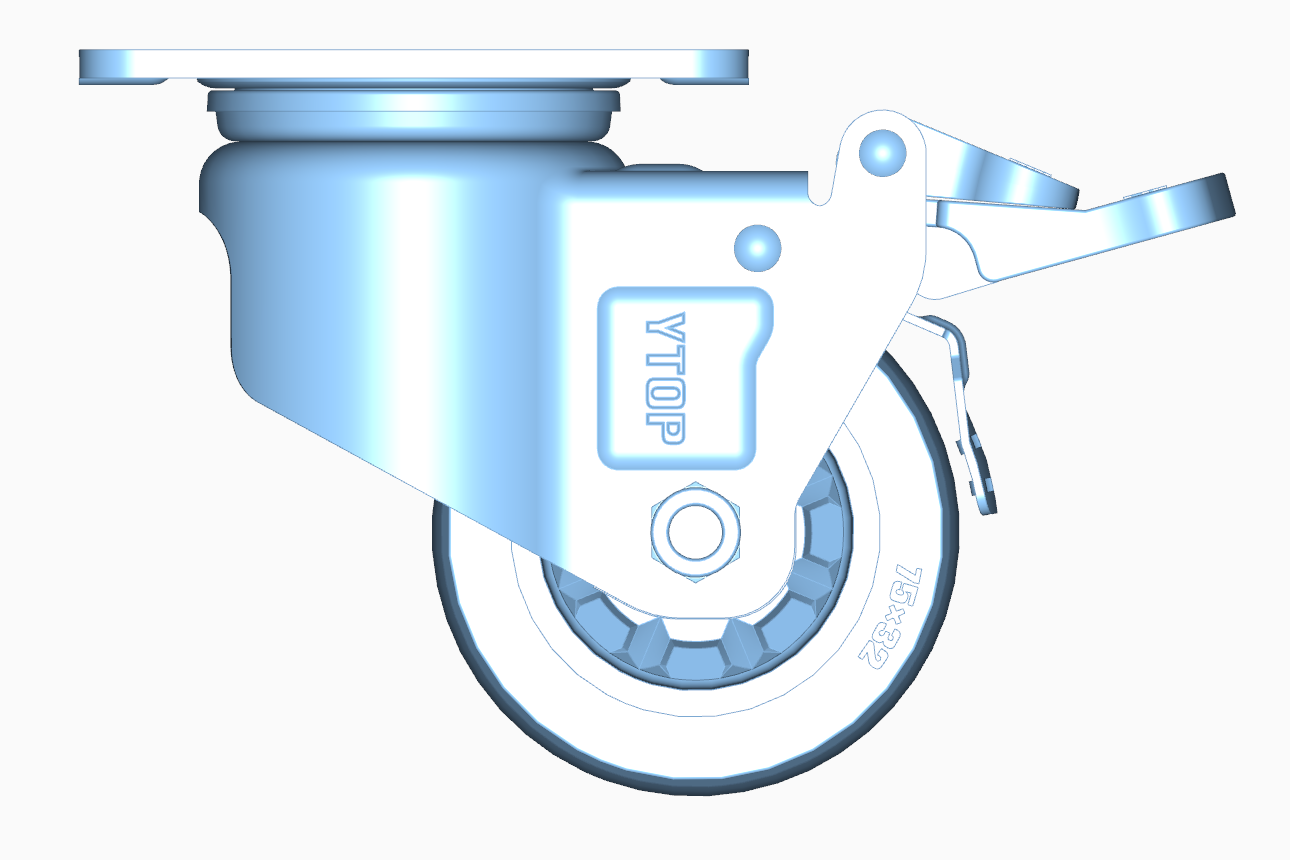
A cart parked on a slight slope — halls are levelled but not perfectly flat — will drift, and drift toward a live rack is unacceptable. Brakes on all four wheels, acting on the wheel rather than the swivel, are the baseline for any cart left unattended.
Doorways, ramps and cable ramps are the three places where casters fail. A cable ramp is a bump that a small hard wheel hits square; a doorway threshold is a step; a ramp needs a brake that will hold. Where these are permanent features, fit transition plates rather than expecting the caster to cope.
Maintenance and Cleanliness
Data halls have their own maintenance constraints.
Dust is not tolerated, so a caster that sheds rubber or paint flakes is a problem regardless of how well it rolls. A non-marking tread and a properly finished bracket matter here.
Joints should be cleaned rather than over-greased, because excess grease collects dust and forms a paste that accelerates wear. In a hall that is cleaned regularly, a sealed raceway with a light, clean grease is the better specification.
Check for flat spots after any period of parking under load, since a soft tread left loaded in one position deforms and then rumbles on every revolution.
Specification Checklist
Six questions settle a data hall caster order.
What is the panel point-load rating of the raised floor, and how many casters share one panel?
Is the cart crossing tile joints regularly, which means a wheel of 150 mm or more?
Does the load contain spinning disks or precision instruments, which means shock absorption?
Is the cart handling electronics directly, which means a dissipative wheel plus a grounding path?
Does the equipment move once at commissioning, or does it live on casters?
Are there cable ramps or thresholds on the route?
Answer those and the usual outcome is two specifications: a soft PU wheel of 150 mm or more with shock-absorbing casters at the load end for the rack dolly, and a hard nylon or steel wheel with a positive brake for installed equipment that is only levelled on casters. The recurring mistake in data halls is treating the raised floor as a normal floor and discovering, one cracked panel at a time, that it is a structure with a point-load limit.
Related Reading
Two guides that support the choices above:
- How to Choose Silent Casters — what actually produces noise on a hard tiled floor.
- Low Centre of Gravity Casters — the principle behind a stable tall rack on small wheels.
Explore our heavy-duty casters (150-610kg) and super heavy-duty casters (700-1600kg), or contact our engineering team with the floor rating, the rack weight and the tile type.
Post time: Nov-26-2026