
Tool cabinets, mobile workbenches and workshop storage are among the most caster-dependent pieces of equipment in a plant, and among the most commonly mis-specified. A cabinet that weighs 90 kg empty and 400 kg when full of tooling is often fitted with four small casters chosen for the cabinet’s own weight, on the assumption that it only moves a few metres now and then. Within a year the casters are flat-spotted, the swivel is stiff, and the cabinet has started to lean when a drawer is open.
This guide covers what actually determines caster life on cabinets and workbenches, how to choose wheel size, material and brake layout, and how to retrofit casters onto an existing cabinet without wrecking the base.
Why Cabinet Casters Fail Early
Three factors separate cabinet casters from general industrial casters, and all three shorten life.
Load concentration. A cabinet is a rigid box, so the load sits high and the casters see it through a small base. When drawers are open on one side, the centre of gravity moves noticeably toward that side, and the two casters under the drawer bank carry most of the weight. A 400 kg cabinet can put 130 to 150 kg on one caster in that condition.
Small wheels on dirty floors. Cabinet casters are usually chosen to keep the unit low, which means 50 to 75 mm wheels. Those wheels do not roll over swarf, chips, cable and pallet fragments; they stop dead against them and the operator pushes harder until something gives.
Handling damage. Cabinets are moved by people in a hurry, often by dragging them sideways rather than rolling, and often over door thresholds with the cabinet still loaded. The shock goes into a small bracket with a thin mounting plate.
None of these are caster defects. They are selection errors that a slightly larger wheel and a properly sized caster would have avoided.
Work Out the Load Before Choosing the Caster
Start with the loaded cabinet, not the empty one. Cabinet weight plus tooling plus any shelf or bin mounted on the outside is the number that matters, and tooling is heavier than most people expect: a cabinet rated at 100 kg per shelf holding spanners, dies and fixtures can easily reach 350 to 450 kg total.
Then apply the same distribution logic used for any four-wheel assembly. Four wheels rarely share equally, and a cabinet with drawers on one side is a textbook offset load. Designing each caster for one third of the total weight is a safe starting point; for a cabinet with a heavy drawer bank or a top-heavy load, one half on the worst corner is realistic.
Finally add a dynamic factor of at least 1.3, and 1.5 if the cabinet is regularly pushed over thresholds or dragged. A 400 kg cabinet with an offset load can therefore justify casters rated at 200 kg each, which is far above the 100 kg casters usually fitted.
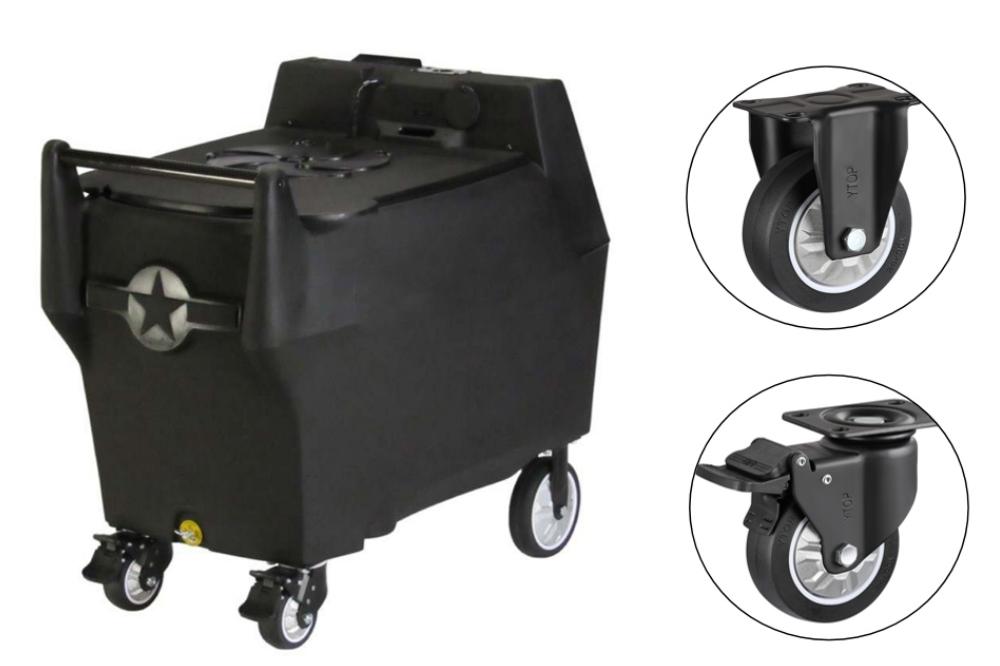
Two Swivel and Two Fixed, or All Four Swivel
The layout decision affects how the cabinet behaves more than the caster rating does.
Two swivel and two fixed is the standard arrangement for cabinets that are pushed along aisles. It tracks straight, needs less effort to start moving, and is more stable at speed. It also means the cabinet cannot be moved sideways without a multi-point turn, which in a tight workshop is a real disadvantage.
Four swivel makes the cabinet manoeuvrable in any direction, which suits workbenches that are repositioned around a cell and cabinets in tight storage areas. The trade-off is that it wanders when pushed quickly and needs more care to keep straight.
Swivel with directional lock gives the best of both: the caster can be locked to roll straight or released to swivel. On cabinets that are moved often and parked precisely, this is usually worth the extra cost.
Whichever layout is chosen, at least two casters should have brakes, ideally diagonally opposite. On a cabinet with drawers, a total-lock brake that stops both wheel and swivel is the better choice, because a wheel-only brake still lets the cabinet rotate about its own axis when someone leans on an open drawer.
Wheel Material and Size for Workshop Floors
The floor determines the wheel, and workshop floors are usually concrete with a certain amount of debris on them.
Polyurethane (PU) is the default for cabinet casters on concrete: quiet, non-marking, good load capacity for its size, and resistant to flat-spotting under a static load. On a floor with swarf or chips it still needs enough diameter to roll over debris.
Nylon and engineering plastics roll easily and resist cuts, but they are hard and noisy on concrete, and they transmit shock into the cabinet’s base. They suit smooth tiled floors and clean assembly areas better than machine shops.
Rubber and TPR are quiet and grip well, but they mark light floors and deform under a heavy static load if left parked for months.
On diameter, the practical minimum for a workshop cabinet is 75 mm, and 100 mm is better where the floor has chips, cable or thresholds. The extra 25 mm costs a little deck height and a little money, and removes most of the debris-stalling problem.

How Often It Moves Changes the Specification
A cabinet that is repositioned twice a year and one that is rolled across a workshop twenty times a day need different casters, even when the weight is identical. Duty cycle is the second input most specifications leave out.
Occasional movement. A cabinet that is moved for cleaning or reorganisation can use smaller wheels and a simpler bearing, because the caster spends most of its life stationary. The risk here is flat-spotting rather than wear, which makes a PU wheel a better choice than a soft rubber one.
Daily movement over short distances. This is the typical tool cabinet in a machine shop. The caster has to start rolling easily from rest, tolerate chips on the floor and survive being pushed into a bench or a wall. A 100 mm PU wheel on a roller bearing, with a total-lock brake on two casters, is a specification that lasts.
Continuous movement or long routes. Cabinets used as picking or kitting trolleys run far more distance than a tool cabinet, and the bearing becomes the limiting component rather than the wheel. Sealed precision bearings roll more freely, and a slightly larger diameter reduces the effort the operator applies all shift.
Movement with the cabinet loaded and drawers open. This happens more than anyone admits, and it is the worst case for both load and stability. If operators habitually move the cabinet with drawers open, the specification should assume a higher dynamic factor and a brake that locks the swivel, not just the wheel.
Adding Casters to an Existing Cabinet
Retrofitting is where most damage happens, and it is almost always a mounting problem rather than a caster problem.
Check the base structure first. Many cabinets have a single-skin sheet metal base with no reinforcement at the corners. Bolting a 200 kg caster to that skin concentrates the load on four small areas and the base deforms. The fix is a reinforcement plate inside the cabinet, or mounting the casters to the cabinet’s frame rather than its skin.
Match the bolt pattern, do not force it. Caster top plates come in standard patterns, and drilling new holes in a cabinet base weakens it. Choose casters whose plate matches or brackets the existing hole pattern where possible, and use a plate large enough that the bolts are not at the very edge of the base.
Watch the deck height. Replacing 75 mm casters with 125 mm casters raises the cabinet by 50 mm, which matters if the cabinet has to fit under a bench or through a doorway.
Check the fasteners. Use bolts with washers and thread-locking compound. Casters that work loose are the most common cause of a cabinet that suddenly leans.
Leveling Feet or Casters
Some cabinets need to be stationary and level for precision work, and movable the rest of the time. Two options serve that requirement.
A cabinet can be fitted with casters plus separate leveling feet, but the feet usually have to be wound down by hand, which is slow and easy to skip.
A hybrid leveling caster combines both: a caster that rolls when the load is on the wheel, and an integrated adjustable foot that lifts the wheel clear when it is wound down. It is the practical answer for workbenches, test equipment and cabinets that must be stable while in use and mobile when reconfigured. The specification points to check are the adjustment range, the load rating in the foot-down condition, and whether the foot pad is large enough for the floor.
Noise, Marking and Maintenance
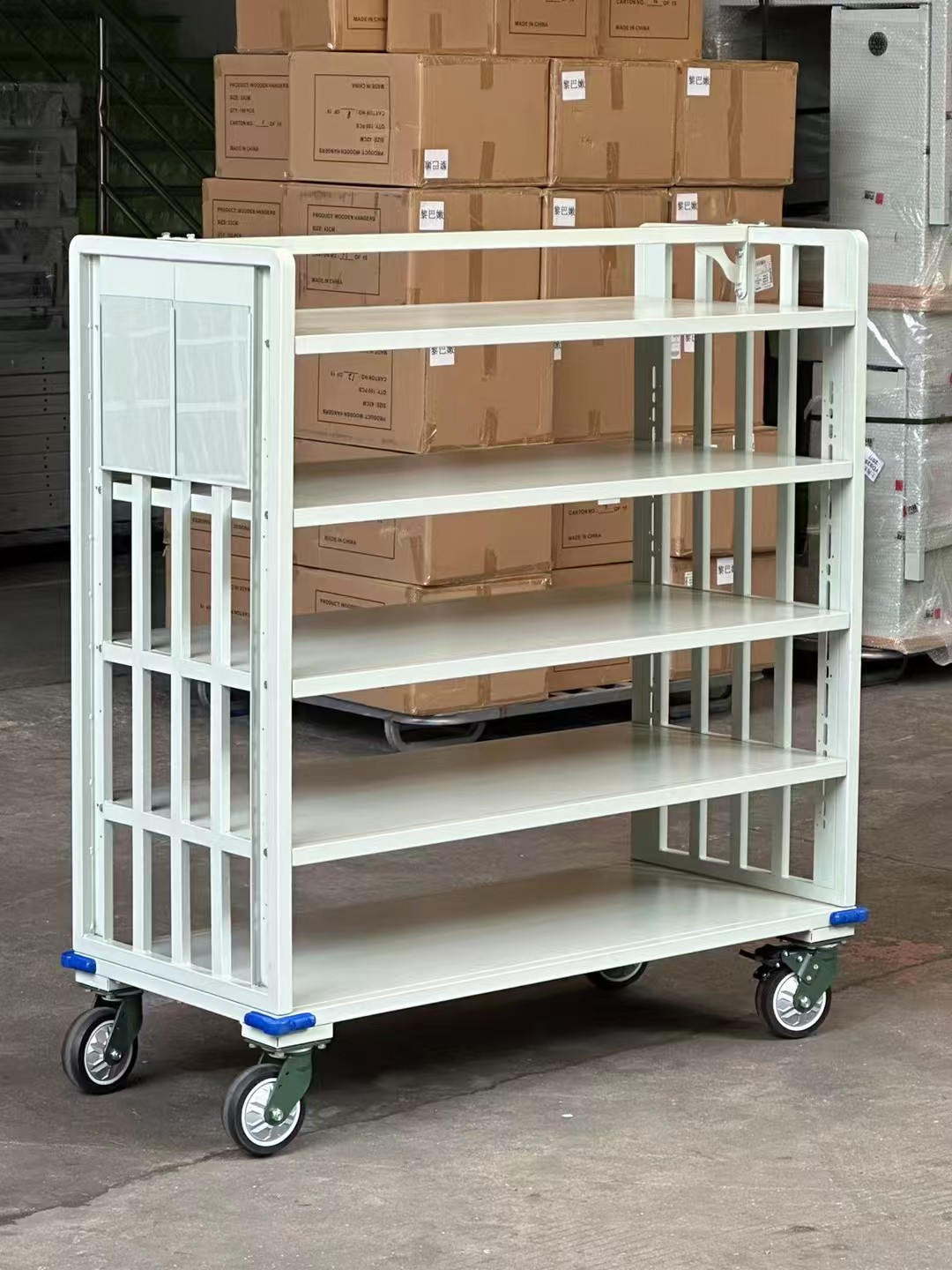
Cabinet casters are close to the operator, so noise and floor marking matter more than they do on a heavy cart. PU wheels on concrete are quiet and leave no marks; nylon on concrete is loud; rubber grips but can leave black marks on light floors after a long static load.
Maintenance is minimal but not zero. Twice a year, check that swivel casters turn freely, remove thread and film from the wheel bore, and confirm that brake pedals still engage fully. Grease nipples, where fitted, should be used rather than ignored, and cabinets stored for long periods benefit from being moved occasionally so the wheels do not sit loaded in one spot.
If you can tell us the loaded cabinet weight, the floor type and whether the unit needs to be stable when parked, we will match a caster layout and wheel specification to the cabinet rather than to its empty weight.
Related Reading
Two guides that pair with this one when specifying cabinet and workbench casters:
- Fixed Wheel vs Swivel Wheel: What Is the Difference — how the 2+2 and 4-swivel layouts behave on equipment that has to track straight.
- How to Choose Silent Casters — reducing noise and floor marking in workshops and indoor work areas.
Explore our heavy-duty casters (150-610kg) and super heavy-duty casters (700-1600kg) for cabinets and workbenches, or contact our engineering team with your loaded weight and floor type.
Post time: Nov-12-2026