
A hospital bed moves dozens of times a day, and every one of those moves is a test of its casters. They have to roll quietly through a ward at night, lock firmly while a patient transfers, survive alcohol and detergent wiping, and do it without leaving black marks on the flooring. When a medical caster is chosen only by load rating, the result is usually noise complaints, worn floor finishes, and brakes that no longer hold.
This guide covers the six specifications that actually decide whether a caster belongs on medical equipment: hygiene, noise, locking behaviour, load capacity, floor protection, and corrosion resistance.
1. What Makes a Caster “Medical Grade”
There is no single medical caster standard, but purchasing departments, biomedical engineers and infection-control teams converge on the same requirements:
- Low rolling and swivel resistance — staff push beds and stretchers all shift; a 20% reduction in push force is a real fatigue difference.
- Quiet operation — night wards typically want wheels that stay under conversation level on hard flooring.
- Reliable total-lock braking — the caster must stop both the wheel and the swivel, not just the wheel.
- Non-marking tread — vinyl and linoleum floors show every rubber mark.
- Cleanable, corrosion-resistant construction — repeated wiping with alcohol, chlorine or quaternary disinfectants.
None of these is visible on a price sheet, which is why two casters with identical load ratings can behave completely differently in a ward.
2. Noise: Tread Compound and Bearing Quality
Noise on hard floors comes from two sources: the tread deforming against the floor, and any metal-to-metal contact inside the caster.
For quiet running, polyurethane at 92–95 Shore A is the usual choice on medical equipment. It is firm enough to roll easily under load, but it damps vibration far better than nylon, and unlike rubber it does not flat-spot when a heavy bed sits in one place overnight. Soft TPR treads run quieter still, but they increase push force and wear faster on aggressive cleaning regimes.
Bearing quality matters as much as the tread. Precision ball bearings with sealed races remove the play that produces rattle, and a nylon or PU wheel with a well-sealed bearing will run noticeably quieter than the same tread on a loose, cheaply made hub. Double-ball swivel raceways also reduce the “clunk” that appears when a caster with a worn single-row race crosses a floor joint.

3. Hygiene: Design for Wiping, Not Just Cleaning
Infection-control teams look at the caster as a surface, not a component. A caster with a rough casting, exposed threads, or a recess that traps lint cannot be effectively wiped, no matter how often it is cleaned.
- Smooth bracket faces with no blind holes pointing upward.
- Sealed or shielded bearings so cleaning liquid does not flush the lubricant out.
- Stainless or high-grade coated hardware where disinfectants are used daily — chlorine-based wipes attack zinc plating quickly.
- Colour options for zoning: many hospitals colour-code equipment by department, and casters are an easy way to keep that system visible.
White and light grey treads are common in patient areas because they show dirt and because they do not visually clash with bed frames — but the more important property is that the compound does not absorb liquid. PU and nylon both resist water absorption; natural rubber does not.
4. Braking and Locking: The Patient-Safety Specification
Brakes are where medical casters most often fail clinically. Three points decide it:
| Brake type | Behaviour | Typical use |
| Wheel brake only | Locks the wheel, but the fork can still swivel | Light carts, short parking |
| Total lock (wheel + swivel) | Locks both axes; the equipment cannot rotate on one wheel | Hospital beds, stretchers, procedure carts |
| Directional lock | Fixes the swivel straight for long corridors | Beds moved over long distances |
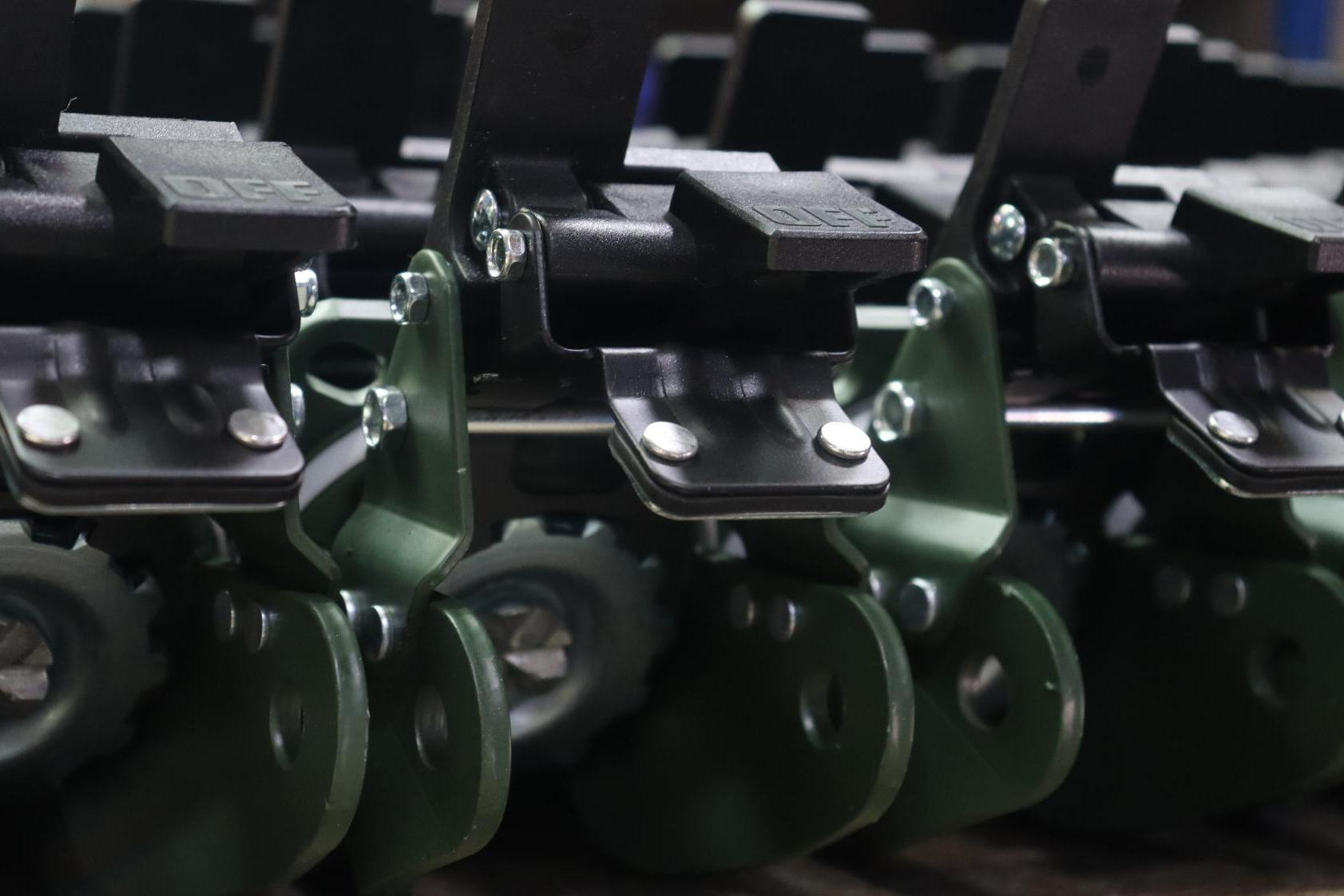
For a bed, specify total lock on all four casters. A wheel-only brake lets the bed pivot around a locked wheel when a patient leans on the rail — a genuine fall risk. Check the pedal force too: a brake that needs a hard stamp with a clogged shoe will not be applied by a busy nurse in a hurry, and pedals should work from either side of the bed without a second person.
Also verify release. A brake that holds but does not release cleanly is worse than no brake, because staff learn to drag the equipment instead of unlocking it.
5. Load Capacity and Weight Distribution
Medical equipment loads are usually underestimated because they are calculated on the equipment alone, not on the equipment plus patient plus accessories plus the mattress and pumps that get hung on the frame.
| Equipment | Realistic total load | Per-caster target |
| Standard hospital bed | 180–280 kg with patient | 100–125 mm wheel, 120 kg+ dynamic |
| ICU bed with equipment | 300–400 kg | 125–150 mm wheel, 150 kg+ dynamic |
| Stretcher / trolley | 150–220 kg | 100–125 mm wheel, 100 kg+ dynamic |
| IV stand, monitor cart | 20–60 kg | 50–75 mm wheel, 40 kg+ dynamic |
Use the dynamic rating, not the static one, and apply the three-wheel rule: on an uneven floor or when crossing a threshold, three casters carry the load while the fourth is airborne. That makes the practical capacity about 75% of four times the per-caster rating.
6. Floor Protection and Rolling Resistance
Hospital flooring is expensive and visible. Non-marking PU tread is the default for patient areas; black rubber treads on vinyl floors leave marks that require machine buffing to remove.
Wheel diameter drives rolling resistance more than any other single variable. A 125 mm wheel crosses elevator sills and floor joints with roughly half the push force of a 75 mm wheel, and it bridges small gaps rather than dropping into them — which is also what keeps a patient comfortable during transport.
Where floor loading is a concern — older buildings, raised access floors — a dual-wheel caster spreads the same load over a larger contact patch and reduces point pressure, at the cost of a slightly larger turning envelope.
7. Selection Checklist
- Total load = equipment + patient + accessories; choose dynamic rating and apply the three-wheel rule.
- Wheel diameter: 125 mm for beds and stretchers, 75–100 mm for light carts and stands.
- Tread: non-marking PU 92–95 Shore A; soft TPR only where noise is critical and loads are light.
- Bearing: sealed precision ball bearing, no visible play.
- Brake: total lock on all four casters for beds; verify pedal force and clean release.
- Hygiene: smooth bracket, no upward-facing recesses, stainless or high-grade coating where disinfectants are used daily.
- Noise: test a sample on the actual flooring before a full rollout; ward flooring varies.
Related Reading
Looking for more in-depth caster guides and industrial mobility resources? Explore these related articles:
- Casters: The Silent Heroes of the Medical Industry — how caster performance shapes patient transport and ward workflow.
- TPU Casters for Home, Office, Industrial and Medical Use — why polyurethane tread suits quiet, non-marking environments.
Explore our complete range of heavy-duty casters (150-610kg) and super heavy-duty casters (700-1600kg) for diverse industrial applications, or contact our engineering team for expert caster application knowledge and selection guidance.
Post time: Nov-10-2026