
A concrete precast yard and a cement plant share one feature that no warehouse has: the material being handled is itself abrasive, and it is everywhere. Cement dust settles on every surface, wash water from the mixer runs across the yard, and the products being moved weigh more than most factory loads.
Casters that work perfectly in a warehouse fail in a precast yard for reasons that have nothing to do with their load rating. This article covers those reasons and the specification that follows from them.
Why Cement and Precast Work Is Different
Four conditions separate a precast yard from a general factory.
The dust is cement, not sawdust or paper. It is fine, alkaline and hygroscopic: it absorbs moisture from the air, sets, and becomes an abrasive solid inside any joint that is not sealed.
Wash water is alkaline and full of fines. It attacks paint and zinc, and it leaves a residue that hardens around seals.
The loads are dense. A precast element or a pallet of blocks concentrates several hundred kilos over a small footprint, so the caster sees high pressure rather than high total weight.
And the floor is often not finished concrete but compacted hardcore, gravel or a worn slab with joints, which changes what the wheel has to roll over.
Cement Dust and the Setting Problem
Cement dust is the single most damaging element in this environment, and it damages in a way most maintenance teams do not expect.
Unlike sand or metal dust, cement does not simply abrade. It absorbs water, sets, and expands slightly as it does so. Inside a swivel raceway, that means a caster that was free at the end of the shift is locked solid the next morning, and the mechanism is a set plug of concrete rather than a worn bearing.
The countermeasure is sealing plus cleaning, not greasing. Grease applied over a cement plug traps the material and accelerates setting. The joint has to be cleaned and dried before any lubricant is added.
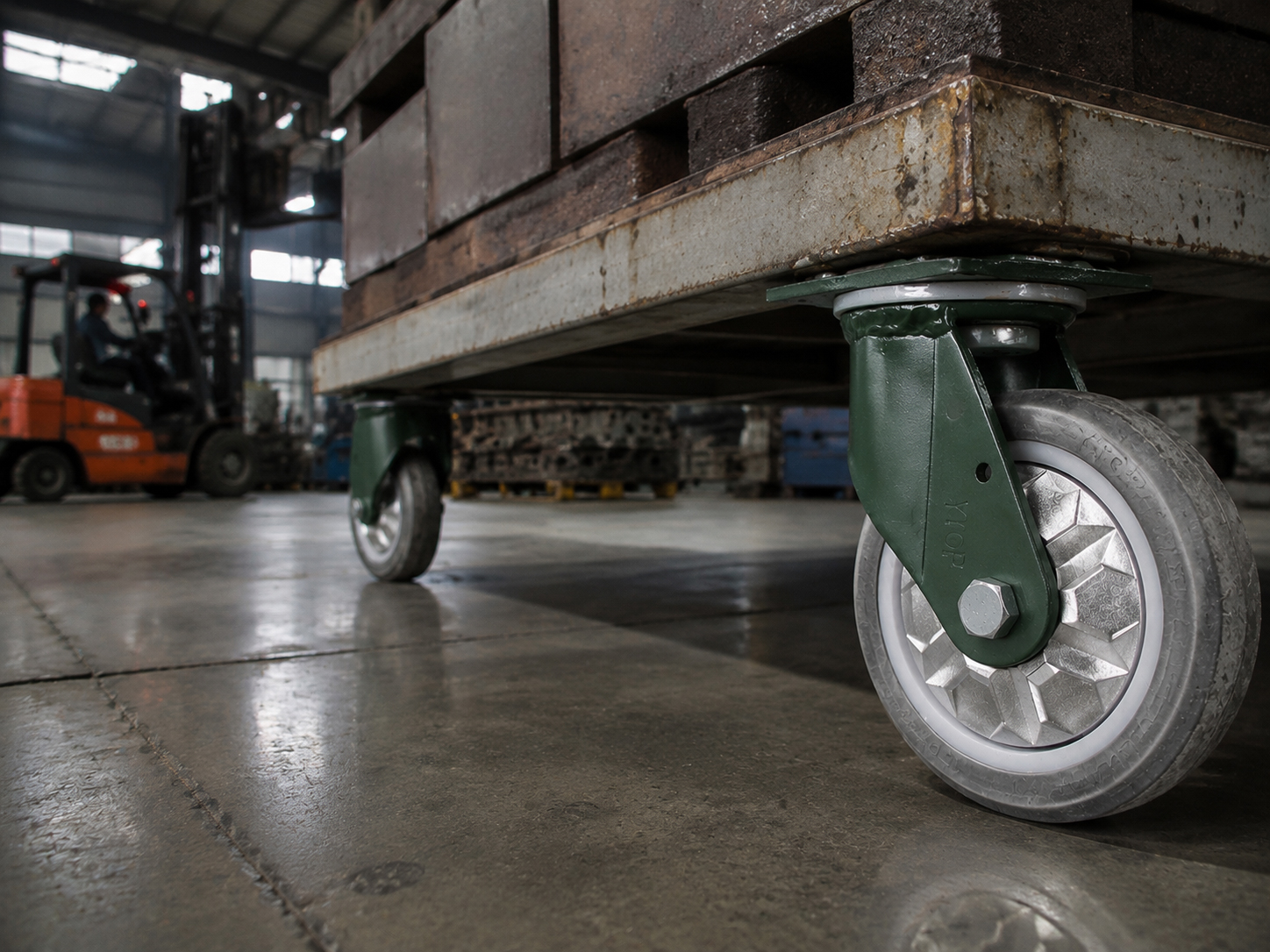
Alkaline Wash Water and Bracket Finish
Concrete wash water sits around pH 12, which is enough to attack a standard zinc coating and to strip the adhesion of a powder coat at the edges.
Three failures follow. Rust starts at the cut edges of the fork and spreads under the plating. Paint flakes off the top plate, which is cosmetic until water reaches the bearing seat. And the grease at the swivel emulsifies, so the raceway runs with an alkaline paste instead of a lubricant.
Where wash water is present daily, a stainless or hot-dip galvanised bracket is worth the cost. Where it is occasional, a heavy coated bracket with a sealed raceway is adequate — but the seal matters more than the coating, because the joint is what fails first.
Dense Loads and Point Pressure
Precast elements and block pallets are heavy for their size, and the load is rarely distributed evenly across four casters.
A pallet that weighs 800 kg on a level floor may put 500 kg on two casters when the yard is uneven, because the cart rocks and the load transfers. That is why casters in a precast yard are usually specified with a margin well above the calculated share.
The practical rule is to size on the worst single caster rather than the average, and to add a margin for the rocking that uneven ground produces. A caster selected at exactly 25 percent of the total load is the one that fails first.
Wheel Choice for Abrasive Ground
Four considerations decide the wheel, and they conflict with each other.
Hardness resists abrasion by cement and aggregate fines, so a hard nylon, cast nylon or cast iron wheel lasts longer on grit than a soft one.
Diameter decides whether the wheel rolls over slab joints and debris or catches on them. In a yard with joints and offcuts, 150 mm is a working minimum and 200 mm is common.
Ground pressure decides whether the wheel sinks into compacted hardcore. A wider wheel spreads the load; a narrow hard wheel cuts a rut and then follows it.
Floor protection matters only in the finished-goods area, where the slab is smooth and a hard wheel would mark it.
In practice, most precast yards end up with two specifications: cast nylon or iron wheels of large diameter for the yard and the block store, and a softer PU or rubber wheel on the small carts that move finished elements across a smooth slab.
Bearings in a Dusty, Wet Yard
The bearing is where a precast caster dies, and there are only two effective defences.
A sealed raceway keeps the dust out. An open ball track in a cement plant is not a question of whether it will fail but of when, because cement dust enters any opening and sets there.
A water-resistant grease keeps the seal working. Alkaline water degrades standard grease quickly, and a degraded grease no longer holds the seal flexible.
Joints, Thresholds and Yard Slopes
A precast yard is rarely one continuous smooth surface. In a single route a cart may cross a slab joint, a drainage channel, a kerb up to the block store and a compacted ramp.
Each of those imposes a load on the caster that the static rating does not describe. A joint is an impact. A channel is a drop and a climb. A kerb is a step that either climbs or stops the cart. A ramp transfers weight to two casters and unloads the other two.
The practical response is wheel diameter rather than capacity: a larger wheel bridges a joint instead of dropping into it, and climbs a kerb instead of stopping against it. Where a kerb or channel cannot be avoided, a 200 mm wheel turns it into a small bump; a 100 mm wheel turns it into a dead stop that operators learn to work around by lifting the cart.
Repair or Replace
Three outcomes are terminal in a cement environment, and repairing them buys a few weeks at the cost of a risk.
Vertical play in the swivel means the raceway has worn past adjustment, and in a dusty yard it will not recover because the grease can no longer exclude the fines. A fork that is visibly out of line has taken an impact beyond its design. And a tread that has hardened and cracked, rather than worn smooth, has been degraded by alkaline water.
Everything else is serviceable: a set plug can be cleaned out, a dry raceway can be re-greased, and a flat-spotted wheel from a long standstill is usually cosmetic if the spot is shallow.
Outdoor Storage and Weather
Precast yards store product outdoors, which means casters sit in rain and sun for weeks at a time.
Rain is survivable with a sealed raceway. Standing water is not, because it reaches the bearing seat through the top plate opening on a cart that sits in a puddle. Where carts are parked outdoors, drainage under the parking area matters as much as the caster specification.
Sun and frost matter less, but they do affect polymer wheels: a PU wheel that sits loaded in direct summer sun takes a permanent flat spot, and a nylon wheel in sub-zero conditions becomes brittle. Where carts sit loaded outdoors for long periods, the load should be removed or the cart moved, regardless of caster quality.
Maintenance Rhythm for a Dusty Yard
Four habits cover most of the risk.
Blow or brush the joints dry at the end of each shift in the wet areas; water plus cement dust is the combination that sets.
Inspect for set plugs weekly by turning each fork through a full circle by hand; a caster that turns stiffly has a plug forming, not a worn bearing.
Re-grease only after cleaning, never as a first response to stiffness.
Replace casters that show vertical play, because a worn raceway in a cement environment will not recover and the load will start to ride unevenly.
Specification Checklist
Six questions settle a precast or cement plant caster order.
What is the worst single-caster load on uneven ground, rather than the average share?
Is the floor finished slab, jointed concrete, or compacted hardcore?
How much cement dust is in the air, and does wash water reach the wheels?
Do carts stand outdoors, and do they stand loaded?
Does any route cross into a finished-goods area where the floor must not be marked?
Who cleans the joints, and how often?
Answer those and the specification is usually straightforward: a large-diameter hard wheel with a sealed raceway and water-resistant grease for the yard, and a softer wheel for the finished-goods slab. The recurring mistake in this industry is buying one caster for both and then wondering why the finished-goods cart is the one that fails.

Related Reading
Two guides that support the choices above:
- How to Determine the Load Capacity of Casters — why the worst single caster governs the choice.
- 8-Level Powder Coating Corrosion Protection — what a coating can and cannot survive in alkaline wash water.
Explore our heavy-duty casters (150-610kg) and super heavy-duty casters (700-1600kg), or contact our engineering team with the load, the ground and the dust conditions.
Post time: Nov-20-2026